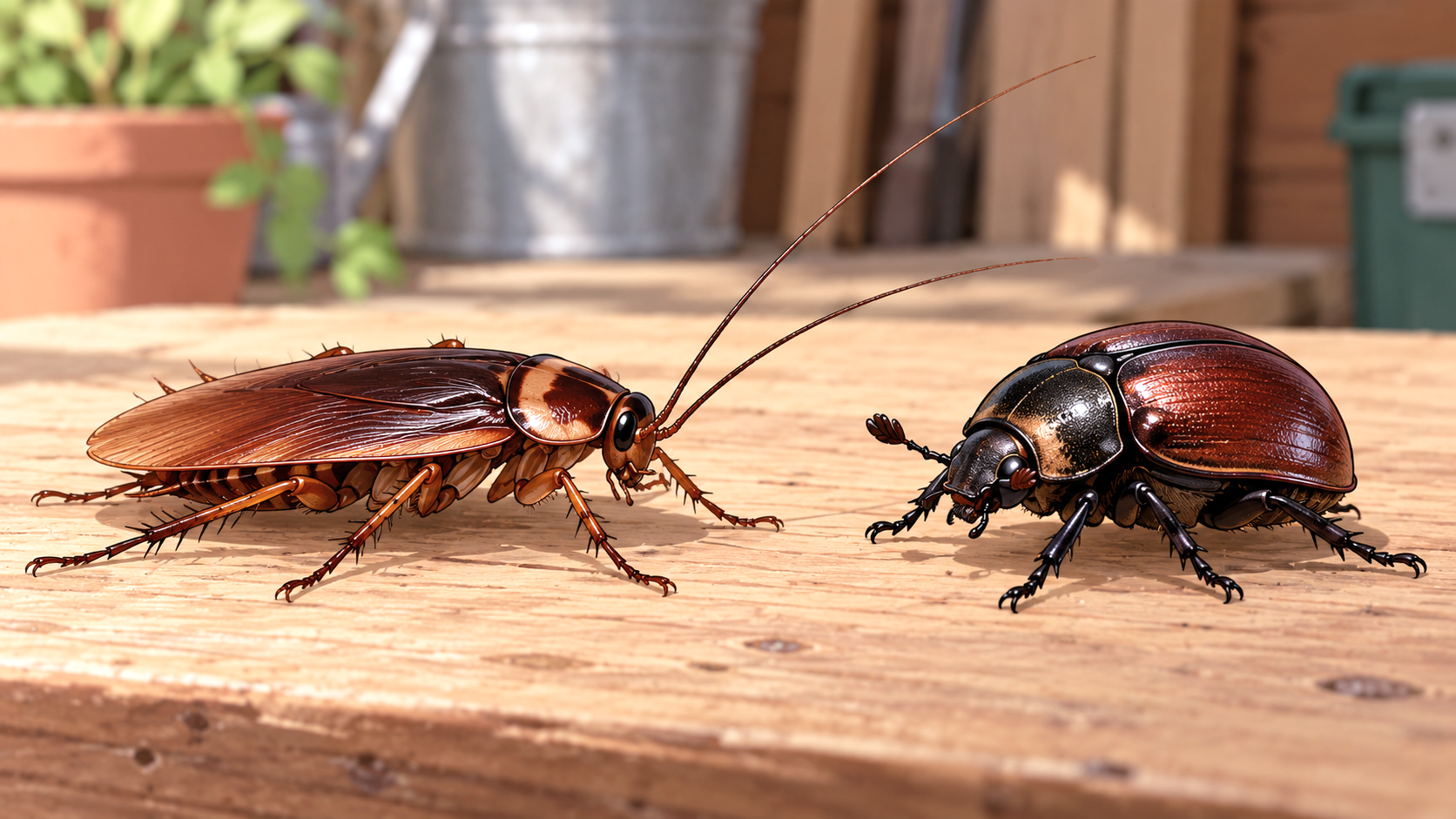
A shiny brown insect races across the floor and disappears before you get a good look. Cockroach is an understandable first guess, but several beetles can create the same impression. Cockroaches and beetles are different groups of insects. The most useful differences are their forewings, head position, antennae, body profile, and the presence of cerci at the rear of a cockroach. Color alone is much less reliable.
Both animals have six legs, antennae, chewing mouthparts, and an exoskeleton, so those shared insect features cannot settle the identification. A close photograph from above is usually far more useful than trying to identify a fast-moving specimen from memory.
Check How the Wings Meet Across the Back
The clearest anatomical difference on many adults is the construction of the forewings. Beetles belong to Coleoptera and possess elytra, a pair of hardened forewings that protect the more delicate flight wings underneath. When a typical beetle is viewed from above, the two elytra meet along a distinct straight seam running lengthwise down the middle of the back.
Cockroach forewings are not elytra. When developed, they are usually leathery structures called tegmina, with the forewings lying over the membranous hind wings. Rather than forming the hard symmetrical shell characteristic of most beetles, cockroach forewings overlap. That difference between cockroach wing anatomy and beetle elytra can be especially useful when comparing similarly colored adults.
Wing structure is not available on every specimen. Immature cockroaches lack fully developed adult wings, and beetles are extraordinarily diverse, with modified or reduced wings in some groups. If you cannot clearly see the wings, move to other anatomical clues rather than forcing an identification from a feature that is absent or obscured.
A Cockroach’s Head Can Look Tucked Under Its Body
Viewed from directly above, a cockroach often appears almost headless. The head sits beneath the front edge of a broad shield-like structure called the pronotum, which can partly conceal the head in dorsal view. The long antennae may be much more conspicuous than the head itself.
Beetles also have a pronotum, so finding a plate behind the head does not identify a cockroach. The arrangement differs, however. A beetle’s head is generally more exposed in front of the pronotum, while the cockroach pronotum characteristically projects over the head. A comparison based on overall cockroach body shape becomes much stronger when head position is considered together with the wings.
Body texture can reinforce the impression. Many beetles look rigid or shell-like because the elytra form a hard dorsal covering. Cockroaches generally present a flatter, more flexible-looking profile. Neither texture nor shape is universal enough to use alone because Coleoptera contains an enormous range of body forms.
Long Antennae Favor a Cockroach, but Some Beetles Can Fool You
Cockroaches characteristically have long, slender, threadlike antennae. They frequently extend to around the length of the body or beyond and remain conspicuous as the insect moves. Together with the flattened body and partly concealed head, those antennae contribute heavily to the familiar cockroach silhouette.
Beetle antennae vary enormously. Depending on the family, they can be short, clubbed, serrated, elbowed, feathery, or long and threadlike. Longhorn beetles demonstrate why antenna length cannot serve as a universal separator: some have antennae longer than the entire body. A long-antennaed insect is therefore not automatically a cockroach.
Look at the combination instead. Very long threadlike antennae plus a flattened oval body, a head largely covered from above, and overlapping forewings strongly support a cockroach identification. Long antennae attached to a hard-bodied insect with paired elytra meeting along a central seam support a beetle.
Look at the Rear End for Cerci
Cockroaches possess a pair of appendages called cerci at the rear of the abdomen. They are usually visible as two short projections when the insect is viewed closely from above or behind. Cerci have a sensory function and form part of the characteristic external anatomy of a cockroach.
Adult beetles do not have the conspicuous paired cerci seen on cockroaches. Identification references specifically use cerci and the overhanging pronotum to distinguish wingless cockroaches from beetles. This becomes particularly valuable when wings cannot provide an answer.
Do not mistake a cockroach egg case protruding from a female’s abdomen for part of the normal rear anatomy. An ootheca is a reproductive structure containing eggs, and cockroach egg cases have their own characteristic form.
Young Cockroaches and Young Beetles Look Nothing Alike
Adult comparisons are only part of the identification problem. Cockroaches develop by incomplete metamorphosis. Their young are nymphs, which share the general body plan of adults but begin smaller and without developed wings. As they progress through the cockroach life cycle, repeated molts gradually produce the adult form.
Beetles undergo complete metamorphosis: egg → larva → pupa → adult. Beetle larvae can therefore look radically different from the adults they eventually become. Depending on the species, the larva may resemble a grub, wireworm, mealworm, or another elongated larval form. The pupal stage separates larva from adult, a developmental arrangement characteristic of beetles and other insects with complete metamorphosis.
This difference can solve cases involving immature insects. A small wingless insect shaped much like an adult cockroach may be a cockroach nymph. A grub-like animal cannot be a cockroach nymph simply waiting to develop wings.
Color and Size Are Weak Evidence on Their Own
Brown does not mean cockroach. Beetles occur in brown, black, reddish, yellow, green, metallic, patterned, and many other forms. Cockroaches also vary considerably in coloration, while their adult sizes range from relatively small indoor species to much larger forms. Considerable overlap is inevitable.
Size creates the same difficulty. Beetles range from tiny species measured in fractions of a millimeter to insects several centimeters long, with extreme variation in beetle body size and shape. Cockroach species also differ enough that describing an insect as “large and brown” leaves too many possibilities.
Identification becomes more reliable when several independent features agree. Check the forewings, head position, antennae, rear appendages, and overall body construction. If those characters still conflict, the insect may belong to another group entirely because several household insects resemble cockroaches.
Questions That Help With Difficult Cockroach and Beetle IDs
Can a beetle run as fast as a cockroach?
Some beetles are fast runners, particularly ground beetles, so rapid movement does not prove that an insect is a cockroach. A specimen that disappears quickly under furniture still needs physical identification.
Can a beetle have a flat body like a cockroach?
Yes. Beetles are too diverse for body flatness to function as an absolute rule. A flattened insect with beetle-style elytra remains a beetle, while the combination of overlapping forewings, long threadlike antennae, an overhanging pronotum, and cerci supports a cockroach.
Why do ground beetles get mistaken for cockroaches?
Many ground beetles are dark, quick-moving, and active at night. Indoors, that behavior can produce a cockroach-like first impression. Their hard elytra and more exposed head reveal the beetle once the insect is seen clearly.
Does finding a beetle indoors mean there is a cockroach infestation nearby?
No. Beetles enter or inhabit buildings for many reasons unrelated to cockroaches. If the specimen really is a cockroach, repeated sightings and additional evidence of cockroach activity are more informative than the presence of an unrelated beetle.