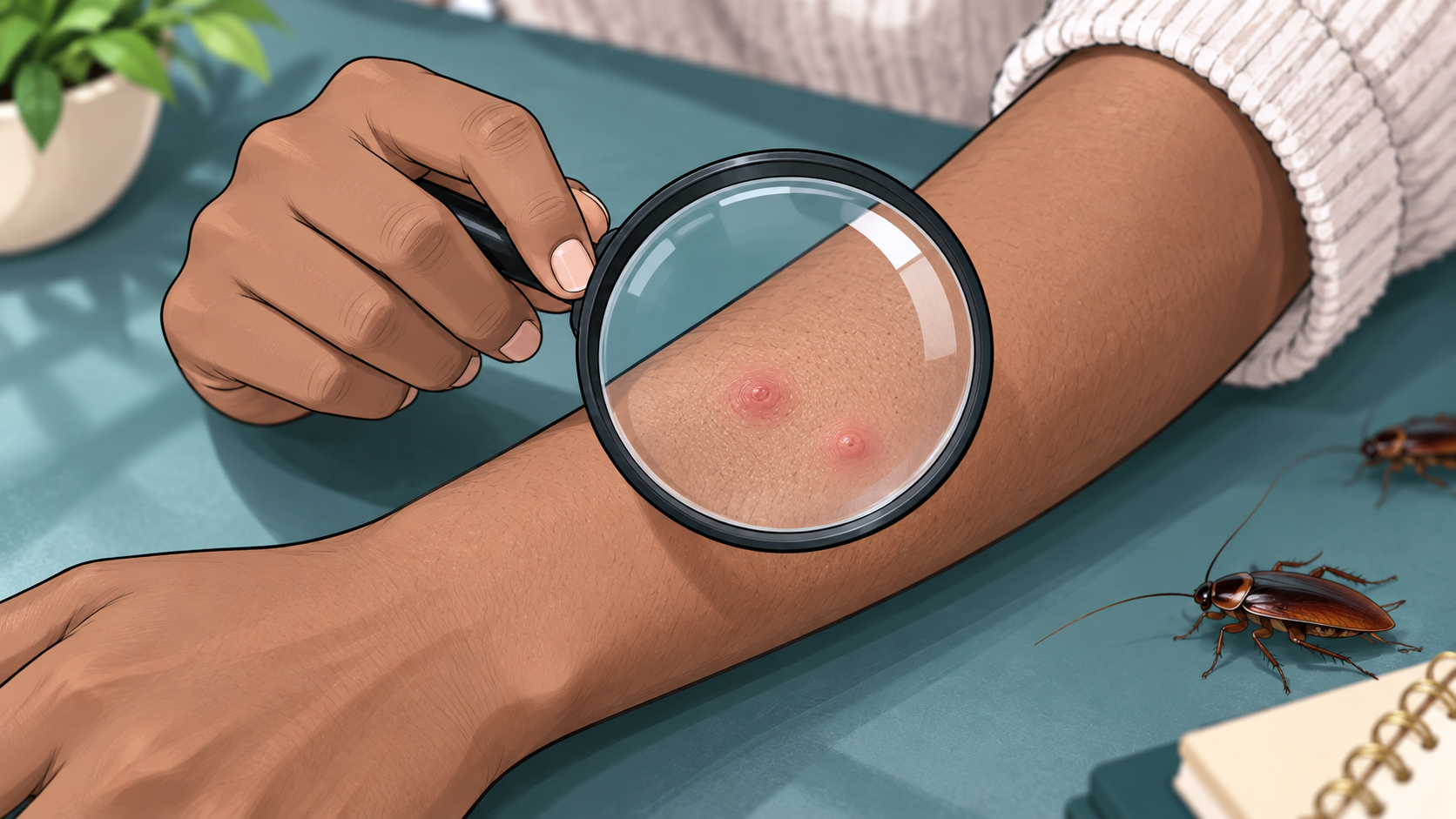
A suspected cockroach bite may appear as a small area of broken or irritated skin, sometimes with surrounding redness, swelling, or tenderness. Unlike mosquito or bed bug bites, however, cockroach bites have no reliably established pattern of raised bumps, puncture marks, or clustered lesions that allows them to be identified by appearance alone.
Cockroaches have chewing mouthparts rather than the specialized skin-piercing structures of blood-feeding insects. When they damage human skin, the resulting mark may resemble a superficial abrasion or irregular erosion rather than a typical insect-bite welt. Documented cases are relatively uncommon, and a photograph of a skin lesion is insufficient to attribute it to a cockroach.
Why Cockroach Bite Marks Can Look Different
Most familiar insect-bite photographs show small, swollen bumps produced partly by the body’s reaction to substances introduced during feeding. Mosquitoes and bed bugs pierce the skin to obtain blood, and their saliva can provoke characteristic inflammatory responses.
Cockroaches feed differently. Their paired mandibles cut and crush material rather than forming a narrow feeding puncture. Researchers measuring the biting forces of American cockroach mandibles demonstrated that these insects possess powerful chewing mouthparts adapted to processing various materials.
If a cockroach damages human skin, the appearance depends on how much tissue is affected. A shallow injury might leave a small irritated patch, whereas more extensive damage could produce an irregular area of missing surface skin. Redness or swelling may develop around the affected area, but neither reaction identifies the insect responsible.
There is no medically established diameter, color progression, or healing pattern unique to cockroach bites. Claims that they always resemble mosquito bites, always appear in clusters, or leave two distinct punctures are not supported by reliable diagnostic evidence.
What Documented Cockroach Skin Injuries Look Like
One of the important published reports comes from forensic medicine rather than routine dermatology.
In 1997, researchers described three infant death investigations in which cockroaches caused postmortem skin injuries. The lesions were sufficiently unusual that observers initially considered other explanations, including burns and nonaccidental trauma.
The case report published in the American Journal of Forensic Medicine and Pathology established that cockroach feeding can produce visible tissue damage and that the resulting marks may be difficult to interpret correctly.
However, those injuries occurred after death. They cannot be used as a standard photographic reference for how a minor cockroach bite on a living person will appear. Living skin can develop inflammatory responses that are absent or different in postmortem tissue.
The report also illustrates a broader diagnostic limitation: even experienced investigators may need contextual evidence to distinguish cockroach-related damage from other injuries.
A small red mark on someone’s arm is therefore not comparable evidence to a cockroach being observed actively damaging skin.
Cockroach Bites vs. Bed Bug, Flea, and Mosquito Bites
Several conditions can produce spots that someone might mistakenly attribute to cockroaches.
| Possible cause | Typical skin appearance | Important limitation |
|---|---|---|
| Cockroach-related injury | Possible superficial erosion, broken skin, or localized irritation | No validated, distinctive bite pattern |
| Bed bug bite | Small itchy bumps, sometimes grouped or arranged in lines | Some people develop no visible reaction |
| Flea bite | Small itchy papules, frequently around ankles or lower legs | Similar marks can have other causes |
| Mosquito bite | Raised, itchy swelling or a small inflamed bump | Reaction varies considerably |
| Contact dermatitis | Redness, patches, bumps, or blistering | May occur without any insect bite |
| Dermatographism | Raised wheals or lines after friction or scratching | Can be mistaken for bites |
The CDC’s clinical description of arthropod bite reactions explains that common biting insects can cause overlapping skin findings. Bed bug and flea bites, for example, often produce itchy papules, but their appearance is not unique to either insect.
DermNet likewise explains that bed bug bites cannot be identified reliably from the skin reaction alone. Their appearance varies between individuals, and some people show no visible response.
A cockroach should not become the presumed explanation merely because one was recently seen in the same room. The insect may be present for unrelated reasons.
A Cockroach Sighting Does Not Confirm the Cause of a Skin Mark
Suppose someone wakes with several irritated spots and discovers a cockroach near the bed. The two observations establish that the person has a skin reaction and that a cockroach was present. They do not establish that the cockroach caused the marks.
One particularly relevant case report, Symptomatic Dermatographism Misattributed to Cockroach Exposure, describes a patient whose raised, linear skin lesions were initially associated with cockroaches. Further examination identified dermatographism, a condition in which friction or scratching produces temporary raised wheals.
The published diagnostic case illustrates why the shape of a lesion and the circumstances of its appearance must be considered together.
Cockroaches may also contribute allergens to indoor environments without physically biting anyone. A skin reaction occurring in an infested building therefore should not automatically be interpreted as evidence of mouthpart injury.
Likewise, the fact that cockroaches groom their antennae and legs cannot establish whether an insect caused a particular skin lesion.
What Evidence Would Support a Cockroach Bite?
The strongest evidence is direct observation of a cockroach contacting and damaging the skin, preferably with the insect identified or retained for examination. Without that observation, attribution becomes substantially less certain.
The circumstances may offer supporting information. A visible superficial injury immediately after observed chewing contact is more persuasive than an unexplained bump discovered hours later. Identifying a cockroach nearby may establish that the insect was present, but it does not confirm that contact occurred.
Environmental evidence can help establish whether cockroaches occupy the area. The appearance of cockroach droppings and captures in monitoring traps provide information about insect activity rather than proof of biting. The Cornell Integrated Pest Management guidance recommends collecting specimens and using sticky monitors to identify the species present.
The daytime hiding locations of cockroaches may also explain why one is occasionally encountered near sleeping or resting areas, but proximity alone is not evidence of injury.
Where bed bugs are suspected, examining the actual insects and their associated evidence is more dependable than comparing photographs of skin marks. The EPA specifically warns that bite marks are poor evidence for identifying bed bug infestations, since similar reactions occur with other insects and skin conditions.
Can You Identify a Cockroach Bite From a Photo?
No photograph of a skin mark can reliably confirm a cockroach bite by itself. Even a sharp image showing redness, a central mark, or damaged surface skin does not establish what caused it.
A photograph can still document useful clinical features, including the shape, distribution, and visible condition of the affected skin. Those observations may help a healthcare professional evaluate possible causes, especially when accompanied by a history of when the marks appeared and whether an insect was actually observed.
The photograph of an insect is a different matter. A sufficiently clear image may help establish whether the animal encountered was a cockroach, although the identification of different cockroach species does not establish that it produced the skin injury.
When lesions are unexplained, changing, or recurring, interpreting them solely through online insect-bite photographs can delay recognition of an unrelated skin condition. The safest conclusion from appearance alone is that the skin has been irritated or injured; identifying the responsible cause requires additional evidence.
2 thoughts on “What Do Cockroach Bites Look Like?”