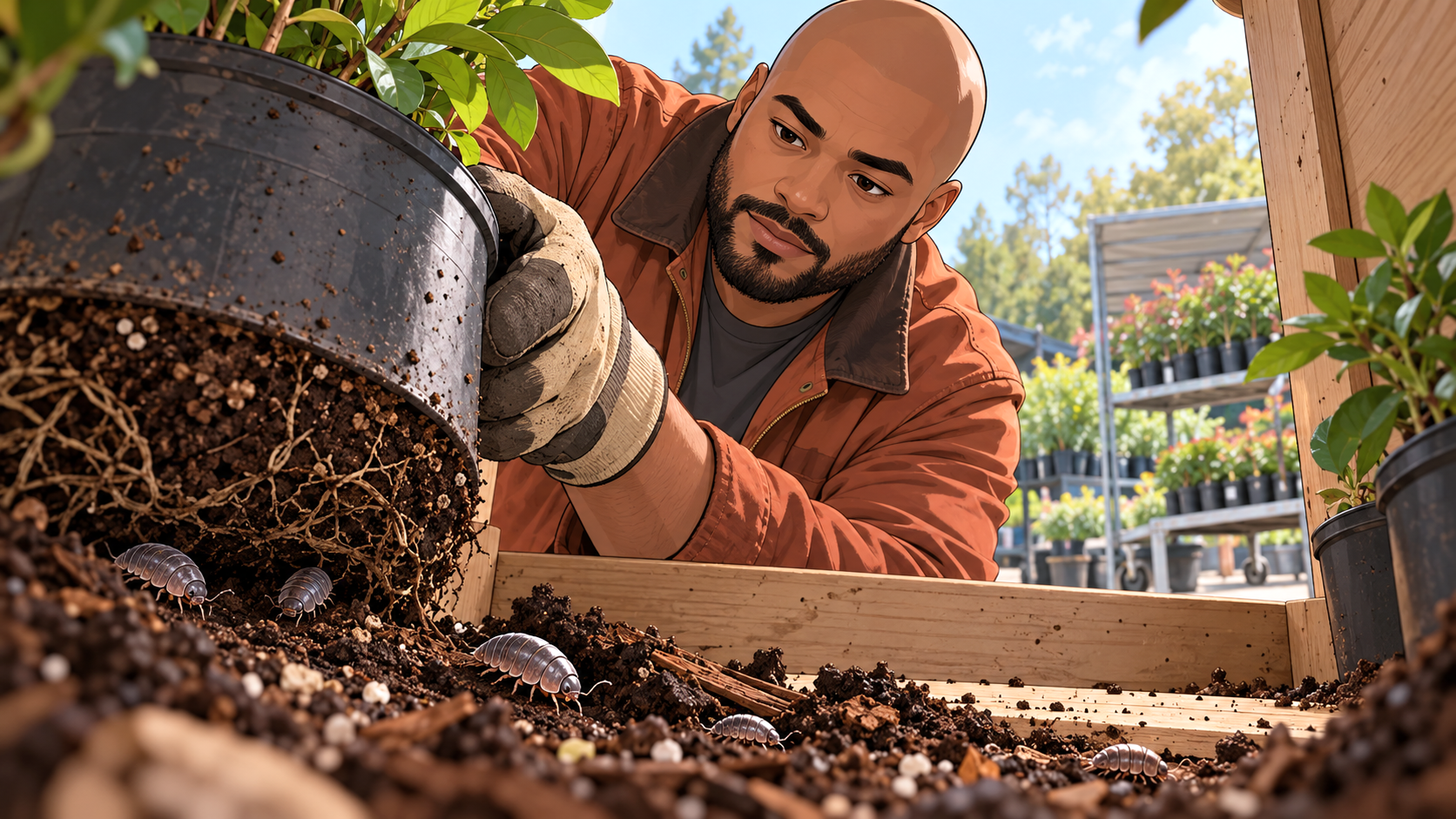
Roly-polies can sometimes be invasive, but they cannot all be classified as invasive species. “Roly-poly” is a common name applied to multiple terrestrial isopods. The common pillbug Armadillidium vulgare is native to the Mediterranean region and introduced across North America and many other parts of the world, but whether it is classified as invasive depends on the region and evidence of ecological or economic harm. A pillbug can therefore be native in one part of the world and non-native in another. Even within the same country, the label attached to an introduced species may depend on how an agency, database or scientific study defines invasion.
Introduced and Invasive Describe Different Things
An introduced, alien, exotic or non-native species occurs somewhere outside its historical native range because human activity moved it there, intentionally or accidentally. Invasion adds another ecological dimension. Definitions vary among scientific and regulatory frameworks, but an introduced species is not automatically considered invasive merely because it survives and reproduces in its new range.
That difference is especially important for roly-polies. North American terrestrial-isopod communities contain numerous species brought from elsewhere, and inland communities across Canada, the Atlantic region and the Midwest consist largely of cosmopolitan isopods introduced from outside North America. Some have become extremely common without receiving the same invasive classification in every database or jurisdiction.
The animal also has to be identified correctly before any geographic label can be useful. Several different terrestrial isopods are called roly-polies, and similar-looking species can have different native ranges and introduction histories. Treating the common name as though it represents one globally distributed species erases those differences.
Armadillidium vulgare Is Native to the Mediterranean Region
The common pillbug A. vulgare probably originated in the Mediterranean region and subsequently spread through temperate parts of the world. Modern ecological literature describes it as Mediterranean in origin and introduced worldwide, while studies of its ability to conserve water help explain how it can persist across a broad range of climates once established.
Its present distribution is therefore much larger than its native range. Records now extend through Europe, North America, South America, Africa, Asia, Australia and numerous islands. On Rapa Nui, for example, A. vulgare is one of several European or Mediterranean terrestrial isopods that arrived through human activity and became established.
Finding the species far from the Mediterranean does not mean it recently arrived. Some introduced populations have existed for generations, making a long-established non-native species look like an ordinary part of the local fauna.
The Common Pillbug Is Introduced Across the United States
Armadillidium vulgare is recorded as introduced in the continental United States and Alaska. Its spread appears to have occurred through multiple introductions rather than one population slowly expanding across the continent. Historical and genetic evidence indicates that eastern and western North American populations were founded independently from European source populations, and the species probably became established initially around greenhouses before spreading farther into surrounding habitats.
Human transport gives small terrestrial isopods several opportunities to cross natural geographic barriers. Soil, ornamental plants, nursery material and historically transported ballast can move animals without anyone intentionally releasing them. Their reproductive biology includes females carrying developing young in a brood pouch, which also protects offspring during development. A fertilized female transported with soil or plants can therefore contribute to establishment at a new location.
North American records now extend far beyond gardens and greenhouses. Introduced terrestrial isopods occur in forests, grasslands, wetlands, agricultural fields and cities, and A. vulgare is among the most frequently recorded species in urban isopod communities. Its ability to occupy moist shelters across many terrestrial habitats has helped it persist well beyond heavily developed areas.
Non-Native Pillbugs Can Move Into Natural Habitats
A long-established introduced species does not necessarily remain confined to places created by people. North America’s common European isopods have spread from settlements into less modified ecosystems, and this expansion raises ecological questions that simple backyard observations cannot answer.
Terrestrial isopods process leaf litter, interact with microorganisms and affect nutrient movement, so adding abundant non-native decomposers can alter processes below the level of obvious plant or animal displacement. The role roly-polies play in decomposition and nutrient cycling means changes in their abundance can influence how organic material is processed.
Such effects have been measured experimentally. Research involving A. vulgare found that the species could alter decomposition processes and nutrient dynamics under particular environmental conditions. Broader reviews of introduced soil fauna consequently recognize terrestrial isopods among organisms capable of affecting ecosystem processes after establishment.
Evidence of an ecological effect still needs geographic and ecological context. A result from one forest, grassland or experiment cannot establish that every population of A. vulgare produces the same outcome everywhere it has been introduced.
Some Introduced Roly-Polies Also Become Agricultural Pests
Economic effects provide another route by which an introduced population may attract invasive-species concern. Although roly-polies usually consume decaying vegetation, A. vulgare can feed on living plants under some conditions. Large populations have caused damage to crops in several countries, particularly where conservation tillage and accumulated surface residue create favorable habitat.
Agricultural studies have documented A. vulgare damaging soybean, sunflower and canola seedlings in parts of the Americas, South Africa and elsewhere. Reviews of terrestrial isopods in farming systems describe the species reaching pest status after colonizing agricultural fields.
A crop-damaging population is different from a handful of pillbugs beneath mulch. Their occasional ability to consume living tissue does not make every population economically harmful. Gardeners can encounter substantial numbers while receiving mostly decomposition benefits, which is why whether roly-polies are good or bad for a garden depends on actual plant damage rather than origin alone.
Other Roly-Poly Species Have Their Own Geographic Histories
Armadillidium vulgare is only one rolling terrestrial isopod. Armadillidium nasatum, Cylisticus convexus and other species capable of partial or complete conglobation also occur outside their historical ranges. A North American identification survey records A. nasatum as introduced across eastern and central states as well as parts of the West, while C. convexus is introduced through much of the contiguous United States. These species cannot simply inherit the geographic status assigned to A. vulgare.
Introductions are still occurring. The Mediterranean isopod Chaetophiloscia sicula was first reported in North America in 2000 and has since appeared in additional states, with recent surveys documenting continued spread through urban and coastal environments. Unlike Armadillidium, it does not represent the familiar tightly rolling pillbug body form, but its expansion demonstrates that the North American terrestrial-isopod fauna continues to change.
Correct identification therefore comes before deciding whether a particular backyard animal is native, introduced or potentially invasive. The shape, segmentation and other visible features used to identify roly-polies can establish that an animal is a pillbug, but species-level identification may require finer anatomical details.
A Roly-Poly in Your Yard Does Not Need Removal Just Because It Is Non-Native
Geographic origin alone does not establish a household pest problem. A non-native pillbug under a log may be consuming decaying vegetation without damaging anything you value. Its introduced status therefore provides little reason by itself to apply pesticides or remove an entire population.
Management becomes relevant when the animals are producing a specific problem, such as confirmed feeding damage to seedlings or low-growing produce or persistent movement into a building. Even then, the response can target the local problem rather than treating every outdoor roly-poly as an organism that must be eradicated.
Questions About Native and Introduced Roly-Polies
Are there native terrestrial isopods in North America?
Yes. North America has native terrestrial isopods, although their distribution is uneven. Native species are concentrated particularly in southern regions, coastal and wetland habitats, caves and some arid environments, while many familiar inland and urban species are introductions.
How did European roly-polies reach North America?
Historical transport of soil and plants probably played a major role. Soil used as ship ballast and plant material carried by settlers could move small terrestrial isopods across the Atlantic without deliberate introduction.
Can a species remain non-native after hundreds of years?
Yes. Length of residence does not make an introduced species historically native. A population can become naturalized and widespread while its biogeographic origin remains outside that region.
Does finding hundreds of roly-polies mean they are invasive?
No. Abundance alone cannot determine invasion status. Moisture, shelter and food can produce dense local populations, and the conditions that support large numbers of roly-polies do not reveal whether the species is native or introduced.