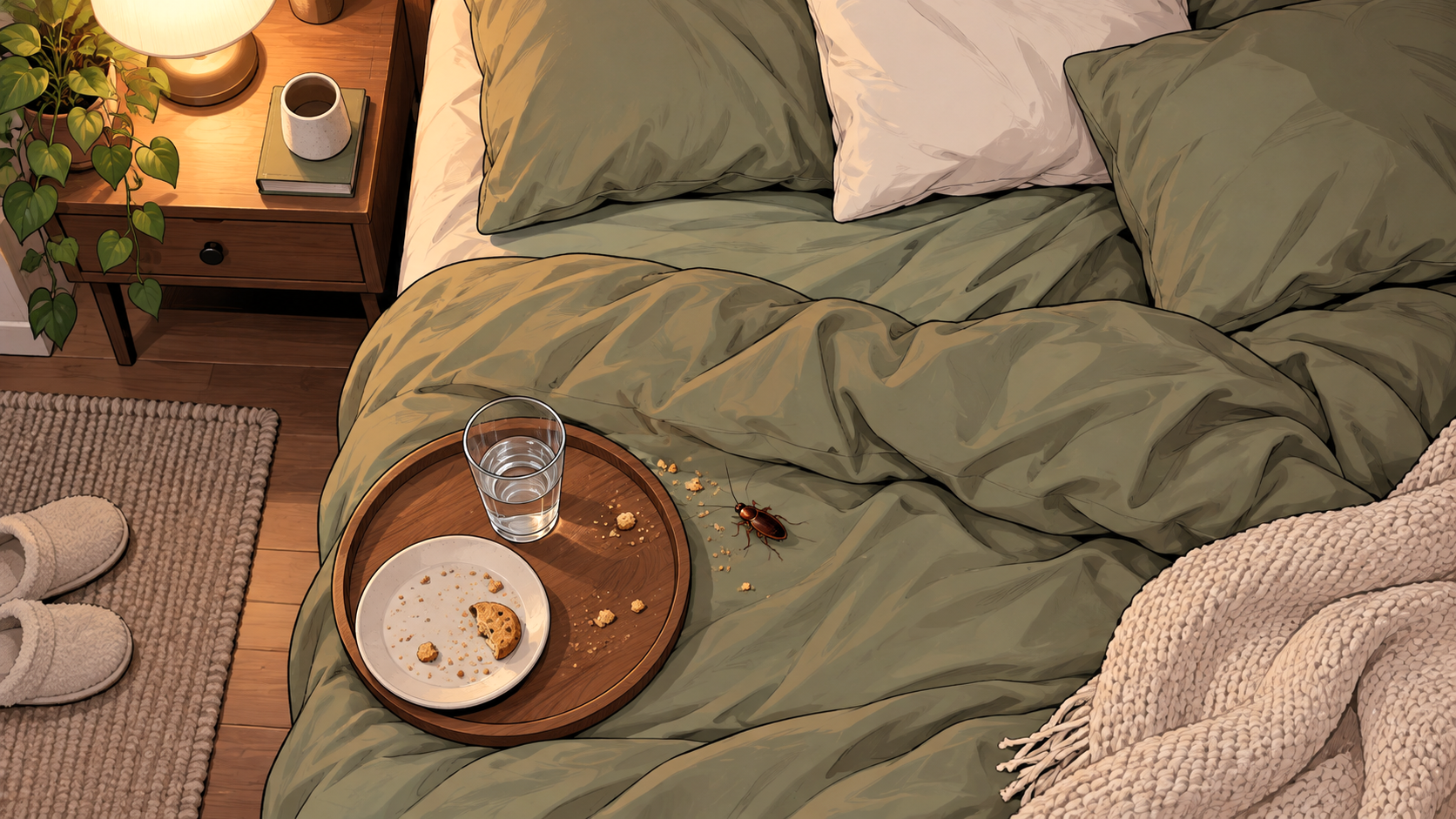
Finding a cockroach between your sheets does not necessarily mean it lives in your mattress. A cockroach may enter a bed while searching for food, following a route across nearby furniture, or investigating a sheltered gap in the bed frame. In some cases, the insect is an occasional visitor from elsewhere in the building. In others, repeated sightings indicate that cockroaches are resting in the bedroom itself.
The species matters. Brown-banded cockroaches readily occupy bedroom furniture and relatively dry spaces, while German cockroaches are more strongly associated with kitchens and bathrooms. Where the insect was found, whether others have appeared, and what lies immediately around the bed provide better clues than the sighting alone.
Food Crumbs Can Bring Cockroaches Onto a Bed
Eating in bed creates opportunities for cockroaches to encounter food in an otherwise unlikely feeding location. Crumbs trapped beneath pillows, spilled drinks, snack wrappers, and residue on bedside tables can provide resources for insects exploring the room.
Cockroaches do not require an entire meal to make a location worth investigating. Their varied feeding habits allow them to exploit small amounts of accessible organic material. The University of California’s cockroach management guidance identifies food availability and sanitation as important factors affecting household cockroach activity.
A cockroach discovered beside an open snack packet has a more plausible immediate reason to investigate the bedding than one found on a freshly made bed with no accessible food. Nevertheless, the absence of crumbs cannot rule out cockroach activity. An insect may cross the mattress without stopping to feed.
The range of materials cockroaches can eat also means that food-related attraction should not be interpreted too narrowly. Residues on nearby furniture may be relevant even if no obvious food remains on the sheets.
The Bed Frame May Offer Shelter
Beds contain joints and enclosed spaces that can be suitable for cockroach concealment. A hollow metal frame, loose wooden joint, upholstered headboard, or gap behind a wall-mounted headboard may provide a protected resting place.
Brown-banded cockroaches (Supella longipalpa) are particularly relevant because they tolerate drier indoor conditions than German cockroaches and frequently occupy furniture. Texas A&M University’s urban entomology guidance identifies upholstered furniture, furniture undersides, closets, and elevated wall locations among their typical refuges.
The insect does not necessarily occupy the mattress fabric itself. A cockroach resting in a headboard joint may emerge onto a pillow or sheet because the bedding touches the frame. Similarly, insects beneath a bedside cabinet can encounter the bed through adjoining objects.
The daytime hiding preferences of different cockroach species help explain why one bedroom can offer suitable refuge while another contains little that attracts resident cockroaches.
Finding an insect on the mattress is therefore different from finding evidence that cockroaches repeatedly occupy the bed structure.
The Cockroach May Have Followed an Existing Route
A bed does not have to contain food or shelter to be crossed by a cockroach.
A blanket hanging onto the floor, a bed pushed against a wall, or a bedside table touching the frame can provide a continuous surface between the insect’s normal route and the sleeping area. Cockroaches use contact with surrounding surfaces to guide their movements and can travel along furniture edges.
The EPA’s school integrated pest management manual describes the tendency of cockroaches to travel along structural edges and explains why monitoring devices work best when placed along those routes.
An insect that climbs the outside of a headboard and crosses the bedding may simply be continuing along an accessible path. Some species can also approach beds by moving directly up vertical surfaces. Their ability to climb walls and furniture makes it difficult to identify the precise route from the final sighting alone.
A single cockroach on a pillow cannot establish that the pillow was the insect’s intended destination.
Brown-Banded Cockroaches Are More Likely to Occupy Bedroom Furniture
A small cockroach repeatedly found around a headboard, dresser, closet, or bedroom wall deserves particular attention because brown-banded cockroaches commonly occupy these locations.
Unlike German cockroaches, which generally concentrate near food and moisture, brown-banded cockroaches can establish themselves throughout warmer, drier parts of a building. They may hide behind picture frames, inside furniture, near electrical fixtures, and beneath tables or chairs.
Utah State University’s brown-banded cockroach guidance also notes that females attach their egg cases to protected surfaces, including walls and furniture. An insect found near a bed frame may therefore belong to a population developing within the bedroom rather than arriving from a distant room.
German cockroaches can appear in bedrooms, especially when populations occupy multiple connected areas. However, finding a cockroach near dry bedroom furniture should not automatically be treated as evidence of a German cockroach infestation.
Accurate identification of the cockroach species helps determine which nearby locations deserve closer attention.
How to Tell Whether the Cockroach Was Passing Through or Living Nearby
The strongest distinction is between an isolated encounter and repeated evidence concentrated around the bed. A cockroach wandering across a mattress may have arrived from another part of the room, whereas insects repeatedly emerging from the headboard or bed-frame joints suggest that a nearby refuge deserves attention.
Certain observations are especially informative:
| Observation | What it may suggest |
|---|---|
| One large cockroach with no further sightings | An incidental visitor |
| Several small cockroaches around bed-frame joints | Possible nearby developing population |
| Egg cases attached beneath furniture | Potential brown-banded cockroach breeding activity |
| Droppings or shed skins concentrated around a headboard | Repeated occupation of that area |
| Cockroaches caught near the bedroom doorway but not around the bed | Possible movement into the room from elsewhere |
These observations require species identification and context. A single adult cockroach can travel between rooms, and the distance cockroaches move during ordinary activity varies with species and environmental conditions.
Brown-banded egg cases are particularly useful evidence. Utah State University’s guidance documents how females attach cases to sheltered surfaces, including furniture and elevated parts of rooms. Several attached cases near a bed provide stronger evidence of local occupation than one insect found on a sheet.
The appearance of cockroach droppings can help distinguish accumulated insect activity from ordinary dust, although droppings alone cannot establish whether the population is currently active.
Inspect the Bed Without Assuming the Mattress Is Infested
Begin with the location of the sighting. If the cockroach was on the pillow beside a wall-mounted headboard, prioritize the accessible headboard joints and adjacent wall gap. If it emerged from beneath the bed, examine the frame’s underside, nearby furniture edges, and the floor beneath the bed.
A flashlight can reveal insects or deposits within accessible crevices. Check seams and folds where they meet rigid components, but avoid assuming that every mattress seam is a cockroach harborage. The University of Minnesota’s cockroach guidance identifies elevated furniture, pictures, and other household objects as characteristic brown-banded cockroach sites.
Pay attention to what the inspection actually establishes. A cockroach on a bedsheet confirms its presence there; it does not establish where it was hiding previously. Several insects occupying a frame joint, especially alongside shed skins or egg cases, provide more substantial evidence of a local refuge. The physical characteristics of cockroach harborages can help interpret these findings without treating every narrow gap as occupied.
For uncertain activity, place cockroach sticky monitors along accessible floor-wall junctions near the bed and nearby furniture, keeping them away from children and pets. The EPA’s integrated pest management manual recommends positioning monitors along likely movement routes, since traps placed away from those routes may capture few insects even when activity occurs elsewhere.
Could the Insect in Your Bed Actually Be a Bed Bug?
Small cockroach nymphs and bed bugs can be confused during a brief encounter, especially when the insect is partially concealed by fabric.
Cockroach nymphs generally have conspicuously long antennae, spiny legs, and a body shape that differs from the broad, oval form of a bed bug. Their movements may also differ, although speed alone is not a reliable identification method.
The EPA’s bed bug identification guidance specifically identifies cockroaches among insects that can be mistaken for bed bugs and recommends accurate identification before choosing a treatment.
Capture the insect in a secure container or take a clear photograph showing its body and antennae. Identification becomes especially important when someone has unexplained skin marks, because the presence of an insect on a bed does not prove it caused those marks.
The appearance of suspected cockroach bites cannot reliably distinguish them from other skin reactions. Physical identification of the insect provides substantially stronger evidence.
What to Change Around the Bed After Finding a Cockroach
The immediate priorities depend on what drew the insect into the sleeping area.
If food residue is present, remove wrappers and crumbs from the bedding and nearby furniture. If the bed touches the wall or hanging blankets reach the floor, creating a small separation may reduce convenient routes onto the mattress. Move stored cardboard and unnecessary belongings away from the frame so that accessible joints and surrounding surfaces can be examined.
Do not spray household insecticides onto pillows, sheets, mattresses, or upholstered surfaces unless a product is specifically registered and labeled for the intended application. The EPA’s pesticide safety guidance emphasizes following label directions and avoiding unnecessary pesticide exposure.
One cockroach does not justify throwing away a mattress. Even repeated bedroom sightings require identifying the species and establishing where activity is concentrated before deciding whether furniture itself is involved.
A cockroach discovered directly on the bed is therefore an observation worth investigating, not proof that the mattress contains a breeding population. The most revealing evidence usually lies in the adjacent furniture, accessible frame joints, and repeated movement patterns around the sleeping area.
One thought on “Why Would a Cockroach Be in Your Bed?”