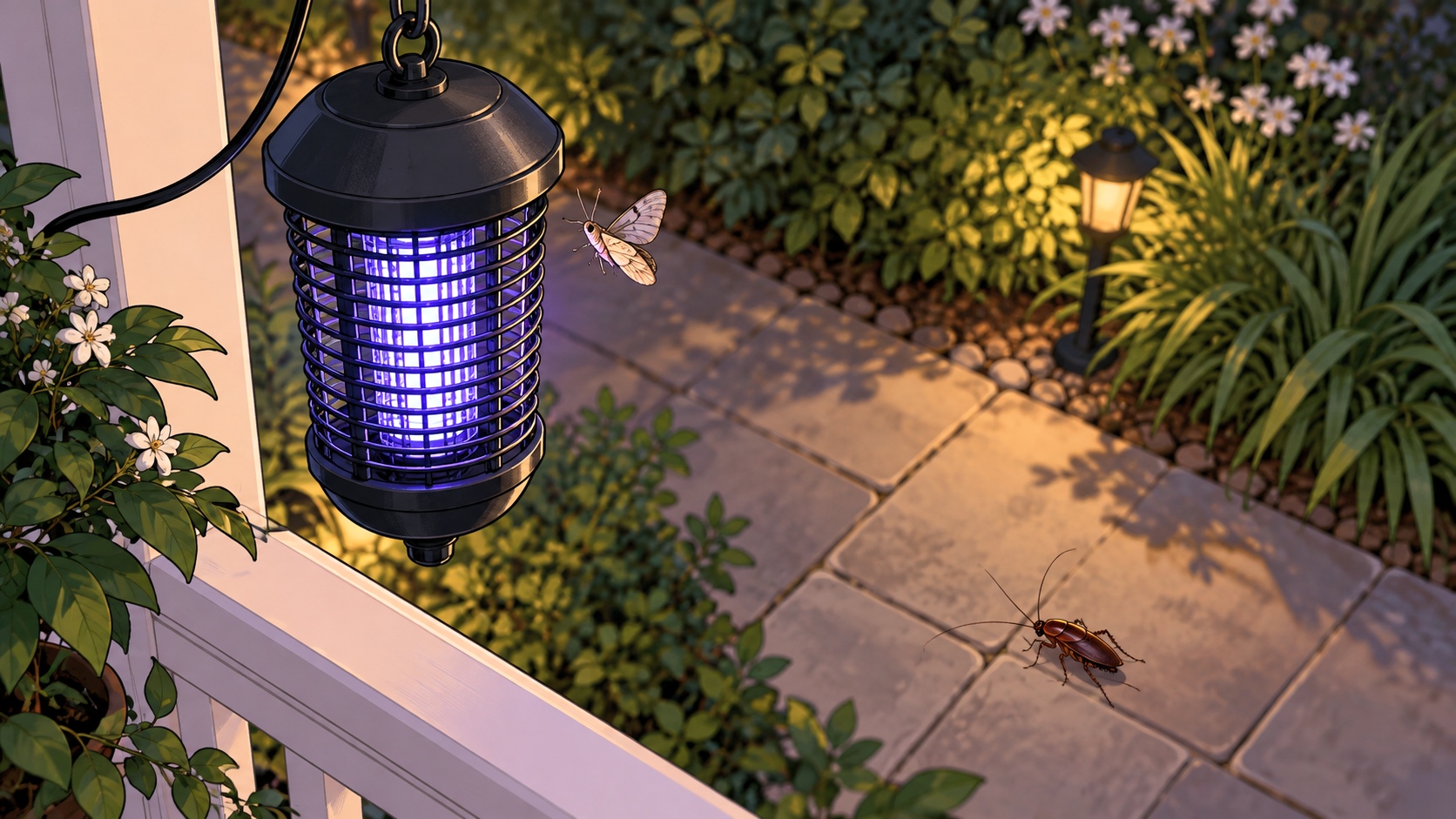
Bug zappers are designed to attract insects toward an electric grid, where contact with the energized wires can kill them. They work against some flying insects, but cockroaches present a different challenge. Most household pest cockroaches spend their time crawling through protected spaces rather than flying toward illuminated traps.
Yes, a bug zapper can kill a cockroach that contacts its electrified grid, but ordinary UV bug zappers are not effective cockroach-control devices. Most cockroaches are unlikely to encounter the grid, and killing an occasional insect does not meaningfully reduce a population living inside cabinets, walls, or other concealed locations.
Research on cockroach responses to ultraviolet radiation has produced some interesting findings, but those experiments should not be confused with evidence that household bug zappers eliminate infestations.
Why Cockroaches Rarely End Up in Bug Zappers
Most commercial bug zappers use ultraviolet or near-ultraviolet light to attract flying insects toward a high-voltage grid. Moths, flies, and other insects that approach the light may contact the wires and be electrocuted.
Cockroaches generally do not behave like these flying insects. German cockroaches, among the most common indoor pest species, possess wings as adults but rarely fly. Instead, they travel along surfaces and occupy protected spaces close to their preferred resources.
The University of California’s cockroach management guidance identifies German cockroaches as primarily crawling insects that shelter in narrow openings. Their movement patterns make elevated light traps poorly suited to intercepting them.
A cockroach crawling beneath a kitchen cabinet may never approach a zapper hanging above the floor. Even when light is visible from its location, there is no reason to assume that illumination will draw the insect across the room.
The ability of cockroaches to fly varies considerably among species. Some outdoor-associated cockroaches are capable fliers, making accidental contact with an illuminated electrical trap more plausible, but their flight capability does not establish reliable attraction.
Does Ultraviolet Light Attract Cockroaches?
Cockroach responses to ultraviolet light are more complicated than the common claim that all cockroaches avoid illumination.
In a 1989 Japanese study involving German and American cockroaches, researchers used germicidal ultraviolet lamps to investigate how insects entered an irradiated area. German cockroach adults and nymphs, along with American cockroach nymphs, showed attraction under some experimental conditions. Adult American cockroaches tended to avoid intense radiation.
A subsequent 1995 field experiment on German cockroaches reported substantial population reductions following exposure to germicidal ultraviolet lamps, although results differed according to lamp placement.
These studies demonstrate that cockroaches can respond to particular ultraviolet exposures. They do not establish that the lower-intensity light found in ordinary household bug zappers will attract enough cockroaches to provide effective control.
Germicidal UV lamps also present serious eye and skin injury hazards and should never be improvised as household cockroach treatments. Their purpose, radiation characteristics, and exposure risks differ from those of consumer insect zappers.
Would a Bug Zapper Placed on the Floor Work Better?
Placing a zapper closer to cockroach travel routes might appear to improve its chances of catching them. However, ordinary bug zappers are not designed to intercept crawling insects, and moving one to floor level does not address the uncertainty surrounding light attraction.
Their protective cages may prevent cockroaches from reaching the electrical grid. Some insects could approach the illuminated enclosure without crossing the energized wires, while others may simply travel around it.
A research comparison published in the Journal of Economic Entomology evaluated several devices for capturing German cockroaches, including traps equipped with electrified barriers. The 1984 laboratory and field study found that trapping could remove insects, but the researchers considered traps primarily useful for monitoring rather than adequate population control.
Those experimental electrical traps were not conventional UV bug zappers. Their findings nevertheless illustrate why capturing some cockroaches with electricity does not establish that a household infestation will disappear.
The typical movement speed of cockroaches also means that insects can cross an exposed area without remaining near a device long enough to encounter its grid.
Do not modify a commercial zapper, remove its protective cage, or operate it in an orientation prohibited by the manufacturer to improve cockroach access.
Are Outdoor Bug Zappers Useful Against Flying Cockroaches?
Outdoor bug zappers may occasionally kill flying cockroaches that approach their lights, particularly in regions where large flying species are common. However, there is insufficient evidence that these incidental captures substantially reduce outdoor cockroach populations.
Most insects electrocuted by conventional outdoor zappers are not the household pests people intend to control. An Iowa State University Extension review of insect electrocutor traps describes research in which only 31 of 13,789 collected insects were biting flies. The study did not measure cockroach control, but it illustrates how poorly a light-based zapper can target particular pest groups.
The University of Florida’s guidance on outdoor lighting also warns that bug zappers indiscriminately kill many insects, including beneficial species.
Using a zapper to target a handful of outdoor cockroaches may therefore create greater effects on unrelated insects than on the population causing concern.
The different cockroach species living around homes vary in their flight behavior and preferred habitats, so the presence of a flying adult should not be taken as evidence that light traps will control its population.
Can Bug Zappers Make an Indoor Infestation Worse?
There is no strong evidence that an ordinary bug zapper directly increases cockroach reproduction or causes an established indoor infestation to grow.
The more realistic disadvantage is misplaced confidence. A homeowner may leave a zapper operating for weeks while surviving cockroaches continue reproducing in locations the device cannot reach.
Electrical insect zappers can also create sanitation concerns. Electrocution may scatter fragments of insect bodies around the equipment, which is undesirable near food preparation areas.
The University of Florida’s discussion of ultraviolet insect traps explains that light-based devices can attract substantial numbers of insects that are not the intended targets.
Any electrical insect killer used indoors should be kept away from exposed food, water sources, and combustible materials, following its manufacturer’s placement and maintenance instructions. Do not position one above countertops, dining tables, or food-storage areas.
What Works Better Than a Bug Zapper for Cockroaches?
Commercial sticky cockroach monitors are better suited to the movement patterns of crawling cockroaches. They can be placed along protected edges and other accessible routes where insects are likely to travel.
In a 2008 study comparing German cockroach traps, researchers found substantial differences in capture performance among trap designs. Sticky traps generally performed better than the tested jar traps, demonstrating the importance of designs suited to cockroach movement.
For an established infestation, appropriately labeled cockroach baits can provide population control that a monitoring trap or incidental electrical kill cannot.
The EPA’s integrated pest management principles emphasize selecting methods according to the pest, measuring activity, and evaluating results rather than relying on devices with unsupported effectiveness claims.
Neither a loud electrical zap nor a collection tray containing dead insects confirms that cockroaches have been eliminated. The evidence needed to determine whether cockroaches are gone involves sustained monitoring and an absence of continuing activity.
A bug zapper can electrocute a cockroach that reaches its grid, but ordinary UV zappers are poorly matched to cockroach behavior and should not be relied upon for household cockroach control.