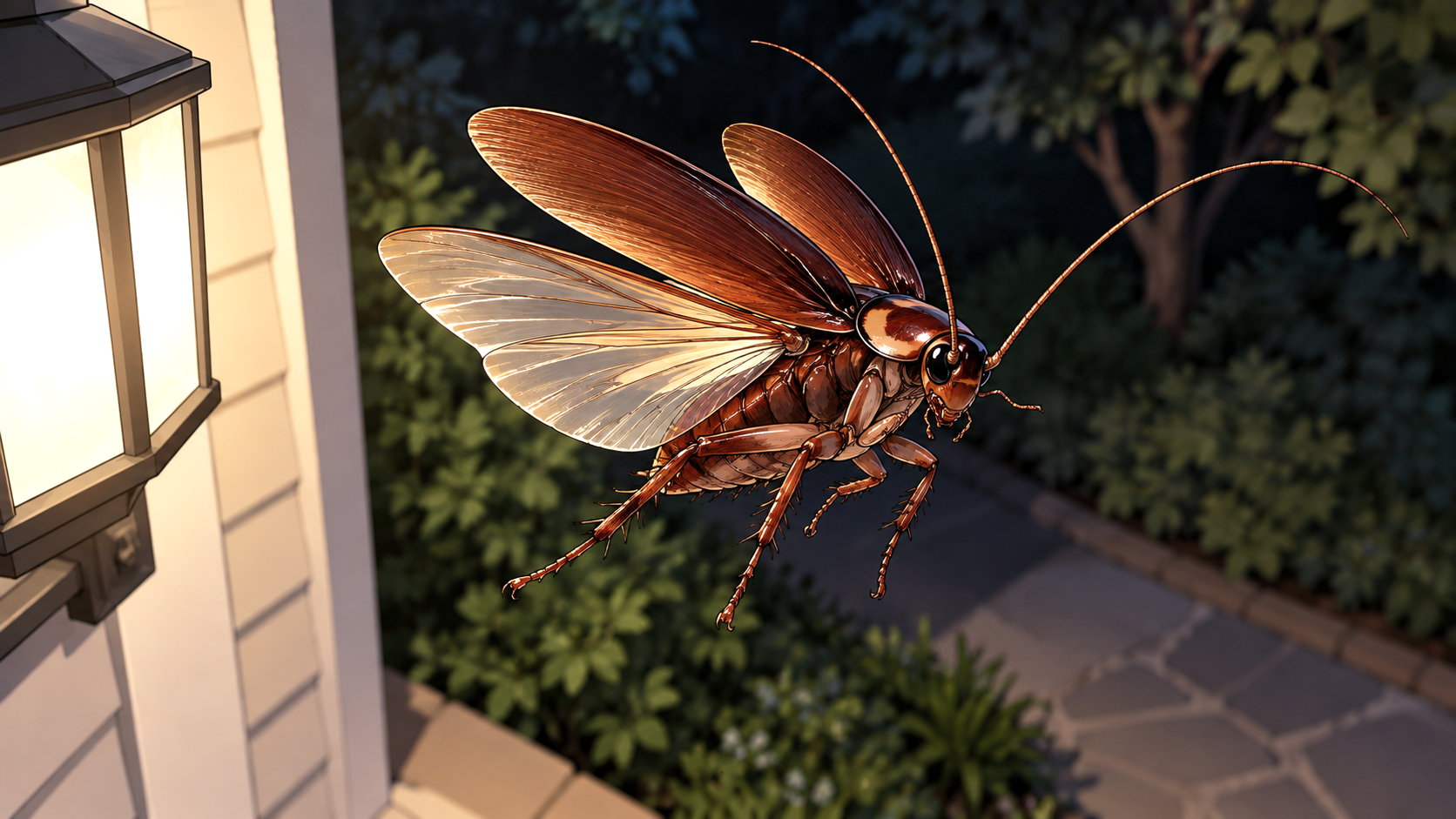
Some cockroaches can fly, but flight ability varies greatly by species and sex. Smokybrown and Australian cockroaches are capable fliers, American cockroaches can use their wings for short flights or gliding, and male brown-banded cockroaches fly more readily than females. German and Oriental cockroaches have wings as adults but normally do not fly. Seeing wings is therefore not enough to predict what a cockroach will do. Among the species commonly encountered around buildings, wings range from functional flight equipment to structures that contribute little or nothing to airborne movement.
The Cockroaches Most Likely to Fly Are Not All Indoor Species
Smokybrown cockroaches are among the more capable fliers likely to turn up around homes. Both adult sexes have fully developed wings and can fly, while their close association with outdoor vegetation, tree holes, roofs, wall voids, and other sheltered locations means flight can bring them toward buildings. A review of major U.S. cockroach species classifies adult male and female smokybrown cockroaches as capable of flight.
Australian cockroaches also have functional wings in both sexes and can fly. They are another primarily peridomestic species in many parts of their range rather than the classic small cockroach reproducing behind a kitchen refrigerator. The same review identifies both sexes of the Australian cockroach as fliers.
Species identification consequently matters when someone reports a “flying roach.” Color, markings, body size, wing length, and where the insect was found can narrow the possibilities. Comparing those traits with the broader types of cockroaches found around homes is more reliable than assuming every airborne cockroach belongs to the same species.
American Cockroaches Have Wings but Usually Keep Their Flights Short
Adult American cockroaches have long, fully developed wings. Their flight ability is real, although running remains an important means of movement. They can use their wings for short-distance flight or controlled movement through the air rather than behaving like insects that routinely travel long distances on the wing.
Warm conditions can make airborne activity more noticeable. American cockroaches are large insects associated with warm, moist environments such as sewers, basements and other protected sites, and adults may move between indoor and outdoor habitats. Their substantial size can make even a short flight conspicuous when one enters a room.
A large reddish-brown cockroach taking off is therefore plausible rather than an indication that the insect has been mistaken for something else. Identification still needs more than flight behavior because several insects can resemble cockroaches at a glance, especially when the encounter lasts only a few seconds.
German Cockroaches Rarely Put Their Wings to Use
Adult German cockroaches have wings extending over the abdomen, yet they normally travel by running. They are strongly associated with human structures and are the species behind many persistent indoor infestations. EPA pest-management material describes German cockroaches as especially successful at infesting human structures and resisting control efforts, but their success indoors does not depend on routine flight.
That combination can be surprising when someone examines an adult closely. The presence of developed wings does not mean the insect routinely launches from countertops or flies between rooms. A German cockroach disappearing across a kitchen is far more likely to have run into a nearby crevice.
Young German cockroaches make the answer easier because nymphs do not yet have adult wings. If a very small cockroach-like insect appears to fly, its behavior is another reason to check whether the insect has been identified correctly. The appearance of baby cockroaches changes as they mature, including the development of adult wings after the final molt.
Brown-Banded Cockroaches Show a Clear Difference Between the Sexes
Brown-banded cockroaches make a simple species-level answer less useful because males and females differ markedly in wing proportions and flight behavior. Adult males are slender and have wings extending beyond the abdomen, while females are broader and have shorter wings. Government identification material shows this pronounced difference between male and female brown-banded cockroaches.
Males are the more capable fliers and may take flight when disturbed, particularly under warm conditions. Their ability to move through the air fits a species that can occupy areas well beyond the damp, floor-level locations commonly associated with German cockroaches. Brown-banded cockroaches can occur higher in rooms and around furniture and electrical equipment, so an indoor flying cockroach is not automatically an outdoor species that wandered inside.
Flight still provides only one identification clue. Brown-banded adults also carry pale transverse bands, and the sexes differ in body shape. Those physical traits deserve more weight than a brief observation of movement when determining what a cockroach looks like.
Oriental Cockroaches Cannot Fly
Oriental cockroaches demonstrate most clearly why wings and flight cannot be treated as interchangeable. Adult males have wings covering only part of the abdomen, while females possess much smaller wing pads. Neither sex flies. The Illinois Department of Public Health specifically identifies both male and female Oriental cockroaches as flightless.
Their movement is therefore confined to surfaces rather than airborne travel. Oriental cockroaches are commonly associated with cool, damp environments such as basements, crawl spaces, drains, garages, and outdoor areas around foundations. Their tendency to occur near moisture also helps explain why they are sometimes called water bugs, although cockroaches and insects called water bugs are not always the same thing.
Wings Appear Only After a Cockroach Becomes an Adult
Cockroach nymphs cannot fly because they have not developed functional adult wings. They hatch as small, wingless versions of the general cockroach body form and acquire their final adult structures through successive molts. The wings appear after the final immature stage rather than gradually becoming usable little flight surfaces on young nymphs.
That developmental point can help when interpreting an infestation. A mixture of winged adults and wingless nymphs does not represent two species merely because their backs look different. The cockroach life cycle passes through egg, nymph, and adult stages, and cockroach molting allows the nymph to grow before reaching its adult form.
Adult wing length still varies enormously after development is complete. Oriental females retain only reduced wing structures, while species such as the smokybrown cockroach develop wings covering the abdomen in both sexes. The difference reflects species and sex rather than the age of two fully mature insects.
A Cockroach Coming Toward You Is Not Necessarily Attacking
A flying cockroach can appear to aim directly at a person, particularly when it abruptly changes direction in a confined room. There is no need to interpret that movement as an attack. Cockroach flight is not a hunting behavior directed at people.
Indoor obstacles also make the path look less controlled than flight in open space. Walls, furniture, lights, air currents, and a startled takeoff can produce a short trajectory that happens to cross a person’s position. Cockroaches are primarily trying to move between suitable surfaces, escape disturbance, or reach shelter.
Light can influence the activity of some outdoor and peridomestic species, making porches, windows, and illuminated areas relevant to encounters. Flight into or around a home therefore does not automatically establish that cockroaches are reproducing indoors. Finding repeated adults, nymphs, egg cases, droppings, or monitor captures provides stronger evidence of a cockroach infestation than one flying individual.
Flying Ability Can Help Narrow Down an Identification
If you actually watch a cockroach sustain flight rather than merely fall or flutter from a wall, species known to be capable fliers move higher on the list. Smokybrown, Australian, some wood cockroaches, and male brown-banded cockroaches are more plausible candidates than Oriental or German cockroaches. A broad review of U.S. species also identifies male wood cockroaches as capable of flight, while females in the group may have reduced wings or lack them depending on the species.
Do not identify the insect from flight alone. Note its approximate length, overall color, markings behind the head, bands across the body, wing length, and where the encounter occurred. Those observations are far more useful than trying to decide whether a half-second flutter qualified as “real” flight.
An isolated outdoor species that entered through an open door may require no indoor infestation treatment at all. Repeated captures of a domestic species call for a different response, and understanding why cockroaches are entering the house helps separate accidental entry from a population already living indoors.
Questions About Cockroaches in the Air
Can cockroaches fly up from the floor?
Flight-capable adults can launch from surfaces, although the ease and distance vary by species. Seeing a cockroach become airborne from the floor is therefore possible and does not require it to begin from an elevated surface.
Can cockroaches fly when they are babies?
No. Cockroach nymphs are wingless. Functional adult wings, where the species develops them, appear after the final molt.
Can a cockroach fly onto your bed?
A flight-capable species could land on a bed just as it could land on another surface. That possibility does not mean cockroaches specifically target beds or sleeping people.
Do all large cockroaches fly?
No. Body size does not determine flight ability. American and smokybrown cockroaches have functional wings, while the similarly large Oriental cockroach cannot fly. Identification requires species-specific traits rather than size alone.
2 thoughts on “Can Cockroaches Fly?”