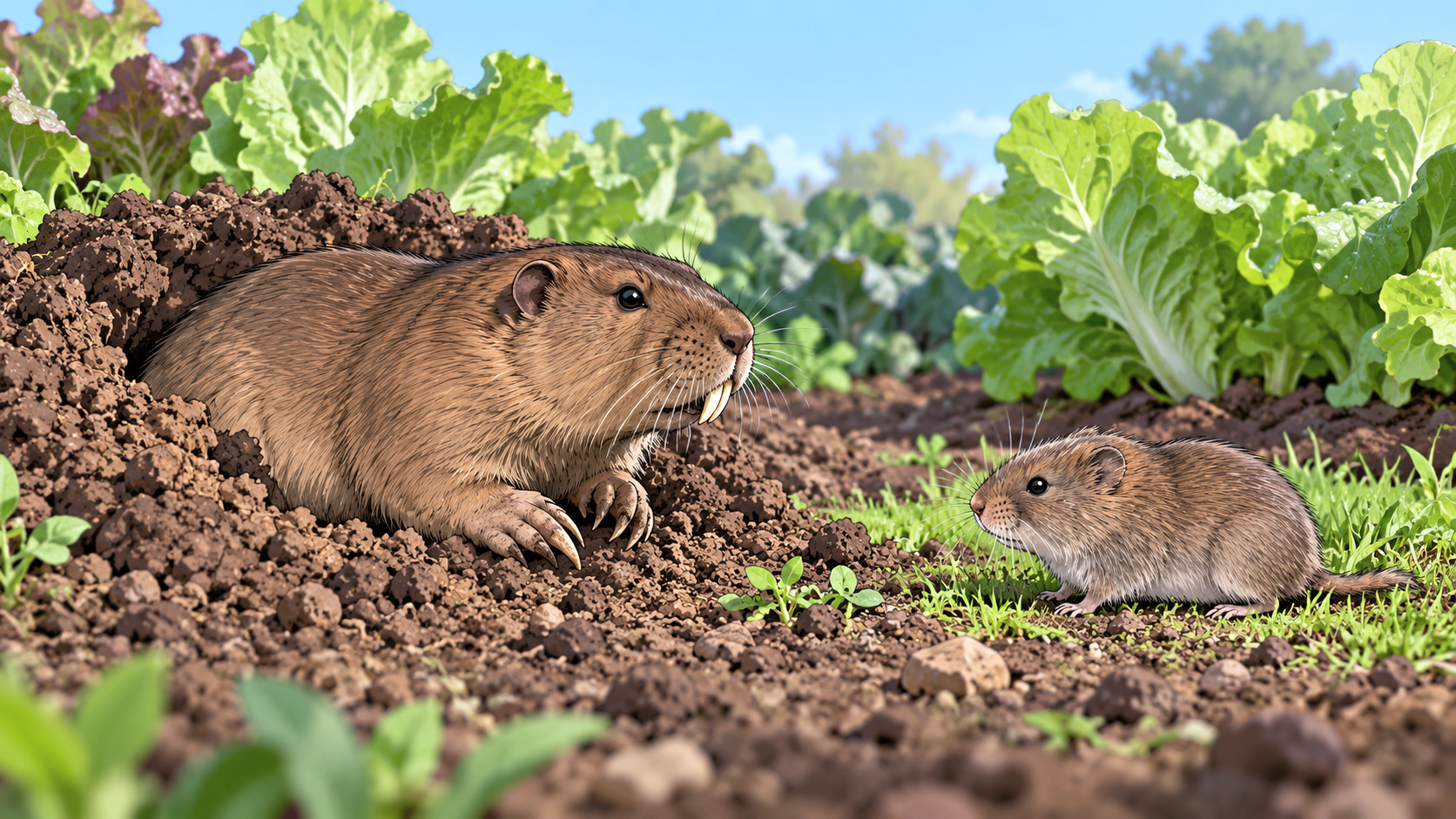
A vole is a small, stocky rodent with a blunt nose, short tail, and ordinary front feet, while a pocket gopher has powerful digging claws, prominent yellowish incisors, and fur-lined cheek pouches for carrying food. Voles commonly leave narrow pathways through grass. Pocket gophers spend most of their lives underground, pushing excavated soil into conspicuous mounds. Both eat vegetation and can damage garden plants, but they leave different patterns of evidence.
The front feet provide one of the strongest identification clues when you can see the animal. A gopher’s forequarters are built for excavation, whereas a vole’s feet resemble those of other small rodents. When neither animal is visible, look at whether the disturbed ground contains freshly excavated soil or flattened vegetation.
Vole vs. Gopher: Main Differences
| Feature | Vole | Pocket gopher |
|---|---|---|
| Body | Compact, mouse-like | Heavyset with powerful forequarters |
| Nose | Short and blunt | Rounded, with prominent incisors |
| Eyes and ears | Small, with ears partly concealed | Very small and inconspicuous |
| Front feet | Small paws | Large, strong claws adapted for digging |
| Tail | Short and covered with fine fur | Short and sparsely haired |
| Cheek pouches | No external food-carrying pouches | Fur-lined external cheek pouches |
| Typical movement | Through vegetation and shallow passages | Mainly through underground tunnels |
| Common ground evidence | Flattened grass trails and burrow openings | Fresh soil mounds with plugged openings |
| Feeding damage | Clipped vegetation, bark, roots, and bulbs | Roots, underground plant tissues, and occasionally entire plants |
| Visibility | Regularly travels aboveground | Rarely seen outside its burrow |
These characteristics apply to familiar North American voles and true pocket gophers. The term gopher is sometimes used informally for ground squirrels, which are different animals. The United States Forest Service’s identification of pocket gophers emphasizes their external cheek pouches, yellow incisors, and curved digging claws.
A Pocket Gopher Has Teeth and Cheek Pouches That Voles Lack
The most unusual feature of a pocket gopher is the pair of fur-lined pouches opening outside its mouth. The animal uses them to transport food and nesting material through its tunnels. These pockets can be turned inside out for cleaning, and their openings are separate from the mouth itself.
Gophers also possess large, exposed incisors that are often yellow-orange. Their lips can close behind these teeth, helping prevent soil from entering the mouth when they dig with their incisors. The University of California’s pocket gopher identification guidance documents these adaptations alongside the animal’s powerful forelimbs.
Voles have the continuously growing incisors characteristic of rodents, but they lack the specialized external cheek pouches. Their faces are less dominated by visible front teeth, and their forefeet are comparatively small. The rounded body and facial proportions of voles produce an appearance closer to a short-tailed mouse than to a pocket gopher.
Body size can provide supporting evidence, although the ranges overlap. California pocket gophers commonly measure 6–10 inches long, including the tail, while California voles commonly measure 5–8 inches. The actual size of a vole depends on the species, so a large vole should not automatically be identified as a gopher.
A Gopher Pushes Soil Up While a Vole Creates Grass Pathways
Fresh dirt piled above an underground excavation is characteristic evidence of pocket gopher activity. Gophers construct feeding tunnels through the soil and push the excavated material to the surface. Their mounds are commonly crescent-shaped or fan-shaped, with a plugged tunnel opening positioned to one side.
The pocket gopher’s underground tunnel system may extend across several hundred square feet. Feeding passages commonly lie 6–12 inches belowground, while nesting and storage chambers can be deeper. A single gopher can produce multiple soil mounds, so the number of mounds does not represent the number of animals present.
Voles often leave less conspicuous evidence aboveground. Meadow voles repeatedly travel through the same strips of grass, forming narrow routes sheltered by surrounding vegetation. Their passages connect shallow burrow entrances without requiring large quantities of excavated soil to accumulate on the lawn. The surface runways created by voles may become especially noticeable when vegetation is flattened or after snow cover disappears.
Woodland voles complicate this comparison because they spend more time underground than meadow voles. However, their activity still differs from the substantial soil excavation associated with pocket gophers. A small opening alone cannot establish which rodent made it. The surrounding evidence matters, particularly whether fresh soil has been displaced or vegetation repeatedly clipped.
Both Eat Plants, but Their Feeding Damage Often Appears in Different Places
Pocket gophers feed heavily on roots and other underground plant parts. Their excavations bring them directly into contact with the root systems of grasses, vegetables, shrubs, and trees. They may also pull vegetation into their burrows or emerge briefly to clip plants close to an entrance.
A disappearing vegetable plant surrounded by fresh soil mounds presents a different pattern from grass clipped along a surface pathway. The University of California’s agricultural observations document pocket gophers feeding on roots, damaging underground irrigation lines, and sometimes gnawing the buried portions of trees. In orchards, serious damage may remain concealed until the affected plant begins to decline.
Voles consume vegetation both above and below the soil surface. Grass and tender stems can be clipped at ground level, while roots and bulbs are vulnerable where voles feed underground. Their feeding on bulbs and roots means underground damage alone cannot distinguish a vole from a pocket gopher.
The position of bark injury can help around trees. The University of California’s vole damage assessment identifies gnawing at and slightly above the soil line as characteristic of vole activity, while pocket gophers generally injure roots and buried crowns. Both can damage the same kinds of plants, so the location and appearance of vole bark damage should be considered alongside fresh tunnels or surface trails.
Neither animal should be blamed solely because a plant has wilted. Root diseases, drought, and other soil disturbances also affect plant health. Exposing an already damaged root or examining a gnawed stem can provide stronger evidence than interpreting the plant’s appearance from a distance.
Pocket Gophers Spend Much More Time Underground
A vole running across a garden path is a plausible sight, particularly where grass or low-growing plants provide nearby shelter. Pocket gophers are far less conspicuous because their feeding, traveling, and excavation occur predominantly belowground.
Gophers occasionally appear at tunnel entrances while pushing out soil or collecting nearby vegetation. They may also travel aboveground when moving to another area. Those brief appearances are exceptions to their predominantly subterranean lifestyle. The documented behavior of pocket gophers explains why fresh mounds are generally easier to detect than the animals themselves.
Their underground habits also influence how they occupy a property. Pocket gophers are territorial, and established adults generally maintain separate burrow systems outside the breeding period. Vole social arrangements vary considerably among species. Some share nesting areas, while others maintain more separate territories. The number of voles living together therefore cannot be inferred from the social habits of pocket gophers.
Both animals can remain active throughout the year, but the evidence visible at the surface changes with vegetation, soil moisture, and snow cover. A lack of fresh mounds or visible trails on one inspection does not establish that an existing burrow system has been abandoned.
How to Identify the Animal Without Seeing It
Begin by examining the kind of disturbance present. Fresh piles of loose soil with plugged openings favor pocket gophers. Narrow, repeatedly used grass paths accompanied by clipped vegetation favor voles. In agricultural fields, the University of California’s vertebrate identification guide uses these two different forms of activity as primary field clues.
Next, consider where the damage is concentrated. Underground root injury beside fresh gopher mounds supports a pocket gopher identification. Clipped grass and feeding on exposed lower stems near surface pathways support voles. A property can also have more than one burrowing animal, making it unsafe to assign every hole and damaged plant to a single species.
Photographs of the animal offer an additional check. For a gopher, look for large digging claws and prominent incisors. For a vole, examine the compact body, smaller paws, blunt muzzle, and short tail. The differences between voles and mice become relevant when the animal has ordinary rodent-like feet but its identity remains uncertain.
If you are examining damage in a garden, record the location of fresh soil, vegetation trails, and affected plants before disturbing the area. We would avoid placing traps or applying rodenticides based on the appearance of one opening. Equipment and pesticide labels differ by target species, and inappropriate use creates risks for pets, children, and other wildlife.
For a property with repeated plant losses, photographs of the animal or characteristic activity provide a useful basis for seeking professional identification. Confirming whether the damage comes from a surface-traveling vole or a tunnel-digging pocket gopher prevents time and money being spent on the wrong animal.