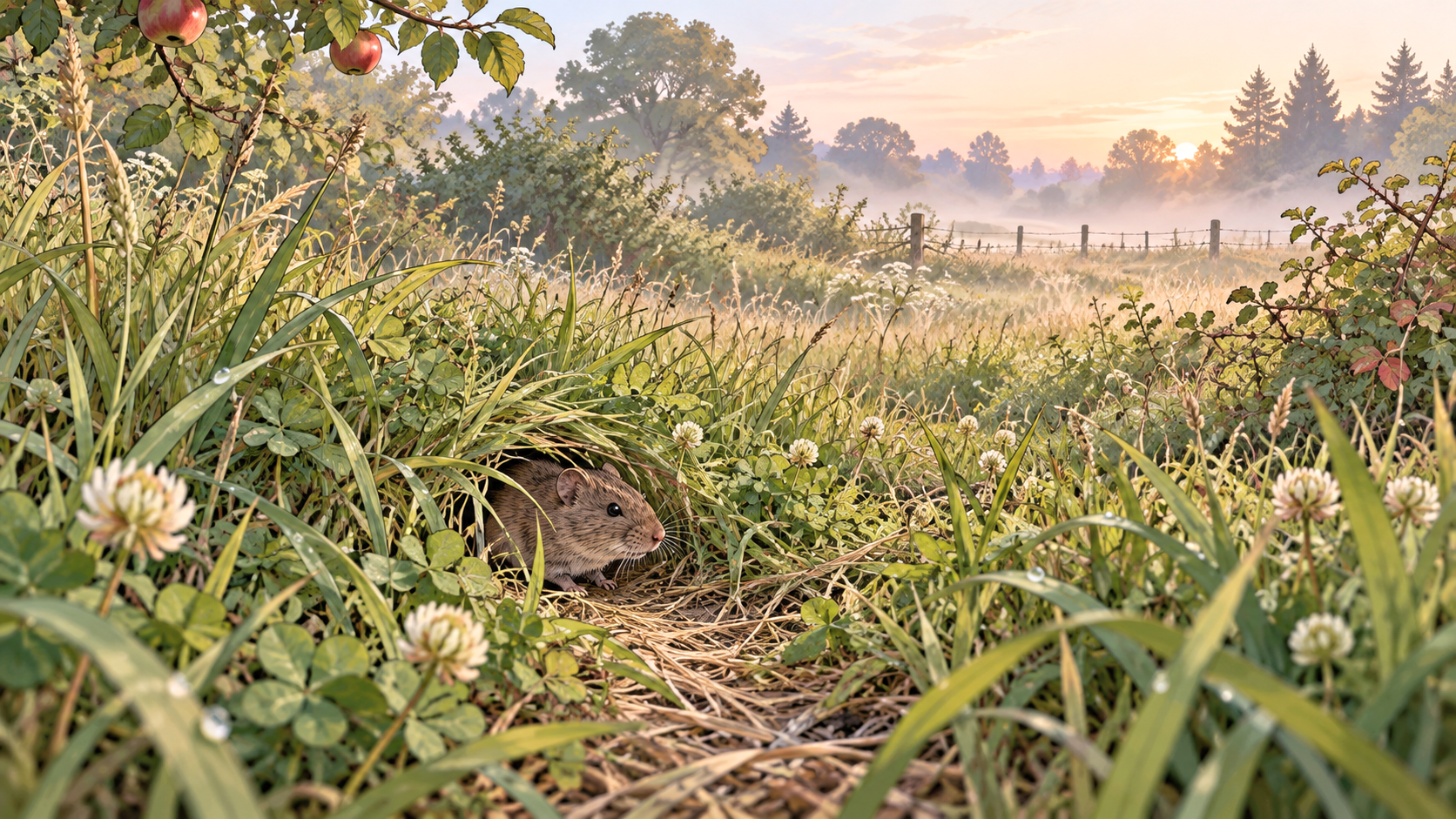
A typical vole habitat is a grassy or vegetated area where the ground remains sheltered by thick plant growth. Meadows, pastures, field margins, marshes, orchards, and woodland edges can all support voles, depending on the species. Some prefer open grasslands, while others occupy forests with moss, fallen logs, and deep leaf litter. The common feature is sufficient cover near the ground for the animals to move and feed without remaining exposed.
A vole habitat does not have to look wild or undisturbed. A roadside verge bordered by tall grass may provide suitable conditions, as can an overgrown field adjoining cultivated land. Equally, a mature forest with little grass can support woodland species that rely on different forms of shelter.
What a Meadow Vole Habitat Looks Like
Picture a field containing thick grasses, sedges, and scattered broadleaf plants, with relatively few areas of exposed soil. This is characteristic habitat for the meadow vole (Microtus pennsylvanicus), one of the most widespread voles in North America. Meadow voles occupy pastures, abandoned fields, wet meadows, grassy roadsides, and the edges of marshes. Their distribution is strongly associated with vegetation growing close enough together to provide continuous ground cover.
The documented habitat preferences of meadow voles include agricultural fields, sedge marshes, open-canopied bogs, and grass-covered roadsides. Uncut grass can support greater vole abundance than heavily disturbed vegetation, although local populations also depend on food availability, moisture, and other conditions. Open grassland does not mean bare ground: the plants themselves provide the sheltered environment.
Moist areas are particularly common meadow vole habitats. The Virginia Cooperative Extension’s account of meadow and woodland voles identifies wet meadows, pastures, fallow fields, and vegetated transitions between wetlands and uplands. Dense growth beside streams and ponds can be suitable even when the animals spend most of their time away from open water.
A neatly maintained lawn has a different structure from an unmowed meadow. Short turf offers less concealment, whereas bordering vegetation can provide sheltered ground-level habitat. The contrast may be visible within a few feet, particularly where closely cut grass meets an unmowed field.
Forest Voles Prefer a Different Kind of Ground Cover
Not every suitable vole habitat contains tall grass. In northern forests, fallen branches, decaying logs, moss, stones, and accumulated leaves create a complex layer of sheltered spaces near the ground. Southern red-backed voles (Clethrionomys gapperi, also widely recorded as Myodes gapperi) are strongly associated with these conditions.
Their forest habitat includes mossy and rocky areas, particularly within coniferous, deciduous, and mixed woodlands. They can occupy both comparatively dry and moist forests, and their association with fallen wood makes mature forest floors important environments for this species.
Research on western red-backed voles (Clethrionomys californicus, formerly Myodes californicus) provides more specific evidence. In mature coniferous forests of Oregon, areas used intensively by females contained deep organic soils and substantial quantities of decayed wood. The U.S. Forest Service’s study of western red-backed vole habitat identified coarse woody debris and organic material as important habitat features.
A forest can therefore appear open above the ground while still offering suitable conditions beneath fallen timber and vegetation. The tree canopy alone tells little about whether the forest floor provides the structure used by resident voles.
Woodland Voles Depend on Soil Conditions as Well as Vegetation
Woodland voles (Microtus pinetorum), also called pine voles, occupy deciduous forests, woodland margins, orchards, and some other vegetated environments. They are especially associated with soil that permits underground movement.
The Canadian woodland vole status assessment identifies loose, well-drained soils and dense herbaceous vegetation as favorable habitat characteristics. Highly saturated soil is less suitable because it interferes with underground excavation. In southwestern Ontario, woodland voles have been recorded in forests containing substantial layers of decomposing leaves and organic matter.
This species can also occupy the margins between forests and agricultural land. Hedgerows, scrubby vegetation, and orchard environments combine ground cover with soil conditions that may support woodland voles. An area does not need continuous tree cover to fall within the species’ habitat.
Mountain Vole Habitats Include Meadows and Sagebrush
High elevation does not automatically make an area unsuitable for voles. Montane voles (Microtus montanus) inhabit mountain valleys, moist meadows, grassy sagebrush communities, and vegetated areas near streams in western North America.
In Yellowstone National Park, montane voles occupy moist mountain meadows and grassy sagebrush habitat across a range of elevations. The vegetation provides both food and concealment, while the surrounding landscape may include forest, open slopes, and flowing water.
Farther north, tundra voles (Microtus oeconomus) inhabit damp tundra vegetation, including sedge and cottongrass meadows near lakes and streams. The National Park Service’s description of Alaska’s small mammals illustrates how vole habitats extend beyond temperate grasslands into northern landscapes with short growing seasons.
These environments can look dramatically different from an agricultural field. Some contain low sedges and shrubs rather than tall grass, but vegetation still creates sheltered ground-level spaces.
Water Voles Occupy Vegetated Banks and Wetlands
The Eurasian water vole (Arvicola amphibius) is associated with rivers, streams, drainage ditches, ponds, and other wetland environments. Suitable habitat generally includes substantial vegetation along the water’s edge, providing both shelter and access to food.
The Wildlife Trusts’ water vole habitat guidance emphasizes the importance of vegetated banks, reedbeds, ponds, and backwaters. Heavily shaded banks with sparse grasses and other herbaceous plants are often less suitable than banks supporting a diverse layer of vegetation.
Bank structure also influences where these animals can live. Soft, stable earth allows excavation, while vegetation offers concealment along the water’s edge. A concrete-lined channel with little bankside growth does not provide the same conditions as a stream bordered by grasses, sedges, and other plants.
The name water vole can refer to different animals in different regions. North America’s water vole (Microtus richardsoni) occupies western mountain environments associated with streams and wet meadows, whereas the Eurasian species belongs to another genus.
Why Habitat Boundaries Can Be Particularly Suitable
Some vole populations occupy areas where two vegetation types meet. A meadow bordered by woodland, a grassy ditch between agricultural fields, or a marsh surrounded by upland vegetation may combine shelter and different plant communities within a relatively small area.
Meadow voles are documented along transitions between forests and fields, while woodland voles occur in hedgerows and forest margins. The Government of Canada’s woodland vole management plan identifies forest-edge environments and nearby open habitats among the areas occupied by the species.
However, an edge is not automatically suitable simply because two habitats meet. A narrow strip of sparse vegetation beside exposed pavement offers different conditions from a densely vegetated boundary between a meadow and woodland. The structure and continuity of cover remain important.
Can You Recognize Vole Habitat Without Finding a Vole?
Habitat observations can identify places where voles might live, but they cannot confirm that animals are currently present. A grassy field, wooded patch, or wetland may be suitable without supporting an active population. Geographic range also matters: an environment resembling woodland vole habitat does not establish the presence of that species outside its distribution.
A useful habitat assessment begins with the vegetation nearest the soil. Determine whether the area contains continuous grass, low shrubs, deep leaf litter, moss, or fallen wood. Consider the soil and moisture conditions, then compare those characteristics with the habitats documented for local species.
The most important limitation is that suitable habitat is not the same as evidence of occupation. Confirming vole activity requires separate observations of the animals or the signs they leave behind. Habitat alone can narrow the possibilities, but it cannot establish which species lives there or whether the area is currently occupied.