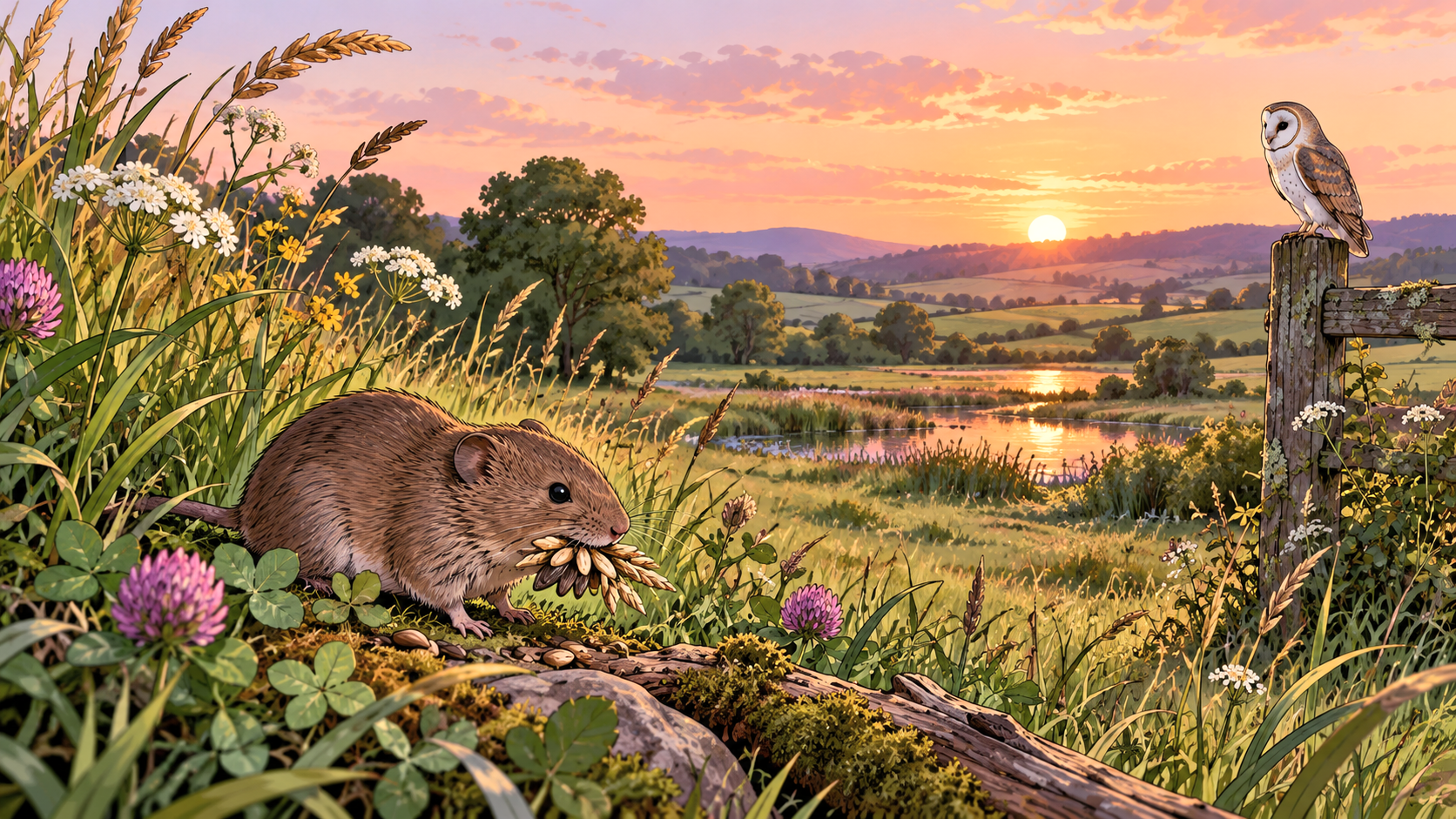
Voles are important to the environment because they feed predators, influence which plants grow in grasslands, and contribute to soil and nutrient processes. Their ecological effects are not always beneficial, however. Heavy feeding can reduce vegetation, damage roots, and change plant communities in ways that are unfavorable to certain species. Whether their overall influence is positive or negative depends on the habitat, vole species, and population density.
A vole eating grass in a meadow participates in several ecological processes simultaneously. It transfers plant energy into the food web, removes some vegetation while leaving other species untouched, and deposits organic material through its waste. Those effects extend beyond the small patches of damaged grass that people commonly associate with voles.
Voles Are an Important Food Source for Predators
Owls, hawks, foxes, weasels, snakes, and several other predators regularly consume voles. In some ecosystems, vole abundance influences how successfully predators reproduce.
Prairie voles, for example, are important prey for raptors, snakes, foxes, weasels, and bobcats. Their position near the base of the food web allows energy stored in grasses and other plants to support animals farther up the food chain.
The relationship becomes particularly apparent in regions where vole populations fluctuate dramatically. In northern European forests, Tengmalm’s owls depend heavily on voles during the breeding season. Changes in vole abundance have been associated with changes in owl breeding success and population dynamics.
A separate long-term investigation of tawny owls found that breeding probability and the number of fledglings were influenced by vole availability. These relationships demonstrate that changes in prey abundance can affect predators well beyond a single hunting encounter.
Voles are not equally important to every predator, nor does every predator specialize in them. Nevertheless, their abundance and availability can strongly influence local food webs. The natural fluctuations in vole populations are therefore ecologically significant even when they are inconvenient for landowners.
Their Feeding Changes Which Plants Dominate
Voles do more than remove a small quantity of grass. Their selective feeding can change the composition of an entire plant community, particularly where vole numbers are high.
A six-year experiment involving meadow voles (Microtus pennsylvanicus) found that vole feeding reduced standing vegetation by 30–72% in the experimental plots. Several grasses and a legume declined substantially, while five broadleaf plant species that voles avoided increased.
These results illustrate an important ecological effect: removing preferred plants can give less palatable species opportunities to expand. Voles may therefore change not only the amount of vegetation present but also the identity of the plants that eventually dominate.
Such changes are not automatically improvements in biodiversity. A community can become different without becoming healthier or more diverse. In the same experiment, plant diversity initially declined following heavy feeding, although that reduction did not persist as other species replaced the vulnerable plants.
The vegetation consumed by voles also varies among species and environments. Meadow, prairie, and woodland voles do not exert identical feeding pressure on every plant community.
In a managed garden, removing desirable vegetation is usually considered damage. In an unmanaged meadow, selective feeding is one of several processes that determine how the plant community develops. The harm voles can cause to gardens and their ecological role can therefore exist simultaneously.
Vole Burrows Can Influence Soil Conditions
Burrowing voles physically rearrange soil as they construct passages and resting chambers. Their excavations can create small differences in soil structure, the distribution of organic material, and the movement of air and water.
The extent of these effects depends on the species. Woodland voles maintain underground networks, whereas meadow voles use many surface-level pathways that involve less excavation.
Townsend’s voles have been associated with soil aeration and the creation of underground passages that can also be used by small organisms.
Burrowing mammals more broadly can produce substantial ecological effects. Across studies involving numerous soil-disturbing vertebrates, excavation altered soil nutrients, plant recruitment, and water runoff. These findings support the ecological importance of soil disturbance, although their combined results should not be presented as measurements of vole activity alone.
The depth and extent of vole tunnels determine how much soil an individual system can disturb. A shallow woodland vole network does not produce the same physical effects as the extensive excavations of a pocket gopher.
Digging can also have unfavorable consequences. Soil disturbance may expose roots, reduce vegetation cover, or create conditions that favor some plants over others. The effects depend on the amount of disturbance and the surrounding environment rather than following a universally beneficial pattern.
Voles Participate in Nutrient Cycling
When voles eat vegetation, part of the plant material becomes incorporated into their bodies, while other portions return to the environment through feces, urine, and eventually decomposition.
These processes move nutrients between plants, herbivores, predators, and decomposers. Prairie voles are recognized as contributors to nutrient cycling in grassland ecosystems, alongside their role as prey.
Nutrient cycling does not mean that vole droppings act as a substantial fertilizer for every lawn. The contribution of any individual animal is small and depends on how much material it consumes and deposits.
At an ecosystem scale, however, repeated feeding and waste deposition help redistribute organic matter. Plants take up nutrients from the soil, voles consume the plants, and their waste becomes part of the material processed by decomposing organisms.
Predation extends this transfer. When an owl or fox consumes a vole, some of the nutrients originally obtained from vegetation become available to the predator. Waste and remains eventually return portions of those nutrients to the environment.
These pathways form part of the wider ecological function of small herbivorous mammals rather than a unique ability possessed only by voles.
Can Voles Help Spread Seeds?
Some vole species can contribute to seed movement, although their effects depend on whether seeds survive feeding or remain intact after being transported.
Taiga voles (Microtus xanthognathus) collect and store vegetation, including underground plant parts, for later use. Their food-caching behavior may contribute to plant dispersal, particularly when stored material is not subsequently consumed.
Townsend’s voles have also been associated with seed dispersal. Movement of plant material between feeding locations and underground shelters may redistribute seeds within their habitats.
A vole consuming a seed does not necessarily disperse it successfully. Many seeds are destroyed during feeding, and others may be deposited in unsuitable conditions for germination.
Consequently, seed dispersal should be considered a possible contribution of certain species rather than a universal or consistently beneficial vole function.
Can Too Many Voles Harm an Ecosystem?
High vole densities can place considerable pressure on vegetation, especially when food is limited or preferred plants are already stressed.
Their feeding may reduce plant cover, weaken roots, alter the balance between plant species, and expose soil. When these effects occur across large areas, they can influence other organisms that depend on the affected vegetation.
The ecological consequences of rodent activity in grasslands are strongly dependent on population density and environmental conditions. Moderate populations may contribute useful disturbance and food-web functions, while outbreaks can intensify vegetation loss and soil degradation.
The direction of the effect is not always obvious. Reduced growth of one plant species may allow another to expand, but the replacement species may offer different habitat or food resources to insects and other animals.
A decline in plant diversity, loss of protective vegetation, or substantial erosion would be negative outcomes even if some competing plants benefited.
The frequency of vole reproduction can contribute to rapid increases under favorable conditions, but reproduction alone does not determine the ecological consequences. Population size, food availability, and the resilience of the surrounding plant community all influence the outcome.
Are Voles Beneficial Enough That They Should Never Be Controlled?
Ecological value does not mean that vole activity must be tolerated in every setting.
A meadow supporting voles and the predators that eat them can benefit from their presence, while a newly planted orchard may experience serious losses if voles damage young trees. The ecological role of an animal does not eliminate the practical consequences of its feeding.
The appropriate response depends on whether there is an identifiable problem. Voles moving through a field or an undamaged section of a property generally do not require intervention merely because they are present. Repeated feeding on vulnerable landscaping may justify targeted protection.
Physical barriers and habitat management can sometimes protect valuable plants while avoiding unnecessary disturbance elsewhere. The protection of trees from vole damage is one example of addressing a specific vulnerability rather than treating every vole on a property as a threat.
Maintaining healthy predator populations is also ecologically valuable, although predators cannot be relied upon to eliminate every local vole problem. Predator–prey interactions influence vole population cycles, but those relationships are affected by weather, habitat, food supply, and other ecological factors.
The presence of voles is therefore neither proof of a healthy ecosystem nor evidence of an ecological problem. Their contribution is best understood through the changes they produce in food webs, vegetation, and soil, with both beneficial and harmful outcomes possible.