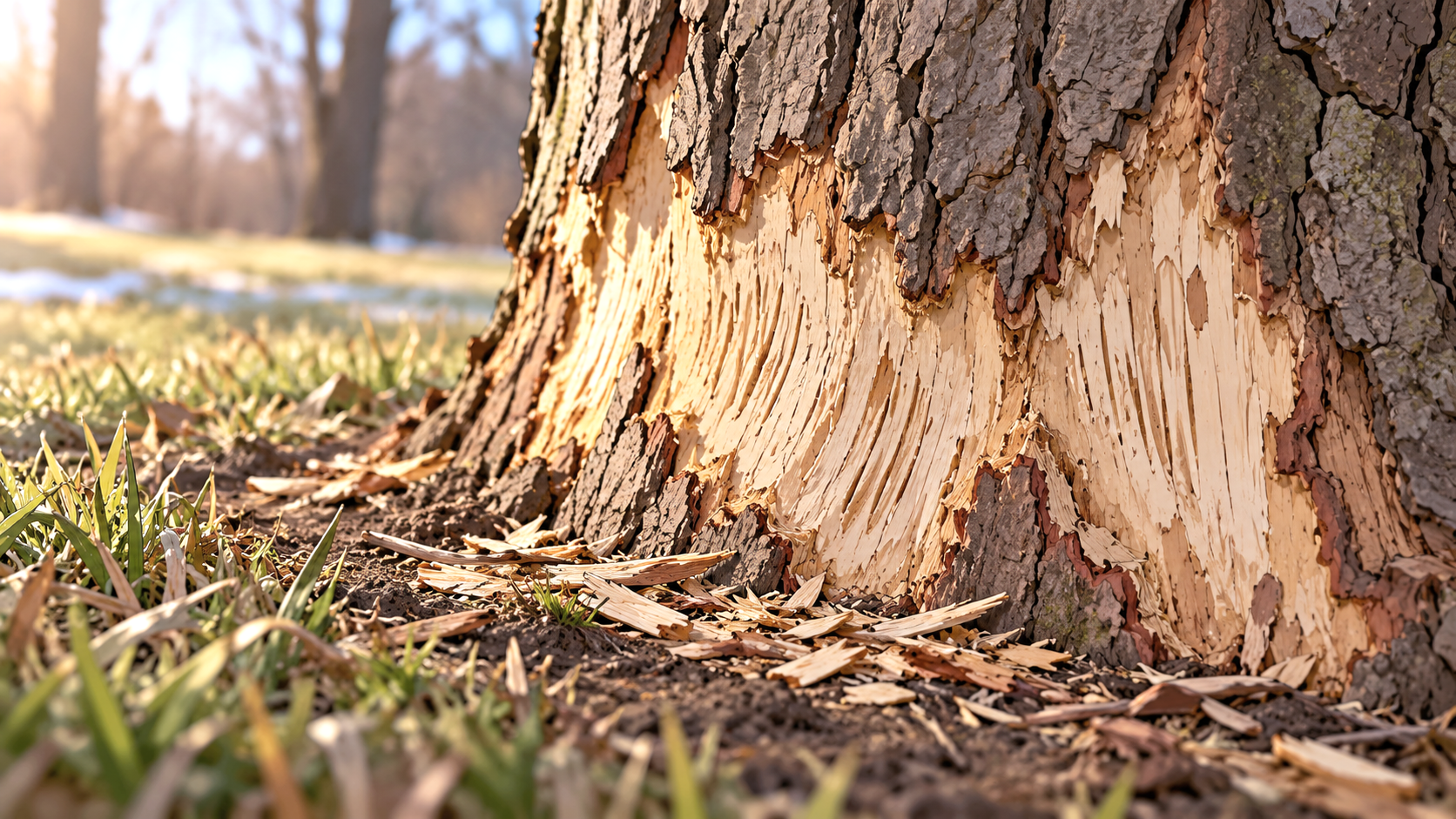
Vole damage to trees usually appears as irregular patches of missing bark near the trunk’s base, with numerous tiny tooth marks running at different angles across the exposed wood. Severe feeding can strip bark completely around a trunk or root, causing girdling that may kill the tree. The injury is especially common on young trees and often becomes visible after winter snow melts.
The strongest identification evidence is the combination of wound location, gnaw-mark size, and nearby vole activity. Rabbits, mice, and pocket gophers can also remove bark, so missing bark alone does not establish which animal caused the injury.
What Vole Gnaw Marks Look Like on Tree Bark
Vole feeding leaves a distinctive roughened surface. Instead of removing a broad, clean sheet of bark, the animal makes numerous small cuts that overlap in irregular patches. The resulting wound can look fuzzy or finely shredded, particularly where thin strips of bark remain attached along its edges. Individual tooth grooves are approximately 1/8 inch (3 mm) wide and 3/8 inch (10 mm) long, although the appearance varies with the angle of feeding and the bark’s texture.
These measurements help distinguish vole feeding from the larger, more uniform marks left by rabbits. The diagnostic characteristics of vole feeding wounds include randomly angled grooves and patchy bark removal. A single wound may contain scratches running horizontally, diagonally, and vertically because the animal changes position while feeding. The exposed wood is often lighter than the surrounding bark when the injury is recent, although weathering gradually changes its appearance.
The damage can range from scattered superficial scratches to broad areas where the bark has been removed down to the underlying wood. On a young apple tree, several irregular wounds may join into an almost continuous band around the lower trunk. Similar marks on a small conifer seedling may accompany clipped shoots or damaged lateral branches. The USDA Forest Service’s tree-damage reference documents tooth marks on roots and the injuries that small mammals can cause to woody plants.
Where Voles Damage Trees
Inspect the lowest portion of the trunk first, including the area where the stem meets the soil. Meadow and prairie voles commonly gnaw bark at or just above ground level. Feeding may extend several inches below the soil surface, especially around roots and the buried portions of young trunks. The documented distribution of vole feeding wounds includes damage both above and below ground, so a trunk that appears intact at the surface may still have injured tissue beneath it.
The height of an injury also depends on winter snow conditions. Snow creates a temporary surface from which voles can reach bark that would otherwise be above their normal feeding level. Wounds discovered in spring can extend a foot or more up the trunk when substantial snow accumulated around the tree. Their position often corresponds to the former snow cover rather than the current ground surface. An understanding of vole activity during winter helps explain why bark damage may develop while a tree is hidden beneath snow.
Some species cause less visible injuries underground. Woodland voles can gnaw larger roots and remove bark near the root collar, leaving the aboveground trunk apparently undamaged. Such feeding can produce symptoms without an obvious external wound, particularly in orchard trees and established shrubs. Root damage must be considered separately from the surface injuries associated with meadow voles.
How to Recognize Girdling Damage
Girdling occurs when an animal removes bark and living tissues around the circumference of a trunk or root, interrupting the plant’s internal transport system. The phloem, located beneath the outer bark, carries sugars produced by the leaves to other parts of the plant. Extensive removal of this tissue deprives the roots of carbohydrates, while associated damage can also disrupt water movement.
A completely girdled young tree may initially produce leaves because its roots and stored resources remain active. Later, foliage can wilt, growth can stop, and the tree may die. Observed symptoms of vole girdling include trees that partially leaf out in spring before declining suddenly. The visible bark injury can therefore precede obvious canopy symptoms.
Partial girdling produces a less predictable outcome. Trees may survive with reduced vigor, delayed fruit production, yellowing foliage, or poor growth. Some develop permanent trunk deformities where wound tissue forms around the damaged area. Exposed wood can also become an entry point for decay organisms. The severity depends on how much living tissue remains connected, the age and condition of the tree, and whether additional stress occurs. A narrow damaged patch on one side of a mature trunk does not carry the same consequences as a continuous band of missing bark around a thin sapling.
A useful inspection involves following the wound around the entire trunk rather than judging its severity from the front. Two small patches visible on opposite sides may connect around the back, creating a continuous girdle that is easy to overlook. If the damage extends below ground, carefully exposing the root flare may reveal whether the injury continues around buried tissue. Avoid cutting into intact bark to investigate.
Vole Damage Compared With Rabbits, Deer, and Other Rodents
The appearance and position of bark injury can narrow the possible causes, but accompanying evidence is necessary when several animals inhabit the same property.
| Animal | Typical bark injury | Supporting evidence |
|---|---|---|
| Voles | Small, irregular tooth grooves and patchy bark removal, commonly near the trunk base | Narrow surface runways, small burrow entrances, feeding beneath vegetation or snow |
| Rabbits | Larger, more uniform gnaw marks, often extending higher above ground | Cleanly clipped twigs, larger feeding marks, round droppings |
| Deer | Broad rubbing damage with shredded or peeled bark | Vertical scraping, torn bark, damaged branches, deer tracks |
| Pocket gophers | Gnawing and girdling that commonly affect underground roots or buried trunk sections | Plugged burrow entrances and distinctive soil mounds |
| Mice | Small gnaw marks that may overlap with vole damage | Species-specific tracks, droppings, nesting or feeding evidence |
Rabbit damage deserves particular attention because both animals can girdle young trees during winter. Rabbits typically leave larger, more regularly spaced tooth marks and may clip nearby twigs with neat, angled cuts. The Agriculture and Agri-Food Canada comparison of wildlife damage identifies feeding height and tooth-mark characteristics as useful clues.
Deer injury generally has a different appearance. Antler rubbing can tear long strips of bark from young trunks, leaving broad, ragged wounds rather than densely packed rodent gnaw marks. The UK government’s visual guide to mammal damage documents these patterns alongside vole feeding and other forms of bark stripping.
Pocket gophers create another identification challenge when the injury occurs underground. Their feeding commonly affects roots, while vole damage may occur on both buried and exposed tissues. A comparison of voles and gophers is especially relevant when a declining tree has underground gnawing and nearby soil disturbance. No single wound characteristic identifies every case reliably.
Which Trees Show Vole Damage Most Clearly?
Young trees with relatively thin bark are particularly vulnerable because feeding can remove a substantial proportion of their protective and living tissues. Apple trees are familiar examples in residential landscapes and orchards. Other affected fruit trees include cherry, citrus, almond, avocado, and olive, depending on the region. Among native and plantation trees, aspen, poplar, willow, pine, and Douglas-fir can sustain significant injury.
The expression of damage differs among these plants. On apple trees, gnawing may produce conspicuous exposed patches around the lower trunk. On young conifers, feeding can remove shoots, sever small stems, or leave frayed ends where repeated bites have cut through the plant. The Canadian forestry assessment of vole damage documents both bark injury on broadleaf trees and shoot damage in conifer plantings.
Tree species alone cannot establish the cause of an injury. An apple tree can sustain damage from several mammals, and a young pine with damaged lower branches may have experienced browsing rather than vole feeding. The wound’s structure and surrounding evidence remain necessary for diagnosis.
Evidence Around the Tree That Supports Vole Activity
A narrow, winding path through grass can strengthen a diagnosis when it leads toward a tree with characteristic gnaw marks. Meadow voles establish surface routes through vegetation, often connecting feeding areas with covered locations. These pathways may be especially visible after snow melts, when compressed grass and previously concealed routes are exposed. The appearance of vole runways in grass provides useful supporting evidence, although an old pathway does not establish when bark damage occurred.
Small openings near the trunk can also indicate rodent activity, but vole holes and burrows must be assessed alongside other signs because several small mammals use ground-level entrances. Droppings, clipped vegetation, and fresh feeding wounds provide additional context. The University of Kentucky’s vole-damage observations identify irregular gnaw marks around orchard trees and runways leading toward injured plants as useful evidence.
The absence of surface runways does not eliminate woodland voles as a possibility. They spend much of their time underground, where root feeding may continue without conspicuous grass trails. A declining tree with an intact exposed trunk requires a different inspection from one surrounded by visible surface routes.
What to Check When a Tree Starts Declining
An unexplained decline in spring warrants an inspection of the trunk base before assuming disease, drought, or fertilizer deficiency. Look for missing bark, small tooth grooves, and a band of injury around the stem. Check whether the exposed wood is continuous around the trunk and whether the damage extends into the root collar. Yellowing leaves or weak growth alone cannot establish vole damage because many unrelated problems produce similar symptoms.
Document the injury before disturbing the surrounding area. Photographs showing the entire tree, a close view of the wound, and a ruler beside the tooth marks provide more useful evidence than an isolated photograph of exposed wood. Include the soil surface in at least one image so the height of the damage remains clear. Recording whether the wound was found immediately after snowmelt can also help establish the likely conditions under which feeding occurred.
Severe girdling on a valuable tree warrants prompt assessment by a qualified arborist. The USDA Forest Service’s guidance on wildlife injuries explains that extensive bark damage can lead to growth loss, deformity, or tree death, depending on its severity. Identifying the injury accurately also helps determine whether protecting nearby trees from vole damage deserves immediate attention before additional plants are affected.