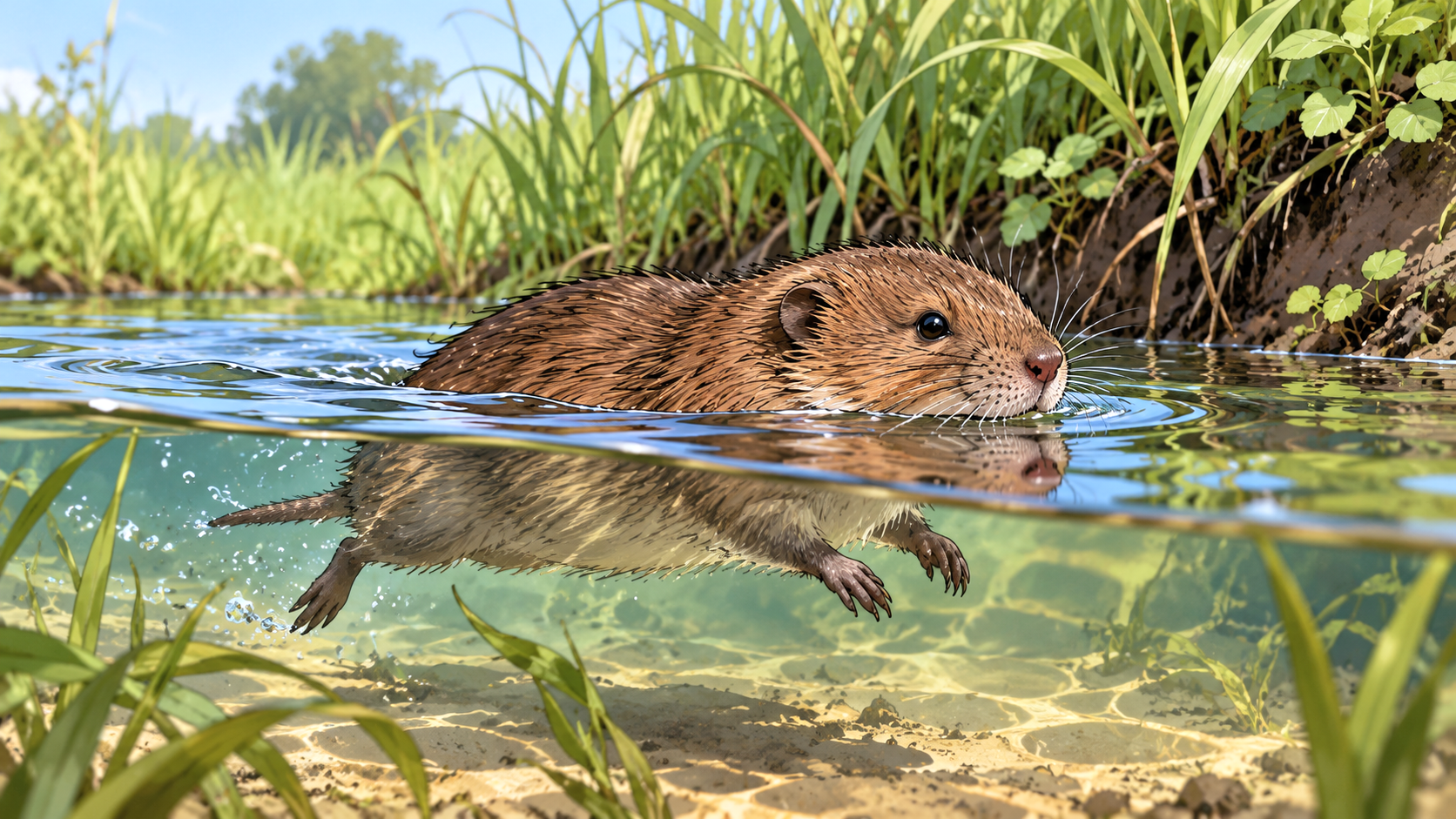
Voles can swim, including common land-dwelling species such as meadow voles. Some can cross streams, ponds, and other bodies of water, while water voles regularly swim and dive as part of their normal behavior. Swimming ability varies by species, however, and most voles are not as specialized for aquatic movement as animals such as muskrats or beavers. A vole swimming across a pond is not necessarily a water vole. Ordinary meadow voles can enter water and move through it effectively, even though they spend most of their lives on land.
Meadow Voles Are Surprisingly Capable Swimmers
Meadow voles (Microtus pennsylvanicus) are primarily terrestrial rodents, but they can swim and tolerate immersion in relatively cold water.
A 1979 investigation comparing meadow voles with white-footed mice found that both species showed good swimming endurance in warm water. At 10°C and 20°C, however, meadow voles demonstrated significantly greater swimming endurance than the mice.
The investigation examined whether swimming ability might explain differences in how the two species occupied a coastal island and its nearby mainland. Meadow voles were present on the island, while white-footed mice occurred on the mainland.
These findings establish that meadow voles are capable swimmers, including under relatively cool experimental conditions. They do not establish a universal maximum swimming distance or prove that every vole can cross a particular river.
The compact body and short tail typical of voles may make them appear poorly suited to swimming, but those proportions do not prevent them from moving through water.
Water Voles Swim and Dive Regularly
The European water vole (Arvicola amphibius) is much more closely associated with aquatic habitats than the meadow voles commonly encountered in North American lawns.
These animals inhabit riverbanks, streams, canals, ponds, and marshes. When threatened, they frequently dive into the water, sometimes producing a distinctive splash. Their burrows may include underwater entrances, allowing them to escape into sheltered chambers without remaining exposed along the bank.
Water voles swim using coordinated paddling movements. Their heads and portions of their backs commonly remain above the surface, although they can also swim underwater.
Despite these habits, they lack the webbed feet and strongly flattened swimming tails associated with certain aquatic mammals. Their slow, paddling swimming style reflects an animal that uses water effectively without possessing extreme aquatic adaptations.
They also spend considerable time on land, feeding among bankside vegetation and resting inside burrows.
How Far Can Voles Swim?
There is no established maximum swimming distance that applies to all voles.
The available endurance research demonstrates that meadow voles can remain active in water under experimental conditions, but swimming endurance and distance traveled across a natural waterway are different measurements.
A crossing depends on the animal’s condition, water temperature, current, available resting places, and the distance to shore. Calm, shallow water presents a different challenge from a wide, fast-flowing river.
Water voles normally remain associated with suitable bankside habitat. Their movements concentrate around vegetated waterways, where water provides access to feeding areas and escape routes.
An animal capable of crossing a pond should not be assumed capable of surviving prolonged exposure to deep or turbulent water.
Can Voles Swim Underwater?
Water voles can dive and travel underwater, particularly when escaping predators or entering submerged burrow openings. Their underwater entrances provide concealed access to burrow systems. Diving is therefore an important part of how they use their habitat, rather than an unusual response restricted to accidental immersion.
For ordinary meadow voles, the evidence more clearly establishes swimming ability than routine underwater travel. It would be inaccurate to assign the same diving behavior to every vole species merely because all belong to related rodent groups. There is also no dependable universal figure for how long a vole can remain underwater. Claims that all voles can hold their breath for a particular number of minutes overlook differences between species and circumstances.
How to Tell a Swimming Vole From a Rat
A small brown rodent swimming near a riverbank can easily be mistaken for a rat, particularly when only its head is visible. European water voles usually have rounded faces, small ears partly concealed by fur, and comparatively short, furry tails. Brown rats have more pointed faces, prominent ears, and longer, sparsely haired tails.
Swimming posture can provide another clue. A water vole often swims with much of its back visible, while a brown rat commonly travels with most of its body submerged.
This is a useful observation rather than a definitive identification rule. Water depth, swimming speed, and viewing angle can change how much of either animal is visible. The distinguishing appearance of voles becomes easier to assess when the animal reaches the bank and its tail, ears, and complete body proportions can be seen.
Can Voles Cross Water to Reach Your Yard?
A stream, ditch, or pond is not an absolute barrier to vole movement. Meadow voles can swim, and a narrow water crossing may not prevent an animal from reaching suitable vegetation on the opposite bank.
However, evidence of vole activity beside water does not establish that animals are regularly crossing it. The grass runways used by meadow voles may connect feeding and sheltered areas along one bank without requiring aquatic travel.
Water also does not explain every new appearance of voles around a property. Animals may move through connected grassland, field margins, and sheltered vegetation without entering water.
The habitats occupied by different vole species are more informative than the mere presence of a pond when assessing how they reached an area.
What Should You Do If You See a Vole Swimming?
A vole swimming normally toward a bank usually does not require intervention. Avoid chasing it, attempting to catch it, or forcing it back into the water. An animal moving independently toward suitable cover should generally be left undisturbed.
If a vole is trapped in a steep-sided container or artificial pond with no accessible exit, contact a wildlife rehabilitator or appropriate animal-rescue organization for guidance. A securely positioned escape ramp may allow an otherwise healthy animal to leave without direct handling, provided it can be arranged safely.
European water voles have legal protection in the United Kingdom, so disturbing their burrows or attempting to capture them can have legal consequences.
For a vole that has escaped from water but appears injured, weak, or unable to move normally, appropriate assistance for an injured vole should prioritize minimizing handling and obtaining qualified wildlife advice.
Swimming is a genuine ability among voles, not a behavior restricted to animals with water vole in their name. The strongest distinction is between land-dwelling species that can swim when necessary and semiaquatic species that regularly use water as part of their habitat.
2 thoughts on “Can Voles Swim?”