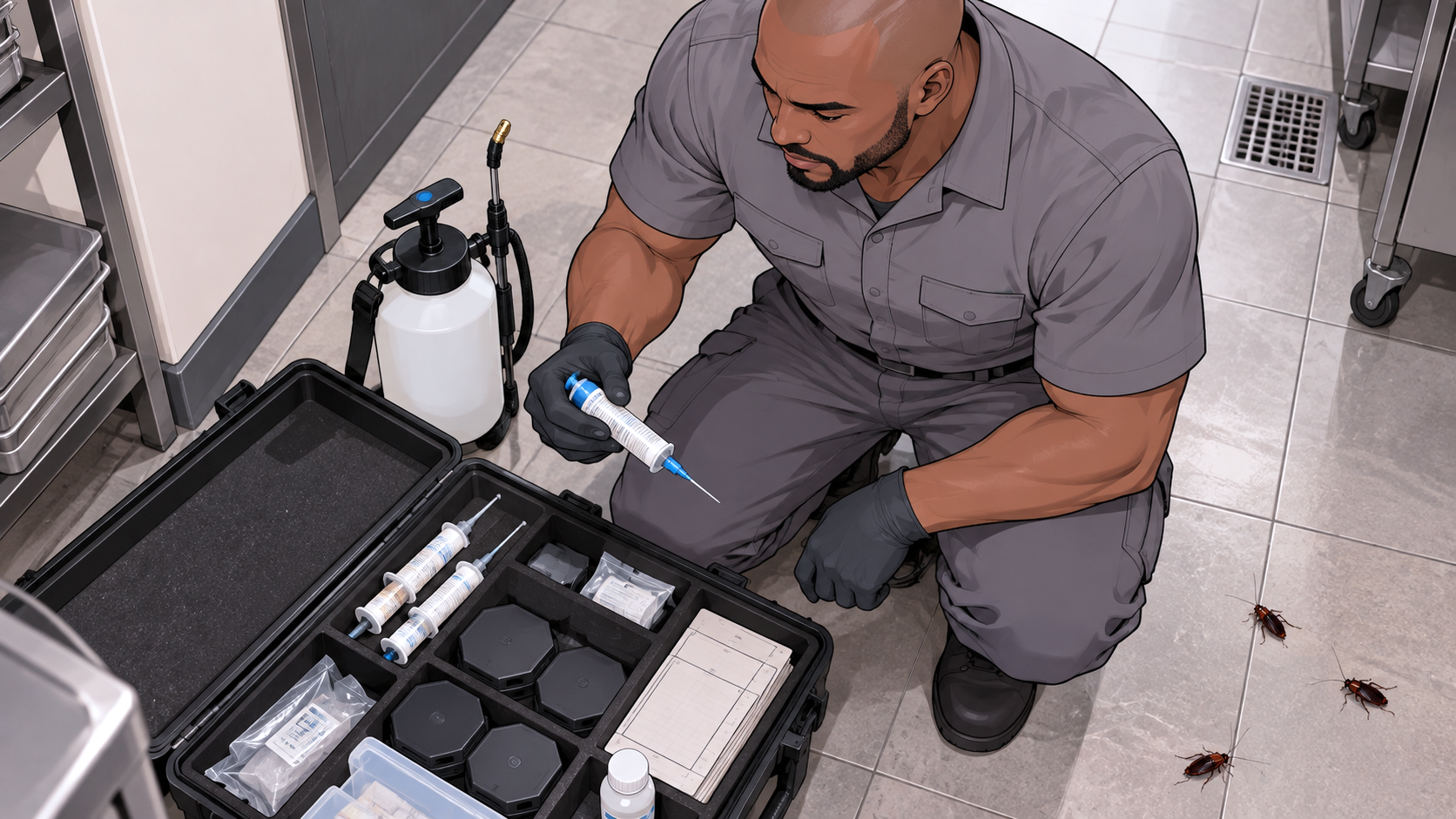
Professional exterminators use insecticide gel baits, bait stations, residual sprays, insect growth regulators, insecticidal dusts, and monitoring traps to control cockroaches. They select these tools according to the species, infestation location, population size, and evidence of previous treatment failure. For German cockroaches breeding indoors, targeted bait treatments are frequently preferred over general spraying. Larger outdoor-associated species may require exterior habitat management, exclusion, and treatment of specific harborages.
A professional cockroach treatment rarely involves applying one chemical throughout an entire building. The applicator first determines where the insects are living and feeding, then selects products capable of reaching those locations. Some insecticides kill exposed adults, others poison cockroaches through feeding, and growth regulators interfere with reproduction. Successful control depends on coordinating these effects while preventing the insects from returning.
The Professional Cockroach Control Toolset
Different products address different parts of an infestation. The following comparison shows the principal options used in professional pest management and the circumstances that justify them.
| Treatment | Common active ingredients or materials | Primary function | Typical use |
|---|---|---|---|
| Gel baits | Indoxacarb, fipronil, dinotefuran, abamectin | Poison feeding cockroaches | Indoor breeding populations |
| Enclosed bait stations | Fipronil, hydramethylnon and other labeled bait insecticides | Deliver insecticide through feeding | Accessible travel routes and protected placements |
| Nonrepellent residual sprays | Dinotefuran and other approved nonrepellent insecticides | Kill insects contacting treated deposits | Active structural harborages |
| Pyrethroid residuals | Cypermethrin, beta-cyfluthrin, bifenthrin | Contact and residual mortality | Selected structural and perimeter treatments |
| Insect growth regulators | (S)-hydroprene, pyriproxyfen | Disrupt normal development and reproduction | Established breeding infestations |
| Insecticidal dusts | Boric acid, silica-based desiccants | Kill through ingestion, contact, or dehydration | Dry, concealed spaces |
| Monitoring traps | Adhesive surfaces | Capture and count cockroaches | Inspection and treatment evaluation |
| Exclusion materials | Sealants, door sweeps, screens | Restrict entry and movement | Building openings and structural gaps |
These categories describe treatment functions rather than interchangeable products. Two formulations containing the same insecticide may have different permitted application sites, and a chemical authorized for exterior treatment cannot automatically be used inside kitchen cabinets. The EPA’s integrated pest management framework emphasizes identifying pest activity and choosing interventions appropriate to the actual infestation.
Gel Baits Are Often the Main Treatment for German Cockroaches
German cockroaches (Blattella germanica) spend much of their lives sheltered in narrow spaces around appliances, plumbing, and cabinetry. Spraying the insects visible on a countertop leaves many others concealed. Gel bait addresses this problem by placing insecticidal food close to the routes cockroaches already use.
Professional applicators commonly work with formulations containing indoxacarb, fipronil, dinotefuran, or abamectin. These ingredients have different modes of action, but the treatment requires cockroaches to locate and consume the bait. Technicians use applicators that deposit measured amounts in permitted cracks, joints, and other protected locations rather than spreading bait across exposed household surfaces.
The feeding behavior involved in cockroach bait treatments also influences how a professional positions the product. Cockroaches generally encounter bait while traveling between harborages and feeding areas. Some poisoned individuals return to sheltered locations before dying, allowing secondary exposure through contaminated material or consumption by other cockroaches.
Food competition affects performance. Grease deposits, crumbs, and accessible pet food may reduce feeding on the bait. The California Department of Pesticide Regulation’s cockroach-management guidance favors targeted baiting over routine general insecticide spraying when chemical treatment is necessary.
Bait acceptance is not universal. Certain German cockroach populations avoid particular food components, and repeated exposure to an insecticide can select for resistant individuals. Professionals can evaluate bait consumption and monitoring results before selecting a different formulation. Simply applying more of a rejected bait does not address its lack of acceptance.
Residual Insecticides Are Selected According to Cockroach Movement
Residual insecticides remain on approved treated surfaces after application. Cockroaches crossing those deposits can receive a toxic dose without being directly sprayed. Professionals use these products when inspection identifies recurring travel routes, active structural hiding places, or exterior areas where labeled treatment is appropriate.
There are two broad behaviors worth separating. Some formulations are nonrepellent, allowing insects to cross treated surfaces without an intended avoidance response. Others contain pyrethroids that can produce rapid knockdown but may also discourage cockroaches from entering treated locations.
The difference influences treatment planning. Nonrepellent formulations can fit certain programs involving cockroach bait, provided the pesticide labels permit the intended applications and the bait is not contaminated. Repellent residues can interfere with feeding when applied around bait placements.
Professional cockroach sprays and residual killers also differ in their target sites. A residual treatment intended for approved exterior foundation surfaces has a different role from a crack-and-crevice application inside a kitchen. Neither should be interpreted as permission to spray every accessible surface.
Pyrethroid resistance is especially relevant to German cockroaches. The National Pesticide Information Center’s cockroach guidance identifies insecticide resistance and bait aversion as possible reasons for unsuccessful control. A competent applicator considers these possibilities alongside poor placement and untreated harborages before repeating the same chemical treatment.
Insect Growth Regulators Target Future Reproduction
An insect growth regulator (IGR) affects the development of immature cockroaches rather than functioning primarily as an adult contact poison. Products containing (S)-hydroprene or pyriproxyfen can disrupt normal maturation and reproduction, making them useful when a population contains multiple developmental stages.
Hydroprene mimics juvenile hormone activity. Exposed nymphs may develop into adults with distorted wings and reproductive abnormalities. These visible changes can indicate developmental interference, although the insects may remain alive.
A professional may combine an IGR with an appropriately selected adult-control treatment. The adulticide reduces current activity, while growth regulation affects insects developing after exposure. The combination can be useful when breeding continues despite a reduction in visible adult cockroaches.
The Cornell cockroach management recommendations identify growth regulators as one of the specialized tools available to professional applicators. Their effects depend on the insect’s developmental stage, so they are not substitutes for a treatment intended to kill adults promptly.
Dusts Reach Dry Spaces Where Liquid Treatment Is Unsuitable
Insecticidal dusts remain useful in protected structural spaces, particularly where moisture is limited and the product can stay undisturbed. Professionals may select boric acid or silica-based desiccant formulations for approved voids and concealed travel routes.
Boric acid can poison cockroaches through ingestion, including material acquired during grooming after contact with dust. Silica-based desiccants work differently by damaging or removing protective components of the insect’s outer covering, causing water loss.
The University of California’s cockroach control recommendations identify boric acid and desiccant dusts as options for inaccessible spaces where deposits can remain dry. Application quality matters because heavy accumulations can be avoided or disturbed, while inappropriate placement creates exposure risks for occupants.
Dust application also requires equipment suited to the product. Professionals use devices designed to deliver controlled deposits into permitted openings rather than scattering powder across floors. The health and exposure characteristics of boric acid make concealed, label-compliant placement particularly important in occupied buildings.
Dusts are poor substitutes for sanitation or structural repair. If the cavity remains damp, accessible to occupants, or unsuitable under the product label, another treatment method is necessary.
Inspection Equipment Determines Where Treatment Goes
A professional visit may involve surprisingly little spraying. Flashlights, inspection mirrors, monitoring traps, and access to removable panels can provide more useful information than immediately applying insecticide.
A technician inspecting a kitchen may examine the refrigerator area, cabinet joints, plumbing penetrations, and sheltered spaces where droppings or live insects indicate activity. Sticky traps placed along travel routes provide a record of cockroach movement. Comparing catches between locations helps establish where treatment should be concentrated.
Species identification changes the interpretation of those findings. A German cockroach population reproducing in kitchen cabinets requires a different strategy from American cockroaches entering through exterior openings. The EPA’s cockroach and rodent control guidance includes inspection, targeted baiting, dust application, and structural exclusion as coordinated measures.
Technicians may also use vacuums to remove accessible cockroaches, cast skins, droppings, and debris before treatment. Vacuuming reduces visible insects and competing food material without adding insecticide. However, insects concealed outside the vacuumed area remain unaffected, so physical removal is generally one component of a larger program.
Outdoor Cockroaches Require a Different Treatment Strategy
American, Oriental, and Turkestan cockroaches can occupy outdoor habitats and enter buildings through gaps, drains, and service openings. Treating the interior alone may leave the exterior source untouched.
Professionals may inspect utility areas, foundation edges, drainage surroundings, exterior vegetation, and other sheltered locations. Depending on the species and conditions, they can select labeled outdoor baits, targeted insecticides, or exclusion work.
Outdoor baiting can be effective without relying exclusively on perimeter spraying. A 2026 California field program involving Turkestan cockroaches used protected bait placements, structural sealing, and monitoring at schools. Cockroach numbers declined substantially during the initial treatment period and remained low during the continuing management program.
Environmental exposure is an additional consideration outdoors. Broad insecticide deposits can affect non-target organisms or reach drainage systems. Correcting entry points and treating identified harborages reduces unnecessary pesticide use while addressing the routes through which cockroaches reach occupied rooms.
Why Exterminators Usually Avoid Relying on Bug Bombs
A total-release fogger distributes insecticide into the surrounding air after activation. This can expose insects occupying open areas, but cockroaches sheltered deep inside cabinet joints, wall cavities, or appliances may receive little treatment.
Foggers also create avoidable exposure and ignition hazards. Their distribution is difficult to confine to the precise locations occupied by the infestation. The EPA’s fogger safety requirements address fires, explosions, and pesticide exposure associated with these devices.
The limitations of foggers against cockroach infestations explain why targeted placement usually makes better use of insecticide. Professionals can treat actual travel routes and harborages instead of assuming airborne pesticide will penetrate every protected opening.
Broad aerosol applications may also scatter surviving cockroaches into previously unaffected areas. A severe infestation calls for better access and coordinated treatment, not automatically a larger volume of pesticide.
What Happens During a Professional Cockroach Treatment?
The sequence depends on the building and the species. A technician dealing with German cockroaches in an apartment may begin by inspecting kitchen and bathroom harborages, identifying active feeding areas, and installing monitoring traps. Treatment may then involve gel bait in approved locations, selected insecticide deposits, and an IGR when reproductive suppression is justified.
An appointment involving outdoor-associated cockroaches may concentrate more on entry points, exterior shelter, and suitable perimeter or bait placements. Multiple apartment units can require coordinated management because cockroaches may move between connected spaces.
The technician should be able to identify the proposed pesticide products, explain their purpose, and provide applicable safety instructions. Product labels determine whether food must be removed, which areas need protection, and when occupants or animals may reenter treated locations. The National Pesticide Information Center’s pet-safety recommendations also emphasize protecting animal food, bedding, toys, and aquariums during pesticide treatment.
A professional’s license does not permit unrestricted pesticide use. Approved application sites, product rates, and local regulations still apply. Some specialized products or application methods are restricted to appropriately credentialed applicators, and requirements differ between jurisdictions.
What Makes a Professional Treatment Successful?
The strongest evidence is a sustained decline in cockroach activity across the affected locations. A technician can compare monitoring catches, inspect former harborages, and determine whether additional insects are entering from untreated spaces.
Repeated sightings do not automatically justify increasing insecticide strength. They may indicate missed harborages, poor bait consumption, reinvasion, or resistance. Each possibility calls for a different response.
Structural repairs and sanitation remain important because cockroaches can continue feeding and sheltering wherever the building provides favorable conditions. The EPA’s household pest-control guidance supports removing food and water sources, correcting leaks, and limiting hiding places as part of treatment.
When choosing an exterminator, we would prioritize a company that identifies the species, explains its product selection, and measures progress through inspections or monitoring. A company proposing to spray every room without first identifying where the cockroaches are living offers less evidence of a targeted treatment plan.