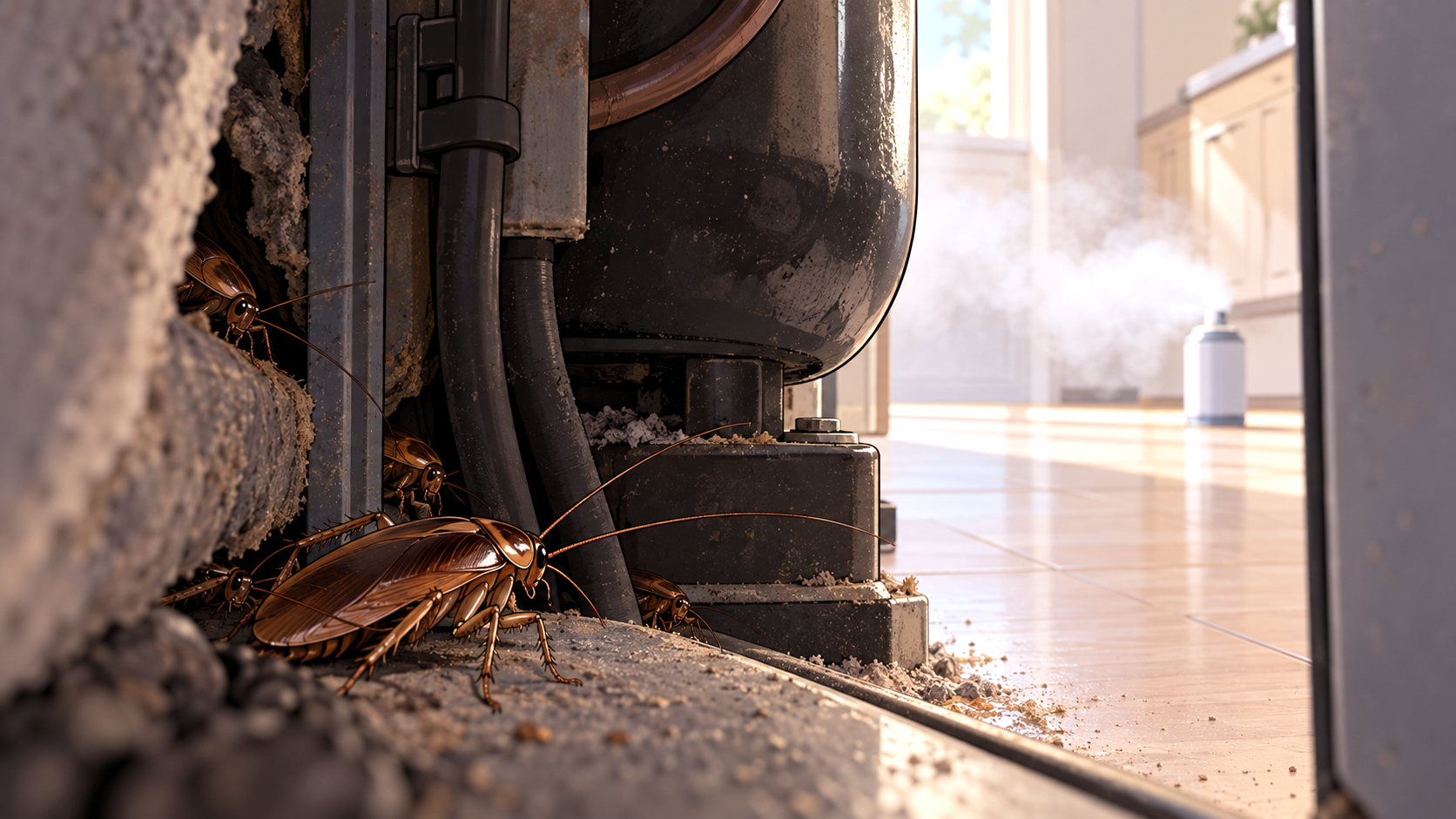
Bug bombs can kill cockroaches that receive enough insecticide exposure, but they are a poor choice for controlling an established German cockroach infestation. In occupied apartments, total-release foggers failed to reduce cockroach populations while substantially increasing pesticide residues on household surfaces. Their insecticide also has difficulty reaching the protected cracks and voids where cockroaches spend much of their time.
A “bug bomb” is a total-release fogger, or TRF. Once activated, the canister releases its pesticide aerosol without further control by the user. That delivery method is fundamentally different from placing an insecticide precisely into a cockroach harborage. The room may fill with aerosol while much of the population remains sheltered behind appliances, inside cabinets, or within other narrow spaces.
Real Apartments Exposed the Main Weakness of Bug Bombs
A particularly useful test involved 30 cockroach-infested homes in Raleigh, North Carolina. Twenty apartments received one of four commercially available total-release foggers according to label directions, while another ten received gel bait. Researchers then measured cockroach populations with sticky monitors rather than judging success from the number of dead insects visible after treatment.
After two and four weeks, none of the four foggers produced a significant reduction in German cockroach populations. The gel-treated apartments showed significant declines. The experiment matters because the foggers were not being tested against a few exposed laboratory cockroaches in an empty chamber. They were being tested against established populations living in actual homes.
The researchers also placed cockroaches in open cages during fogging. Insecticide-susceptible laboratory cockroaches suffered high mortality with several products, while apartment-collected cockroaches were much less affected. The contrast helps explain why someone can find dead cockroaches after using a fogger without having controlled the infestation. Killing exposed individuals is not equivalent to reducing the hidden population.
The Aerosol Settles Where Cockroaches Are Not Necessarily Living
German cockroaches favor tight, protected spaces. A fogger releases pesticide into open room volume, then material settles onto exposed surfaces. It cannot be assumed to penetrate deeply into every cabinet joint, appliance void, wall opening, or other harborage. Even federal guidance on total-release foggers recognizes the underlying limitation: pesticide has to reach the pest for contact insecticides to work.
The apartment study demonstrated the distribution problem from another direction. Surface sampling found that foggers deposited substantial insecticide across horizontal kitchen surfaces. Average measured residues shortly after treatment were more than 600 times higher than baseline, with a median increase of 85 times. Some elevated residues remained detectable a month later.
A countertop receiving pesticide therefore tells you nothing about whether the same dose reached cockroaches several centimeters inside a protected crevice. Targeted cockroach bait and gel uses the opposite strategy: the formulation is placed near travel routes and harborages so feeding cockroaches encounter it without requiring insecticide to blanket the room.
Pyrethroid Resistance Can Make Fogger Performance Even Worse
Many household foggers have historically relied on pyrethrins, pyrethroids, or combinations containing these insecticides and synergists. The CDC found that pyrethroids, pyrethrins, or both were common active ingredients among total-release foggers involved in reported exposure incidents. (cdc.gov) German cockroach resistance to pyrethroids is widespread, which creates another obstacle beyond poor penetration.
The apartment experiment provided a striking demonstration. Susceptible laboratory cockroaches and field-collected cockroaches were placed near one another during the same fogger treatment, yet mortality differed substantially. The authors identified pyrethroid resistance among the likely reasons the resident cockroaches survived exposures that killed susceptible insects.
Resistance is also why a dramatic knockdown should not be used to rank commercial cockroach sprays and killers. A product can kill susceptible cockroaches under direct exposure while performing badly against a resistant population receiving less insecticide inside a real building.
More Foggers Increase the Hazard, Not the Quality of the Treatment
Using extra canisters is not a solution to poor penetration. Total-release foggers contain aerosol propellants that can be flammable, and excessive fogger use can allow flammable vapors to accumulate. Current safety instructions warn users to use only the number of foggers specified for the space and keep them away from ignition sources such as flames, pilot lights, and electrical appliances that can spark.
Those warnings are based on a documented hazard rather than theoretical caution. Federal regulators strengthened fogger labeling after fires and explosions associated with flammable propellants, and current labels require prominent instructions concerning ignition sources, room size, evacuation, ventilation, food protection, and confined spaces. The required fogger safety pictograms specifically reinforce these restrictions.
Foggers should never be activated inside closets, cabinets, under counters, or other small enclosed spaces in an attempt to force pesticide closer to cockroach hiding places. Concentrating the aerosol in confined spaces can create an explosion hazard. A method’s inability to reach a harborage safely cannot be corrected by putting the canister inside the harborage.
People and Pets Have to Leave During Treatment
A total-release fogger changes how an entire treated space can be used for several hours. Everyone, including pets, must leave as directed by the product label. Reentry before the required interval has passed can result in pesticide exposure, and the treated space must be ventilated according to label directions before normal occupancy resumes.
Human illness associated with these products has been documented. Surveillance across eight U.S. states identified 466 illnesses or injuries related to total-release foggers between 2001 and 2006. Common contributing circumstances included failure to leave before discharge, premature reentry, excessive numbers of foggers, inability to notify others nearby, and unintentional discharge.
Food, toys, and other exposed belongings may also require protection according to the label. Those considerations make foggers especially awkward in homes where cockroach activity is concentrated in kitchens. Households with animals need to evaluate cockroach-control choices around pets by exposure risk as well as insecticidal performance.
Fogging Can Give a Misleading Impression of Progress
Seeing several dead cockroaches the morning after treatment feels more convincing than looking at an untouched gel placement. The two observations cannot be compared that way. A fogger can rapidly affect insects that happened to be exposed during discharge, while a slower treatment can reduce insects feeding and sheltering out of sight.
Population monitoring gives a cleaner answer. The residential fogger study measured catches before treatment and again afterward, allowing researchers to determine whether the infestation itself declined. You can apply the same principle at home with sticky cockroach traps placed for monitoring. Comparable trap counts over time are more informative than the number of carcasses visible immediately after pesticide use.
Repeated captures of adults and nymphs after fogging indicate continuing activity even if the first night produced visible mortality. Other signs of an established cockroach infestation can also persist when hidden harborages were never adequately affected.
What to Do Instead of Releasing Another Fogger
Once a fogger has failed, repeating it exposes the same fundamental limitations. Start by locating activity with monitors, remove accessible food and water, and concentrate treatment where cockroaches travel and shelter. A targeted cockroach-control plan can combine sanitation, monitoring, appropriate bait or other labeled treatment, exclusion, and follow-up without distributing insecticide indiscriminately throughout the room.
Apartment infestations may require attention beyond one unit. Cockroaches can move through connected building spaces, so persistent activity after treatment can reflect movement between apartments rather than a need for a stronger room-wide pesticide release. Treating one kitchen repeatedly cannot resolve an infestation continually supplied from elsewhere in the structure.
Heavy populations, repeated DIY failure, inaccessible harborages, or widespread building activity can justify professional cockroach treatment. The useful escalation is better diagnosis and more precise treatment, not additional fogger canisters.
Questions That Matter Before Using a Bug Bomb
Can you use a fogger inside a kitchen cabinet where cockroaches are hiding?
No. Total-release foggers should not be used inside cabinets, closets, under counters, or similarly confined spaces. Concentrating flammable aerosol in a small enclosure can cause fire, explosion, injury, or property damage.
Can you stay in another room while a fogger goes off?
Follow the individual product label, which generally requires people and pets to leave the treated residence, apartment, or other specified area. Closing a bedroom door does not substitute for the required evacuation instructions.
Can you use a bug bomb in an apartment without telling the landlord or neighbors?
Building rules and local requirements vary, but fogger aerosol, fire hazards, shared ventilation, and the possibility of another person entering the treated area make communication important. Follow the label and any building or local requirements before using a pesticide in multi-unit housing.
What should you do if you accidentally breathe fogger mist or feel sick after exposure?
Move away from the exposure and follow the product label’s first-aid instructions. In the United States, the National Pesticide Information Center provides pesticide information, while urgent symptoms or suspected poisoning warrant immediate medical or poison-control assistance.