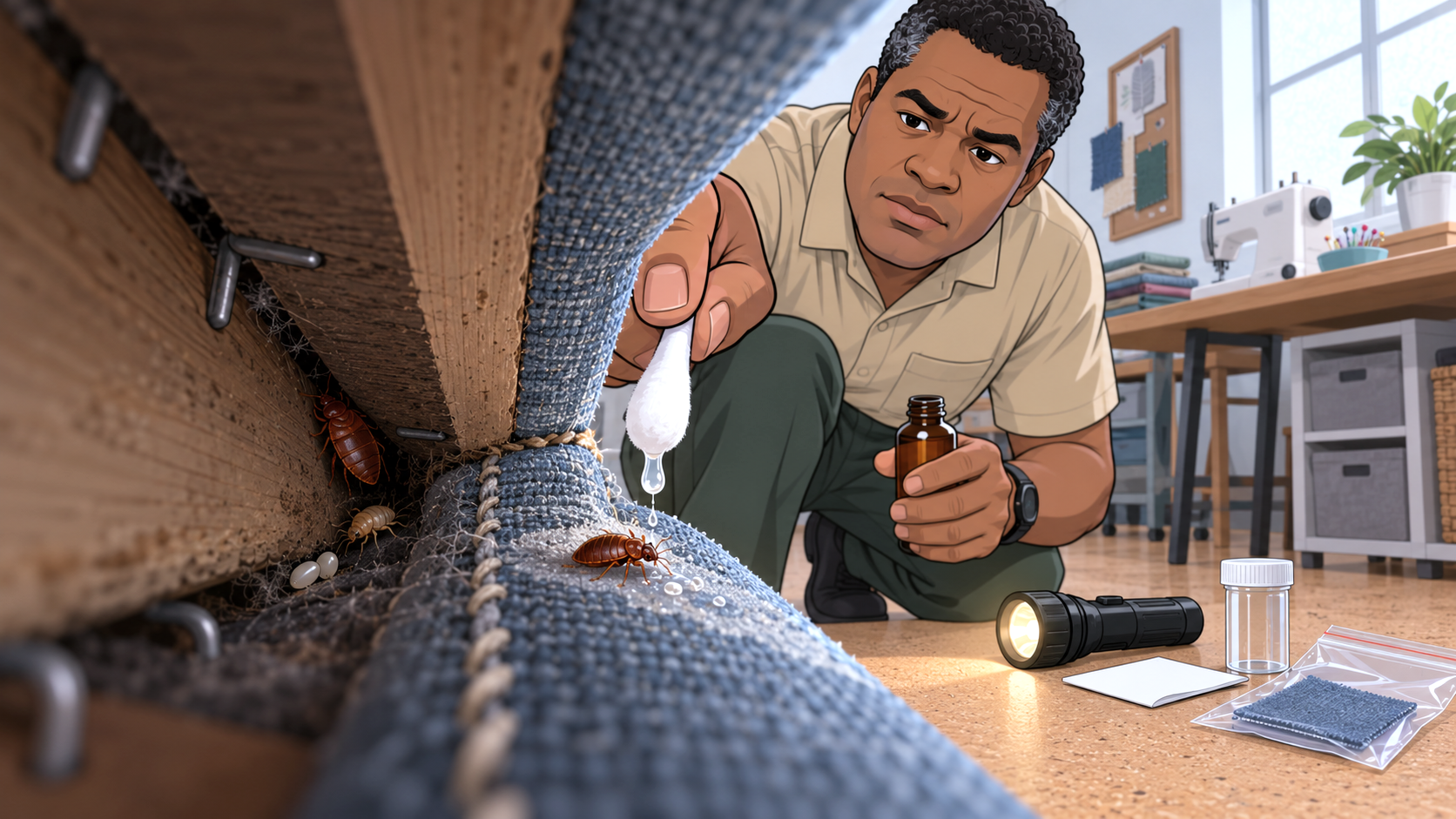
Hydrogen peroxide has a reputation for doing things that look destructive. It bubbles on contaminated surfaces, can bleach materials, and works as an oxidizing disinfectant in appropriate applications. That makes it easy to imagine a spray bottle of peroxide as a cheap answer to bed bugs. Household hydrogen peroxide is not a bed bug treatment we recommend relying on. Ordinary peroxide is not a substitute for a pesticide labeled for bed bugs, and spraying visible insects would not address the hidden bugs and eggs that make an infestation difficult to eliminate. Effective control has to reach far beyond whichever bed bugs happen to be exposed.
A Bed Bug Remedy Has to Pass More Than a Contact Test
This distinction eliminates a lot of misleading home-remedy advice.
Imagine a liquid that kills every bed bug you manage to soak directly. That sounds impressive until you consider where most of the infestation may be. Bed bugs hide in mattress seams, box springs, frame joints, furniture, cracks, baseboards, and other protected spaces. They can occupy a crack about the width of a credit card, which makes direct-contact-only control a poor standard for judging whether a treatment works.
A bottle of hydrogen peroxide does not become a useful infestation treatment merely because someone sprays a visible bug and sees a reaction. The important test is whether the method can eliminate bugs you cannot see, deal with the rest of the life cycle, and prevent surviving insects from rebuilding the infestation.
That is the same reason our guide to whether home remedies for bed bugs actually work separates a dramatic effect on one insect from control of an established population.
Bed bugs make that distinction especially unforgiving.
Hydrogen Peroxide Fails Where Bed Bugs Spend Most of Their Time
An exposed bed bug is the easiest bed bug to reach.
The harder ones are tucked into the structural gaps around a sleeping area. Even registered pesticide treatments can fail when applications miss hiding places, nearby resting areas, or insects that have moved away from the obvious infestation site. Successful treatment depends heavily on finding and targeting the places bed bugs actually occupy.
Hydrogen peroxide does not solve that access problem. Spraying the top of a mattress cannot treat insects hidden inside a frame joint. Wetting an exposed baseboard does not mean liquid reached the bug behind it. Saturating household furnishings in an attempt to compensate creates its own problems without turning peroxide into a proven residual bed bug treatment.
This is where we think the remedy stops making practical sense. The more peroxide you would need to spray in an attempt to reach hidden harborages, the further you move from its ordinary household use without gaining a validated bed bug treatment.
A method that depends on seeing the insect first is particularly weak against a pest that succeeds by staying hidden.
Eggs Make the Direct-Spray Idea Even Less Useful
A bed bug infestation is not made up only of active adults walking across surfaces.
Eggs are deposited in protected locations, while nymphs and adults can remain tucked away between feeding periods. Control therefore has to account for several life stages rather than merely the insects visible during one treatment session. Pesticide performance itself is judged partly on whether treatment targets the necessary bed bug life stages.
There is no reason to treat household hydrogen peroxide as a dependable bed bug egg treatment. We would not spray peroxide onto suspected eggs and assume the infestation has been dealt with.
That matters because surviving eggs can undermine what initially looks like success. You might kill or remove several visible insects, see nothing for a short period, and then encounter activity again as untreated stages remain.
Our guide to the bed bug life cycle explains why control cannot be built around adults alone. It is also why professional and well-designed do-it-yourself programs use monitoring and repeated evaluation rather than declaring victory after one visible kill.
Bubbling Does Not Tell You That Bed Bugs Are Dying
Hydrogen peroxide creates one of the most visually persuasive household chemical reactions.
When it encounters substances that accelerate its decomposition, hydrogen peroxide breaks down into water and oxygen. The release of oxygen produces the familiar bubbling or fizzing. That reaction can look like proof that peroxide is aggressively “eating through” whatever you sprayed.
It is not a bed bug efficacy test.
Hydrogen peroxide is a reactive oxidizing chemical, and household solutions are commonly sold for cleaning or disinfecting uses. Its chemistry does not transform visible fizzing into evidence that an infestation has been eliminated.
This is a broader problem with home pest remedies. Foam, odor, discoloration, rapid evaporation, or an insect suddenly moving after being sprayed can all look dramatic. None of those observations tells you whether hidden insects survived or whether the method provides continued control.
We would judge a bed bug treatment by what happens to the infestation, not by how interesting the liquid looks when it hits a surface.
A Disinfectant and an Insecticide Do Different Jobs
The word “kills” causes a lot of confusion here.
A product can kill microorganisms without being an insecticide. Hydrogen peroxide is widely used in disinfecting and sterilizing applications because of its oxidizing properties. That does not mean a bottle intended as a household disinfectant has been evaluated for killing bed bugs.
For pesticide use, the product label matters. Bed bug pesticides registered for consumer use are supported by efficacy data before they can carry a bed bug claim, and consumers are directed to choose registered products that specifically list bed bugs on the label.
Current registered bed bug pesticide classes include pyrethrins, pyrethroids, desiccants, biochemical pesticides, pyrroles, neonicotinoids, insect growth regulators, and a narrowly used organophosphate application. The available bed bug pesticide categories are designed and regulated for pest-control purposes.
That is a much higher bar than “this chemical is reactive.”
Our article on chemicals used to kill bed bugs covers that distinction without treating every household cleaner as an insecticide.
Stronger Hydrogen Peroxide Is Not a Better Bed Bug Experiment
Someone who concludes that ordinary household peroxide is too weak may be tempted to increase the concentration.
That is the wrong direction.
Common household hydrogen peroxide is typically sold at about 3%. Even at that concentration, exposure can irritate the eyes, skin, and respiratory tract. More concentrated solutions can cause much more severe injury, including burns. The risks increase as hydrogen peroxide concentration increases.
Hydrogen peroxide is also a powerful oxidizer. Occupational safety guidance lists the eyes, skin, and respiratory system among its exposure targets. Concentrated peroxide therefore has no sensible place in an improvised bed bug experiment around mattresses, upholstery, clothing, children, pets, or sleeping areas.
We would not recommend concentrating it, misting it through a room, or repeatedly saturating surfaces with it.
“Stronger” does not turn an unsupported treatment into a validated one. It mainly increases the potential consequences of misuse.
Spraying Your Mattress Creates Another Problem
The mattress is often where people want to use peroxide first because that is where they associate bed bugs with the infestation.
Bed bugs can certainly hide around mattress seams and folds, but they can also occupy the box spring, frame, headboard, nearby furniture, and cracks around the bed. Soaking the mattress attacks one surface while ignoring much of the environment.
It can also leave you applying a chemical to the material you sleep against without a bed bug pesticide label telling you that the product belongs there. Pesticide labels specify whether a registered product can be used on mattresses, in cracks and crevices, or on other surfaces. Bed bug safety guidance specifically warns consumers to use products only in the locations permitted by their labels.
That principle should not disappear simply because the bottle came from a medicine cabinet instead of the pesticide aisle.
If the mattress is the suspected center of activity, start by checking the mattress carefully for bed bugs. Knowing where the insects are hiding gives you something useful to act on. Wetting everything with peroxide does not.
What Actually Has to Replace the Peroxide Idea
Rejecting hydrogen peroxide does not mean every bed bug problem automatically requires one particular pesticide.
Bed bug control works better as a system. A do-it-yourself program can involve identification, reducing clutter, containing infested materials, laundering and heat-drying suitable items, vacuuming, using steam correctly, monitoring, and applying properly labeled pesticides where appropriate. These methods are combined because bed bug elimination usually requires more than one control technique.
Heat is a good example of why evidence matters. Steam can kill bed bugs when applied correctly, but even steam has requirements. Guidance calls for a steam temperature of at least 130°F and cautions against forceful airflow that can scatter insects. Those details exist because a control method needs defined conditions to work, not just a reputation for being hot or harsh.
The same principle applies to pesticides. Products labeled for bed bugs have instructions governing where and how they can be used. A random household chemical has no equivalent bed bug-use framework.
If you are choosing between established approaches, our main guide to getting rid of bed bugs is a better starting point than moving from peroxide to the next liquid under the kitchen sink.
If You Already Sprayed Hydrogen Peroxide, Stop Treating the Wet Area as Proof of Success
Using peroxide once does not tell you whether bed bugs remain.
Return to identification and monitoring. Inspect the mattress, box spring, frame, headboard, and nearby furniture for live insects, eggs, shed skins, fecal spotting, and other physical evidence. Recheck the area over time rather than assuming the lack of an immediately visible bug means the treatment worked.
This matters because bed bug control failures commonly come from missed insects and untreated harborages. A treatment that reaches only the easy-to-see bugs can create the impression of progress while activity continues elsewhere.
If you plan to use a pesticide next, choose a product specifically labeled for bed bugs and follow the complete label. Never improvise mixtures or assume adding another cleaner will make peroxide more effective.
That is our practical verdict on hydrogen peroxide. It is the wrong tool for the job, and trying to force it into a bed bug treatment strategy distracts from methods designed to address the actual infestation.
Other Questions About Hydrogen Peroxide and Bed Bugs
Can hydrogen peroxide remove bed bug stains?
Hydrogen peroxide can affect some stains because it has bleaching and oxidizing properties, but fabric compatibility varies. A stain-cleaning decision is separate from bed bug control. Removing a mark from bedding does not treat insects or eliminate an infestation.
Is hydrogen peroxide safer than bed bug pesticide sprays?
That comparison is too broad to make. Safety depends on concentration, route of exposure, the specific pesticide, where it is used, and whether its label is followed. Household-strength peroxide can irritate the eyes and skin, while concentrated peroxide can cause serious injury. A registered pesticide must be used only as its label directs.
Can I mix hydrogen peroxide with another home remedy to make it work better?
Do not improvise chemical mixtures for bed bug treatment. Combining household chemicals can create additional hazards, and a homemade mixture has no validated bed bug application instructions. Use established nonchemical methods or properly registered and labeled pest-control products instead.
Will hydrogen peroxide repel bed bugs even if it does not eliminate them?
Hydrogen peroxide should not be relied on as a bed bug repellent. Repelling a few exposed insects would not eliminate the population and could complicate treatment if surviving bugs remain elsewhere. Prevention and control should focus on verified methods rather than attempting to create a chemical barrier with household peroxide.
What household chemical should I try instead?
We would not replace peroxide with another improvised cleaner. Similar questions arise with rubbing alcohol, bleach, vinegar, and other household products. Start with bed bug identification and established control methods, then use a registered pesticide only when its label fits the location and intended use.