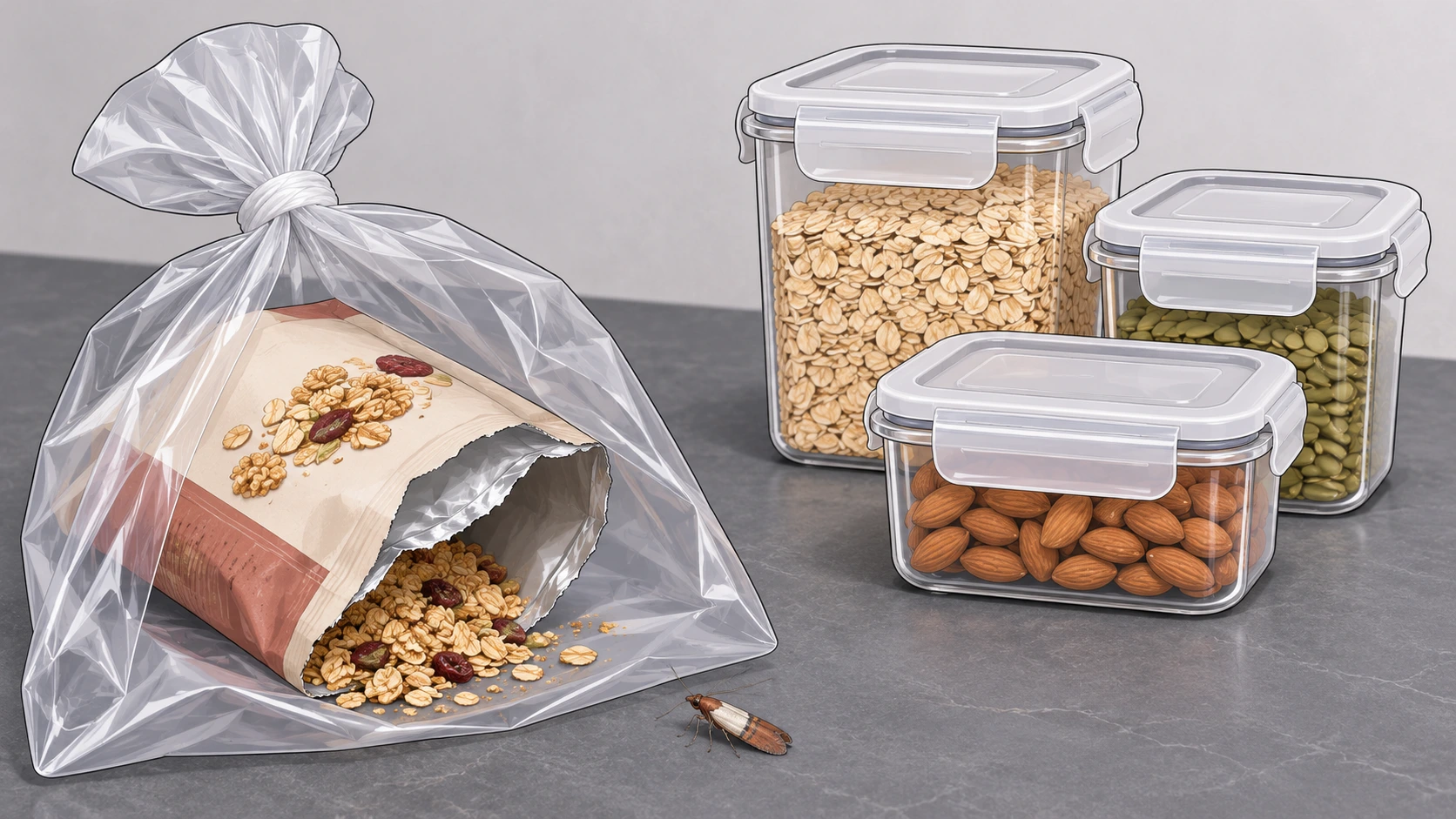
Indian meal moths are not considered a significant direct health threat to people. They do not bite or sting, and they are not known to transmit human pathogens. Their main health-related concern is contamination of stored food. The larvae leave silk webbing, droppings, shed skins, and insect material in the products where they develop, making visibly infested food unsuitable for normal use.
An adult moth landing on your kitchen wall is generally a nuisance. Finding larvae and webbing throughout an open bag of flour is a different situation because the insects have been living and feeding in something you might otherwise eat.
We recommend taking food contamination seriously without assuming that every moth sighting means someone has been exposed to a dangerous disease. The most useful response depends on whether you have simply encountered an adult moth, discovered infested food, or developed symptoms that require medical attention.
How Dangerous Are Indian Meal Moths? A Quick Risk Assessment
Indian meal moths (Plodia interpunctella) are common stored-food pests. Their reputation comes from the food they spoil, rather than from attacking people or transmitting infections.
The following table separates the concerns homeowners often group together.
| Concern | What is established | Practical significance |
|---|---|---|
| Biting people | Indian meal moths are not considered biting pests | A moth sighting does not explain an unexplained bite mark |
| Stinging | They do not have a stinger | There is no sting injury to expect |
| Known human disease transmission | They are not recognized as vectors of human pathogens | Avoid assuming they spread infectious disease |
| Contamination of dry food | Larvae leave silk, droppings, skins, and insect material | Discard visibly infested products |
| Accidental ingestion | Larvae are not considered poisonous; incidental ingestion generally presents low risk | Assess symptoms and the condition of the food |
| Allergic or irritation concerns | Individual sensitivities and other exposures require separate assessment | Do not diagnose an allergy from a moth sighting |
| Damage to people or buildings | Adults are primarily a nuisance; larvae damage stored products | Concentrate on affected food rather than personal protection |
The conclusion that pantry moths are not known to transmit human pathogens is supported by stored-food moth health and contamination guidance.
These classifications describe what is known about Indian meal moths as household pests. They do not guarantee that every piece of food containing insects is safe or that symptoms experienced after eating suspect food should be ignored.
The Main Health Concern Is Contaminated Food
Indian meal moth larvae develop in dry stored products, including grains, flour, cereals, nuts, dried fruit, seeds, and other susceptible foods. While feeding, the caterpillars spin silk and leave insect waste and shed skins among the contents.
A heavily infested package may contain grains held together by webbing, loose insect debris, and larvae at different stages of development. Some material can remain concealed even after the visible insects have been removed.
These insects can therefore make food unusable without necessarily introducing a recognized human pathogen.
In fact, pantry pests often contaminate more food than they consume. The damage associated with stored-food insects includes contamination that makes products unsuitable for continued household use.
Is Insect-Contaminated Food Dangerous to Eat?
Food containing Indian meal moth larvae is not automatically poisonous. However, the presence of the insects does not establish that the rest of the product is clean, wholesome, or suitable to consume.
A bag showing substantial webbing, droppings, and shed skins should be discarded. Removing a few caterpillars does not remove all the material they have left behind.
Food quality may also have deteriorated for reasons unrelated to the moths, especially when a product has been stored for a long time or exposed to moisture.
The practical recommendation is therefore straightforward: do not deliberately eat visibly infested food, even though the moths themselves are not recognized as poisonous.
For a closer examination of the different kinds of contamination, see what Indian meal moths do to stored food.
Does Every Moth Sighting Mean Your Food Is Contaminated?
No. Adult Indian meal moths can fly away from the product where they developed, and mature larvae may also travel before pupating.
Seeing an adult on a kitchen wall does not establish that the nearest container of cereal is infested. The stronger evidence is inside a product, particularly when you find larvae, webbing, shed skins, or insect debris.
A moth flying in a room should prompt an inspection of susceptible dry goods. It does not justify automatically discarding every item in the pantry.
The distinction between adult sightings and actual product evidence matters because Indian meal moth larvae are responsible for the damage to stored food.
Can Indian Meal Moths Make You Sick?
Indian meal moths are not generally associated with direct human illness. Their larvae are not considered poisonous, and the species is not recognized as a routine transmitter of human disease.
That is reassuring when someone has accidentally consumed a small insect or discovered an adult moth near the dinner table.
However, finding insects in food cannot rule out spoilage, contamination from other sources, or unrelated foodborne illness. The condition of the food still matters, as do any symptoms that develop after eating it.
We would not treat a pantry moth infestation as a medical emergency in an otherwise healthy person who has no symptoms. We also would not advise someone to continue eating a visibly contaminated product simply because the moths have a low direct health risk.
What if You Accidentally Ate an Indian Meal Moth Larva?
Accidental ingestion of a small Indian meal moth larva is generally unlikely to cause harm. The larvae are not poisonous, and a species-specific extension reference describes accidental ingestion as generally harmless.
If you discover the problem while eating, stop using the affected food. You do not need to induce vomiting or take medication solely because you may have swallowed a larva.
Symptoms such as persistent vomiting, significant diarrhea, or abdominal pain warrant medical assessment, particularly if they are severe, worsening, or accompanied by other concerning changes. Those symptoms should not automatically be attributed to the insect.
Seek urgent medical attention for difficulty breathing, swelling of the lips or throat, fainting, or another potentially serious allergic reaction, regardless of what you suspect caused it.
For the specific ingestion question, including symptom-based next steps, see what happens if you eat Indian meal moth larvae.
Do Indian Meal Moths Bite or Sting Humans?
Indian meal moths are not biting or stinging household pests. They do not attack people to obtain blood, and they are not equipped with a stinger.
A moth landing on your arm or crawling across your hand may feel unpleasant, but contact alone does not indicate that it has bitten you.
This matters when someone notices red bumps or itching after discovering pantry moths. The timing may appear connected, yet a moth sighting does not identify the cause of a skin reaction.
Other insects, skin conditions, and environmental exposures may produce marks or itching. Identifying the actual cause requires appropriate evidence rather than assuming that the most recently noticed insect is responsible.
The health significance of common pantry pests specifically distinguishes these insects from pests that bite or sting.
For a species-specific explanation, see do Indian meal moths bite?.
Can Indian Meal Moths Spread Disease?
Indian meal moths are not known to transmit human pathogens in the way recognized disease vectors do.
This is an important limit on claims that pantry moths spread dangerous infections whenever they appear in a home. Finding their larvae in cereal does not establish that anyone has contracted a disease or that a particular pathogen is present.
However, stored-food insects can create unsanitary conditions in affected products. Their activities may contribute to deterioration of food quality, and contamination concerns should be considered independently of demonstrated disease transmission.
Stored-product pest guidance recognizes that infested food can contain insect material and that insect activity may be associated with additional quality problems. These concerns support discarding affected food without making unsupported claims that Indian meal moths routinely infect people.
The broader scientific discussion of microbial contamination, allergy evidence, and disease-vector claims belongs in can Indian meal moths cause allergies or carry disease?.
Does Finding Moths Mean Your Kitchen Is Unsanitary?
Not necessarily. Indian meal moths can arrive in purchased products that already contain eggs or developing larvae. A household may discover an infestation despite maintaining clean kitchen surfaces.
Poor storage practices and spilled food can allow a problem to persist or spread, but the presence of moths is not proof of neglect.
The sensible response is to assess the condition of susceptible products and their storage areas rather than draw conclusions about household hygiene.
Can Indian Meal Moths Cause Allergies or Irritation?
An allergic reaction and an insect bite are different possibilities, and neither should be diagnosed solely from the presence of moths.
People may react to various environmental allergens, food ingredients, or insect-related materials. Laboratory or occupational evidence concerning insects does not automatically establish that ordinary household exposure to Indian meal moths causes a particular person’s symptoms.
For homeowners, the practical point is to avoid unnecessary handling of heavily contaminated food. Seal affected products for disposal, clean visible debris without spreading dust, and wash hands after handling suspect material.
Someone with asthma, known allergies, or unexplained symptoms may need individualized medical advice. If symptoms occur around a storage area, a clinician can consider the full range of exposures rather than presuming that Indian meal moths are responsible.
Detailed evidence about sensitization, allergic reactions, and the difference between occupational and household exposure is covered in our Indian meal moth allergy and disease review.
Is It Safe to Touch an Indian Meal Moth?
Ordinary incidental contact with an adult Indian meal moth is not considered dangerous.
You can remove an exposed moth using a tissue, a container, or a vacuum without applying insecticide. Avoid touching your mouth or food immediately after handling insects or contaminated material, and wash your hands afterward.
The more relevant hygiene concern arises when handling a product that contains many larvae, droppings, and other debris. Rather than repeatedly sorting through the contents by hand, seal the affected product and dispose of it.
You do not need to disinfect your entire home because a moth landed on a wall or countertop. Clean surfaces that actually contacted contaminated food or insect material, using an appropriate household cleaning method.
What About Larvae on Walls or Ceilings?
Indian meal moth larvae sometimes leave their food and crawl along walls, cabinet edges, and ceilings before pupating.
Finding one on a wall does not mean that the wall itself is contaminated with a dangerous pathogen. Collect the accessible larva and look for the dry food that may have supported its development.
The separate guide to getting rid of Indian meal moth larvae addresses physical collection and suitable hiding spots without assuming a direct human health hazard.
What Should You Do to Protect Your Health After Finding Moths?
The most useful precautions are based on normal food hygiene and avoiding unnecessary chemical exposure.
| Situation | Appropriate response |
|---|---|
| One adult moth flying indoors | Remove it if convenient and check susceptible dry foods for infestation evidence |
| Larvae or webbing inside food | Stop using that product, seal it, and discard it |
| Insect debris on a cupboard shelf | Remove the debris and clean the affected surface |
| Suspected accidental ingestion without symptoms | Stop eating the affected product and assess the situation without assuming poisoning |
| Persistent or significant symptoms after eating suspect food | Seek appropriate medical advice |
| Severe allergic-type symptoms | Seek emergency medical care |
| Considering insecticide near food | Avoid routine spraying and check product-specific restrictions |
These actions address the most realistic risks without turning a pantry infestation into an unnecessary chemical treatment problem.
Insecticides are generally not recommended for controlling Indian meal moths in household food cupboards. Sprays cannot reliably reach insects inside food packages, and improper use can expose people to pesticide residues.
Guidance on avoiding pesticides in pantry pest control favors removal of infested products, cleaning, and protected storage.
If you are considering a pesticide, consult the separate guide to chemical sprays and pesticides for Indian meal moths before using anything near food.
Why Food Safety Matters More Than Killing Individual Moths
An adult Indian meal moth flying around a kitchen is unlikely to cause direct harm. Its presence matters because it may signal that larvae have been developing in stored food somewhere nearby.
Killing that adult does not tell you whether the food is contaminated. Nor does a successful trap catch establish that every affected package has been identified.
The more meaningful health precaution is preventing visibly contaminated products from being eaten.
Once suspect food has been removed, focus on ordinary sanitation and appropriate food storage. There is generally no reason to treat kitchen walls, dishes, furniture, and clothing as hazardous merely because moths were present.
If a confirmed infestation requires removal, the main Indian meal moth removal guide covers the household control sequence. That procedure is a pest-management task, not evidence that the home poses an infectious-disease emergency.
Frequently Asked Questions
Are Indian meal moths poisonous?
Indian meal moths and their larvae are not considered poisonous. Accidental ingestion of a small larva is generally unlikely to cause harm, but visibly infested food should still be discarded because of insect contamination and possible deterioration.
Can Indian meal moths make food unsafe?
They can contaminate food with silk, droppings, shed skins, and insect material. The presence of this debris makes visibly infested products unsuitable for normal use, even though the species is not known to transmit human pathogens.
Can Indian meal moths cause a rash?
A rash should not automatically be attributed to Indian meal moths. They are not biting pests, and skin reactions can have many causes. Persistent, severe, or unexplained symptoms require appropriate medical evaluation.
Do Indian meal moths carry bacteria or viruses that infect people?
Indian meal moths are not recognized as vectors of human pathogens. That does not mean infested food is sterile or suitable to eat. Food contamination and documented disease transmission are different issues.
Is it dangerous to sleep in a room with Indian meal moths?
An occasional Indian meal moth flying into a bedroom is generally a nuisance rather than a direct health danger. Adults may travel away from the stored food where they developed. Their presence does not indicate that they are feeding on people or bedding.
Should you go to the doctor after finding moth larvae in your pantry?
Finding larvae in food does not, by itself, require a medical visit. Seek medical advice when an actual exposure is accompanied by concerning symptoms or when you have a specific medical vulnerability. Severe allergic-type symptoms or other emergencies require urgent attention.
Are Indian meal moths dangerous to children?
The insects are not recognized as biting, stinging, or poisonous pests. However, children should not be given visibly infested food, and contaminated materials should be kept out of reach. If a child develops concerning symptoms after a suspected ingestion, contact a healthcare professional or poison-control service for individualized advice.
Indian Meal Moths Are Primarily a Food-Contamination Problem
Indian meal moths can be disturbing to find in the home, particularly when larvae appear inside food that a family has been using. Their presence deserves attention, but the established health picture is less alarming than many online claims suggest.
The insects do not bite or sting, and they are not known to transmit human pathogens. Accidental ingestion of a small larva is generally unlikely to cause harm. The main reason to reject infested food is the webbing, waste, shed skins, insect material, and possible deterioration associated with larval activity.
We recommend treating confirmed food contamination seriously while keeping medical concerns proportionate to the actual exposure and symptoms.
Discard visibly infested food, use ordinary hygiene precautions, and seek medical advice when symptoms justify it. There is no need to assume that a moth sighting alone has made your household dangerous.