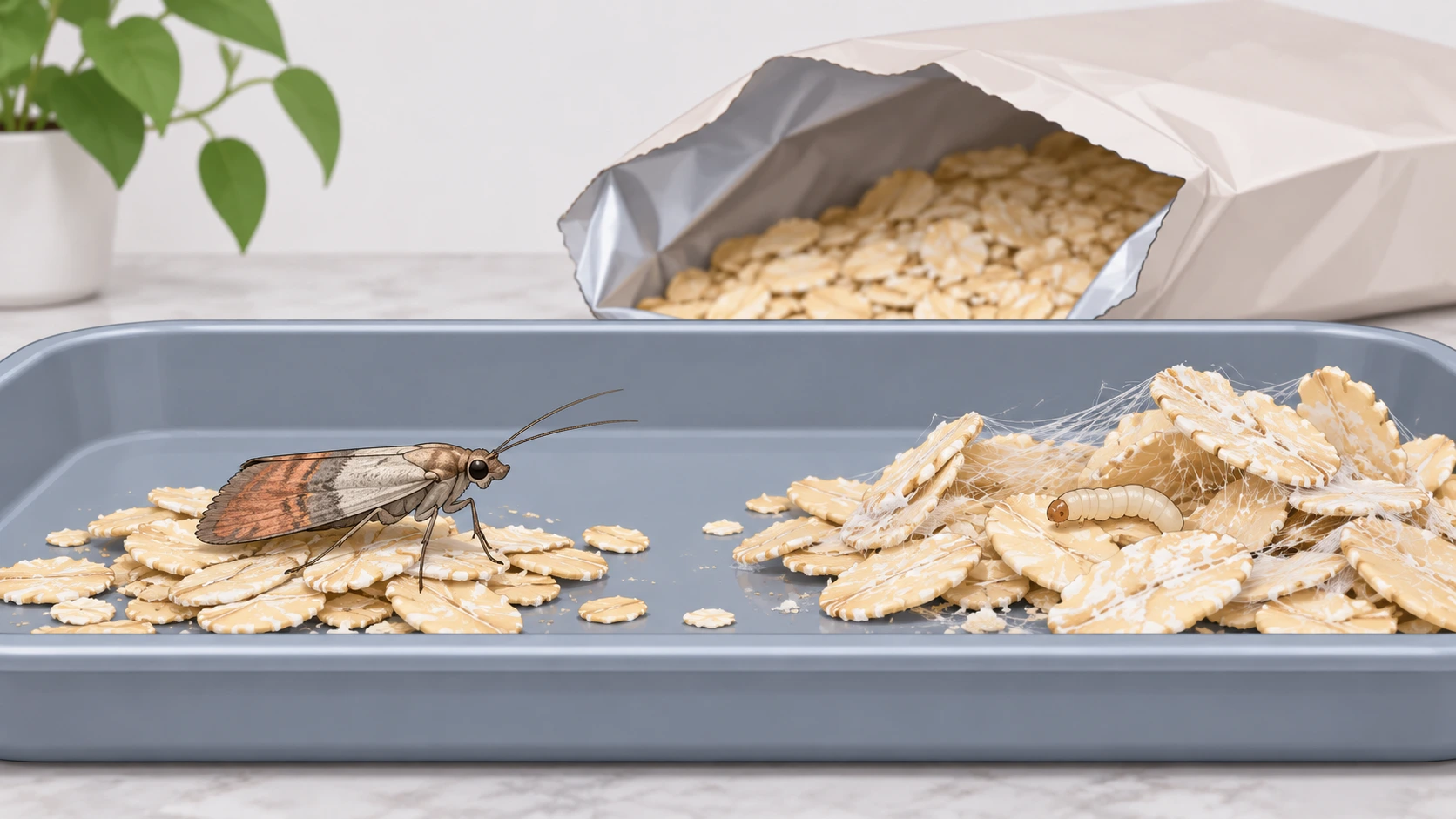
Indian meal moths can cause allergic sensitization, but they are not established transmitters of infectious diseases to humans. Scientific research has identified proteins in Indian meal moths (Plodia interpunctella) that can trigger allergic immune responses. Researchers have also recovered potentially harmful bacteria and fungi from these insects, although detecting microorganisms on a moth is different from demonstrating that it transmits a disease to someone.
For homeowners, the most immediate concern is usually contamination of stored food. Indian meal moth larvae produce silk, shed their skins, and leave droppings in the materials where they develop. In a substantial infestation, insect fragments and other residues may become mixed with food dust.
Those materials can create exposure concerns, particularly for someone with allergies or asthma. But a person who notices a moth near the kitchen ceiling should not assume that it caused their sneezing, rash, or respiratory symptoms.
The amount and type of exposure matter. A single adult moth in a bedroom presents a very different situation from repeatedly handling heavily infested grain in an enclosed, dusty workplace.
The evidence is strong enough to take moth allergens seriously, while still being careful about what has actually been demonstrated.
Can Indian Meal Moths Cause Allergies?
Yes. Indian meal moths contain proteins capable of provoking allergic immune responses in some people.
Researchers have identified specific proteins from this species that bind to immunoglobulin E (IgE), the antibody involved in many immediate allergic reactions. Laboratory experiments have also shown that certain Indian meal moth proteins can activate immune cells associated with allergic inflammation.
This is stronger evidence than simply observing that someone sneezed after finding pantry moths.
A 2001 investigation tested blood samples from 102 patients who already had indoor allergic symptoms. Of those patients, 52 had IgE antibodies that recognized Indian meal moth allergens.
The researchers subsequently identified an Indian meal moth protein called arginine kinase, designated Plo i 1. This protein was recognized by 13 of the 52 moth-sensitized patients in the study.
The identification of Indian meal moth arginine kinase as an allergen provided direct evidence that this species contains biologically active allergens.
There is an important limit to the numbers. The 102 participants were selected because they already experienced indoor allergic symptoms. They were not a random sample of the general population.
Consequently, the finding that 52 of them had moth-reactive IgE does not mean that approximately half of all homeowners are allergic to Indian meal moths.
It also does not establish that all 52 participants experienced symptoms specifically caused by exposure to these moths.
What Is Allergic Sensitization?
Allergic sensitization means that a person’s immune system has developed a specific response to a substance, often demonstrated by the presence of relevant IgE antibodies.
Sensitization is not the same as a diagnosed clinical allergy.
Someone may have antibodies that recognize an insect protein without experiencing noticeable symptoms whenever that insect is present. Other people may develop symptoms after exposure.
Doctors generally interpret allergy tests alongside the patient’s symptoms, exposure history, and other clinical findings.
This distinction is especially important for Indian meal moths because many published studies examine immune responses to laboratory-prepared moth extracts rather than measuring illness caused by ordinary household infestations.
The research establishes that Indian meal moth allergens exist and can be biologically active. It does not provide a reliable estimate of how often a small pantry infestation causes symptomatic allergy in the general population.
Which Indian Meal Moth Proteins Can Trigger Allergies?
Two proteins have received particular attention: arginine kinase and thioredoxin.
Both occur in a wide range of organisms, but particular forms of these proteins can be recognized by the immune systems of sensitized individuals.
Arginine Kinase (Plo i 1)
Arginine kinase is an enzyme involved in cellular energy metabolism. In Indian meal moths, researchers identified a form that binds IgE antibodies from certain allergic patients.
The protein is significant partly because similar enzymes occur in other invertebrates.
Laboratory tests found cross-reactivity between Indian meal moth arginine kinase and related allergens from house dust mites, cockroaches, and several shellfish.
Cross-reactivity means that an antibody recognizing one protein may also recognize a structurally similar protein from another organism.
This does not mean every person allergic to dust mites or shellfish will react to Indian meal moths. Nor does it prove that a positive laboratory test predicts symptoms when someone encounters moth dust.
The finding helps explain why insect-allergy testing can be complicated, especially in people sensitized to multiple invertebrate allergens.
Thioredoxin (Plo i 2)
Thioredoxin is another protein associated with Indian meal moth allergenicity.
A 2012 study investigated a thioredoxin from Plodia interpunctella and examined how it interacted with immune responses.
Approximately 8% of the tested sera from patients with IgE against moth extracts reacted with the recombinant thioredoxin. For comparison, approximately 25% reacted with the arginine kinase examined in the study.
The researchers also tested the proteins in mice and observed immune responses consistent with allergic sensitization.
These experiments involving Indian meal moth thioredoxin strengthen the biological evidence that the species contains allergens.
The mouse results should not be interpreted as a measurement of how many people develop asthma or another allergic condition after encountering pantry moths.
They demonstrate allergenic potential under experimental conditions, not the frequency or severity of household reactions.
What Allergy Symptoms Might Occur After Exposure?
An allergic reaction to airborne insect material may involve the nose, eyes, skin, or respiratory system.
Possible manifestations include sneezing, a runny or congested nose, itchy or watery eyes, coughing, wheezing, and asthma symptoms. Contact with allergenic material may also contribute to skin reactions in susceptible individuals.
These symptoms are not specific to Indian meal moths.
A person with an infested pantry might also be exposed to grain dust, mold, dust mites, pollen entering through an open window, or ordinary household cleaning products.
The timing of symptoms may offer useful information, but it cannot identify the responsible allergen on its own.
For example, someone who repeatedly develops coughing and itchy eyes while emptying dusty, infested bags has a plausible exposure pattern worth discussing with a clinician.
Someone who notices a rash after seeing one adult moth on a wall does not have enough evidence to attribute the rash to that moth.
A medical evaluation is particularly appropriate if symptoms repeatedly occur during exposure to stored-product dust, improve away from the location, or involve wheezing and breathing difficulties.
Can Indian Meal Moths Trigger Asthma?
Indian meal moth proteins are capable of producing allergic immune responses relevant to asthma, but the frequency of clinically confirmed Indian meal moth-induced asthma is not well established.
The laboratory findings involving IgE binding, histamine release, and related immune responses establish a plausible biological pathway.
They do not prove that every dusty pantry containing moths is producing enough airborne allergen to trigger asthma.
The distinction is important because respiratory symptoms associated with stored products may have several causes.
Flour dust, grain proteins, fungal material, and other airborne particles can irritate the respiratory system or trigger occupational allergies independently of Indian meal moths.
In workplaces where dusty food materials are repeatedly handled, these other exposures can be substantial.
For people with existing asthma, it is sensible to avoid unnecessary exposure to heavily contaminated dust, regardless of which component is responsible.
Severe breathing difficulty, rapid worsening of wheezing, or symptoms suggesting a serious allergic reaction require urgent medical attention. People with prescribed emergency medication should follow their established medical action plan.
Are Indian Meal Moth Allergies More Common in Warehouses and Food Facilities?
Occupational exposure deserves particular attention because workers may encounter much larger quantities of insect and food dust than household residents.
A person employed in grain handling, food processing, packaging, or storage may repeatedly disturb products that contain insect fragments, larval silk, and other particulate material.
Repeated handling can release dust into the breathing zone, especially during pouring, transferring, screening, or cleaning operations.
However, it would be inaccurate to assume that respiratory problems in those workplaces are primarily caused by Indian meal moths.
Grain and flour dust are recognized respiratory hazards in their own right. The evidence on work-related asthma and grain-processing dust identifies several occupational sources of respiratory sensitization, including insects and biological materials.
Studies of flour-handling workers have also identified grain proteins and processing enzymes as important causes of occupational allergic disease.
Therefore, an employee with symptoms in a moth-infested facility may be responding to the moths, another component of the dust, or more than one exposure.
Determining the cause requires occupational and medical assessment rather than assuming that the most visible insect is responsible.
Household Exposure vs. Occupational Exposure
The setting changes how the evidence should be interpreted.
| Exposure situation | Main concern | What the evidence can establish |
|---|---|---|
| One adult moth flying indoors | Limited incidental contact | A sighting alone does not establish meaningful allergen exposure |
| Small infestation inside a food package | Insect fragments and contaminated material | Exposure is possible when the material is handled |
| Heavy infestation with accumulated food dust | Greater opportunity for airborne particles | Respiratory exposure may become more relevant, especially for sensitive individuals |
| Repeated handling of infested bulk grain | Frequent contact with insect and commodity dust | Occupational assessment may be warranted |
| Laboratory testing with purified moth proteins | Direct immune recognition of defined allergens | Establishes allergenic potential, not the population-wide incidence of illness |
This comparison is a synthesis of exposure routes and published research. It is not a clinical risk score or a prediction that someone in one category will develop symptoms.
A heavily infested bag may present a meaningful exposure concern when disturbed, but the actual risk depends on the material, the person’s susceptibility, and how much dust becomes airborne.
Can Indian Meal Moth Dust Cause Allergic Reactions?
Potentially. Insect proteins may be present in material associated with an infestation, including fragments of insect bodies and other biological residues.
The scientific identification of moth allergens makes airborne exposure a reasonable concern, especially when dried insect material is disturbed.
Still, it is important not to label every speck of dust in an infested pantry as a proven Indian meal moth allergen.
Stored-product dust is a mixture. It can contain broken food particles, insect fragments, silk, shed skins, and unrelated environmental material.
The webbing produced by Indian meal moth larvae may hold food particles and other debris together, but its presence does not tell us how much allergenic protein is suspended in the surrounding air.
Likewise, Indian meal moth droppings are evidence of insect activity, not a diagnostic measure of allergic exposure.
In a dusty environment, avoiding practices that create unnecessary airborne debris is a reasonable precaution.
For someone with asthma or known respiratory sensitivities, reducing contact with heavily contaminated material is more useful than attempting to determine whether each individual particle came from the moth, its food, or another source.
Can Indian Meal Moths Carry Bacteria or Fungi?
Yes. Research has recovered bacteria and fungi from Indian meal moths, including organisms that may be important to human health under certain circumstances.
A 2016 investigation examined microorganisms associated with Plodia interpunctella. The researchers identified bacteria from genera including Enterococcus, Bacillus, Klebsiella, and Escherichia, along with fungi such as Aspergillus and Penicillium.
Some recovered strains were potentially pathogenic.
The research on microorganisms associated with Indian meal moths establishes that these insects can harbor microbial populations containing organisms of possible medical concern.
However, a microorganism’s presence on or within an insect does not by itself establish that the insect transmits disease to humans.
To demonstrate disease transmission, researchers would need stronger evidence connecting the insect, the microorganism, the exposure route, and actual infection.
For example, finding a potentially harmful bacterium in a moth specimen does not demonstrate that the moth transferred an infectious dose to food or caused an illness.
This is where the words carry, contaminate, and transmit must be used carefully.
Do Indian Meal Moths Spread Diseases to Humans?
Indian meal moths are not established human disease vectors in the way mosquitoes are established vectors of certain infectious diseases.
There is no well-demonstrated pattern of Indian meal moths routinely transmitting a specific human infectious disease through their normal household activity.
Guidance on pantry moths states that they are not known to transmit human pathogens.
That statement should be interpreted alongside the microbiological research rather than used to dismiss it.
Indian meal moths can harbor microorganisms, and stored-product insects may contribute to microbial contamination under some conditions. Yet the available evidence does not establish that ordinary household Indian meal moth infestations are a recognized route for transmitting a particular infectious disease to people.
The distinction can be summarized as follows.
| Claim | Evidence assessment |
|---|---|
| Indian meal moths contain proteins that can trigger allergic immune responses | Demonstrated in human laboratory research |
| Indian meal moths can harbor bacteria and fungi | Demonstrated in microbiological studies |
| Infested stored food can contain insect fragments and biological residues | Well established |
| Indian meal moth activity may contribute to microbial contamination | Biologically plausible and supported by stored-product research, with conditions affecting the outcome |
| Indian meal moths routinely transmit a named infectious disease to household residents | Not established |
| Finding one Indian meal moth means someone will become ill | Unsupported |
This evidence-based separation prevents two opposite errors.
The first is claiming that Indian meal moths are completely free of microorganisms and incapable of any health-related contamination.
The second is presenting them as proven transmitters of serious infectious diseases merely because a study recovered bacteria from their bodies.
Neither claim reflects the evidence accurately.
How Can Infested Food Become Contaminated?
Indian meal moth larvae live and feed within suitable stored products, leaving insect-derived material behind as they develop.
Their silk may bind food particles together. Shed skins, droppings, dead insects, and fragments can become mixed with the contents.
These materials can make a product unsuitable for use even when there is no evidence of a specific infectious disease.
Insect activity can also influence the condition of stored products. Changes in the storage environment, moisture, and damage to food materials may create conditions more favorable to certain microorganisms.
A scientific review of health hazards associated with arthropods in stored products discusses both insect-derived contamination and indirect effects involving fungi, microbial populations, and food deterioration.
These effects are not identical for every infestation. A small number of larvae in dry material does not necessarily produce the same conditions as a heavily damaged, damp product.
The condition of the food therefore matters independently of whether the insect is known to transmit disease.
Moldy or spoiled material can present concerns beyond the moth itself, and simply killing the insects does not remove mold, insect fragments, or other residues.
The types of damage caused by Indian meal moth infestations help explain why food contamination is often the more immediate issue.
Can Indian Meal Moths Cause a Skin Rash?
Indian meal moth allergy is biologically possible, but a rash appearing after a moth sighting cannot be attributed to the insect without additional evidence.
Skin reactions can arise from many causes, including contact dermatitis, other environmental allergens, irritants, medication reactions, and unrelated medical conditions.
A person may also react to materials used while cleaning a pantry.
For example, someone who handles dusty, contaminated food and then develops itchy skin might reasonably consider an exposure-related reaction. Yet the responsible substance could be the food ingredient, an insect protein, a cleaning chemical, or another material.
A rash alone cannot identify Indian meal moth allergens as the cause.
If the reaction recurs with similar exposure, a healthcare professional can evaluate whether allergy testing or another investigation is appropriate.
Persistent, extensive, or worsening skin symptoms warrant medical advice, particularly when accompanied by other symptoms.
Does Finding Indian Meal Moths Mean Your Home Is Unhealthy?
An isolated Indian meal moth sighting does not establish an unhealthy indoor environment.
The adult may have emerged from a small amount of affected stored material. Its presence alone does not reveal the amount of insect debris, airborne allergen, or microbial contamination in the building.
Repeated sightings alongside larvae, silk, and damaged products provide stronger evidence of a stored-food infestation.
Those findings justify addressing the affected material, but they still do not diagnose a health hazard or explain someone’s symptoms.
The signs of an Indian meal moth infestation can help separate an occasional adult sighting from an established problem.
For households with people who have asthma or significant allergies, it is reasonable to take additional care with dusty materials and avoid unnecessary exposure.
That precaution does not require assuming that every Indian meal moth infestation causes asthma or infectious disease.
What Should You Do if You Suspect an Allergy to Indian Meal Moths?
Start by documenting the exposure circumstances rather than trying to diagnose yourself from the presence of moths.
Notice whether symptoms occur during a particular activity, such as handling infested food or disturbing dusty packaging. Record whether the symptoms improve away from that location and whether other exposures may be present.
If the pattern repeats, discuss it with a healthcare professional, particularly if coughing, wheezing, or persistent nasal and eye symptoms are involved.
An allergist may consider your history and appropriate testing. The fact that Indian meal moth allergens have been identified in research does not mean a routine commercial test is available or clinically validated in every location.
A positive test for another invertebrate allergen also does not automatically identify Indian meal moths as the cause of symptoms because some proteins can cross-react.
Avoid deliberately exposing yourself to moth extracts, dust, or infested products to see whether symptoms return. Such informal challenges can be unsafe, especially for someone with asthma.
How Should Sensitive People Handle Infested Materials?
Avoid shaking, pouring, or dry-brushing heavily infested products when doing so would send dust into the air.
An affected package can often be enclosed before being moved, reducing the chance of scattering loose debris.
If substantial dusty material must be handled, someone without respiratory sensitivities may be better suited to the task. Appropriate respiratory protection may also be needed depending on the exposure.
A disposable filtering respirator can reduce inhalation of airborne particles when properly selected and fitted, but it does not prevent all exposure or replace medical and workplace advice. Someone with significant asthma or another respiratory condition should not assume that wearing a mask makes a heavily contaminated environment safe.
If exposure is recurring at work, report the concern through the workplace’s occupational health and safety process. The investigation may need to assess multiple dust components rather than concentrating only on moth allergens.
The process of locating an Indian meal moth infestation source can help identify affected materials, but people with significant respiratory symptoms should avoid undertaking dusty investigations that worsen their condition.
Frequently Asked Questions
Can Indian Meal Moths Cause Sneezing?
Indian meal moths contain proteins with demonstrated allergenic properties, so exposure could contribute to sneezing in a sensitized individual. However, sneezing is nonspecific. Dust, pollen, grain particles, mold, and other allergens may be responsible, particularly in a food-storage environment.
Can Indian Meal Moths Cause Asthma Attacks?
Moth allergens are biologically capable of contributing to allergic reactions, but the frequency of Indian meal moth-triggered asthma attacks in ordinary homes is not established. Someone with asthma should avoid unnecessary exposure to heavy insect or food dust and follow their prescribed asthma management plan.
Are Indian Meal Moths Known to Carry Salmonella?
Indian meal moths are not established transmitters of salmonellosis. The fact that research has identified potentially harmful bacteria associated with these insects does not establish that they routinely carry Salmonella or cause human infections. Claims involving a specific pathogen require species-specific evidence.
Can You Be Allergic to Indian Meal Moths Without Knowing It?
Sensitization can exist without a person recognizing a specific trigger. However, having detectable IgE antibodies does not necessarily mean someone has a symptomatic clinical allergy. Diagnosis depends on symptoms, exposure history, and appropriate medical assessment.
Are Indian Meal Moth Allergies the Same as Dust Mite Allergies?
No. Indian meal moths and house dust mites are different organisms. Some of their proteins share features that may produce cross-reactive immune responses, but sensitivity to one does not automatically establish clinical allergy to the other.
Can Dead Indian Meal Moths Still Cause Allergy Symptoms?
Dead insects can leave behind biological material containing proteins. The disappearance of live moths therefore does not automatically remove every potential allergen from an infested area. Whether a particular residue causes symptoms depends on the person’s sensitivity and actual exposure.
The Bottom Line
Indian meal moths have demonstrated allergenic potential, but they are not established vectors of human infectious diseases. Researchers have identified allergenic proteins, including arginine kinase and thioredoxin, and shown that some patients’ immune systems recognize them.
Microbiological studies have also recovered potentially harmful bacteria and fungi from Indian meal moths. Those findings justify taking food contamination seriously, but they do not prove routine transmission of infectious illness to household residents.
For most homeowners, the immediate concern is the condition of affected stored food and the debris left by developing larvae. The significance of airborne exposure increases when large amounts of insect and food dust are repeatedly disturbed.
If you develop recurring allergy or asthma symptoms around infested materials, seek an appropriate medical assessment rather than assuming the moth is the confirmed cause. If stored products contain insects, silk, or substantial debris, address the contaminated material without generating unnecessary dust.
The evidence calls for sensible exposure precautions, not alarm over every moth that appears in the kitchen.