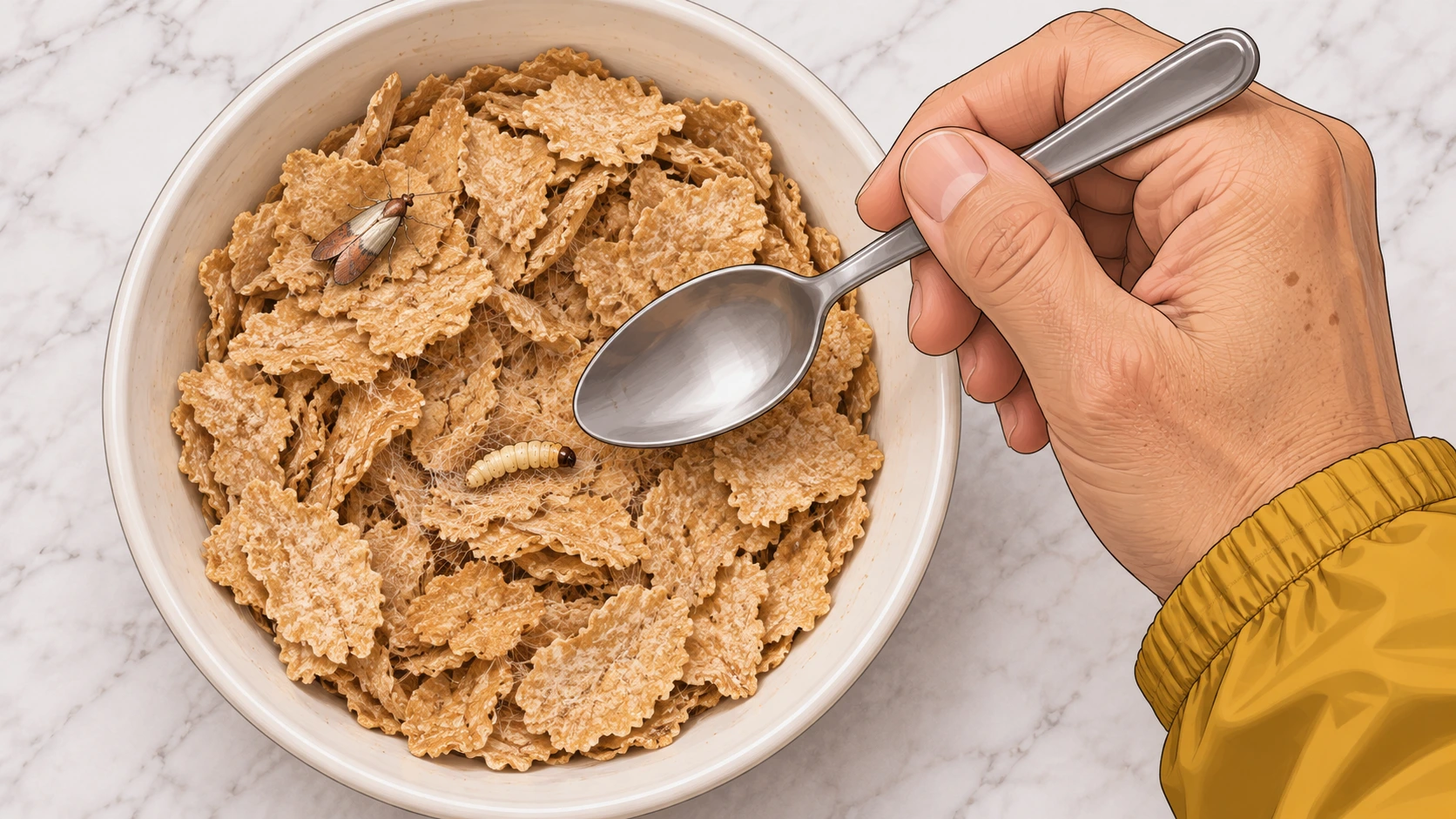
Discovering a small caterpillar in your cereal after you have already eaten several spoonfuls can be unsettling. You might wonder whether you swallowed more larvae without noticing, whether they could survive inside your stomach, or whether you need medical treatment.
Accidentally eating an Indian meal moth larva is generally unlikely to harm you. These caterpillars are not poisonous, and swallowing one does not ordinarily require medication or emergency treatment. However, food containing visible larvae, webbing, or insect waste should not be eaten deliberately. Stop using the affected product and seek medical advice if concerning symptoms develop.
Indian meal moths (Plodia interpunctella) are common insects that infest dry stored products. Their caterpillars may develop unnoticed in cereal, flour, grains, nuts, dried fruit, and other foods before someone discovers them. Accidental ingestion is possible because young larvae are small and can blend into their surroundings.
What Happens if You Accidentally Swallow an Indian Meal Moth Larva?
In most cases, nothing unusual happens. The swallowed larva enters the digestive system along with the food and is broken down during digestion.
Indian meal moth larvae are not poisonous and are not known to establish themselves as parasites inside the human digestive tract. They are caterpillars adapted to feeding on stored products, not organisms that require a human host to develop.
There is no reason to expect a swallowed larva to continue crawling around inside the stomach, grow into an adult moth, or lay eggs in your body.
The established guidance on accidentally ingesting Indian meal moth larvae describes them as nonpoisonous and not expected to cause harm when swallowed inadvertently.
That reassurance applies to the insect itself. It does not prove that the food was free of spoilage, unrelated contamination, or an ingredient that could cause a reaction.
Can a Larva Survive in Your Stomach?
An Indian meal moth larva cannot establish a normal feeding and reproductive cycle in the human stomach.
Its development depends on suitable food and environmental conditions associated with stored products. The digestive tract is not an appropriate habitat for this species.
Normal digestive processes break down ingested food and insect material. You do not need to take an antiparasitic medicine because you accidentally swallowed an Indian meal moth caterpillar.
If someone develops persistent gastrointestinal symptoms after eating suspect food, those symptoms deserve assessment on their own merits. They are not evidence that a pantry moth larva has begun living inside the body.
Can It Turn Into a Moth Inside You?
No. Indian meal moths undergo development from egg to larva, pupa, and adult in the environment. Swallowing a caterpillar does not allow that process to continue inside a person’s digestive system.
The adult moths you see flying around the kitchen emerged from pupae in their surroundings, not from insects that passed through a person.
This concern sometimes arises because the insects look like small worms. However, a caterpillar is not the same thing as a parasitic intestinal worm.
For the stages involved in ordinary development, see our guide to the Indian meal moth life cycle.
What Should You Do Immediately After Eating One?
If you have swallowed a suspected Indian meal moth larva and feel well, there is usually no need for emergency action.
Stop eating the affected food. Remove any remaining portion from the table or serving bowl so that nobody else accidentally consumes it. You can rinse your mouth or drink some water for comfort, but neither action is required to neutralize a toxin from the insect.
Do not deliberately make yourself vomit. Vomiting provides no established benefit for an ordinary accidental ingestion and can create additional risks.
A practical response depends on what happened:
| Situation | Appropriate next step |
|---|---|
| You accidentally swallowed one suspected larva and have no symptoms | Stop eating the suspect product; no specific treatment is usually needed |
| You noticed several larvae or webbing after eating some food | Stop using the product and discard visibly infested food |
| You feel nauseated but have no significant physical symptoms | Observe how you feel and avoid assuming the insect caused illness |
| You develop persistent vomiting, diarrhea, or abdominal pain | Contact a healthcare professional for assessment |
| You have breathing difficulty, throat swelling, or faintness | Seek emergency medical help immediately |
| You are unsure what insect or substance was swallowed | Contact a healthcare professional or poison-control service for individualized guidance |
This is a symptom-based guide, not a diagnostic tool. The amount consumed, the condition of the food, the person’s medical history, and the symptoms all affect what advice is appropriate.
Should You Drink Water or Take Medicine?
You can drink water normally if you are comfortable swallowing. There is no established need to flush out the insect with large amounts of water, take a laxative, or use a special cleansing product.
Antibiotics, antiparasitic medications, and activated charcoal are not routine treatments for accidentally swallowing an Indian meal moth larva.
Do not take medication solely because the insect was present unless a healthcare professional recommends it for a specific reason.
When an actual poisoning is suspected, first-aid guidance for swallowed substances advises against inducing vomiting and emphasizes obtaining appropriate advice instead of trying improvised treatments.
What Symptoms Should You Watch For?
Most accidental Indian meal moth larva ingestions are not expected to cause symptoms. If someone feels normal afterward, there is no established requirement to undergo medical testing simply because the insect was swallowed.
However, symptoms following a meal should be taken seriously when they are persistent, worsening, or severe.
Nausea, vomiting, diarrhea, and abdominal discomfort can occur for many reasons, including ordinary gastrointestinal illness, foodborne illness, food intolerance, or anxiety after discovering something unpleasant in food.
The presence of a larva does not establish which explanation is correct.
Nausea After Discovering Larvae
Feeling nauseated immediately after seeing a caterpillar in something you ate does not necessarily mean the insect has caused a physical illness.
Disgust and anxiety can produce genuine nausea. The timing alone cannot distinguish that reaction from a gastrointestinal problem.
If the feeling settles and there are no other symptoms, no special treatment is usually required. If nausea persists, becomes severe, or occurs with repeated vomiting, medical advice is appropriate.
Avoid diagnosing the cause from the sight of the insect alone.
Vomiting, Diarrhea, or Stomach Pain
Repeated vomiting, significant diarrhea, worsening abdominal pain, or symptoms accompanied by fever should prompt medical assessment.
A person can become ill after eating contaminated or spoiled food, but the Indian meal moth larva itself is not established as the cause of every symptom that follows such a meal.
Seek advice sooner for young children, older adults, pregnant people, people with weakened immune systems, and anyone at greater risk from dehydration or foodborne illness.
If someone cannot keep fluids down, develops signs of dehydration, or experiences severe abdominal pain, prompt medical care is particularly important.
Swelling, Wheezing, or Difficulty Breathing
Difficulty breathing, wheezing, swelling of the tongue or throat, fainting, or rapidly developing widespread symptoms after eating require emergency medical attention.
Some people can experience allergic reactions after consuming insects. The evidence varies by insect species, and a reaction should not automatically be attributed to Indian meal moth larvae without clinical assessment.
The general medical guidance on swallowing insects recognizes that insect ingestion is usually harmless but can occasionally raise allergic-reaction concerns.
If severe symptoms occur, call emergency services. Do not wait to identify the exact insect before seeking help.
Can Indian Meal Moth Larvae Make You Sick?
The larvae themselves are not regarded as poisonous, and Indian meal moths are not recognized as ordinary transmitters of human pathogens.
This is different from saying that all food containing the insects is safe to eat.
As larvae feed, they produce silk webbing and leave droppings, shed skins, and other material in the product. In an extensive infestation, these contaminants may become distributed throughout the food.
The fact that an insect is unlikely to cause harm when swallowed accidentally does not mean that deliberately consuming an infested product is sensible.
Indian meal moth activity is primarily associated with contamination of stored food rather than transmission of human pathogens.
Does Finding a Larva Mean the Food Contains Dangerous Bacteria?
Not necessarily. A visible larva does not prove that a particular bacterial pathogen is present.
The insect’s presence does establish that the product has been exposed to stored-food pest activity. Depending on the infestation, that may include webbing, droppings, cast skins, and damage to the food.
Food can also deteriorate through moisture, improper storage, or other contamination unrelated to moths. You cannot rule out those problems simply because the insect itself is considered nonpoisonous.
For a broader evaluation of health concerns and possible disease associations, see can Indian meal moths cause allergies or carry disease?. The distinction matters because contamination evidence is not the same as proof of infectious-disease transmission.
Is It Safe to Deliberately Eat Indian Meal Moth Larvae?
We do not recommend deliberately eating Indian meal moth larvae collected from stored household food.
Accidental ingestion and intentional consumption are different decisions. Accidentally swallowing one small caterpillar during a meal generally presents low direct risk. Choosing to continue eating a package with visible insects and waste creates unnecessary exposure to contaminated food.
Indian meal moth larvae found in groceries have not been raised, processed, or evaluated as food-grade edible insects. Their presence in cereal or flour is evidence of unwanted infestation, not proof that they are appropriate ingredients.
The nutritional value of insects in general does not change that recommendation. A species may contain digestible protein without being suitable for consumption in an uncontrolled household setting.
For visibly infested food, disposal is the safer practical choice.
What if You Pick Out the Larvae?
Removing visible caterpillars does not remove their silk, droppings, shed skins, or smaller insects that may remain hidden.
Young Indian meal moth larvae can be difficult to detect, especially in foods containing small particles or irregular fragments. A package that appears clean after several visible caterpillars are removed may still contain contamination.
You also cannot establish the overall condition of the product by inspecting a few spoonfuls.
The recommendation to discard food with confirmed pantry moth infestation reflects the contamination associated with stored-food insects.
Does Cooking Make Infested Food Safe?
Heating food may kill insects when adequate temperatures are reached, but killing an insect does not reverse the contamination left while it was feeding.
Silk, shed skins, and insect waste do not disappear simply because the food has been baked or boiled.
Cooking also cannot guarantee that every unrelated food-quality or contamination problem has been corrected.
If you find clear insect infestation in an uncooked product, we recommend rejecting that product instead of trying to rescue it through ordinary food preparation.
The distinction is straightforward: accidentally eating a larva is usually not dangerous, but knowingly preparing visibly infested food is not recommended.
What if You Ate Several Larvae Without Realizing It?
Discovering numerous caterpillars in the remaining food does not establish exactly how many you consumed.
For someone who feels well, the discovery alone is not evidence of poisoning or intestinal infestation. There is no reliable larva count that automatically determines whether treatment is needed.
The condition of the food and any symptoms are more useful than trying to estimate how many insects may have been swallowed.
Stop eating the affected product, avoid using the remaining contents, and monitor for symptoms. If the food was heavily contaminated, spoiled, or associated with illness, contact a healthcare professional for individualized advice.
Do not attempt to induce vomiting to remove insects you believe you may have swallowed.
What if a Child Accidentally Eats a Larva?
An otherwise well child who accidentally swallows an Indian meal moth larva is not automatically in danger. The same basic reassurance about the insect’s lack of known toxicity applies.
However, the child’s age, medical history, symptoms, and any uncertainty about what was swallowed may justify calling a pediatric healthcare professional or poison-control service.
Do not give a child an over-the-counter treatment to purge the insect. If the child is coughing, choking, having trouble breathing, or developing severe symptoms, seek urgent medical help.
The event should also prompt removal of the affected food from access so the child or another household member does not continue eating it.
What if You Find Eggs, Webbing, or Moth Parts in Food?
The ingestion question is not limited to live larvae. Indian meal moth infestations can involve eggs, shed skins, pupal material, dead insects, and fine silk strands.
Accidentally swallowing a small amount of insect material does not automatically cause illness. However, visible evidence of these stages makes the product unsuitable for continued household use.
Webbing is particularly relevant because it can bind food particles together and accumulate other debris. A single moving larva is easy to notice, but fine silk or waste may be less obvious.
The broader effects of larval activity on product quality are explained in Indian meal moth damage to stored food.
Do not continue eating a product because the larvae appear dead. Their condition does not tell you whether the food is otherwise acceptable.
Should You Save the Food or Insect for Identification?
You do not usually need to retain an insect specimen after an ordinary, symptom-free accidental ingestion. However, photographs of the insect and affected product can be useful if you need to verify what was found.
If symptoms occur or identification is uncertain, keep the product name, packaging details, and information about when it was eaten. Those details may help a clinician or poison-control specialist assess the situation.
Do not keep an open, heavily infested bag of food in the kitchen solely to preserve evidence. If a sample is requested by a healthcare professional or another qualified authority, follow their instructions for secure handling.
Remember that not every small worm-like organism found in food is an Indian meal moth larva. The advice in this article applies when the insect has been reasonably identified as this species.
If you are uncertain about the insect, refer to what Indian meal moth larvae look like rather than assuming all small caterpillars or maggots have the same significance.
When Should You Contact Poison Control or a Doctor?
For an otherwise healthy person who accidentally eats one confirmed Indian meal moth larva and develops no symptoms, medical treatment is generally unnecessary.
Professional advice becomes more useful when the swallowed material is unidentified, a significant exposure to another substance is possible, symptoms are persistent, or the person has medical circumstances that increase concern.
In the United States, Poison Control is available at 1-800-222-1222. The service can provide individualized advice about possible poisoning or uncertain exposures.
A clinician is the appropriate contact for ongoing gastrointestinal symptoms or concerns about foodborne illness. Emergency services are appropriate for severe breathing difficulty, throat swelling, collapse, seizures, or other medical emergencies.
Do not delay urgent care while searching the pantry for a specimen or trying to determine the exact number of insects swallowed.
Frequently Asked Questions
Are Indian Meal Moth Larvae Poisonous to Humans?
No. Indian meal moth larvae are not considered poisonous, and accidental ingestion generally is not expected to cause harm. Food with visible infestation should still be discarded because of contamination.
Can Indian Meal Moth Larvae Live in Your Stomach?
No. They are stored-food caterpillars, not human intestinal parasites. They cannot establish their normal development and reproduce inside the digestive tract.
Can Eating a Pantry Moth Larva Cause Vomiting?
The larva itself is not generally expected to cause illness. Nausea may follow the unpleasant discovery, while vomiting can have other causes, including unrelated food problems. Persistent or severe symptoms require medical assessment.
Can You Get Worms From Eating Indian Meal Moth Larvae?
Swallowing an Indian meal moth larva does not cause an intestinal infestation with Indian meal moths. Their caterpillars are not adapted to parasitize humans.
What if You Already Ate Half a Bowl of Infested Cereal?
Stop eating the cereal and discard the affected product. If you feel well, there is usually no need for special treatment solely because you may have consumed larvae. Seek medical advice if significant symptoms develop or another contamination concern is present.
Can You Eat Food After Removing the Larvae?
We do not recommend eating food with confirmed infestation. Removing visible larvae cannot reliably remove silk, droppings, shed skins, and other debris that may remain.
Will Stomach Acid Kill an Indian Meal Moth Larva?
Normal digestive processes break down swallowed insect material. There is no reason to expect an Indian meal moth larva to survive and develop inside the human stomach. You do not need to take anything specifically to kill it.
Is Accidentally Eating Indian Meal Moth Eggs Dangerous?
Accidental ingestion of small amounts of Indian meal moth material is generally a low-risk event, although there is less direct published guidance on the eggs specifically than on larvae. An egg cannot establish an Indian meal moth infestation inside a person. Visible eggs or other insect evidence in food are reasons to stop using that product.
Accidental Ingestion Is Usually Harmless, but Infested Food Should Go
Finding an Indian meal moth larva after you have eaten some of a stored food is unpleasant, but it is generally not a medical emergency. These insects are not poisonous, and their larvae cannot develop into moths inside the human digestive system.
If you feel well, stop using the affected product and avoid unnecessary medication or attempts to induce vomiting. Significant gastrointestinal symptoms deserve medical assessment, and severe allergic-type symptoms require emergency care.
The larger practical concern is the food itself. Indian meal moth larvae can leave silk, waste, and shed skins throughout an infested product. Removing one visible caterpillar does not restore that product to its original condition.
Accidentally swallowing a larva is generally unlikely to cause harm. Deliberately eating food with confirmed moth infestation is still a risk you do not need to take.