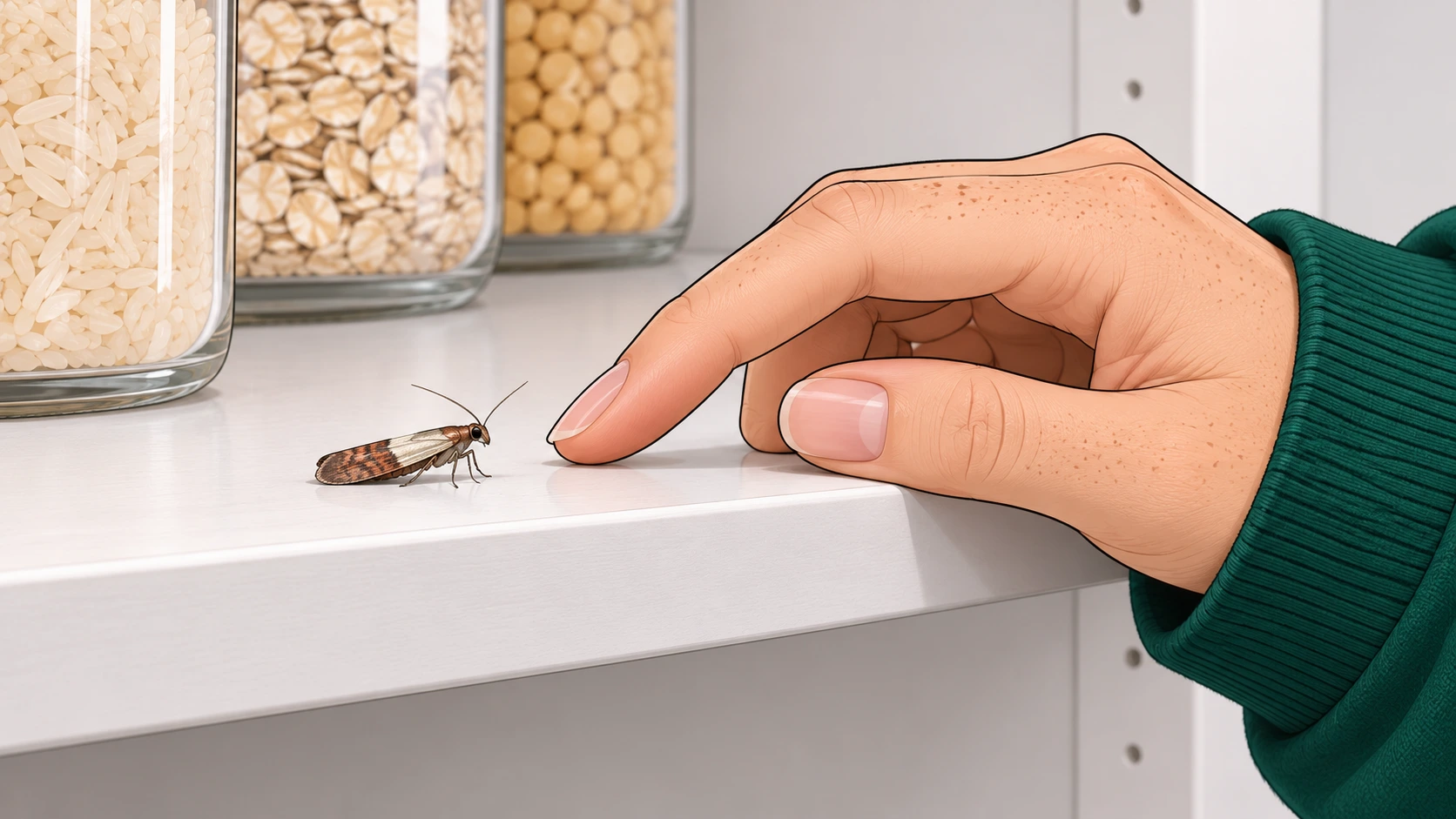
Indian meal moths do not bite humans. Neither the flying adults nor their caterpillar-like larvae are adapted to pierce human skin, feed on blood, or attack people. If you notice itchy bumps or red marks after seeing Indian meal moths in your kitchen, the moths themselves are not a likely explanation.
Indian meal moths (Plodia interpunctella) are stored-food pests. Their larvae feed on dry products such as cereal, flour, grains, nuts, and dried fruit. Adults are mainly concerned with reproduction and may fly through rooms far from the food where they developed.
The confusion often starts when someone discovers moths and skin marks around the same time. A moth may land on a person’s arm, or a caterpillar may crawl across a hand while an infested package is being inspected. Neither observation demonstrates a bite.
The most useful distinction is between an insect touching your skin and an insect being capable of biting it. Indian meal moths can make contact with people, but their normal feeding structures and behavior do not support human biting.
Can Adult Indian Meal Moths Bite Humans?
Adult Indian meal moths are not biting insects. They do not seek human blood, have no stinger, and do not use their mouthparts to puncture skin.
An adult may flutter close to your face, rest on your clothing, or land on exposed skin. These encounters happen because adults can fly around the home, including into rooms that contain no infested food.
The adult stage is associated primarily with mating and egg laying, rather than feeding on stored groceries. The damage to food is caused by the larvae.
A species-specific description of Indian meal moth adult behavior confirms that adults normally do not feed. This is one reason a flying moth is not searching for a meal on your body.
Do Indian Meal Moths Have Mouthparts?
Yes. It would be inaccurate to say that adult Indian meal moths have no mouthparts at all.
The adults possess a coiled feeding structure called a proboscis. Research examining this species has identified anatomical structures associated with the potential uptake of liquids, although ordinary adult feeding is not generally observed.
The important point for the biting question is that this proboscis is not a blood-feeding needle or a pair of jaws capable of biting human skin.
Indian meal moths are not equipped like mosquitoes or other blood-feeding insects. Their mouthparts are not adapted to puncture the skin and withdraw blood.
A more detailed examination of their proboscis, adult feeding capability, and dependence on resources accumulated during larval development belongs in do adult Indian meal moths eat?.
Can an Adult Moth Hurt You When It Lands?
An adult Indian meal moth landing briefly on your skin is not expected to cause a bite or sting injury.
You may feel its legs touching your arm, particularly if it moves before flying away. The sensation can be surprising, but movement across the skin should not be interpreted as feeding.
A moth also may brush against your face or hair when flying around a light. That contact is not evidence of an attack.
If you experience a painful skin reaction, persistent itching, or swelling around the same time, the cause should be assessed independently rather than attributed to the moth simply because it was nearby.
Can Indian Meal Moth Larvae Bite?
Indian meal moth larvae have chewing mouthparts, but they are adapted to eating stored food, not biting people.
This distinction matters because larvae are different from adult moths. The caterpillars possess mandibles that allow them to feed on suitable dry products. They can also interact with vulnerable food packaging as they move and feed.
However, having chewing mouthparts does not mean an insect normally bites human skin. Indian meal moth caterpillars are not predators, blood feeders, or parasites of people.
The stored-food feeding behavior of Indian meal moth larvae involves food particles, grain products, and other suitable materials. Larvae cause damage through feeding and silk production, not by attacking humans.
What if a Caterpillar Crawls Across Your Hand?
A larva may crawl onto your hand while you are handling a contaminated food package or cleaning a shelf. You may feel it moving or notice a slight tickling sensation.
That is not a bite.
Remove the caterpillar with a tissue or another suitable collection method and wash your hands after handling the insect or contaminated food.
There is no need to apply bite medication merely because a larva touched your skin.
If a skin problem develops afterward, avoid assuming the caterpillar bit you. Skin irritation can have different causes, and a temporal association does not establish the mechanism.
For additional identification details, see what Indian meal moth larvae look like.
Why Do People Think Indian Meal Moths Bite?
The most common reason is timing. Someone may discover moths in a kitchen, bedroom, or storage area around the same time they begin noticing itching or red bumps.
When two unfamiliar things appear together, it is natural to suspect a connection. But an Indian meal moth sighting is not evidence that the moth caused a skin lesion.
Adult Indian meal moths can move away from their original feeding location. They may appear near windows, ceilings, lights, or other areas of the home.
Their presence in a bedroom, for example, does not mean they are feeding on sleeping people. It may simply mean an adult flew into the room from another location.
The ability of adult Indian meal moths to move into distant rooms makes it particularly important not to interpret their location as evidence of biting behavior.
Does a Moth Landing Near a Red Mark Prove It Bit You?
No. Finding an insect close to a skin mark does not prove causation.
Suppose you notice a moth on your bedside wall in the morning and discover two itchy bumps on your arm. The moth’s presence tells you that an adult insect entered the room. It does not establish what caused the bumps or when they developed.
Even witnessing a moth land on the affected area would not demonstrate a bite. You would need evidence of a mechanism that is consistent with the species.
Indian meal moths lack the feeding adaptations associated with human blood feeding, and they are not recognized as biting pests.
The appropriate conclusion is that the skin marks require their own assessment.
Can Indian Meal Moths Bite While You Sleep?
No. Indian meal moths do not feed on sleeping people.
An adult may fly into a bedroom or settle on a wall, ceiling, curtain, or another surface. Such sightings are not unusual when moths have emerged elsewhere in a home.
Unlike insects that seek a blood meal, Indian meal moths have no reason to approach a sleeping person for feeding.
If unexplained skin marks appear after sleep, do not identify Indian meal moths as the cause based on a nearby sighting. The marks alone also cannot establish which other explanation, if any, is responsible.
What Should You Do if You Have Bite-Like Marks and Indian Meal Moths?
First, separate the skin concern from the moth observation.
Indian meal moths are not considered biting or stinging household insects. The presence of these moths therefore does not provide a convincing explanation for newly appearing bite-like marks.
It is also important not to identify a different pest from skin marks alone. Red bumps, itching, and localized swelling can arise from several causes, and visual appearance often overlaps.
A sensible response depends on what you actually observe.
| What you notice | What it means for the moth question | Appropriate response |
|---|---|---|
| An adult moth lands on your arm | Contact does not indicate biting | Remove it if desired; no bite treatment is normally needed |
| A larva crawls across your hand | Movement does not establish a bite | Collect it and wash your hands |
| Itchy bumps appear near a moth sighting | Timing does not establish causation | Assess the symptoms separately |
| Bite-like marks recur but no insect is observed biting | The responsible cause remains unconfirmed | Seek an appropriate assessment if symptoms persist |
| Severe swelling, breathing difficulty, or fainting occurs | These symptoms cannot safely be explained by an ordinary moth encounter | Seek emergency medical help |
The distinction between bite evidence and insect sightings helps prevent unnecessary pest treatments and unsupported medical assumptions.
Should You Treat the Marks as Indian Meal Moth Bites?
No. There is no established pattern of Indian meal moth bites to use for identifying skin marks.
Descriptions of supposed Indian meal moth bite marks as red dots, clusters, welts, or punctures should be treated skeptically. These insects are not recognized as human-biting pests, so assigning a characteristic bite appearance to them is misleading.
Do not choose an insecticide or other pest-control treatment based solely on a rash or a few marks.
If itching or skin lesions persist, a healthcare professional can assess the symptoms. If there is independent evidence of another insect problem, that evidence can be investigated separately.
Are Indian Meal Moths Dangerous When They Touch You?
Ordinary contact with an adult Indian meal moth is not considered dangerous. The insects do not attack people or inject venom through a sting.
Their principal importance in the home is related to the food in which their larvae develop.
A larva inside cereal, for example, may have left silk, droppings, and shed skins among the contents. That is a stored-food contamination issue, not a biting hazard.
General pantry pest guidance distinguishes these insects from pests that bite or sting and identifies contamination of dry foods as their main household impact.
If you find a moth on your skin, simply remove it. If you discover larvae inside food, assess the food separately rather than focusing on the possibility of a bite.
For the broader distinction between direct harm and food contamination, see are Indian meal moths dangerous to your health?.
Can Touching Moth Dust or Larvae Cause Itching?
Contact with insects or dusty stored materials should not automatically be treated as a bite. The wings of moths have scales, and infested foods can contain various kinds of insect debris.
However, a specific itching episode cannot reliably be attributed to Indian meal moth material merely because exposure occurred.
There are separate questions about sensitivities, allergic reactions, and the significance of insect-related environmental exposures. Those require evidence beyond the mechanics of biting.
Our article on Indian meal moth allergies and disease concerns examines those issues without treating them as bites.
How Can You Tell Whether the Insect Is Actually an Indian Meal Moth?
Identification matters when someone reports being bitten by a moth.
An adult Indian meal moth is typically a small, narrow-winged insect whose forewings have a pale gray or tan portion closer to the body and a coppery or reddish-brown outer portion.
These contrasting wing markings can be less obvious on worn individuals, but they remain useful clues.
The adult is generally seen flying around a kitchen or resting on walls and ceilings. The larvae are caterpillars associated with stored products and may produce silk webbing where they feed.
The appearance and behavior of the species are described in Indian meal moth identification guidance.
If an insect is actually seen piercing skin or taking blood, it should not be identified as an Indian meal moth on that observation alone. Obtain an identification based on the insect’s physical features, not its presumed name.
For a more complete visual identification framework, see what an adult Indian meal moth looks like.
What if You Keep Seeing Moths Around Your Body or Bed?
Repeated moth sightings around your bed or clothing do not change the species’ inability to bite.
Adults can fly into rooms away from the original infestation. Some may be drawn to indoor lighting, while others settle on nearby surfaces during their movement through the home.
A moth’s location is therefore not enough to identify its developmental source.
You do not need to treat a mattress, bedding, or a person’s skin with insecticide because an Indian meal moth landed there. Such applications are unlikely to address the actual source and could create unnecessary chemical exposure.
If the moths are correctly identified, investigate susceptible stored products rather than assuming they are living on people.
The complete pest-management procedure is covered in how to get rid of Indian meal moths. For this biting question, the central point is that moths moving through a bedroom do not constitute evidence of an insect feeding on occupants.
Frequently Asked Questions
Do Indian Meal Moths Bite or Sting?
No. Indian meal moths are not human-biting insects and do not have stingers. Their larvae feed on stored food, while adults are primarily involved in reproduction.
Can Baby Indian Meal Moths Bite?
The larvae, sometimes described as baby moths or small caterpillars, have chewing mouthparts suited to their food. They are not adapted to biting human skin and are not recognized as biting pests.
Do Indian Meal Moths Suck Blood?
No. Indian meal moths are not blood-feeding insects. Their adults do not possess the specialized piercing mouthparts required to obtain blood from humans.
Can Indian Meal Moths Bite Through Clothes?
No. They do not bite people through clothing or exposed skin. A moth resting on your shirt does not indicate that it is trying to feed on you.
Do Indian Meal Moth Bites Leave Red Marks?
There is no established Indian meal moth bite pattern because these insects do not bite humans. Red marks or itching that occur near a moth sighting require another explanation and should not be attributed to the moth without evidence.
Can Indian Meal Moths Bite You at Night?
No. Indian meal moths do not become human-biting pests at night. Adults may fly or rest indoors during nighttime hours, but that behavior does not involve feeding on people.
Can Indian Meal Moth Larvae Hurt Your Skin?
Ordinary contact with a larva is not expected to cause a bite injury. If you develop persistent or unusual skin symptoms after handling infested material, seek an appropriate medical assessment rather than assuming a caterpillar bite.
Indian Meal Moths Are Not the Cause of Human Bites
Indian meal moths can be annoying when adults fly around the home, and their larvae can contaminate dry stored food. Neither problem involves biting people.
The larvae have chewing mouthparts adapted to food, while adults possess a proboscis that is not designed to pierce skin or draw blood. A moth landing on a person, crawling nearby, or appearing in a bedroom does not establish a bite.
If you have unexplained itchy marks, investigate the symptoms separately instead of assuming the moth is responsible. If you have confirmed Indian meal moths, focus on the stored-food evidence that explains their presence.
Indian meal moths do not bite humans. Their real household impact comes from larvae feeding in stored products, not from injury to your skin.
One thought on “Do Indian Meal Moths Bite?”