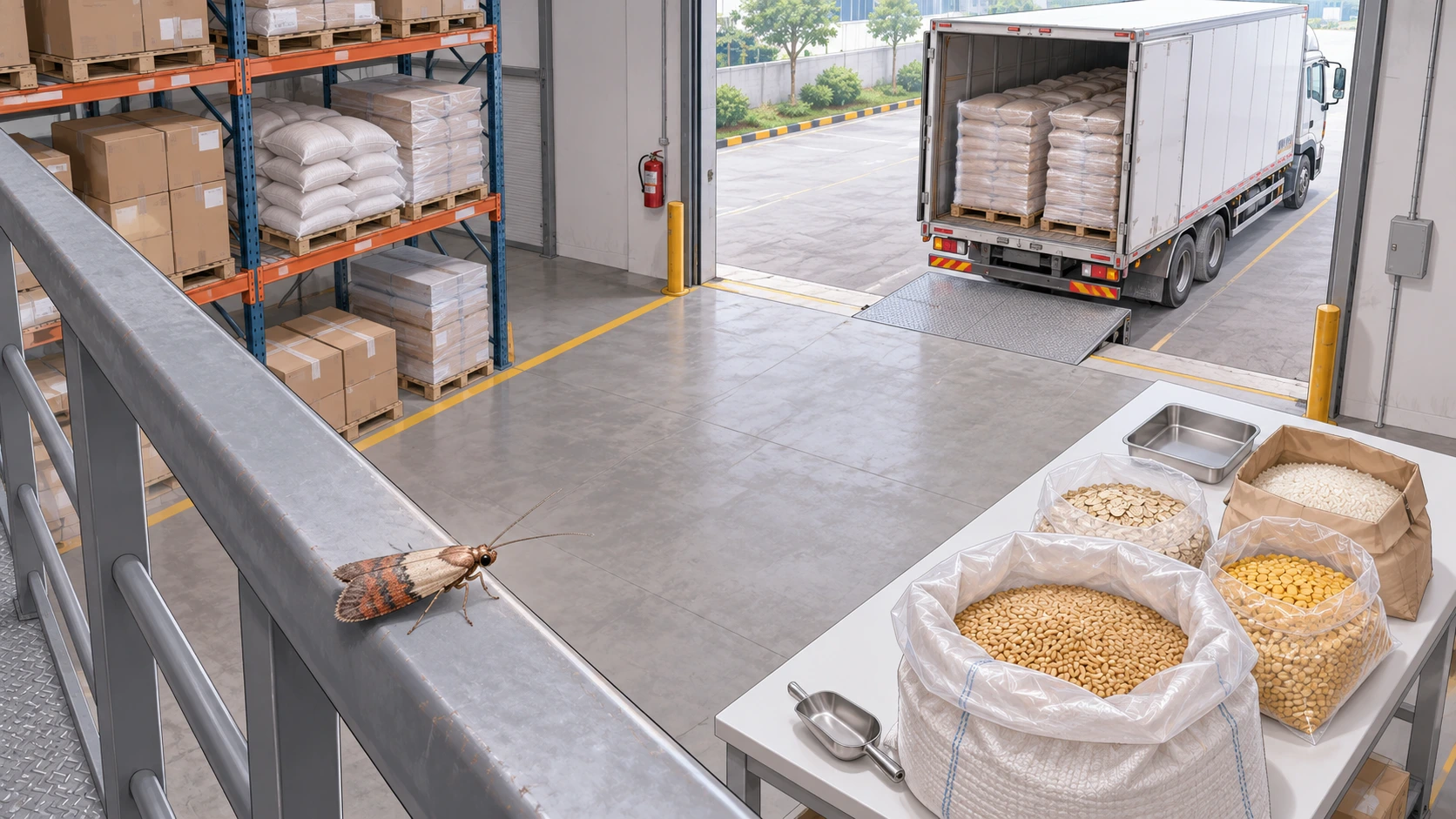
Indian meal moths are commonly described as native to South America, but their exact geographic origin is not firmly established across the entomological literature. Some published references identify South America as their original home, while older scientific works describe an Old World origin. What is much more certain is that Indian meal moths, Plodia interpunctella, are now distributed around the world.
The species is found throughout the United States, across Canada, and in many parts of Europe, Asia, Africa, South America and Oceania. Its worldwide distribution is closely connected to the movement of stored foods and agricultural commodities through trade.
This distinction between where an insect originated and where it occurs today is important. Finding Indian meal moths on several continents does not mean they evolved independently in those places. Equally, discovering them in imported food does not establish the country or continent where the species originally evolved.
The Indian meal moth provides a particularly useful example of how centuries of movement through stored products can make the original range of a familiar pest difficult to reconstruct.
Are Indian Meal Moths Native to South America?
South America is the native-region attribution found in several modern moth-identification references.
The Indian meal moth is listed as originally native to South America but now found worldwide in Butterflies and Moths of North America. Other contemporary identification resources make the same attribution.
That is why a search for the moth’s origin often produces the straightforward answer “South America.”
However, it would be misleading to present that answer as completely undisputed.
Historical entomological publications have offered a different explanation, identifying the moth as a probable or definite native of the Old World. These conflicting statements show that the native-range question has not always been treated consistently.
The available identification references establish that South America is a commonly cited origin, but they do not, by themselves, demonstrate that the question has been resolved through a comprehensive modern reconstruction of the species’ ancestral range.
A carefully worded answer is therefore more useful than an absolute claim: Indian meal moths are often considered South American in origin, although historical sources disagree and the precise native range remains uncertain.
Why Do Some Sources Say Indian Meal Moths Came From the Old World?
The Old World attribution appears in historical scientific literature, including research published well before modern online identification databases existed.
For example, a 1913 Kansas agricultural bulletin described the Indian meal moth as native to the Old World while noting its widespread occurrence in the United States.
Other historical work similarly connected the species with an Old World origin. A mid-twentieth-century California study described Plodia interpunctella as probably native to the Old World and already cosmopolitan through commerce.
These were not claims that the insect occurred only in Europe, Asia or Africa at the time. The authors recognized that it had spread widely. Their disagreement concerns where the species originated before becoming globally established.
The phrase Old World is itself broad. It traditionally encompasses Europe, Asia and Africa rather than identifying a precise country or biological region.
Consequently, even accepting an Old World hypothesis would not establish that the moth originated in a particular European or Asian nation.
| Origin statement | What the statement supports | Important limitation |
|---|---|---|
| Native to South America | A widely repeated attribution in modern identification references | Does not by itself establish a definitive ancestral location |
| Native to the Old World | An attribution found in historical entomological literature | Refers to a very broad geographic region |
| Found worldwide | The well-supported modern distribution | Does not establish the original native range |
| Frequently found in imported products | International transport and introduction are well documented | The shipment’s origin is not necessarily the species’ evolutionary origin |
The disagreement is not a reason to dismiss every geographic statement about the moth. It is a reason to distinguish a historical native-range hypothesis from a documented modern occurrence.
Why Is the Original Native Range Difficult to Establish?
Indian meal moths are exceptionally well suited to being transported with stored products. Their larvae develop within suitable dry materials, and infested commodities can be moved long distances without the insects being obvious at the time of shipment.
That long association with human food storage complicates efforts to establish a natural geographic baseline.
When a species has been moved repeatedly between continents, a specimen collected in one country may represent a population established through trade rather than a population that has always been native to the region.
Historical collection records also have limitations. The first known published record from a place is not necessarily the first time the insect was present there. It may simply be the first documented observation that has survived.
The same problem applies in reverse. A moth recorded from Europe in an early scientific publication could have been transported there before anyone formally described it.
A convincing reconstruction of native range would require more than a list of countries where specimens have been collected. It would benefit from historical records, evidence concerning populations outside human storage, and population-level genetic or phylogeographic research capable of testing competing origin hypotheses.
The sources reviewed for this article do not establish a definitive modern resolution between the South American and Old World attributions.
The defensible conclusion is that its current global distribution is certain, while its ancestral geography is less securely established.
Where Are Indian Meal Moths Found Today?
Indian meal moths have a cosmopolitan distribution, meaning they occur across much of the world rather than being restricted to one geographic region.
They are documented across North America and in many countries throughout South America, Europe, Africa, Asia and Oceania.
A major scientific review of Indian meal moth biology and management describes the species as occurring on every continent except Antarctica.
That is a useful geographical summary, although it should not be interpreted as a claim that every country, province or climatic zone has the same level of infestation.
A moth can be widespread internationally while remaining closely associated with particular habitats and materials within each region.
For Indian meal moths, those associations often include stored-food environments such as grain-handling facilities, warehouses, food retailers and homes.
Their recorded presence in a country also does not mean they are continuously abundant in every outdoor environment within that country.
Indian Meal Moth Distribution by Region
| Region | What is established |
|---|---|
| United States | Widespread, with records throughout the country in stored-product environments |
| Canada | Found across the country, including coast-to-coast records |
| Central and South America | Established occurrence; South America is also the native-range attribution used by several modern references |
| Europe | Widely recorded in stored-product environments |
| Africa | Recorded across multiple regions, including in stored commodities |
| Asia | Widely recorded, including in internationally traded products |
| Australia and New Zealand | Recorded as part of the species’ broad global distribution |
| Antarctica | Not included in the established continent-level distribution reported by the scientific review |
This table summarizes documented geographic occurrence. It is not a ranking of infestation severity, and it does not assign native or invasive status to each region.
The useful point is that Indian meal moths are no longer geographically restricted in the way that some insects with narrower distributions are.
Where Are Indian Meal Moths Found in the United States?
Indian meal moths are found throughout the United States wherever suitable stored products and conditions support them.
Their occurrence is not confined to the South, despite the warm conditions associated with faster insect development. They are also encountered in northern states, where indoor food storage provides conditions different from those outdoors.
The species’ widespread distribution throughout the United States is well established in university entomology guidance.
Geographic occurrence does not mean identical seasonal activity in every location. Temperature, food availability and the conditions inside buildings affect the insects’ development and persistence.
This is why a pest associated with stored foods can occur in regions with very different climates.
The relevant geographic question is not simply whether the local winters are cold or summers are hot. Stored products are moved and kept in buildings with their own environmental conditions.
The detailed requirements for surviving and reproducing outside buildings belong to whether Indian meal moths can live outdoors, rather than to an account of worldwide distribution.
Are Indian Meal Moths Found in Canada?
Yes. Indian meal moths are recorded throughout Canada.
The Canadian Grain Commission identifies the species as present worldwide and found coast to coast in Canada.
That broad distribution includes regions where outdoor conditions are far colder than those normally associated with rapid moth development.
Its presence in Canada is consistent with the species’ connection to stored products and buildings. Food processing, grain storage, distribution and retail networks provide recurring opportunities for the insects to occur.
However, a coast-to-coast distribution statement does not establish equal numbers in every province or that a population will reproduce continuously outdoors during winter.
It is a record of geographic occurrence, not a description of year-round outdoor suitability.
Are Indian Meal Moths Found in Europe, Asia and Africa?
Yes. Indian meal moths are widely recorded across these regions, particularly in stored-product environments.
Their presence in Europe has been documented for generations, while modern species records and research also describe populations associated with stored foods in Asian and African countries.
The breadth of the distribution is not surprising given the range of commodities that can support the moth’s larvae. Grains, dried fruits, nuts, seeds and other suitable materials are handled and transported internationally.
A species moving with traded goods may appear in very different regions without needing to undertake long-distance natural migration.
There is also an important distinction between a moth being detected in an imported consignment and a population being established outside the shipment.
A border interception establishes that the insect was associated with the transported material. It does not necessarily establish where the insect population developed originally, whether it is established in the destination country or whether it was native to the export country.
This difference matters particularly when interpreting international pest databases.
How Did Indian Meal Moths Spread Around the World?
International movement of infested stored products is the principal explanation for the moth’s extensive global distribution.
Indian meal moth larvae can develop in dried plant-based commodities and processed foods. These materials have been traded over long distances for centuries, providing opportunities for eggs, larvae or pupae to be carried between locations.
The insects do not have to fly across oceans to arrive on another continent. They can be transported inside or alongside infested goods.
Commercial shipping records provide direct support for this pathway. The scientific review of Plodia interpunctella reports the species in infested commodities transported by ocean freight and in food products imported into the United Kingdom from Africa.
That is stronger evidence than simply assuming that international trade must have been involved because the moth is widespread.
The ability to move through transport networks helps explain why Indian meal moths are found in distant regions with otherwise very different climates and ecosystems.
What Do Import Interceptions Tell Us?
Inspection records show that Indian meal moths can be associated with internationally traded materials from numerous countries.
A specialized identification resource for moth larvae intercepted through trade records Plodia interpunctella in products from several origins, including China, India, Iran and Mexico, and describes the species as worldwide in distribution.
The records are valuable because they connect real insect identifications with commercial pathways.
But a country’s appearance in an interception record should not be mistaken for evidence that the moth originated there.
Consider a shipment exported from one country after its ingredients were gathered, processed or stored in several others. The moth’s presence in the final shipment does not reveal every earlier step in the commodity’s movement.
Even when the product was grown entirely in the exporting country, the insect population associated with it may have arrived there through previous introductions.
A trade record identifies a pathway and a point of detection. It is not, by itself, a native-range study.
Did Indian Meal Moths Spread Naturally or Through Human Activity?
Indian meal moths can fly, and local movement is part of how adults disperse around suitable environments.
However, local adult flight should not be confused with the ability to cross oceans or travel independently over continental distances.
The published review of Indian meal moth biology notes that there is no evidence of natural migrations over such distances. By contrast, the species has been documented in internationally transported commodities.
This makes human-assisted movement a much stronger explanation for its presence across widely separated continents.
A useful distinction is between three scales of movement.
At a local scale, a moth may move within a building or between nearby suitable locations. At a regional scale, insects can be carried along with food and other stored products through distribution networks. At an international scale, commodity transport can cross geographic barriers that the insect is not known to cross by natural migration.
These mechanisms can operate together. Human transport introduces insects to new places, while local movement may contribute to their spread within an area where suitable conditions and materials are available.
That does not establish how every individual population first arrived, but it provides a well-supported explanation for the species’ broad distribution.
Why Are Indian Meal Moths Found in So Many Different Climates?
Their global occurrence reflects both the movement of suitable commodities and their association with protected storage environments.
A warehouse, grocery store, grain facility or heated home does not experience the same conditions as the surrounding landscape.
That difference can allow populations to persist in places where the outdoor climate would otherwise impose major seasonal limitations.
Indian meal moths are therefore associated with a broad geographic range without being equally adapted to every outdoor environment.
A moth recorded in a northern country may be living and reproducing primarily in stored-product settings, while populations in warmer regions may encounter different opportunities outside buildings.
The distinction between distribution and climate suitability is especially important when interpreting global occurrence maps.
A dot on a map usually indicates that a species has been recorded. It does not necessarily show where the insect first evolved, whether it thrives outdoors or how frequently infestations occur.
Does Worldwide Distribution Mean Indian Meal Moths Are Native Everywhere?
No.
A species can become widespread through introductions and transport without being native to every region where it occurs.
The words native, introduced, established and cosmopolitan describe different aspects of geographic occurrence.
A native range concerns the region where a species occurred without human introduction. An introduced occurrence involves arrival through human activity, whether deliberate or accidental. An established population is able to persist and reproduce in the relevant environment. Cosmopolitan describes broad geographic distribution.
These concepts are related, but they are not interchangeable.
A globally distributed stored-product pest may have numerous established populations outside its ancestral range.
Determining whether those populations should be classified as invasive requires additional regional evidence and a more specific definition than worldwide presence alone.
That separate question is addressed in whether Indian meal moths are an invasive species.
For this article, the important conclusion is that worldwide occurrence does not erase the distinction between an original native range and areas reached through human movement.
Does the Name “Indian Meal Moth” Reveal Its Geographic Origin?
No. The common name does not identify the country of India as the moth’s birthplace.
The term Indian meal was historically used for cornmeal, referring to ground maize. The moth’s common name developed from an association with that stored food.
That history is explained in why Indian meal moths have their name.
It would also be a mistake to conclude that the moth must have originated in the Americas solely because the food term referred to maize.
The material that inspired a common name and the ancestral distribution of the insect are separate historical questions.
An insect can receive a name in one location because of a particular encounter, even if the species evolved somewhere else.
The native-range discussion must therefore stand on geographic and biological evidence, not on an interpretation of the word Indian.
How Can You Interpret a Map Showing Indian Meal Moth Records?
A distribution map can be useful, but it is important to understand what the underlying records represent.
Some maps show specimens collected in a particular area. Others combine published observations, institutional collections, citizen-science submissions or records from commercial and agricultural settings.
A record can document an adult caught in a trap, a specimen from a stored product or a confirmed identification from a particular locality. Those records are not necessarily comparable measures of population abundance.
More records in one region may reflect more observation and reporting rather than a genuinely larger population.
Likewise, an area with few records is not automatically free of Indian meal moths. The species may be present but underreported, especially when occurrences are confined to private or commercial storage environments.
When using maps, it helps to distinguish the following:
| What a map or record shows | What it can support | What it cannot establish alone |
|---|---|---|
| A confirmed specimen location | Occurrence at a particular place and time | Native status |
| Many records across a country | Broad documented distribution | Equal abundance everywhere |
| An imported-product interception | Presence in a transported commodity | Original evolutionary homeland |
| A specimen from an indoor store | Occurrence in a protected environment | Year-round outdoor establishment |
| An old published record | Historical documentation of the species | Its first-ever arrival in that region |
This framework is especially useful when older scientific accounts disagree about origin but modern databases agree about worldwide occurrence.
The records can establish distribution with considerable confidence while leaving questions about ancestry unresolved.
What Can We Say With Confidence About the Indian Meal Moth’s Origin?
Three conclusions are supported at different levels of certainty.
Its present distribution is worldwide. The species is recorded across major inhabited regions and is particularly associated with stored products.
Human transport has contributed to its spread. Scientific publications and interception records document Indian meal moths moving with internationally traded commodities.
Its exact ancestral range is less certain. South America is commonly given as the native region in modern identification references, but historical entomological literature has attributed an Old World origin.
The historical disagreement does not justify treating all possibilities as equally proven. South America remains a frequently cited attribution. The point is that a repeated attribution is not the same thing as a conclusive explanation of the species’ evolutionary and geographic history.
A statement such as “Indian meal moths originated in South America and are now found worldwide” reflects many current reference descriptions. A more cautious account adds that the historical literature has not been entirely consistent about their original range.
That extra context is warranted when the article’s central question is specifically about where the species is native.
The Bottom Line
Indian meal moths, Plodia interpunctella, are often described as native to South America, although older entomological sources identify an Old World origin. The exact ancestral range is therefore less firmly established than many short pest descriptions suggest.
Their current worldwide distribution is well documented. They occur throughout the United States, across Canada and on every continent except Antarctica, with records from many other countries and regions.
International trade in stored foods and agricultural commodities has played a major role in that spread. Infested products can move insects across geographic barriers that the moths are not known to cross through natural long-distance migration.
The distinction is simple but important: where Indian meal moths are found today is a documented global pattern; where they first originated is a historical question that deserves more careful qualification.