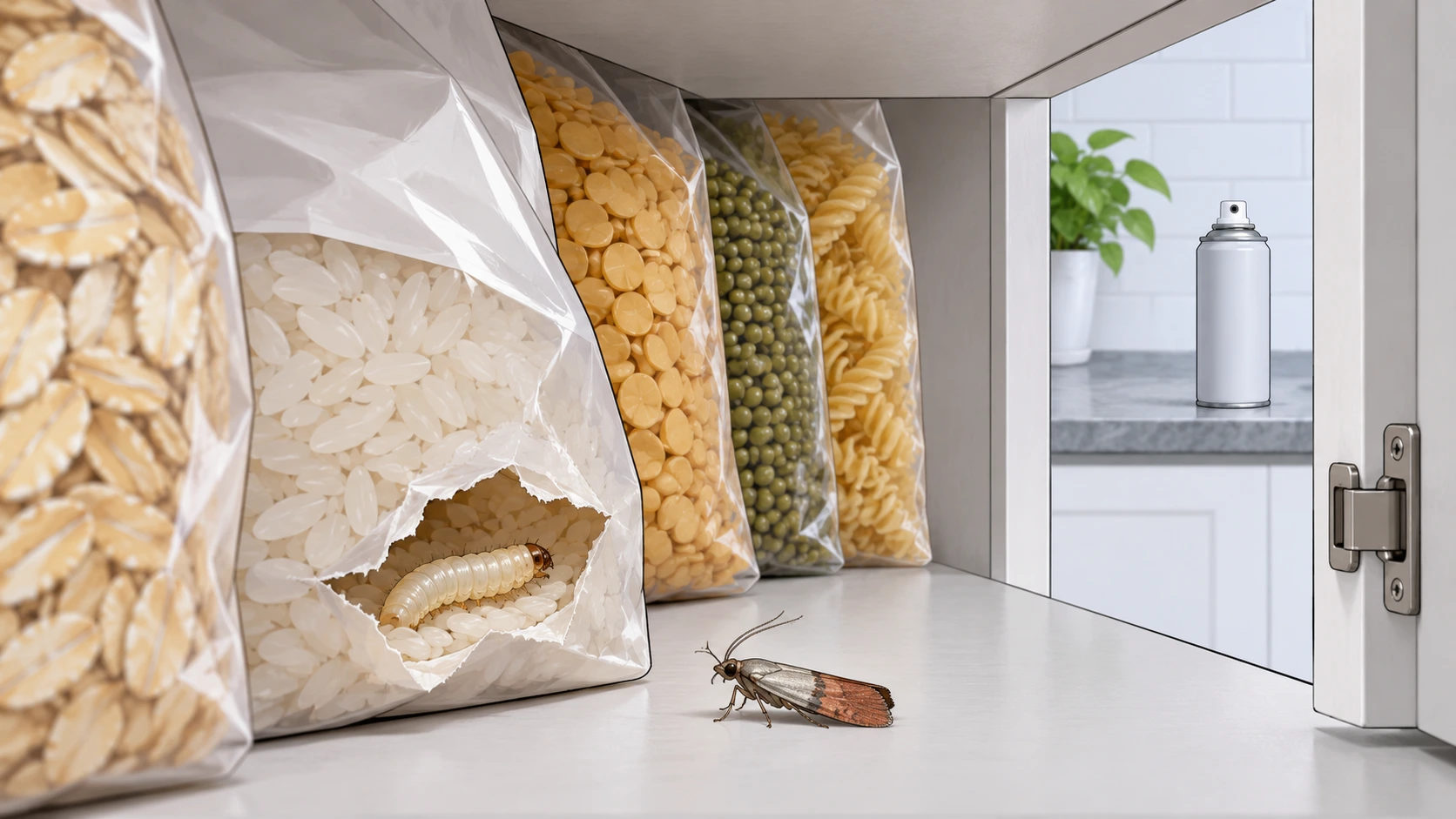
Foggers and bug bombs can kill exposed adult Indian meal moths, but they rarely eliminate an infestation. Their insecticide mist can contact moths flying through a room or resting on exposed surfaces. However, the spray cannot reliably penetrate food packages, dense silk webbing, or protected spaces where eggs, larvae, and pupae may be present.
That limitation makes total-release foggers a poor choice for most Indian meal moth infestations. You might find several dead moths after using one, only to notice fresh adults appearing later because developing insects survived inside stored products.
There is also a food safety problem. Bug bombs distribute pesticide across exposed surfaces, including countertops and other areas used to prepare or store food. The precautions needed to prevent contamination can be substantial, while the treatment does little to address the source.
For a typical household pantry infestation, we would not recommend using a bug bomb. Removing infested material is more important than killing the adults already flying around the room.
What Does a Bug Bomb Actually Do?
A household bug bomb is a total-release fogger. Once activated, its contents discharge into the surrounding air without someone continuously operating the canister.
The released material consists of fine aerosol droplets containing pesticide. These droplets disperse through the room and eventually settle onto exposed objects and surfaces. Insects that receive a sufficient dose may be killed or incapacitated.
This is different from filling every space with a penetrating gas. A total-release fogger does not reliably carry insecticide deep into closed packages, wall voids, or narrow cracks.
The distinction is central to the limitations of total-release foggers. The mist settles where it can travel, leaving sheltered locations with little or no direct exposure.
Indian meal moths (Plodia interpunctella) are especially poorly suited to this treatment method because the damaging stage develops within stored materials. Reaching an adult flying near a ceiling is much easier than reaching a caterpillar surrounded by food inside a folded paper package.
Is a Bug Bomb the Same as Fumigation?
No. A household total-release fogger disperses aerosol droplets. True fumigation uses a gaseous fumigant under controlled conditions, with different equipment, hazards, and regulatory requirements.
The word fogging can make a retail bug bomb sound like a treatment that penetrates every hidden space. It does not.
That distinction matters when evaluating claims about eggs or larvae inside sealed or partly enclosed food products. A retail aerosol fogger should never be assumed to penetrate packaging merely because a room becomes visibly misty.
Which Indian Meal Moth Stages Can a Fogger Kill?
The effects of a fogger depend on whether pesticide reaches the insect, the product’s active ingredients, the dose received, and the insect’s susceptibility.
An exposed adult may be relatively easy to contact. A larva feeding inside a package is much harder to reach. Eggs and pupae introduce additional uncertainty because they may be protected by surrounding materials and may respond differently to particular active ingredients.
| Indian meal moth stage | Typical location | What a total-release fogger can realistically do |
|---|---|---|
| Adult moths | Flying or resting on exposed surfaces | May kill or temporarily suppress adults that receive sufficient exposure |
| Eggs | On or near stored food, including protected surfaces | Cannot be relied upon to reach or kill all eggs |
| Feeding larvae | Inside food, often among silk and food particles | Unlikely to receive reliable exposure while protected in the product |
| Wandering mature larvae | On exposed walls or moving through storage areas | May be affected if directly exposed, but protected individuals can survive |
| Pupae | Within cocoons, package folds, corners, and other sheltered sites | Not reliably controlled because exposure may be limited |
This comparison is based on insect exposure and the documented locations of Indian meal moth stages. It is not a measured kill-rate comparison for a particular fogger formulation.
The Canadian Grain Commission’s account of Indian meal moth development identifies larvae as the damaging stage and describes pupation in silken cocoons on or near food.
Those protected locations explain why killing exposed adults produces such an incomplete result.
Will Bug Bombs Kill Adult Indian Meal Moths?
Some will. Pyrethrin-based foggers can provide temporary suppression of adult Indian meal moths when the insects are exposed to the aerosol.
That possibility is specifically recognized in stored-product pest control guidance, which also warns that aerosols alone will not control the infestation while affected food remains.
You may see dead adults on windowsills, countertops, or the floor after a treatment. However, a visible reduction in flying moths does not establish that eggs or larvae were killed.
Even the adult kill is not necessarily complete. A moth resting inside a sheltered space may avoid contact, and some insects may receive an insufficient dose.
There is no dependable household kill percentage that applies to every fogger, room arrangement, or Indian meal moth population.
Do Bug Bombs Kill Indian Meal Moth Eggs?
You should not rely on a total-release fogger to kill Indian meal moth eggs.
A particular insecticide may affect exposed eggs under suitable conditions, but that does not establish reliable control in a household infestation. Eggs can be deposited on or near stored products, and pesticide mist may never reach their surfaces.
Many foggers are designed primarily to kill insects through contact with exposed surfaces or aerosol droplets. Their labels may not claim effective control of Indian meal moth eggs.
Unless a registered product specifically supports that use, claims that a bug bomb kills every egg in a pantry are unjustified.
Will a Fogger Kill Larvae Inside Flour, Cereal, or Pet Food?
A total-release fogger cannot reliably kill Indian meal moth larvae developing inside stored food.
The package creates a physical barrier, while the food itself and the larvae’s silk can provide additional protection. Even an opened bag does not guarantee that insecticide will contact every caterpillar inside it.
Using more pesticide to force better penetration is not a safe solution. It increases contamination and exposure risks without establishing control of insects protected within the product.
The feeding and sheltering behavior of Indian meal moth larvae is why the affected material must be dealt with directly.
Food that becomes contaminated by pesticide should not be salvaged by brushing away the visible residue or transferring it into another container.
Can Foggers Kill Indian Meal Moth Pupae?
Some exposed pupae might be affected by a particular insecticide, but a typical bug bomb is not a reliable treatment for them.
Indian meal moth larvae commonly leave their feeding material before pupating. Cocoons may occur in sheltered package folds, cabinet joints, or other protected locations.
The moth’s cocoons on walls and ceilings can be visible, but many pupation sites are less obvious.
A fogger may deposit pesticide on the outside of a sheltered area without providing sufficient exposure to the pupa inside. That creates the possibility of adults emerging after treatment.
Why Do Indian Meal Moths Return After a Bug Bomb?
The most common explanation is that the fogger killed some adults while leaving the developing infestation untouched.
Consider a kitchen with a forgotten bag of infested birdseed in a cabinet. The bag contains feeding larvae and perhaps individuals preparing to pupate. A homeowner activates a fogger, sees dead adults afterward, and assumes the treatment was successful.
The larvae inside the birdseed remain protected. When development continues, new adults can emerge and begin appearing around the kitchen again.
This is a predictable limitation of the method, not necessarily proof that the surviving moths have developed insecticide resistance.
Another possibility is that some adults escaped exposure by resting in sheltered locations. The fogger’s aerosol can spread through open space without depositing an effective dose inside every crack or package fold.
Therefore, a temporary drop in flying moths is not evidence that an Indian meal moth infestation has been eliminated.
Why Foggers Cannot Reach the Most Important Hiding Places
Fogger performance is governed partly by where its droplets can travel and settle.
An open countertop may receive considerable residue. A tightly closed food container receives little or none inside. A cardboard package may have narrow seams and folds that are difficult for aerosol droplets to penetrate.
The same issue applies to deep joints between shelves, protected corners, and narrow gaps.
General insect-fogger research and extension guidance show that aerosol deposits poorly in concealed spaces. This is a physical limitation of total-release delivery, although the exact consequences vary among insect species and products.
For Indian meal moths, the problem is amplified by the fact that eggs and larvae are associated with stored food. You cannot solve that mismatch simply by making the room look more heavily fogged.
Would Opening Every Pantry Cabinet Make a Bug Bomb Work Better?
Opening a cabinet might expose some surfaces to more aerosol, but it does not make the method dependable for controlling Indian meal moths.
The contents of packages remain protected. There is also a greater opportunity for pesticide to settle on shelves, dishes, containers, and food-handling surfaces.
A fogger should never be placed or activated inside a cupboard or other small enclosed space. Such uses can create dangerous concentrations of flammable aerosol and are specifically warned against in fogger safety guidance.
Do not assume that a label authorizing treatment in a kitchen also authorizes placing the device inside cabinets or directing pesticide into stored food.
Are Bug Bombs Safe to Use in Kitchens and Pantries?
A kitchen or pantry presents particular concerns because pesticide residues can reach surfaces and objects involved in food storage or preparation.
A fogger does not distinguish between a moth resting on a counter and the counter itself. As aerosol droplets settle, they may contaminate exposed food, utensils, dishes, cookware, and other objects.
The EPA’s safety requirements for total-release foggers emphasize removing or protecting exposed food, following product-specific directions, vacating treated areas, and ventilating before normal occupancy resumes.
These precautions are especially consequential when the original problem involves edible products.
You should not deliberately expose food or animal feed to a household insecticide fogger. If food has been contaminated by pesticide, discard it rather than trying to wash or sift the residue away.
Food preparation surfaces and utensils require handling according to the product label, including any specified washing requirements before reuse.
For a pest that lives largely inside stored food, the trade-off is poor: a fogger can deposit pesticide where people handle food without reliably reaching the insects causing the infestation.
Can You Use a Bug Bomb in an Empty Pantry?
An empty pantry is not automatically an appropriate or label-authorized location for a total-release fogger.
Removing food and utensils reduces some contamination concerns, but it does not remove restrictions on confined spaces, ventilation, ignition sources, or permitted treatment areas.
A small pantry or closet may be specifically unsuitable for fogger activation. An empty pantry can also retain pesticide residues on shelves that will later hold food.
There is no reason to assume that using a fogger in an empty cupboard is necessary simply because Indian meal moths were found there.
What About Kitchens With Gas Stoves or Refrigerators?
The fire and explosion risk is particularly important around gas appliances and equipment that can produce sparks.
Fogger propellants may be flammable. Pilot lights, flames, and electrical appliances that cycle on and off can provide ignition sources.
The EPA warns against using foggers near ignition sources and requires users to follow precautions addressing pilot lights, appliances, and ventilation.
These warnings apply even if the fogger is intended to kill a different insect. Do not improvise around ignition sources or assume a closed appliance is safe merely because its motor is not running at that moment.
If the product’s ignition-control requirements cannot be met safely, do not use it.
Does the Bug Bomb Label Matter?
Yes. A pesticide label determines the product’s permitted uses and required precautions. There is no universal permission to use every bug bomb against Indian meal moths or in a pantry.
Two foggers on the same store shelf may have different active ingredients, target pests, treatment areas, preparation requirements, and restrictions.
A product advertised for flying insects is not automatically authorized for Indian meal moths. Similarly, a product labeled for use in residential rooms may include restrictions that make a particular food-storage location inappropriate.
Before considering any fogger, check these specific label questions.
| Label question | Why it matters for Indian meal moths |
|---|---|
| Is the target pest listed? | A general flying-insect claim does not necessarily authorize treatment for Indian meal moths |
| Is the intended location permitted? | Residential room authorization does not remove food-area or confined-space restrictions |
| What must be removed or covered? | Food, feed, utensils, and food-contact surfaces may require protection |
| What ignition precautions apply? | Flammable aerosol can create a fire or explosion hazard |
| Who must leave, and for how long? | People and pets must remain out for the label-specified period |
| What ventilation and cleaning are required? | Reentry does not necessarily mean every treated food-contact surface is ready for use |
This is a label-reading framework, not a claim that any specific retail fogger has been approved for treating Indian meal moth infestations in food-storage areas.
In the United States, check the current EPA-registered labeling and applicable state requirements. In Canada, use products registered by Health Canada for the intended pest and site, following the Canadian label. A product authorized in one country should not be assumed legal in another.
When a label prohibits a particular use, that restriction controls regardless of what a general pest-control article suggests.
Does Using Two Bug Bombs Work Better Than One?
Using extra bug bombs is unsafe and does not solve the penetration problem.
The amount of aerosol released is supposed to match the labeled treatment volume and instructions. Adding canisters can increase the concentration of flammable propellants and pesticide residues.
More aerosol in a room does not guarantee that the material reaches larvae inside a closed package or pupae sheltered in narrow crevices.
The EPA specifically warns against using more foggers than a product label permits because overuse can increase the likelihood of fire, explosion, and harmful exposure.
There is no sound reason to treat a persistent Indian meal moth infestation by repeatedly increasing the number of bug bombs.
What If You Have Already Used a Bug Bomb for Pantry Moths?
If you have already activated a fogger, focus first on the product’s safety instructions.
Do not enter the treated space before the label permits reentry. Follow the stated ventilation procedure, and keep people and pets away until the requirements have been met.
Next, address potentially contaminated food and food-contact items. Any exposed food that received pesticide should be discarded. Follow the label’s directions for cleaning utensils, cookware, shelves, and preparation surfaces.
If the product was used contrary to its instructions, or someone develops symptoms after exposure, contact a poison control service or healthcare professional and provide the product name and label information. Severe breathing difficulty, collapse, or other serious symptoms warrant emergency medical attention.
After the immediate safety concerns have been addressed, assess the moth problem separately.
A few dead adults do not mean the infestation has ended. If larvae remain inside a stored product, new adults may still appear.
Avoid automatically setting off another fogger when that happens.
Is There Any Situation Where a Fogger Makes Sense for Indian Meal Moths?
A properly registered and labeled fogger might temporarily reduce exposed adults in a suitable setting. That is a narrower objective than eliminating an infestation.
The question is whether killing those exposed moths provides enough benefit to justify the pesticide exposure, preparation requirements, residue cleanup, and possibility of fire.
For an ordinary household pantry, the answer is usually no.
Indian meal moth infestations are driven by developing larvae in stored material. Removing or otherwise appropriately addressing that material tackles the source, whereas a fogger primarily treats accessible airspace and surfaces.
The recommended control of insects in stored food emphasizes finding and removing infested products. Household insecticides do not control insects protected inside packages, and food contaminated by pesticide must be discarded.
If you are choosing between fogging a room and removing a clearly infested package, the package is the priority.
How Can You Tell Whether a Fogger Actually Worked?
Counting dead moths is a poor measure of whether the infestation has ended.
A fogger may kill several visible adults while protected larvae and pupae remain alive. In that situation, the treatment has produced an immediate effect without eliminating the source.
A more meaningful evaluation asks whether infested material is still present and whether fresh adults continue emerging.
If moths appear after fogging, there are at least two plausible explanations: individuals were protected during treatment, or immature stages continued developing and emerged afterward.
There is no need to assume that every new adult represents a new infestation introduced from outside.
The signs of Indian meal moth infestation provide more useful evidence than the number of insects lying dead beneath a light fixture.
Likewise, finding active larvae or silk in stored products demonstrates a problem that the fogger did not resolve.
Questions About Indian Meal Moth Bug Bombs
Will a flea fogger kill Indian meal moths?
Some insecticide ingredients used in flea foggers can affect exposed moths, but that does not establish that a flea fogger is authorized or effective for Indian meal moth control. Check the specific label’s pest list and permitted treatment sites. Do not use a flea fogger in a pantry simply because it contains an insecticide.
Will a pyrethrin fogger kill pantry moths?
Pyrethrin-based foggers can provide temporary suppression of exposed adult Indian meal moths. They do not reliably control larvae or other stages protected inside food packages. Product registration, labeling, and exposure conditions still determine whether any particular use is appropriate.
Can bug bombs penetrate unopened food packages?
No reliable penetration should be assumed. Total-release foggers disperse aerosol droplets that settle on accessible surfaces. They do not act as penetrating gases capable of reaching every egg or larva inside packaging.
Can a bug bomb stop Indian meal moth eggs from hatching?
A general claim that bug bombs prevent all Indian meal moth eggs from hatching is unsupported. Some insecticides have stage-specific effects, but the product must reach the target under conditions covered by its label. Protected eggs may remain unaffected.
Should you fog again if Indian meal moths come back?
Repeating the fogger is not the appropriate default response. New adults may be emerging from larvae or pupae that were protected during the first treatment. Identify and address remaining infested materials instead of repeatedly exposing household surfaces to pesticide.
The Bottom Line
Foggers and bug bombs can kill Indian meal moths that receive enough insecticide exposure, particularly adults flying or resting in accessible areas. However, that does not make them effective tools for eliminating a pantry infestation.
Eggs, larvae, and pupae can remain protected inside packages, silk, and sheltered locations. As those insects continue developing, adult moths may reappear after the fogger’s immediate effects have ended.
The food safety concerns are substantial because total-release foggers deposit pesticide on exposed surfaces, while their labels impose specific restrictions concerning food, ignition sources, occupancy, and ventilation.
For most household Indian meal moth problems, skip the bug bomb. The useful action is to locate and address the affected stored material, following a source-focused Indian meal moth control approach rather than relying on temporary adult knockdown.