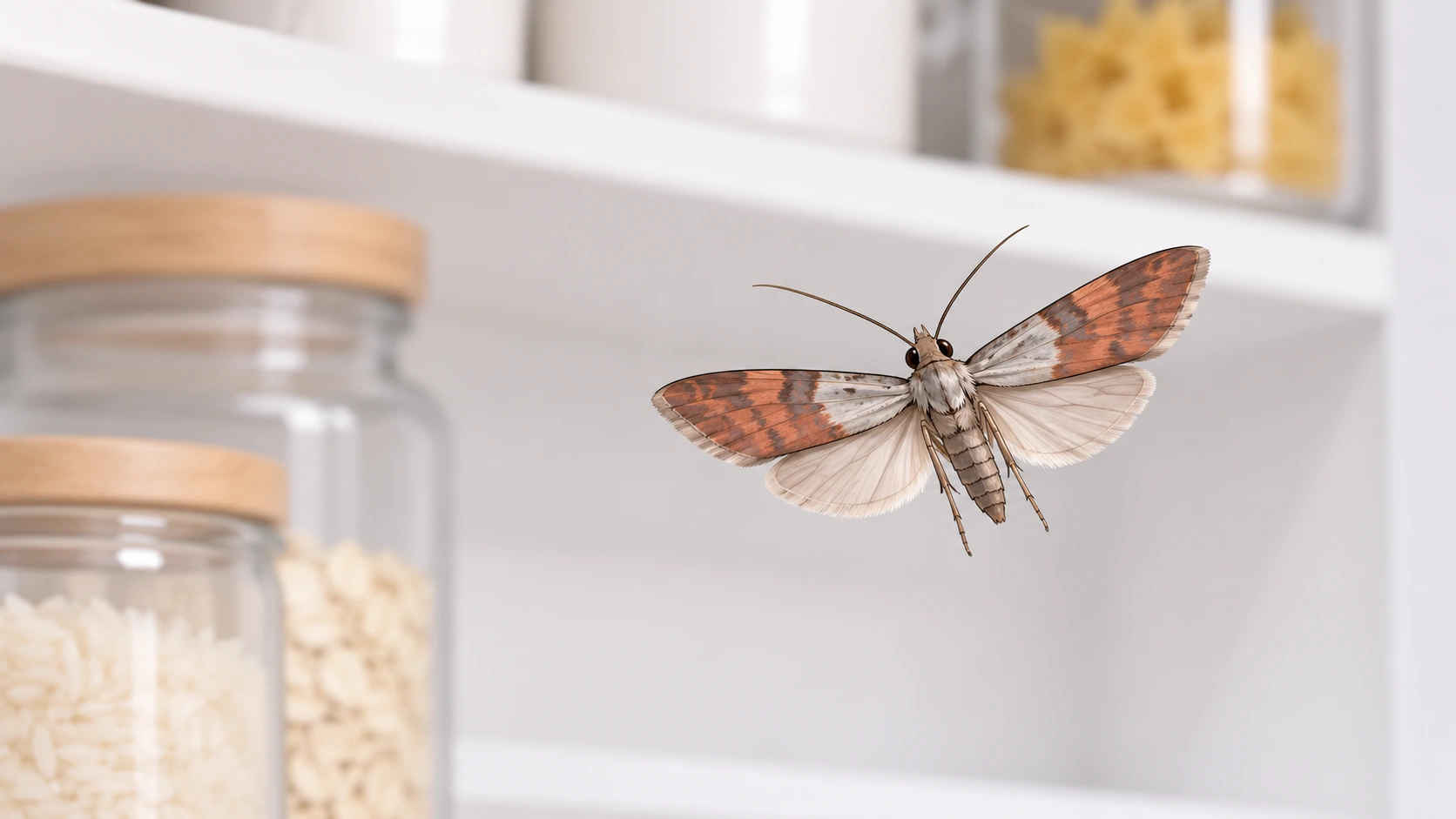
Adult Indian meal moths can fly. They commonly flutter around kitchens, pantries and other rooms, sometimes moving surprisingly far from the food where their larvae developed. Their flight often looks weak, irregular or zigzagging, but they are capable of dispersing throughout a home.
Only the adult stage has functional wings. Indian meal moth larvae are caterpillars that crawl, while eggs and pupae cannot move through the air.
This difference explains why homeowners may find moths flying in a bedroom while the actual infestation is inside a forgotten package of birdseed in the garage. The place where an adult moth is seen is not necessarily where the insect developed.
Indian meal moths, Plodia interpunctella, are mobile as adults, but their flight ability should not be confused with the ability of their larvae to feed and grow in stored food.
How Well Can Indian Meal Moths Fly?
Indian meal moths are fully capable of powered flight, although they do not usually look like strong, straight-line fliers.
A flying adult often appears to flutter, wander or change direction repeatedly. In a kitchen, it may circle near a cupboard, move across the room, land on a wall and then take off again.
The University of Florida’s Indian meal moth identification reference describes adults as fluttering rather than maintaining a straight flight path. It also notes that they can move into rooms distant from the infestation.
This creates an apparent contradiction in descriptions of their flight.
Some university references call Indian meal moths weak or meandering fliers. Others describe them as excellent fliers because they readily disperse through buildings.
Both descriptions can be accurate. A moth can look weak in flight yet still move successfully between rooms.
The University of Georgia’s stored-product pest guide emphasizes that adults readily disperse from the material where their larvae developed. The term excellent fliers in that context refers to their ability to travel away from the source, not to perfectly straight or exceptionally fast flight.
For household identification, the important point is that these moths are not restricted to the shelf or cupboard where they emerged.
What Does an Indian Meal Moth Look Like When Flying?
An adult Indian meal moth usually flies with a fluttering, somewhat uneven movement.
It may make short changes in direction, appear to wobble through the air or move in a zigzag pattern when disturbed. These movements can make the moth difficult to follow visually, especially against a cluttered kitchen background.
The University of Wisconsin’s Indian meal moth description specifically notes that adults often fly in a zigzag pattern and may appear to fly weakly indoors.
Imagine a small moth resting on the outside of a cereal cupboard. When approached, it takes off, veers sideways, crosses part of the kitchen and settles near the ceiling. That behavior is consistent with the species’ documented flight.
However, a zigzag flight path is not an exclusive identification feature. Other small moths and flying insects can also move irregularly.
The adult Indian meal moth is more reliably recognized by its characteristic forewing pattern, with a pale section near the body and darker coppery or reddish-brown outer portions.
The adult Indian meal moth appearance guide explains those features in detail. Flight behavior can support an identification, but should not replace examination of the insect itself.
Can Indian Meal Moths Fly From Room to Room?
Yes. Adult Indian meal moths can travel between rooms in a house or apartment.
They are not confined to the kitchen simply because their larvae feed in stored products. An adult may leave a food-storage area, cross an open hallway and settle in a room containing no suitable larval food.
This can be especially confusing in properties where dry goods are stored in several places.
For example, a household may keep ordinary groceries in the kitchen but store birdseed or dry pet food in a utility room. Adults emerging from the infested material can disperse into other parts of the home.
A moth flying in the living room does not prove there is contaminated food behind the living-room furniture. Similarly, finding an adult on a bedroom wall does not establish that clothing, carpet or bedding is being eaten.
The University of Minnesota’s household identification guidance confirms that adults may be seen flying in rooms where the infestation itself is not occurring.
The distinction is important because adult flight can make the apparent location of a problem misleading.
When the same moth species appears in several rooms, the sightings may reflect movement from a single source, although more than one infested product is also possible.
How Far Can Indian Meal Moths Fly Indoors?
There is no reliable universal distance that an Indian meal moth will travel inside a home.
The insect’s movement depends on the building, the available routes between rooms and its own activity. A small apartment and a large house offer very different opportunities for dispersal.
University extension references establish that adults can move into distant rooms, but that does not justify claiming that every moth can fly a particular number of feet or that its breeding source must lie within a fixed radius.
A moth may also fly in several short movements rather than complete one uninterrupted journey.
Consider a moth found two rooms away from a pantry. Its location tells you that the insect reached that room. It does not establish whether it flew directly from the pantry, stopped along the way or originated in another storage area.
That is why the distance between an adult sighting and a food cupboard is a poor way to rule out Indian meal moths.
For a household investigation, following actual larval evidence is more useful than trying to calculate how far the adult could have flown.
Do Baby Indian Meal Moths Fly?
No. Young Indian meal moths are larvae, not miniature versions of the flying adults.
The larvae are caterpillars with legs used for crawling. They have no functional adult wings and cannot fly, hover or jump through the air to reach another shelf.
Newly hatched larvae must move across suitable surfaces to reach food. As they grow, they remain crawling insects until they pupate and eventually emerge as winged adults.
A mature caterpillar can travel away from its food source before pupation. This is why small pale larvae are sometimes discovered on walls, cupboard edges or ceilings.
The Natural History Museum’s Indian meal moth guide describes fully grown larvae wandering away from food to spin their cocoons.
A larva seen high on a wall did not fly there. It climbed.
That distinction is especially useful when an infestation produces two apparently unrelated observations: moths flying through the kitchen and caterpillars crawling near the ceiling.
Those can be different life stages of the same species.
Which Indian Meal Moth Stages Can Move Through the Home?
Indian meal moths have very different movement abilities depending on their developmental stage.
| Life stage | Can it fly? | How it moves or remains in place | What a sighting tells you |
|---|---|---|---|
| Egg | No | Remains where deposited unless physically moved | Does not identify a flying insect’s route |
| Feeding larva | No | Crawls through food and nearby surfaces | May indicate a source of larval food |
| Mature wandering larva | No | Can crawl away from food, including up walls and across ceilings | Its discovery point may be a pupation destination |
| Pupa | No | Normally remains within a cocoon or protected site | Cannot disperse by flight |
| Adult moth | Yes | Flies, lands and can move between rooms | Its location may be distant from the original food |
This table separates dispersal by adult flight from movement by crawling larvae.
Both forms of movement can spread sightings across a building, but they do not have the same meaning.
A mature larva on a ceiling may have left a nearby food source, while an adult in an upstairs room could have flown there after emerging elsewhere.
Neither observation independently identifies the package in which larval development occurred.
Why Are Indian Meal Moth Larvae Crawling on the Ceiling if Adults Can Fly?
The larvae crawl because they have not yet developed into flying adults.
When Indian meal moth caterpillars are fully grown, they often leave their food and seek protected locations for pupation. Those locations may include cabinet joints, wall-ceiling junctions and other sheltered surfaces.
The crawling and pupation behavior documented by Virginia Tech explains why mature larvae may appear far from contaminated food.
This movement can create the impression that the insects are emerging from the ceiling. In many cases, the caterpillars traveled there from a stored product.
A larva may also spin silk that helps it move across surfaces, including places that appear awkward for a small caterpillar to climb.
Finding several crawling larvae high on a kitchen wall is therefore different from finding several adult moths flying near the same wall.
The larvae may be preparing to pupate, while the adults may already have emerged and moved through the room.
The guide to Indian meal moth larvae and cocoons on ceilings and walls explores the evidence associated with those locations.
Does Seeing Indian Meal Moths Fly Mean They Are Breeding in That Room?
Not necessarily.
Adult flight establishes that a winged moth is present. It does not establish where the insect developed or whether there is an active breeding source in the room.
Imagine finding one Indian meal moth flying beside a bedroom closet. The moth may have arrived from the kitchen, a hallway or another storage area. Its presence alone does not prove that anything inside the closet is infested.
The opposite situation is also possible. A cupboard may contain feeding larvae even when no adults are visible flying nearby.
These examples show why moth movement and larval feeding need to be considered separately.
Evidence from infested stored food is generally more informative than adult location alone. Living larvae, silk-bound food and other signs of feeding can help establish where the infestation is developing.
The signs of an Indian meal moth infestation provide context for interpreting sightings without assuming that the most visible room must contain the source.
A useful investigation records the locations of adults but does not treat each sighting as proof of a separate infestation.
Can Indian Meal Moths Fly Through Open Doorways and Between Floors?
Yes. Adult Indian meal moths can use open routes through a building.
An open doorway, hallway or connected stairwell allows a moth to travel without passing through a sealed wall or cabinet.
The insect does not need to be a strong straight-line flier to move through these spaces. It can fly a short distance, settle, and later take off again.
An adult found upstairs may therefore have come from a lower-floor storage area, provided there is a possible route through the building.
However, the presence of a moth on another floor does not prove which route it used or where it originally emerged.
A closed door may reduce movement through that doorway while it remains shut, but it should not be treated as a permanent barrier that guarantees moths cannot enter the room.
Small insects may also be moved unintentionally with belongings or stored materials. A sighting by itself cannot distinguish flight from every other movement pathway.
This is why documenting where adults appear helps establish a pattern without identifying the breeding source by itself.
Can Indian Meal Moths Fly After Their Food Source Is Removed?
Yes. Adults already present can continue flying after contaminated food has been discarded.
Adult Indian meal moths normally do not feed. Their flight and reproductive activity rely on resources accumulated during earlier development, so they do not need to return to a package of cereal for nourishment.
This is one reason a homeowner may still see a flying moth after the pantry has been emptied and cleaned.
There is also another possibility: a mature larva may already have left the food source before it was removed. If the larva pupated elsewhere, an adult can emerge later and begin flying even though the original package is gone.
The stage-specific dependence of Indian meal moths on food helps explain why food removal does not immediately stop all visible adult activity.
A flying adult after cleanup is therefore not conclusive evidence of a new infestation.
Fresh feeding larvae or silk developing inside another stored product would be stronger evidence that an active food source remains.
The distinction prevents one adult sighting from being interpreted as proof that every previous corrective effort failed.
Are Flying Indian Meal Moths Dangerous?
The flight itself does not make Indian meal moths dangerous to people.
Adult Indian meal moths do not sting, and they are not household insects that feed on human blood. They are mainly a nuisance when flying indoors.
Their significance as pests comes from their larvae, which feed in and contaminate susceptible stored products.
A moth fluttering near someone’s face may be startling, but it is not evidence that the insect is attempting to bite or attack.
The Indian meal moth biting question is separate from the issue of flight. For this article, the relevant distinction is that the adult’s movement through the house does not itself damage food.
That damage occurs during the feeding larval stage.
What Should You Do if You Keep Seeing Indian Meal Moths Flying?
Start by confirming that the insects are Indian meal moths and looking for evidence of their larvae in suitable stored materials.
A flying adult’s location is worth recording, but do not limit the inspection to the exact wall, doorway or room where the moth appeared.
Pay particular attention to susceptible dry foods, including grain products, nuts, seeds, birdseed and dry pet food. These materials can support larval development even when they are stored outside the main pantry.
If you find contaminated products, identifying and removing the source is more important than simply catching flying adults.
The Indian meal moth source-finding guide focuses on connecting visible activity with the material supporting development.
For confirmed infestations, household Indian meal moth removal addresses the source rather than assuming that every moth must be eliminated individually while airborne.
Catching or vacuuming visible adults can reduce the immediate nuisance, but it does not remove eggs or feeding larvae hidden inside an overlooked product.
The practical goal is not to stop the moths from flying. It is to stop new moths from developing.
What a Flying Moth Actually Tells You
An adult Indian meal moth flying indoors demonstrates that a winged adult is present, nothing more specific about the location of its larval food.
Its irregular flight is normal for the species, and its ability to move between rooms explains why sightings may be scattered throughout a house.
A crawling caterpillar is a different observation. Larvae cannot fly, and fully grown ones may climb away from their food to pupate.
If you find moths flying in one room and larvae feeding in a product stored somewhere else, the evidence is compatible with a single infestation. You do not need to invent a separate breeding source for every room where an adult appears.
Use flying moths as a reason to investigate, not as a map showing exactly where the infestation began. The most useful next step is to locate identifiable larval feeding evidence in stored materials.