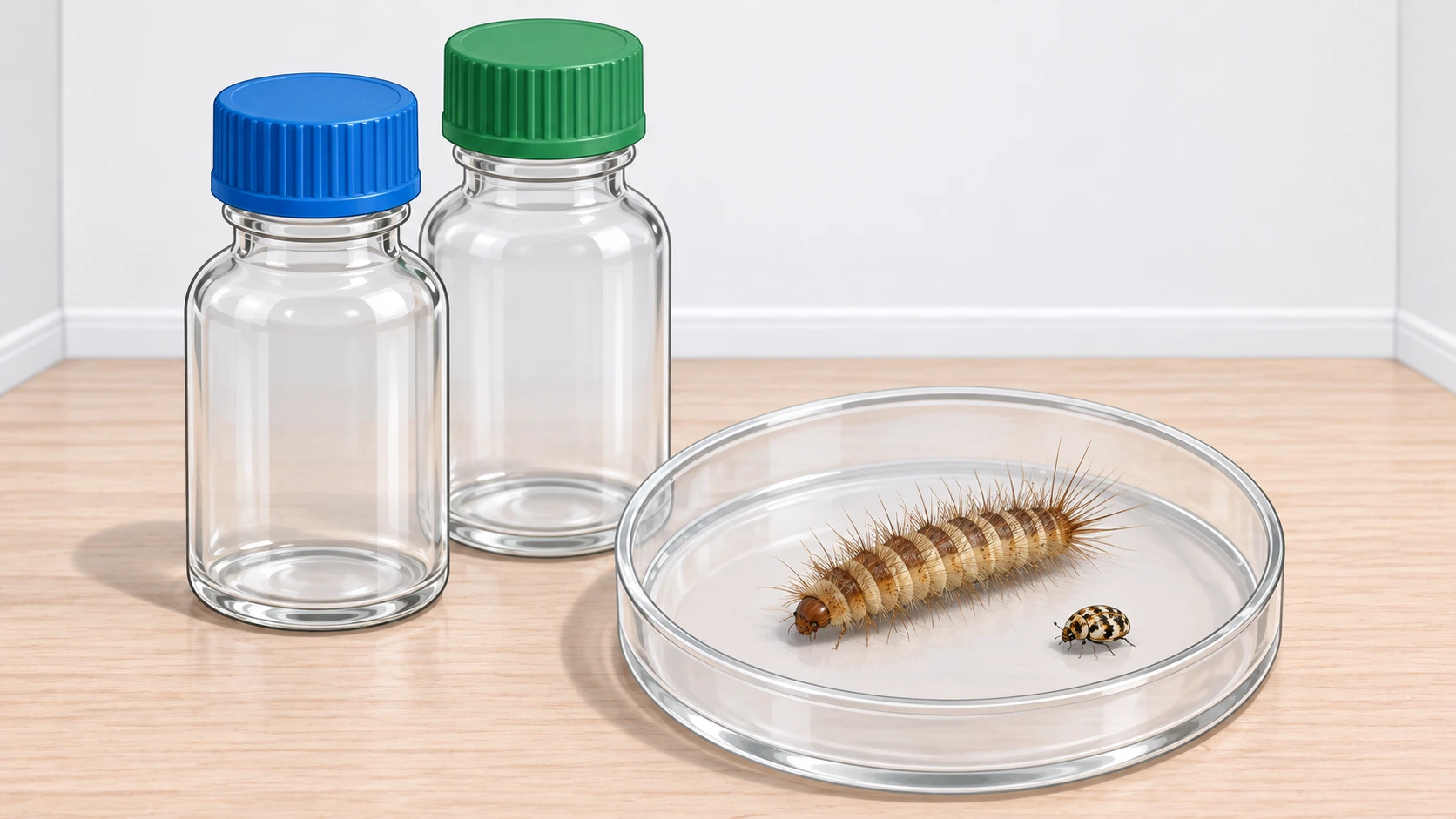
Permethrin and deltamethrin can kill carpet beetles, including exposed larvae and adults, when the insects receive a sufficient dose from an appropriately formulated insecticide. Both chemicals belong to the synthetic pyrethroid family, and both are used in products intended for household insect control. Their effectiveness against carpet beetles is recognized in university extension guidance.
The limitation is where the insects are living. Carpet beetle larvae often develop beneath furniture, inside stored materials, along carpet edges, or among accumulated hair and lint. A spray may kill a larva that crosses a treated surface while missing another larva feeding inside a folded wool blanket. Neither ingredient can compensate for an infestation source that remains hidden and undisturbed.
The most useful way to judge these insecticides is to separate three questions: Can the ingredient kill the insect? Can the chosen formulation reach it? And does the specific product label permit treatment of that location?
How Permethrin Kills Carpet Beetles
Permethrin interferes with electrical signaling in an insect’s nervous system. Nerve cells rely on sodium channels to transmit signals, and permethrin disrupts their normal operation. A sufficiently exposed insect can develop uncontrolled muscle activity, paralysis, and eventually death.
The chemical can enter an insect through contact and may also act when ingested. For household carpet beetle control, contact with a treated surface is particularly relevant. A larva moving along a baseboard or underneath the edge of a rug may encounter insecticide residue without being sprayed directly.
Permethrin is among the active ingredients identified as suitable for carpet beetle control in household insecticide guidance from Rutgers Cooperative Extension. Its ability to kill exposed insects is established, but the level of control in a particular home depends on whether the product and treatment reach the infestation.
A larva feeding inside a stored garment may never encounter a treated baseboard. Meanwhile, larvae that emerge from the garment and travel across a properly treated surface have a greater opportunity for exposure. The same chemical can therefore produce noticeably different results within a single room.
How Deltamethrin Kills Carpet Beetles
Deltamethrin is another synthetic pyrethroid, but it is not chemically identical to permethrin. It also disrupts nerve signaling by affecting sodium channels. Insect exposure can lead to abnormal nerve activity, impaired movement, paralysis, and death.
Deltamethrin is effective through direct contact or ingestion. The deltamethrin toxicology information describes both routes of insect exposure, although real-world performance depends on the formulation, dose, and circumstances.
Carpet beetle control recommendations include deltamethrin alongside other pyrethroid insecticides. Its use is generally associated with localized treatment of areas where larvae hide or travel rather than indiscriminate spraying throughout a room.
One reason deltamethrin is encountered in household pest control is that some formulations leave an insecticidal deposit on treated surfaces. That residue can affect insects that move through the treated location after the initial application.
Residual action is useful, but it has limits. A persistent deposit on a baseboard cannot kill larvae that spend their entire development inside an untreated source of animal fibers.
Permethrin vs. Deltamethrin: Which Is Better for Carpet Beetles?
There is no reliable basis for declaring either ingredient universally superior against carpet beetles in homes. Both have recognized insecticidal activity, and both appear in established carpet beetle management recommendations.
The comparison becomes meaningful only when the actual products and treatment circumstances are considered.
| Factor | Permethrin | Deltamethrin |
|---|---|---|
| Chemical family | Synthetic pyrethroid | Synthetic pyrethroid |
| How it kills insects | Disrupts nerve signaling | Disrupts nerve signaling |
| Direct-contact action | Yes | Yes |
| Residual action | Possible, depending on formulation and conditions | Possible, depending on formulation and conditions |
| Exposed larvae and adults | Can be controlled with sufficient exposure | Can be controlled with sufficient exposure |
| Eggs and deeply concealed larvae | Not reliably controlled by an ordinary surface treatment | Not reliably controlled by an ordinary surface treatment |
| Permitted indoor locations | Determined by the exact product label | Determined by the exact product label |
A deltamethrin dust intended for a permitted crack or void treatment cannot be evaluated as though it were equivalent to a permethrin liquid spray. Their delivery methods, exposure patterns, and label restrictions may be completely different.
Concentration alone is not a dependable ranking method either. A higher percentage of active ingredient does not automatically mean better carpet beetle control, especially when comparing concentrates, ready-to-use sprays, and dusts.
For most homeowners, a product specifically labeled for carpet beetles and the intended indoor location is a more defensible choice than selecting an ingredient based on reputation alone.
Contact Killing and Residual Killing Are Different
A contact treatment exposes the insect directly while the product is being applied. Residual treatment depends on an insect subsequently encountering insecticide deposited on a surface.
This difference matters because carpet beetle infestations are rarely confined to insects that can be seen.
An adult beetle crawling across a windowsill may be easy to locate, but the larvae responsible for fabric damage could be several feet away in a closet, beneath a heavy piece of furniture, or inside a neglected textile. Killing the visible adult does not establish that those larvae have been reached.
Residual insecticides can help when exposed insects move through treated hiding places. Carpet beetle guidance identifies permethrin and deltamethrin among the chemicals used in registered products, while also warning that treatment must reach the locations where infestation is occurring. The carpet beetle control recommendations also identify liquids, dusts, and aerosols as different available formulation types.
A residual deposit does not remain equally effective forever. Cleaning, abrasion, sunlight, treated-surface characteristics, and the formulation itself can influence how much usable insecticide remains. The length of residual control should come from the specific product’s label or supporting product data, not a generic claim about permethrin or deltamethrin.
It is also possible to observe movement after an insecticide exposure. An insect that is still moving has not necessarily escaped the treatment, but visible knockdown alone does not guarantee that it will die. The meaningful outcome is sustained control of the active infestation, not simply the number of beetles lying still immediately after spraying.
Will These Insecticides Kill Carpet Beetle Larvae?
Carpet beetle larvae are an important treatment target because they cause most of the characteristic damage to wool, fur, feathers, and other susceptible materials. Adult carpet beetles often feed on pollen or nectar, while larvae can remain concealed among their food sources for extended periods.
Permethrin and deltamethrin can kill larvae that receive an effective exposure. Their usefulness depends heavily on larval location.
A larva crawling beside a wall may encounter a treated surface. Another larva feeding beneath the lining of an upholstered chair may remain protected from the same treatment. Neither insecticide should be expected to move through layers of fabric and kill every concealed larva.
Larvae may also continue developing in accumulated lint, pet hair, dead insects, or material associated with old animal nests. These sources can support the population even when a nearby carpet has been treated.
The first task is therefore to establish what carpet beetle larvae are feeding on. Once the actual source is identified, it becomes much easier to judge whether insecticide exposure is possible or whether cleaning and removal will solve the problem more directly.
Do Permethrin and Deltamethrin Kill Carpet Beetle Eggs?
You should not assume that an ordinary permethrin or deltamethrin surface treatment will kill every carpet beetle egg.
Eggs cannot crawl across treated surfaces, and many are deposited in protected locations close to suitable larval food. If an egg remains inside an untreated material, insecticide applied nearby may never reach it.
The activity of a particular product against eggs also cannot be inferred solely from its performance against mobile insects. Egg-killing claims require evidence specific to the product, concentration, exposure conditions, and species involved.
New larvae may therefore appear after a treatment that killed exposed adults and older larvae. That observation does not automatically mean the active ingredient was ineffective. It may indicate that eggs or concealed larvae survived outside the treated area.
This is one reason carpet beetle egg control must account for where eggs are placed and which methods can actually reach them.
Why the Formulation Matters as Much as the Ingredient
The word permethrin on a container tells you what active ingredient is present. It does not tell you whether the product can legally or safely be sprayed onto household carpet.
Permethrin is used in a wide range of products, including structural insecticides, agricultural formulations, clothing treatments, and certain animal treatments. The permethrin product and safety information illustrates how widely the same active ingredient can appear across different uses.
Deltamethrin is likewise sold in different formulation types, including sprays, dusts, and other pesticide products. Each formulation is designed to deliver the active ingredient under specific conditions.
A household insecticide label may allow limited treatment along carpet edges or within particular cracks and crevices. Another product containing the same ingredient may be restricted to outdoor uses. A professional-use formulation may carry conditions that a homeowner cannot lawfully satisfy.
The label also controls whether the product may be used on a particular surface and whether direct treatment of carpets, rugs, upholstery, or other materials is allowed.
This matters most when the infestation involves an object rather than a building surface. A wool coat containing larvae is not interchangeable with a carpet edge. A sofa cushion is not automatically an approved treatment site simply because a product lists furniture elsewhere on its packaging.
Never transfer use directions from one permethrin or deltamethrin product to another. Read the complete label on the actual container, including the named pest, indoor-use restrictions, permitted surfaces, precautions, and reentry requirements.
The detailed preparation and application sequence belongs to the carpet beetle spray application guide. For ingredient selection, the deciding issue is whether the formulation can be used where the beetles actually are.
Can You Spray Permethrin or Deltamethrin on Carpets, Clothing, or Furniture?
Some registered insecticide products permit carpet beetle treatment in selected indoor locations. That permission is product-specific and often limited to particular areas or application methods.
Carpet edges, spaces beneath rugs, baseboard junctions, and certain closet surfaces are examples of locations that may appear on eligible product labels. Permission to treat one of these areas does not authorize treatment of every carpeted surface in the house.
Clothing and bedding require particular caution. General carpet beetle management guidance favors laundering or dry cleaning infested fabrics rather than applying household insecticide sprays to them. The integrated pest management guidance for carpet beetles explicitly advises against spraying clothing or bedding.
An insecticide may also damage the material being treated. Some formulations can discolor carpet dyes or leave visible marks. Even a product that permits carpet treatment may require a compatibility test in an inconspicuous location.
For upholstered furniture, the appropriate response depends on where the insects are found and whether a specific product authorizes treatment of the affected components. Larvae inside cushioning or protected furniture joints may remain inaccessible to a surface spray. Carpet beetles in couches and upholstery require attention to those concealed locations rather than treating the furniture exterior as proof of control.
Are Permethrin and Deltamethrin Safe Around Children and Pets?
Neither chemical should be treated as harmless simply because it is sold for pest control. Safety depends on the product formulation, how exposure occurs, the amount involved, and whether the label’s precautions are followed.
Permethrin deserves special attention in households with cats. Cats are particularly sensitive to some permethrin exposures, especially concentrated formulations intended for other animals. Products formulated for dogs must never be repurposed for cats, and veterinary permethrin products must not be improvised as household carpet beetle treatments.
Deltamethrin can also cause adverse effects following sufficient exposure. People may experience skin sensations such as tingling or burning after contact, and animals may be affected if they ingest or otherwise receive significant amounts.
For both ingredients, avoid contaminating food, food-preparation areas, toys, bedding, pet supplies, and surfaces excluded by the label. Children and pets must remain out of treatment areas for the period specified on the actual product label.
Aquatic animals need protection as well. Pyrethroids can be highly toxic to fish and aquatic invertebrates. Preventing contamination of aquariums, ponds, drains, and waterways is particularly important.
The relevant safety assessment is the one for the complete product, not just the active ingredient. Solvents, propellants, concentration, and delivery method can change the exposure risks substantially.
If a person or pet develops symptoms following a pesticide exposure, follow the product’s first-aid instructions and contact the appropriate poison-control service or veterinarian promptly.
Why Carpet Beetles May Remain After Treatment
Continued sightings after using permethrin or deltamethrin have several possible explanations.
The most common practical limitation is incomplete exposure. Larvae feeding inside stored woolens, accumulated debris, or inaccessible structural spaces may never encounter the insecticide. Removing insects from one travel route does not eliminate a food source somewhere else.
Another possibility is that the infestation source was never located. Hair and lint beneath furniture, old nests in building cavities, and undisturbed natural-fiber materials may provide enough food for larvae to develop. Even after exposed insects are killed, concealed stages may remain.
Product mismatch is another concern. An outdoor formulation, a general-purpose insect spray without the appropriate carpet beetle directions, or a treatment placed on an irrelevant surface is not an adequate substitute for a properly labeled product used at the actual infestation site.
Adult carpet beetles can also enter from outdoors. Seeing one adult near a window after treatment is not the same as finding fresh larvae and new fabric damage. How to tell whether carpet beetles are gone depends on evidence of continuing breeding and feeding, not the occasional appearance of an adult.
Repeated chemical applications without identifying the source can increase unnecessary exposure while leaving the underlying infestation unchanged. Recurring carpet beetle problems warrant another inspection of potential breeding materials before more pesticide is considered.
When Is a Pyrethroid Treatment Worth Considering?
Permethrin or deltamethrin may be useful when you have confirmed carpet beetle activity, located the affected area, and identified a specific labeled treatment that can reach insects missed by cleaning.
They are less compelling when the infestation is restricted to removable clothing, when only one adult beetle has appeared at a window, or when the likely source has not been identified.
Removing the food source often produces a more lasting improvement than treating adjacent surfaces. Thorough vacuuming can remove larvae, shed skins, eggs, and the debris on which larvae feed. Appropriate cleaning of infested fabrics addresses insects inside the material, where a surface insecticide may not reach.
Regular vacuuming for carpet beetles remains useful even where an insecticide is justified, although cleaning a treated surface may also affect its residual deposit. Any instructions concerning cleaning after application must come from the product label.
When larvae continue appearing despite careful source removal, or the activity seems to originate from inaccessible wall or attic spaces, a qualified pest management professional can assess whether a targeted chemical treatment is warranted.
The Bottom Line on Permethrin and Deltamethrin
Permethrin and deltamethrin are both credible active ingredients for killing exposed carpet beetles. They act on the insect nervous system, and suitably formulated products may provide contact and residual control.
Neither ingredient guarantees that hidden larvae or eggs will be eliminated. The decisive factors are whether insects encounter an effective deposit, whether the formulation is appropriate for the surface, and whether its label specifically permits the intended use.
For a carpet beetle infestation, start with the material sustaining the larvae. Remove or clean that source, then consider a labeled insecticide only where remaining insects can realistically be exposed. A well-placed treatment can support control. An overlooked wool garment or nest full of animal debris can undermine it.