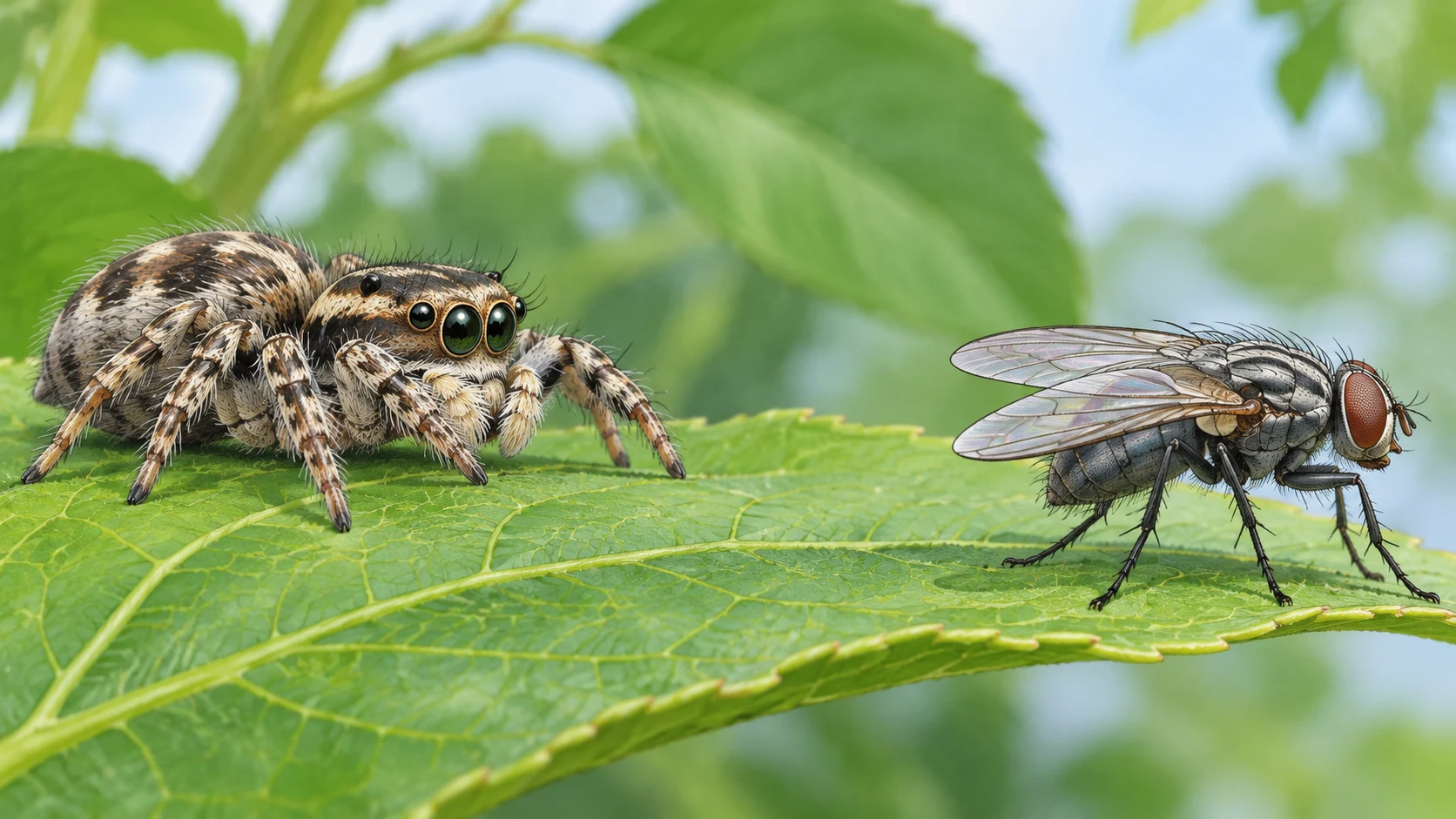
House flies (Musca domestica) are eaten by spiders, predatory beetles, mites, other flies, birds and several other insect-eating animals. Their eggs and maggots are particularly vulnerable to predators living in manure and other decomposing organic material. Tiny parasitoid wasps also attack house fly pupae, preventing some adults from emerging. However, the presence of natural enemies does not guarantee that a backyard will have fewer house flies.
Which Animals Eat Adult House Flies?
Adult house flies are potential prey for several generalist predators. Their ability to fly makes them harder to catch than eggs or maggots, but they remain vulnerable whenever they land or enter the hunting range of another animal.
Common predators include:
Spiders: Web-building spiders can capture adult house flies when they become caught in their webs. Hunting spiders can also seize flies without relying on a web. Spiders are generalist predators, so house flies are only one possible part of their diet.
Predatory flies: Some larger or more specialized predatory flies capture other flying insects. Other muscid flies also prey on immature house flies, making certain fly species both competitors and natural enemies.
Predatory wasps: Several wasps hunt other insects for food. Adult flies can become prey for these hunters, although the parasitoid wasps associated with house flies generally target the pupal stage instead.
Birds: Insect-eating birds can consume adult flies when they encounter them. Chickens also forage for insects around yards and animal enclosures, although their contribution to house fly control is variable.
Frogs and lizards: Insect-eating amphibians and reptiles can capture flies that land within reach. Their feeding activity depends on the availability of prey and suitable hunting conditions. These animals are part of broader insect food webs. Backyard insect predators and their feeding relationships help explain why a variety of animals consume flies and other insects without specializing in one particular household pest.
Adult house flies are mobile, so predators that encounter them occasionally cannot necessarily keep up with a large population emerging from nearby breeding material.
Which Beetles and Mites Eat House Fly Eggs and Maggots?
Some of the most specialized natural enemies of house flies are much smaller than the flies themselves. Predatory mites and beetles living in manure and other organic waste feed on developing house flies before they reach adulthood.
Two particularly well-documented predators are the histerid beetle (Carcinops pumilio) and the macrochelid mite (Macrocheles muscaedomesticae).
Histerid beetles
The histerid beetle Carcinops pumilio is an important predator of house fly eggs and larvae in poultry manure.
Both adult beetles and their larvae feed on immature house flies. They search through the organic material where the flies develop, consuming eggs and small maggots before they can complete development.
These beetles are particularly associated with poultry facilities, where accumulated manure can support substantial populations. They are less common in some other animal facilities, so their contribution varies with the surrounding environment.
Predatory mites
The mite Macrocheles muscaedomesticae is another documented enemy of house flies.
These mites feed on house fly eggs and young larvae within suitable breeding material. They are naturally associated with manure and poultry waste, where they encounter developing flies.
Other predatory mite groups, including members of Macrochelidae, Uropodidae and Parasitidae, also consume fly eggs or larvae.
A peer-reviewed review of house fly predators and biological control identifies these beetles and mites among the important natural enemies of immature house flies. Some research has demonstrated reductions in fly numbers under simulated field conditions, although those results should not be assumed to occur in every backyard. The effect depends on whether predators occupy the same material as the developing flies. A predator living elsewhere in the garden cannot readily reach eggs buried inside an isolated accumulation of manure.
The nutritional environment of developing larvae also matters, since house fly maggots feed on moist decomposing substrates.
Do Other Fly Species Eat House Fly Maggots?
Some other flies have larvae that prey on house fly maggots rather than relying exclusively on decomposing organic material.
One example is the black dump fly (Hydrotaea aenescens), a muscid fly associated with poultry and swine facilities. Its larvae can develop in organic substrates without consuming other fly larvae, but they are also capable of predatory feeding.
Research has documented these larvae killing and consuming house fly maggots when the two species share suitable breeding material.
Black dump flies have been investigated as potential biological-control organisms in animal facilities. Their predatory behavior can contribute to reduced house fly development under some conditions.
However, introducing another fly species into a property is not automatically beneficial. Black dump flies are themselves flies that can interact with contaminated organic material, and their ecological and pest-management implications require consideration.
The scientific review of house fly predators and competing fly species describes the predatory behavior of black dump fly larvae and the limitations of treating this relationship as a universal control method.
What Are Parasitoid Wasps, and How Do They Kill House Flies?
Parasitoid wasps are among the most specialized natural enemies of house flies. Their immature offspring develop inside or on another insect, eventually killing the host as they complete their development.
Several small wasp species attack house fly pupae. These include species belonging to the genera Muscidifurax, Spalangia and Nasonia.
Their reproductive process is particularly interesting.
A female parasitoid searches through suitable breeding material until she encounters a house fly pupa. She then uses a specialized egg-laying structure called an ovipositor to penetrate the protective pupal casing.
Depending on the wasp species, she may deposit one or several eggs inside the casing or on the developing host. The resulting wasp larvae consume the immature fly, preventing it from emerging as an adult.
The wasp eventually completes its development and emerges from the casing instead of a house fly.
An important difference separates parasitoids from ordinary predators. A predator can consume many individual prey during its lifetime, while a parasitoid’s immature stage develops in association with a particular host, which it eventually kills.
The Texas A&M research-based guide to house fly parasitoids describes this process and identifies several wasp groups associated with house fly pupae. The adult wasps are free-living and do not sting people as part of their host-seeking behavior.
Do House Fly Predators Affect the Entire Food Web?
House flies are also prey within a wider ecological network. Their eggs, maggots and adults provide food for organisms occupying different parts of their environment.
Immature flies become food for small invertebrate predators living in decomposing material. Adult flies can be eaten by larger insect predators and vertebrate insect-eaters. This means house flies contribute to food availability at several stages of their development.
Their ecological relationships are part of the broader role house flies serve in nature, including the decomposition of organic material and the transfer of nutrients through food webs.
The presence of a house fly in a garden therefore does not mean it is entirely free from natural pressure. Numerous organisms can consume it, although the amount of suppression varies considerably between habitats.
One thought on “What Eats House Flies?”