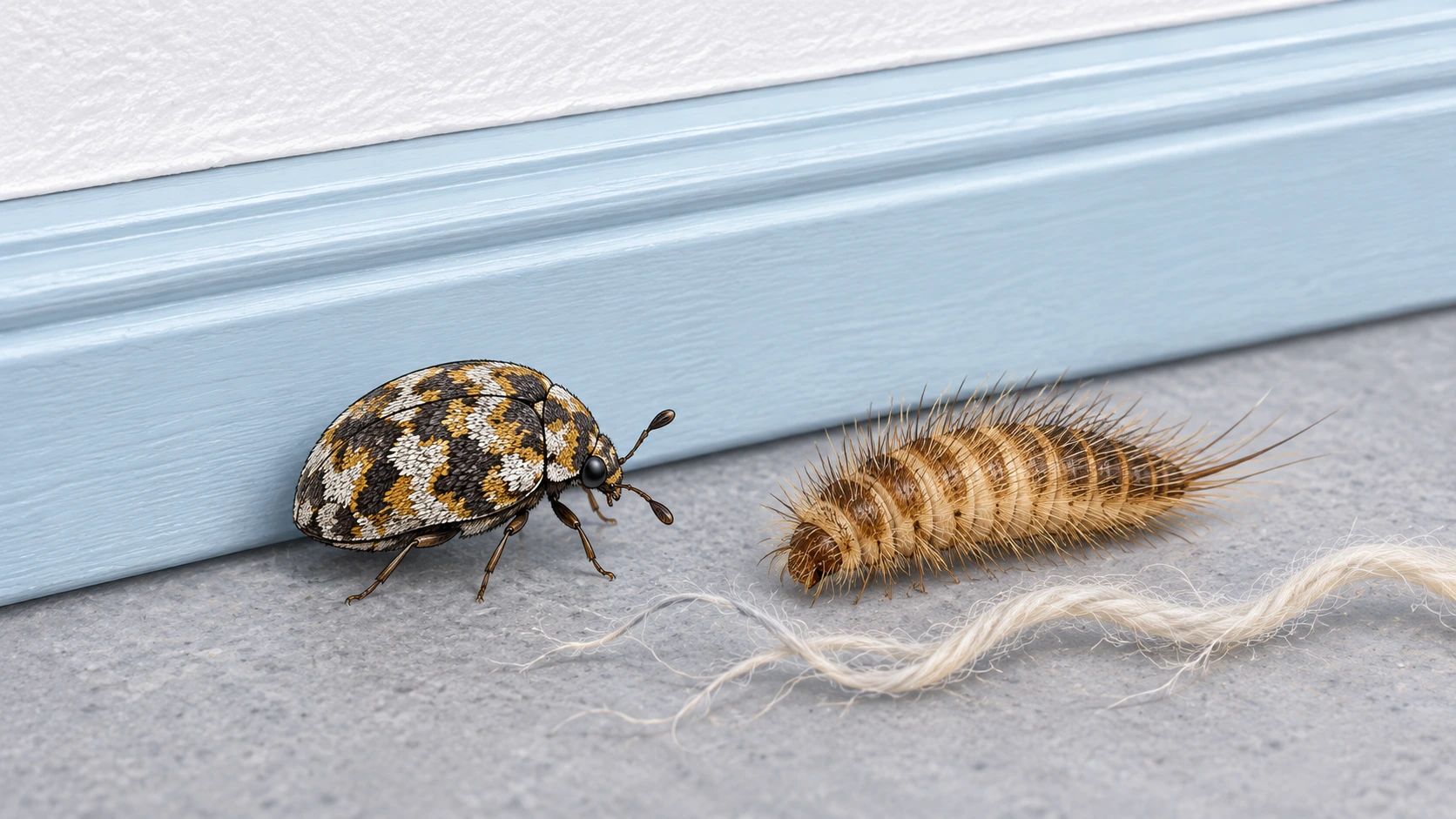
A carpet beetle is a small insect belonging to the beetle family Dermestidae. Several species occur in homes, where their larvae can damage wool, fur, feathers, and other susceptible materials. Adult carpet beetles usually cause little direct damage because many feed on pollen or nectar outdoors. The larvae are responsible for most household infestations and fabric damage.
Despite their name, carpet beetles do not need carpets to survive. They can develop in stored clothing, upholstered furniture, accumulated animal hair, dead insects, and other suitable materials. Some species can also infest dried food products.
An adult carpet beetle on a windowsill may simply have flown indoors. Finding live larvae repeatedly in a wool rug or stored garment is much stronger evidence that the insects are developing inside your home.
Understanding that difference helps you judge whether an unfamiliar beetle is an occasional visitor or a sign of an infestation that could damage your belongings.
What Kind of Insect Is a Carpet Beetle?
Carpet beetles are members of Dermestidae, a family of beetles that includes several insects associated with dry animal materials, stored products, and museum collections.
They belong to the insect order Coleoptera, meaning they are true beetles. Adult carpet beetles have six legs and hardened forewings that protect the delicate flight wings underneath.
The name carpet beetle refers to several related species rather than one individual insect. The varied carpet beetle, Anthrenus verbasci, and black carpet beetle, Attagenus unicolor, are two familiar examples in North American homes. Furniture carpet beetles and common carpet beetles are also recognized household pests.
These species differ in appearance, distribution, and some aspects of their feeding behavior, but they share an important characteristic. Their larvae can develop on materials that contain suitable organic nutrients.
The household carpet beetle overview identifies these beetles as pests of homes, warehouses, museums, and other places where vulnerable materials are stored.
Their scientific classification matters because not every small beetle found in a carpet or cupboard is a carpet beetle. Other beetles may be associated with stored food, plants, or entirely different materials.
Carpet beetles are also not mites, fleas, bed bugs, or moths. Those animals belong to different insect or arthropod groups, even though people sometimes confuse their appearance or signs of activity.
Why Are They Called Carpet Beetles?
The name comes from the damage their larvae can cause to carpets and rugs containing animal-derived fibers, particularly wool.
Historically, wool carpets, rugs, upholstery, and other household furnishings offered suitable food for these insects. Larvae developing in such materials could cause noticeable damage before anyone discovered them.
That association became part of their common name.
Modern houses contain many other potential sources of food, however. A home with synthetic wall-to-wall carpeting can still have carpet beetles if suitable organic material is present elsewhere.
For example, larvae might develop among forgotten wool clothing in a closet while the synthetic carpet in the same room remains untouched. Accumulated pet hair or dead insects can also provide food in locations that are easy to overlook.
This explains why carpet beetles can occur in homes without carpet. Their name describes a familiar type of damage, not a requirement that carpeting must be present.
A homeowner who searches only the visible carpet may therefore miss the material supporting the infestation.
Adult Carpet Beetles and Larvae Have Different Roles
The difference between adults and larvae is the most useful fact to understand about carpet beetles.
Adult beetles are primarily involved in reproduction and dispersal. Adults of many common household species feed on pollen or nectar, and some adult species feed very little or not at all.
They can fly, visit flowers, and enter houses through openings. They are often attracted to light, which explains why homeowners frequently notice them near windows.
Larvae live differently.
After eggs hatch, the larvae seek out suitable material on which to feed and develop. They generally prefer protected locations where they can remain relatively undisturbed.
A larva may spend its time inside stored fabric, beneath furniture, or among accumulated organic debris. It can continue feeding without being seen on an exposed floor.
The adult and larval behavior of carpet beetles explains why the insects noticed most frequently are not necessarily the ones causing damage.
This produces a common household misunderstanding. Someone finds several adult beetles near a window and assumes those beetles have been eating the carpet. The adults may have entered from outdoors, while any fabric damage would generally be associated with larvae developing somewhere else.
The opposite situation is possible too. Larvae may be damaging a stored wool garment even though no adult beetles have been noticed in the room.
For a quick assessment, consider what was actually found:
| What you found | What it suggests |
|---|---|
| One adult beetle on a windowsill | Possibly an incidental visitor; indoor breeding is not established |
| Several adult beetles appearing repeatedly | Further inspection may be warranted, but the breeding source is still unknown |
| Live larvae in a stored wool item | Stronger evidence that the item supports carpet beetle development |
| Bristly cast skins among susceptible materials | Larvae developed there previously; current activity requires additional evidence |
| Fresh fabric damage together with live larvae | More persuasive evidence of an active, damaging infestation |
The observations should be interpreted together. A beetle’s presence by itself cannot establish how many insects are inside a building or whether they are reproducing there.
What Do Carpet Beetles Look Like?
Adult carpet beetles are usually small, oval or rounded insects. Their bodies may be dark brown, black, or patterned with lighter scales, depending on the species.
The varied carpet beetle often has a mottled appearance, while the black carpet beetle is generally darker and more elongated.
Their larvae look different from adults. Many have elongated, segmented bodies covered in hairs or bristles. Some have noticeable tufts of longer hairs near the rear.
Because of this difference, homeowners sometimes fail to recognize the adult beetle and larva as stages of the same insect.
A larva discovered among wool fibers may look like a tiny hairy worm, whereas the adult looks like a conventional small beetle.
The detailed adult carpet beetle appearance and identifying features help distinguish these insects from other household beetles. The appearance of larvae also varies among species, so hairiness alone should not be used to identify every unfamiliar larva.
A specimen’s shape, body covering, and other physical features are more useful than relying exclusively on color or where it was found.
What Do Carpet Beetles Do Inside a House?
Carpet beetles can occur indoors as temporary visitors or as developing populations.
An adult may enter through an open window, arrive on cut flowers, or emerge from a concealed breeding source. Finding that adult does not establish which possibility applies.
A developing population requires suitable material for the larvae.
Some larvae feed among animal-derived fibers, while others exploit debris such as shed hair, feathers, dead insects, or remains associated with old nests. The available material and the beetle species influence where development occurs.
Carpet beetle larvae often remain in locations that receive little disturbance. Spaces beneath heavy furniture, storage areas, and protected gaps can therefore contain activity that goes unnoticed.
The adults may later appear somewhere more conspicuous, particularly near light.
Consider a room where several adults are found on a windowsill. Their presence may suggest that insects are nearby, but it does not identify the original feeding site. The larvae could have developed in a cupboard, beneath furniture, or outside the building.
Understanding what attracts carpet beetles to a home helps separate ordinary adult sightings from conditions that can support indoor development.
An actual infestation is better established through evidence of larvae and their feeding activity than through the location of adult beetles alone.
Are Carpet Beetles Harmful?
Carpet beetles are primarily a concern because of the damage their larvae can cause to belongings.
They are not wood-destroying insects like termites, and they do not feed on living people. Adult carpet beetles do not normally bite humans, and the larvae are not blood-feeding parasites.
However, the hairs and other structures shed by carpet beetle larvae can irritate some people’s skin. Reactions may include itchy bumps or a rash, but such symptoms are not specific to carpet beetles.
A rash alone cannot establish that carpet beetles are present. Similar skin reactions can have many causes, including other insects, allergies, and medical conditions.
The health and household significance of carpet beetles is mainly associated with damage to stored materials and possible irritation from larvae.
Their economic importance can become substantial when vulnerable possessions are involved. Wool rugs, valuable garments, animal specimens, and certain museum collections may be difficult or expensive to restore after feeding damage.
For most households, the practical concern is protecting susceptible belongings rather than fearing that the insects will attack people.
If a skin reaction is persistent, severe, or unexplained, medical assessment is more reliable than assuming carpet beetles caused it.
Can Carpet Beetles Live in a Clean House?
Yes. A clean house can still contain carpet beetles.
Adults can arrive from outdoors regardless of household cleanliness. The presence of a suitable food source, rather than a general judgment about whether a home is clean, determines whether larvae can develop.
Even regularly cleaned buildings may contain neglected spaces, natural-fiber possessions, or other materials that support an infestation.
For example, an old animal nest in an attic may provide suitable larval food despite the rooms below being spotless. A valuable wool blanket stored for years can also become vulnerable without obvious dirt throughout the home.
Housekeeping can influence the amount of lint, hair, dead insects, and other debris available to larvae. However, it cannot guarantee that no adult will enter or that every concealed source will be eliminated.
The relationship between cleanliness and carpet beetles is therefore more specific than the assumption that finding one means a household is dirty.
A better approach is to establish whether suitable breeding material exists and whether the insects are actively developing in it.
How Do You Know Whether You Have a Carpet Beetle Infestation?
The strongest evidence involves immature beetles developing in the home or fresh damage that can be connected to them.
Adults alone are a weaker indicator. A single adult at a window might have arrived from outside, while repeated adults in one area may justify looking for an indoor source.
Larvae and their cast skins provide more information.
As carpet beetle larvae grow, they shed their outer coverings. These discarded skins can remain in sheltered areas long after the larvae have moved or developed into adults.
A collection of bristly skins may indicate that larvae occupied the location, but it does not automatically prove they are still alive there.
Fresh feeding damage in a susceptible item, especially when live larvae are present, gives a stronger basis for concluding that an infestation is active.
The signs of a carpet beetle infestation help distinguish ongoing development from old evidence or an occasional visiting beetle.
One common mistake is treating every small brown particle as carpet beetle droppings. Dust, food fragments, and unrelated insect debris can look similar without further examination.
We would place more weight on a correctly identified live larva associated with a suitable feeding material than on an isolated speck or damaged object with no insects present.
Do Carpet Beetles Have a Queen or Live in Colonies?
Carpet beetles do not have queens or organized colonies like ants, bees, or termites.
Adult females lay eggs in or near suitable materials, and the emerging larvae develop where food is available. Several individuals may occupy the same material, but that does not mean they cooperate within a structured colony.
A group of larvae inside a stored rug is therefore different from a termite colony operating through organized social roles.
This matters when people refer to a carpet beetle “nest.” They may be describing a location where larvae are clustered around food, rather than a constructed nest occupied by a social insect colony.
The meaning of a carpet beetle nest is tied to where the insects develop and the debris they leave, not to an organized household structure with workers and a queen.
You do not need to find a central queen or a colony chamber to establish where carpet beetles are breeding. Identifying the material supporting larval development provides a more useful starting point.
Do Carpet Beetles Only Live Indoors?
No. Many carpet beetle species occur naturally outdoors.
Adult carpet beetles can visit flowers, while larvae may develop in suitable organic materials associated with bird nests, animal remains, or other natural environments.
Their ability to use both outdoor and indoor sources explains why finding an adult inside does not automatically mean the building contains a breeding population.
A beetle on a flower outside may be part of the same species commonly encountered inside houses. Its presence there is not a household infestation.
The outdoor occurrence of carpet beetles is well established, particularly for species whose adults visit flowers and whose larvae exploit animal-derived material.
The boundary between indoor and outdoor populations can be less obvious in buildings with attics, roof spaces, or old animal nests.
A larva developing in a nest associated with a building may later wander into a room, even if the carpet and clothing inside the room are not its original food source.
That possibility is another reason to avoid interpreting every indoor sighting as evidence that the visible carpet is infested.
What Should You Do if You Find Carpet Beetles?
The response should reflect the evidence you have.
For an isolated adult on a window, identifying the insect and checking whether there are additional signs may be sufficient. There is no reason to assume that a single adult requires whole-room pesticide treatment.
When live larvae are repeatedly found near vulnerable materials, the concern is different. Their presence suggests a source that deserves attention, particularly if fresh damage is also occurring.
The immediate priority is identifying the insect correctly and establishing whether it is developing indoors.
Carpet beetle management commonly involves addressing the material supporting larvae, cleaning affected locations, and protecting susceptible possessions. Insecticides may not be necessary when the breeding source is successfully removed.
The starting priorities for carpet beetle removal depend on whether you have found an adult visitor, a localized source, or evidence of activity in several locations.
For a widespread or persistent problem involving inaccessible materials, professional inspection may be appropriate. That is especially relevant when repeated larval activity continues despite attention to the obvious sources.
A confirmed identification should come before choosing a pesticide. If one is needed, the actual product label determines where and how it may be used.
Why Carpet Beetles Matter in Homes
Carpet beetles are easy to underestimate because the adults are small and usually inconspicuous. Their larvae can remain hidden for long periods while feeding on materials that homeowners may not examine regularly.
Their importance also varies greatly from one household to another.
A beetle visiting a window may have no lasting consequence. A few larvae in an overlooked wool garment may cause localized damage. A population developing among valuable textiles or preserved animal specimens may create a much more serious property problem.
These situations all involve carpet beetles, but they should not be treated as equally severe infestations.
The most useful distinction is between the insects you happen to see and the material that may be supporting their development. Adult sightings are often conspicuous, while the damaging larvae tend to be concealed.
Correctly interpreting those stages prevents two opposite mistakes: overlooking a developing infestation because no adults are visible, and assuming a serious infestation exists because one adult beetle appeared on a windowsill.
The Bottom Line
Carpet beetles are small beetles in the family Dermestidae. Several species occur in homes, museums, warehouses, and outdoor environments. Adults commonly visit flowers or move toward light, while larvae can damage susceptible materials when they develop indoors.
Their name is misleading if it makes you think they need carpets. Suitable food can occur in stored possessions and concealed organic debris even in a house without wool carpeting.
The finding that matters most is not simply an adult beetle on a windowsill. It is evidence that larvae are actively developing in material inside the home.
Once that is established, the risk to belongings becomes clearer, and any necessary response can focus on the source rather than the occasional beetle passing through.