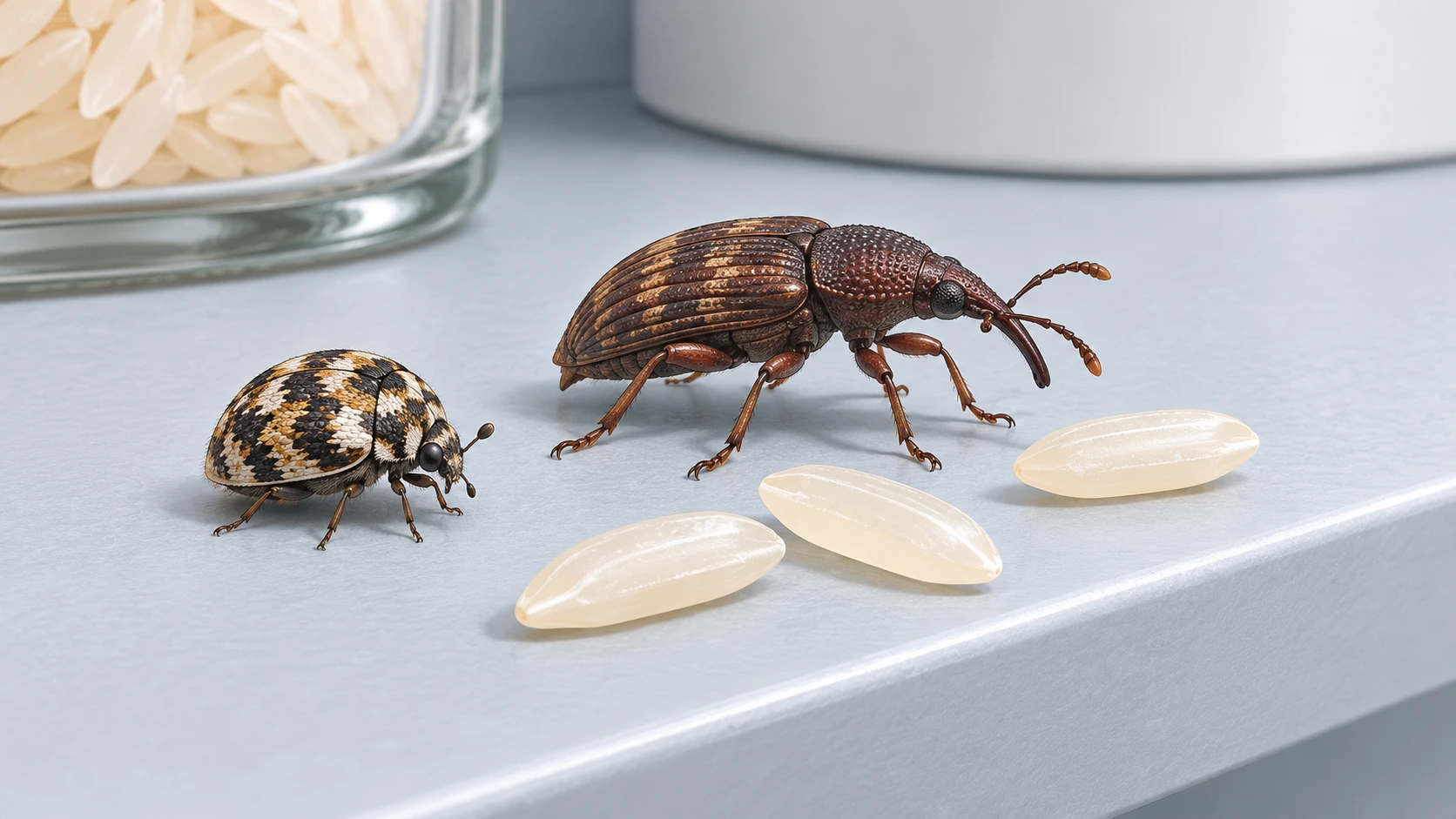
The easiest way to tell a carpet beetle from a stored-food weevil is to look for a snout. Rice, granary, and maize weevils have a distinctive elongated projection at the front of the head, with their mouthparts at its tip. Adult carpet beetles have a more compact head, a rounded or oval body, and short, usually clubbed antennae. They do not have the pronounced snout typical of these grain weevils.
The distinction becomes less obvious when you find a tiny dark beetle in a kitchen cupboard. Some carpet beetles can feed on stored foods, while weevils can leave the grain package where they developed and wander across shelves, walls, or windowsills.
Color is also unreliable. A black carpet beetle can resemble a small dark weevil from a distance, and the reddish or pale spots on certain grain weevils can be difficult to see without magnification.
For a useful identification, we would examine the insect’s head and body first, then inspect the food or other material where it was found. The physical evidence often explains whether the beetle developed in grain, animal-derived materials, or something else nearby.
Carpet Beetle vs. Weevil: The Main Differences
Both insects are beetles, meaning they belong to the order Coleoptera. They have six legs and hardened forewings called elytra, which protect the flight wings underneath when those are present.
Their head structures, immature stages, and usual food associations provide more useful differences.
| Feature | Adult carpet beetle | Common stored-grain weevil |
|---|---|---|
| Beetle family | Dermestidae | Curculionidae |
| Head | Compact, without a pronounced elongated snout | Distinctive projecting snout or rostrum |
| Antennae | Relatively short, commonly with an enlarged club | Usually elbowed, attached along the snout, with clubbed tips |
| Body shape | Rounded to elongated oval, generally convex | More cylindrical or elongated, with a narrower front |
| Common colors | Black, dark brown, or mottled with pale and dark scales | Reddish brown to black, sometimes with four pale or reddish wing-cover spots |
| Larvae | Usually brown, segmented, and visibly hairy or bristly | In rice, maize, and granary weevils, pale, legless grubs developing inside grain kernels |
| Typical food evidence | Susceptible animal-derived materials, debris, and sometimes stored foods | Damaged grain kernels, internal feeding, and emergence holes |
| Typical adult sightings | Windowsills, carpets, closets, shelves, and stored materials | Grain containers, pantry shelves, and areas near infested stored foods |
The weevil column refers specifically to common household grain weevils in the genus Sitophilus. It does not describe every weevil species.
Not all weevils have equally long or obvious snouts. Some broad-nosed weevils have much shorter projections and are more likely to be encountered as incidental visitors from outdoor plants. For a beetle emerging from stored rice, wheat, or corn, however, the prominent snout remains an especially useful identifying feature.
A Weevil’s Snout Is the Best Place to Start
A grain weevil’s snout is not simply a pointed nose. It is an elongated part of the head called the rostrum, with the mouthparts positioned near the end.
On rice weevils, granary weevils, and maize weevils, the rostrum is usually visible in a clear side-view photograph. Their antennae arise along the snout and have a bent or elbowed arrangement.
The rostrum has an important feeding function. Adult grain weevils use their mouthparts to penetrate suitable grain kernels, and females can prepare openings where eggs are deposited.
The identification features of rice and granary weevils include this distinctive snout, along with differences in body markings and flight capability.
An adult carpet beetle does not have the same structure.
The head of a varied carpet beetle can appear partly hidden beneath the front of its rounded thorax. Its antennae are short and typically terminate in an enlarged club.
A black carpet beetle is more elongated, but its head remains compact rather than extending forward into a long rostrum.
If the insect is sitting upright, the snout may be difficult to see from directly above. A side view or a photograph taken slightly from the front often resolves the question.
This is more reliable than comparing two blurry overhead photographs and deciding that one beetle looks slightly longer than the other.
Carpet Beetles Have a More Rounded Body
Adult carpet beetles are generally compact and convex, meaning their backs curve upward rather than appearing flat.
Varied carpet beetles, Anthrenus verbasci, are especially rounded. Their wing covers commonly have an irregular mixture of white, brown, yellowish, and dark scales, giving them a mottled appearance.
Black carpet beetles, Attagenus unicolor, have a longer oval outline and are usually dark brown or black. They can resemble tiny dark seeds.
Many carpet beetle adults are only a few millimetres long. Their small size makes it difficult to see the head or antennae without a magnifying glass.
The adult carpet beetle characteristics include the rounded bodies, patterned scales, and clubbed antennae of familiar household species.
Common grain weevils have a somewhat different profile.
Rice and maize weevils are small, elongated beetles with a cylindrical-looking body and the distinctive snout projecting from the head. Granary weevils are similarly elongated and can be dark enough to resemble black carpet beetles at a glance.
The weevil’s rostrum makes its body outline noticeably different once the head is visible.
A worn varied carpet beetle can lose much of its patterned scale covering and appear almost uniformly dark. Therefore, the absence of mottling does not establish that an insect is a weevil.
The compact head and lack of a pronounced snout remain better clues.
Rice Weevils, Maize Weevils, and Granary Weevils
Three grain weevils are particularly relevant to household comparisons: the rice weevil (Sitophilus oryzae), maize weevil (Sitophilus zeamais), and granary weevil (Sitophilus granarius).
They are all associated with stored grain or suitable grain products, and their adult appearance is similar enough that casual identification can be difficult.
Rice weevils are typically dark reddish brown and may have four faint reddish or yellowish patches on their wing covers. They can fly.
Maize weevils also have four lighter patches and can fly. Their external appearance is so similar to that of rice weevils that confident separation can require specialist examination.
Granary weevils generally lack those four lighter patches. They are often uniformly dark reddish brown to black and cannot fly.
These differences are useful, but they should not distract from the initial carpet beetle comparison.
All three have the distinctive snout associated with Sitophilus grain weevils.
| Grain weevil | Common adult clue | Important limitation |
|---|---|---|
| Rice weevil | Long snout, usually four reddish or yellowish wing-cover spots | Closely resembles maize weevil |
| Maize weevil | Long snout, similar four-spot pattern | Often cannot be reliably distinguished from rice weevil by ordinary external photographs |
| Granary weevil | Long snout, generally uniform dark coloration | Dark color alone can resemble black carpet beetle |
Detailed identification records for rice and maize weevils emphasize how closely their external features overlap.
For homeowners, recognizing a grain weevil rather than a carpet beetle is usually more important than deciding whether a spotted Sitophilus specimen is a rice or maize weevil.
The species-level distinction may matter in grain-handling or professional identification settings, but a doubtful photograph should not be assigned to one species with unwarranted certainty.
Can You Tell Them Apart by Size?
Size is a weak identification method because the ranges overlap.
Rice weevils are commonly around 2.5–4 millimetres long. Granary weevils can be somewhat larger, while adult varied carpet beetles often measure approximately 2–3.5 millimetres.
Black carpet beetles can also fall within the same general range as the household grain weevils.
A beetle measuring about 3 millimetres might therefore belong to either group.
Its apparent length may also change depending on whether the snout is included in a measurement and how the insect is positioned.
Photographs introduce another source of confusion. A beetle photographed beside a grain of rice may appear large, while the same insect on a shelf can look like a tiny black dot.
A ruler or known scale helps, but measurements should support the identification rather than determine it.
If a 3-millimetre beetle has a distinct rostrum and elbowed antennae, it is more consistent with a grain weevil. If it has a convex, oval body and a compact head with short antennae, a carpet beetle becomes more likely.
What If the Beetle Has No Obvious Snout?
An insect without an obvious snout is less likely to be one of the three familiar Sitophilus grain weevils, but it cannot automatically be identified as a carpet beetle.
The wider weevil group contains many species with different head shapes. Some broad-nosed weevils have a short, stout rostrum that does not resemble the long projection of a rice weevil.
A beetle found on an indoor plant, near a doorway, or beside a recently brought-in plant pot may belong to one of those other weevil groups.
There are also numerous small household beetles that are neither carpet beetles nor weevils.
For that reason, the absence of a long rostrum should be combined with other features.
An adult carpet beetle usually has a compact, convex body, short antennae with an enlarged club, and sometimes a distinctive covering of scales or fine hairs.
If those features are not visible, the identification may remain unresolved until a clearer photograph or specimen is available.
The most useful comparison is between the actual insect and a confirmed reference specimen, rather than between its general brown color and a broad category such as pantry bug.
Carpet Beetle Larvae and Weevil Larvae Look Very Different
The immature stages provide a strong distinction when they can be seen.
Carpet beetle larvae are usually elongated, segmented, and covered in short hairs or longer bristles. Varied carpet beetle larvae may have dense tufts along the body, while black carpet beetle larvae have a distinctive tuft of longer hairs toward the rear.
Their bodies typically range from tan or golden brown to dark brown.
Rice, maize, and granary weevil larvae have a very different appearance. They are pale, legless grubs with a defined head capsule and a curved body.
Most importantly, they develop inside suitable grain kernels.
A carpet beetle larva may be discovered moving through lint, wool, animal hair, or stored material. A grain weevil larva can remain hidden inside a kernel until it develops into an adult.
The grain weevil life cycle and internal feeding behavior explain why a container may contain developing insects even when few larvae can be seen.
This is an important practical difference. Opening a rice container and finding small adult weevils does not mean the food was free of insects before those adults appeared. The immature stages may have developed inside individual kernels.
If you find a visibly hairy brown larva among dry debris, a carpet beetle or another hairy dermestid is a stronger possibility than a Sitophilus grain weevil.
However, not every insect larva found in dry food is a carpet beetle or a weevil. Clear anatomical evidence is still necessary when the specimen does not match either form.
The Food Source Can Help Confirm the Identification
The insect’s location provides evidence, but it should not replace inspection of its physical features.
A group of long-snouted beetles emerging from stored whole rice, wheat, or corn strongly suggests a grain weevil infestation.
These insects can develop inside suitable grain kernels. After emergence, adults may move through the container or disperse onto nearby shelves.
The resulting grain can contain small exit holes, damaged kernels, and accumulations of fine debris.
Carpet beetle larvae are more strongly associated with animal-derived food sources such as wool, fur, feathers, hair, dead insects, and certain dried organic materials.
This is why carpet beetle activity is often discovered around stored natural-fiber clothing, carpet edges, animal specimens, or dusty locations containing insect remains.
However, carpet beetles are not restricted to carpets or animal fibers.
Some species, particularly black carpet beetles, can also infest stored grain products and other dried foods.
That overlap means a beetle found in a bag of flour or near cereal cannot be identified from its location alone.
The stored-product feeding behavior of black carpet beetles includes cereal products, dried pet food, bran, ground maize, and other stored commodities.
The distinction is that the familiar grain weevils are specialized for developing within suitable kernels, whereas carpet beetles have a broader set of possible larval food sources and leave different physical evidence.
Does a Beetle in Rice Always Mean You Have Weevils?
Not necessarily.
Rice is strongly associated with rice weevils in household pest discussions, but its presence in the container does not identify the insect.
Even the name rice weevil can be misleading because that species attacks several types of stored grain.
Granary and maize weevils may also be associated with grain products, and other stored-food beetles can appear around rice or cereal.
A carpet beetle may be found in the same storage area for unrelated reasons. Depending on the species and condition of the food, some carpet beetles can also use stored products.
The first question is whether the beetle has a pronounced snout.
If several adults have long rostra and the grain contains characteristic emergence holes, the evidence strongly supports a grain weevil infestation.
If the beetle is rounded, without a snout, and bristly larval skins are present in nearby debris, a carpet beetle becomes more plausible.
An insect walking across the top of a closed rice container is even less conclusive. It may have developed elsewhere and simply wandered onto the packaging.
We would not assume that every nearby food package is infested until the insects or associated evidence are actually found inside it.
Can Carpet Beetles Really Infest Pantry Foods?
They can, although their importance in stored foods varies substantially by species.
Black carpet beetles have a documented association with grain products, dried pet food, and other stored commodities. In some regions, they are considered significant stored-product pests rather than being primarily associated with fabric damage.
Other familiar household carpet beetles may be encountered near stored dried plant materials or organic debris without behaving exactly like black carpet beetles.
The important distinction is between an adult merely visiting a pantry and a larval population developing in material there.
A single adult carpet beetle on a kitchen windowsill could have flown inside or emerged from a source elsewhere in the building.
Finding live larvae, shed skins, or repeated activity directly within a particular stored product provides stronger evidence that the material supports the infestation.
The sources of carpet beetles in kitchens and pantries can include overlooked food debris, dried pet food, dead insects, and other susceptible materials.
An insect found in a pantry should therefore be identified before the entire problem is treated as grain-weevil activity.
A pantry location supports the possibility of a stored-food pest. It does not eliminate carpet beetles from consideration.
Damaged Grain Kernels Point More Strongly Toward Weevils
The damage to individual grain kernels can help separate grain weevils from carpet beetles.
Female Sitophilus weevils prepare an opening in a suitable kernel and deposit an egg inside. The developing larva feeds within the grain, and the mature insect eventually emerges.
The resulting kernel may have a characteristic exit hole.
This internal development is a defining feature of the familiar rice, maize, and granary weevils.
Carpet beetle larvae do not follow that same specialized grain-kernel development pattern. They generally feed among accessible organic materials or within suitable accumulated products rather than routinely completing their development inside individual intact kernels in the manner of Sitophilus species.
The difference matters when the insect is not immediately visible.
A container containing numerous damaged kernels with emergence holes suggests that grain-boring insects may have developed inside the food.
A different container containing hairy larval skins and miscellaneous organic debris could point toward carpet beetle activity.
Neither type of damage should be used alone to establish a species without considering the insects present.
Other stored-product pests can also damage kernels or create holes, so a general grain-damage pattern is not a substitute for identification.
Why One Beetle on a Windowsill Can Be Misleading
Adult carpet beetles commonly occur near windows because several species fly and are attracted to light.
A small, rounded beetle on a sunny windowsill is therefore a familiar carpet beetle discovery.
Rice and maize weevils can also fly, however, and rice weevils may be attracted to light. An adult that developed in stored grain can wander away from its original food source and appear near a window.
Granary weevils cannot fly, but they can still move across household surfaces.
Consequently, the window location does not automatically settle the comparison.
An adult with a compact, domed body and short clubbed antennae remains consistent with a carpet beetle regardless of where it is found.
An adult with a long rostrum and elbowed antennae remains consistent with a weevil even if discovered far from the kitchen.
The important follow-up is whether there is supporting evidence of development indoors.
An isolated adult carpet beetle does not necessarily imply an established infestation. Likewise, a single grain weevil found away from food does not, by itself, identify which package may contain a breeding population.
The meaning of finding one carpet beetle depends on accompanying larvae, shed skins, or other evidence of activity.
For a suspected weevil, a connection to an actual grain product is more useful than the location of the wandering adult alone.
Can a Weevil Eat Your Carpet or Wool Clothing?
The common rice, granary, and maize weevils are not the insects we would expect to cause feeding holes in wool carpets or clothing.
They are associated with grain and suitable stored food materials, not the animal-derived fibers commonly attacked by carpet beetle larvae.
A long-snouted beetle crossing a rug may simply have wandered away from a pantry or another grain source.
The same distinction works in reverse. An adult carpet beetle found inside a kitchen cupboard is not automatically eating the cereal stored there.
It is the feeding behavior of the immature stages and the evidence in the affected material that determine which pest is likely responsible for damage.
A wool garment with irregular damage and bristly larval skins supports a carpet beetle or other fabric-pest investigation.
Grain kernels containing internal feeding damage and adult long-snouted beetles support a stored-grain weevil identification.
When both types of evidence occur in the same household, there may be two separate pest problems rather than one insect attacking every material.
Are There Weevils That Don’t Have Long Snouts?
Yes. This is an important limitation of the snout-based identification rule.
The name weevil includes a very large and diverse group of beetles. While many have conspicuous rostra, the length and shape vary considerably.
Broad-nosed weevils may have much shorter, wider snouts than rice, granary, or maize weevils.
Some can enter homes from surrounding plants or gardens and may be mistaken for other small beetles.
These insects are not automatically stored-grain pests. A weevil found near an indoor plant may have a completely different feeding association from a rice weevil in a grain container.
This is why the shape of the snout should be interpreted together with the antennae, body proportions, and discovery context.
A beetle with short, elbowed antennae and an unusual broad head may require closer examination rather than a confident carpet beetle identification.
Likewise, a small beetle with no obvious snout and no carpet beetle-like body features should not be forced into either category.
The comparison here is intended to separate carpet beetles from the household grain weevils most likely to cause confusion, not to identify every weevil encountered outdoors.
What If You Find Both Types of Beetle in One Pantry?
It is possible for carpet beetles and grain weevils to occur in the same building.
A pantry may contain stored grains, pet food, dried organic debris, or insect remains, creating several possible food sources.
If you find one long-snouted beetle and one rounded dark beetle, do not assume they are different stages of the same species.
Both groups undergo complete metamorphosis, but a carpet beetle does not transform into a weevil, and a weevil larva does not become a carpet beetle.
The two adults belong to different beetle families.
The useful approach is to identify each specimen independently and connect it to the materials where feeding or development is occurring.
A grain package containing long-snouted adults and emergence holes provides one set of evidence.
An accumulation of hairy larvae and cast skins near stored animal-derived material provides another.
A broad assumption that everything in a pantry belongs to one pest can lead to the actual source being overlooked.
The differences between carpet beetles and other stored-food beetles are relevant when a specimen lacks the characteristic grain-weevil snout but also does not match a carpet beetle.
How to Confirm a Tiny Beetle Without Guessing
The most useful photograph is a sharply focused side view that shows the head.
For a suspected grain weevil, look for a forward-projecting rostrum with antennae attached along it. A clear overhead photograph can then show the body shape and any pale patches on the wing covers.
For a suspected carpet beetle, look for a convex, seedlike body, compact head, and short antennae. A close dorsal photograph may also reveal patterned scales or fine hairs.
If the specimen is dark and lacks obvious markings, photograph it from more than one angle. Worn scales can make adult carpet beetles appear much plainer than reference photographs of freshly emerged individuals.
A small transparent container can make observation easier without crushing the insect. Place a ruler nearby to establish approximate size, but avoid using measurement as the sole identifying feature.
Keep a record of exactly where the beetle was found. A specimen collected from inside a grain bag has a stronger food association than one found several feet away on a wall.
The insect and the food evidence should be assessed together.
If the body structures remain unclear, a local university extension service or qualified insect-identification specialist may be able to identify the specimen.
Species-level identification is particularly challenging between rice and maize weevils because their external appearance overlaps so closely.
What the Identification Means for Your Next Step
Identifying the beetle correctly tells you which material deserves closer attention.
For a confirmed grain weevil, inspect the stored grain or other appropriate food associated with the adults. Internal kernel feeding is a reason to examine the contents rather than relying only on whether the package exterior looks intact.
For a confirmed carpet beetle, inspect materials that may support larval development. These can include natural-fiber items, dry organic debris, dead insects, and, depending on the species, certain stored products.
An adult beetle by itself may not reveal the breeding source.
There is no benefit in using a general insecticide before identifying which beetle is present and what it is feeding on. In particular, household pesticide sprays should not be applied directly to food or food-contact surfaces unless the specific product’s labeling expressly permits the intended use.
An infestation involving food also raises different handling and contamination concerns from one confined to an old wool rug.
The most reliable starting point is to identify the adult, confirm the affected material, and assess whether live immature stages or other evidence show that the insects are actually developing there.
That approach avoids unnecessary treatment of unrelated household materials.
The Bottom Line: Carpet Beetle or Weevil?
A pronounced snout strongly favors a rice, maize, or granary weevil. A compact, convex body with a short head and clubbed antennae favors an adult carpet beetle.
The larvae provide a different contrast. Carpet beetle larvae are usually brown and hairy, while the grain weevil larvae of the familiar Sitophilus species are pale, legless grubs that develop inside suitable kernels.
Food evidence adds important context. Damaged grain with emergence holes supports a grain weevil investigation, while bristly skins and feeding damage among animal-derived materials support carpet beetles.
Neither clue works in isolation. Some carpet beetles feed on stored products, some weevils have shorter snouts than the familiar grain species, and small dark beetles are not all members of either group.
Start with the head and antennae, confirm the body shape, and then examine what the insects are associated with. That combination gives a much stronger identification than color, size, or the room where the beetle happened to appear.