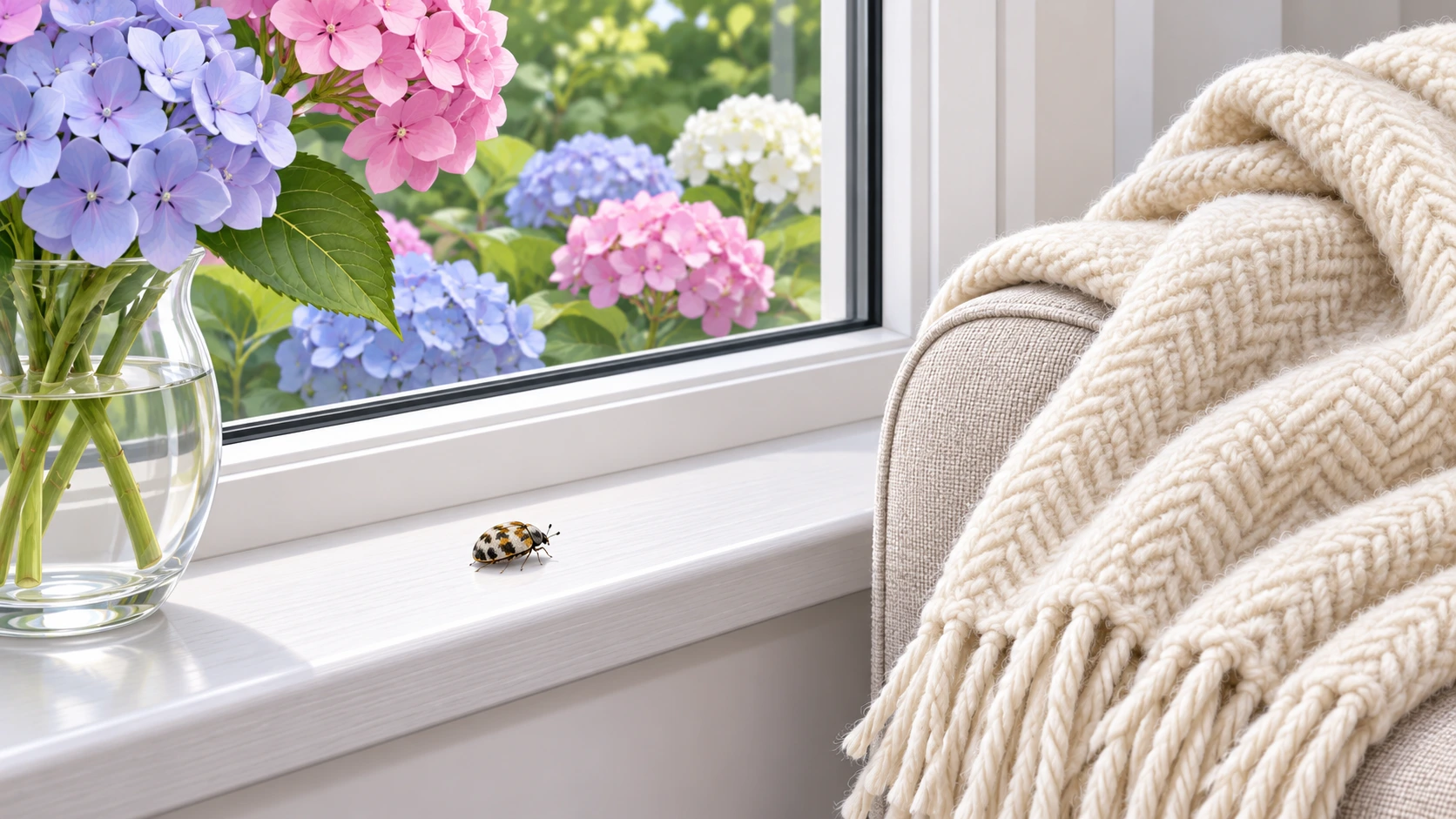
Carpet beetles are attracted to different things depending on their life stage. Many adult carpet beetles respond to sunlight and visit flowers for pollen or nectar, while their larvae develop around wool, fur, feathers, pet hair, dead insects, and other suitable organic materials. Food and perspiration residues on fabrics can also make some materials more appealing to larvae. The strongest reason carpet beetles remain established indoors is the availability of suitable larval food. Light may help explain where adults become visible, but it does not provide the resources their offspring need to grow.
Some household materials are inherently susceptible, while others become more suitable when contaminated with organic residues. Knowing the difference helps explain which conditions matter and which common assumptions are misleading.
What Attracts Adult Carpet Beetles Compared With Larvae?
Adult beetles and larvae have different needs, so the word attracts can describe several separate behaviors.
Adults of many carpet beetle species visit flowering plants, where they may feed on pollen or nectar. Some also respond to light, which helps explain why they are often noticed around illuminated windows and other bright indoor surfaces.
Larvae, on the other hand, generally favor protected places containing suitable food. They are responsible for the characteristic feeding damage associated with carpet beetle infestations. Rather than gathering around sunlight, larvae tend to remain concealed in or near materials that support their development.
The University of Maryland Extension’s carpet beetle guidance describes this contrast: adults may be found around lights and windows, while larvae feed on animal-derived materials and concealed organic debris.
Here is how the main factors differ.
| Material or condition | Adults | Larvae |
|---|---|---|
| Sunlight and bright windows | Some adults respond to light and gather there | Generally prefer concealed locations rather than exposed light |
| Flowers and pollen | Many adults visit flowers; feeding varies by species | Flowers are not the usual indoor feeding habitat for common fabric-infesting larvae |
| Wool, fur, feathers, and animal fibers | Not the stage that damages these materials | Suitable food for many common carpet beetle species |
| Pet hair and dead insects | Not usually a primary adult food resource | Can provide food for scavenging larvae |
| Perspiration and food residues on fabric | Not the main explanation for adult window sightings | Can make otherwise less suitable fabrics more vulnerable |
| Dark, undisturbed spaces | May be associated with egg-laying locations | Can provide shelter while larvae feed and develop |
This comparison is especially useful when beetles appear in several parts of a house. Adults and larvae might be visible in different locations even though only one area contains a suitable developmental food source.
Light responses also differ among species. For example, adult black carpet beetles commonly respond to light, while varied carpet beetles can show different responses depending on their circumstances. Consequently, light should not be treated as a universal attraction shared equally by every species.
Animal-Derived Fabrics Are Important Carpet Beetle Attractants
Wool, fur, feathers, hair, and other animal-derived materials are among the best-known food resources for carpet beetle larvae.
These materials contain proteins that certain carpet beetle species can digest. A wool rug, a felt hat, or a feather-filled decorative item may therefore provide food even when it appears perfectly clean.
Natural animal fibers can be present in places that are not immediately obvious. Antique upholstery may contain horsehair padding. A decorative pillow may contain feathers. A coat made mainly from synthetic material may still have wool lining or animal-fiber trim.
Such differences matter because a household can contain suitable carpet beetle food without having an obvious wool carpet.
The University of Florida’s carpet beetle reference identifies wool, silk, hair, bristles, fur, feathers, and animal-derived upholstery materials among the resources associated with common carpet beetle species.
Not every natural fiber has the same susceptibility. Clean cotton and synthetic fabrics differ from wool, and some textiles become more vulnerable when blended with animal fibers or contaminated by residues.
Those material-specific differences are examined in whether carpet beetles eat cotton and other natural fabrics.
For the broader question of attraction, the important point is that some fabrics already contain a suitable food source before they become dirty or worn.
Pet Hair, Lint, and Dead Insects Can Support Carpet Beetles
Some of the most productive carpet beetle food sources are materials that homeowners do not think of as possessions.
Pet hair accumulates beneath furniture, along baseboards, and in narrow spaces behind appliances or storage units. Lint can contain animal-derived fibers, hair, and other organic particles. Dead insects may collect in inaccessible corners or sheltered building spaces.
These materials can support scavenging carpet beetle larvae even when no clothing or upholstery has been damaged.
Colorado State University Extension identifies pet hair, lint, dead insects, wool, fur, and feathers as common dermestid food resources.
A useful example is a home with synthetic wall-to-wall carpeting and a shedding dog. The carpet fibers themselves may be resistant to feeding, yet hair accumulated beneath a heavy sofa can still provide suitable material for some larvae.
The same issue can arise in a house without pets. Dead flies or other insects collected in a sheltered space may provide larval food.
This is why the presence of carpet beetles should not automatically be blamed on a wool rug or wardrobe. The resource supporting the larvae may be ordinary debris that has accumulated nearby.
Not all household dust is equally attractive
Dust is a mixture of materials. Some components may provide nutrients for carpet beetle larvae, while others do not.
Hair, dead insects, and animal-derived fibers are relevant because certain larvae can feed on them. Mineral dust, ordinary grit, and non-nutritive particles do not become food simply because they accumulate in a dark area.
An undisturbed corner with no suitable food is therefore different from one containing a substantial collection of hair and dried insect remains.
This also explains why having carpet beetles does not necessarily mean a house is dirty. A concealed food source can exist even in an otherwise well-maintained home.
Food and Perspiration Residues Can Make Fabrics More Attractive
Clothing does not have to be made entirely from animal fibers to become vulnerable to carpet beetle larvae.
Food stains, body oils, perspiration, and certain other organic residues can make fabrics more suitable for feeding. This is especially relevant when clothing has been worn and then stored without cleaning.
A wool sweater already contains susceptible animal fibers, but soiling may increase its appeal. A synthetic or plant-based fabric that would otherwise resist feeding can become more vulnerable when suitable residues are present.
The University of California’s integrated pest management guidance notes that food and perspiration stains on fabrics attract carpet beetles.
However, the presence of a sweat stain does not guarantee that larvae will feed on the garment. The extent of vulnerability depends on the insect species, the material, the residues, and the surrounding conditions.
It would also be misleading to conclude that every item of clothing worn against the skin is an especially attractive carpet beetle food source. Regular handling, cleaning, and the nature of the fabric all influence whether larvae can develop.
The distinction is useful when comparing two similar garments: a clean, frequently used synthetic shirt and a long-stored wool sweater containing perspiration residues do not offer equivalent feeding opportunities.
Certain Dry Stored Products Can Also Provide Food
Some carpet beetle species and related dermestid beetles can develop in stored products containing dried animal or plant material.
Examples include dry pet food, birdseed, grain products, and certain dried food ingredients. The relevant species and product composition determine whether a particular item is suitable.
Virginia Tech’s carpet beetle habitat guidance describes larvae associated with dry, protein-rich materials and notes that birdseed and pet food can provide sources in residential settings.
This possibility should be distinguished from a blanket claim that every carpet beetle is strongly attracted to every pantry product.
Different dermestids have different feeding preferences. A small beetle discovered in flour or cereal may also belong to an entirely different stored-product pest group.
That means the insect must be identified before treating the presence of beetles in food as a carpet beetle problem.
For the overall attraction question, these products matter because suitable food resources are not limited to carpeting, clothing, and furniture.
Hidden Animal-Associated Materials Can Sustain Activity
Carpet beetles evolved to exploit organic material well beyond human textiles. Some species develop in bird nests, rodent nests, dead insects, and dried animal remains.
When such material exists in or near a building, it can provide resources that are not visible during ordinary household cleaning.
For example, an old bird nest may contain feathers, dead insects, and other dry debris. An abandoned rodent nest may contain fur and animal-associated materials. Certain carpet beetle larvae can use resources like these without ever coming into contact with a wool sweater.
These hidden sources help explain cases where adult beetles repeatedly appear indoors despite no obvious damage to stored clothing.
However, the presence of carpet beetles does not prove that a dead animal or nest exists in the building. Such materials are possible resources, not conclusions that can be drawn from a single sighting.
The actual materials carpet beetle larvae eat vary across species. Understanding those preferences is especially important when an apparent food source differs from the usual textile examples.
Why Dark, Sheltered Spaces Favor Carpet Beetle Larvae
Darkness and limited disturbance can help larvae remain concealed while feeding. Larvae of many common household carpet beetle species avoid light and occupy protected spaces within or near food materials.
The value of these conditions is practical. A larva developing inside folded wool or beneath furniture is less exposed than one crawling across a bright floor. It may remain close to its food source for extended periods without being noticed.
This association can lead people to conclude that carpet beetles are attracted to darkness by itself. Darkness is not food, and a protected location does not guarantee that larvae can survive there.
A useful comparison is between an empty drawer that remains closed for several months and a similarly undisturbed drawer holding a susceptible wool garment. Both provide shelter, but only the latter contains an obvious food resource.
The relationship can be summarized as follows:
Suitable food plus shelter: Can provide favorable conditions for larval development.
Suitable food in an exposed location: May still be used, but exposure and disturbance can affect larval activity.
Shelter without suitable food: Does not provide the nutrients larvae need for continued development.
Light without suitable food: May concentrate some adults but cannot sustain feeding larvae.
These are biological distinctions rather than a ranking of every possible household location.
Does Warmth or Humidity Attract Carpet Beetles?
Temperature and humidity can affect carpet beetle development, but neither should be treated as a universal lure.
Carpet beetles are insects, so their growth and activity depend partly on environmental conditions. Temperature influences the speed of development, while moisture conditions can affect whether eggs and larvae survive successfully.
The effects are species-dependent. A room being warm does not mean carpet beetles will necessarily gather there, and a dry home is not automatically protected from infestation.
Carpet beetle larvae are particularly notable for their ability to develop on relatively dry materials. They do not require standing water or the persistently damp conditions associated with some other household pests.
Warm indoor temperatures can support development when suitable food is available, but temperature alone does not explain an infestation.
The same applies to central heating. It may help maintain conditions compatible with insect development, yet it does not create the animal-derived materials larvae need.
What Attracts Carpet Beetles to a House With No Carpet?
A house without carpeting may still contain wool clothing, feather-filled bedding, upholstered furniture, pet hair, dead insects, and other suitable materials.
Carpet beetles were named partly because some species damage wool carpeting. The name does not limit their feeding behavior to carpets.
Consider a home with hardwood floors, synthetic furniture coverings, and no visible rugs. If dead insects have accumulated behind a fixed cabinet, that concealed material may still support some carpet beetle larvae.
Similarly, natural-bristle brushes or feather decorations may supply food independently of the flooring.
For this reason, carpet beetles can occur in homes without carpeting. The availability of suitable food matters more than the presence of any particular household furnishing.
Attraction Is Not the Same as Proof of an Infestation
One adult carpet beetle found near a lighted window does not establish that attractive larval food exists somewhere in the home.
Adults can be present indoors without a continuing breeding population. Some may be temporary visitors, and others may have developed in materials that are no longer present.
Larvae provide more useful evidence when they are found directly associated with a suitable food source. Several living larvae within wool, pet hair, or dead insect debris suggest a closer relationship between the material and their development.
The distinction can help avoid overinterpreting a common observation.
| Observation | What it supports | What remains uncertain |
|---|---|---|
| Adult beetle on a bright window | Some adults gather near light | Whether any larvae are developing indoors |
| Larva inside a wool item | The material may be providing food or shelter | Whether additional items are affected |
| Larvae among accumulated pet hair | A plausible local larval food resource | Whether that is the only source |
| Adult beetles in a clean room | Adults are present | Whether the room supports their offspring |
| Larvae and cast skins among dead insects | Stronger evidence of activity associated with suitable debris | Whether the source remains active after discovery |
The central distinction is between a condition that makes an adult visible and a material that can support immature development.
A homeowner who finds one adult should not assume every wool garment or concealed space is infested. The meaning of finding a single carpet beetle depends on additional evidence.
Do Perfume, Laundry Detergent, or Artificial Light Attract Carpet Beetles?
Claims that carpet beetles are strongly attracted to particular household fragrances, laundry scents, or detergents are not well established by the extension guidance used for this article.
That does not establish that every fragrance is irrelevant to every carpet beetle species. It means there is insufficient basis for presenting scented products as major household attractants.
Light is better documented. Some adults respond to illuminated areas and are commonly found around windows, but that does not mean every household light attracts all carpet beetles equally.
Light also should not be confused with food attraction. An adult moving toward a window is not demonstrating that the glass, curtains, or nearby furniture contain resources suitable for larvae.
Similarly, a clean synthetic garment with a strong laundry fragrance should not be considered more vulnerable than wool solely because of its scent.
When evaluating possible attractants, evidence of usable food and actual larval activity is more meaningful than an unsupported assumption about odors.
How to Use This Information Without Overreacting
If carpet beetles are appearing repeatedly, the first question is whether you are seeing adults or larvae.
Adult sightings can reflect movement toward light, while larvae are more directly connected to the materials supporting development. A few adults around a window may justify observation and identification, but they do not automatically require insecticide treatment.
When larvae are present, examining the material where they were found can help establish whether a suitable resource is involved.
For example, larvae among dead insects present a different situation from an adult resting on a clean curtain. In the first case, there is a plausible feeding resource at the sighting location. In the second, the curtain may simply be where the adult happened to land.
The University of California’s integrated pest management guidance emphasizes removing larval food sources and states that insecticide treatments may be unnecessary when sanitation and exclusion resolve the problem.
Avoid spraying clothing, bedding, or occupied household surfaces simply because they are among the materials carpet beetles might visit. Pesticide use must follow the product label, including permitted sites and restrictions.
A more detailed investigation is justified when living larvae repeatedly appear or when suitable materials show confirmed feeding activity. The objective is to establish what is supporting development rather than assume every suspected attractant is involved.
Frequently Asked Questions
Are carpet beetles attracted to dirty clothes?
Food stains, body oils, and perspiration residues can make some fabrics more suitable for carpet beetle larvae. However, clean animal-derived materials such as wool and feathers may also be susceptible. Soiling is one contributing factor, not a requirement for infestation.
Are carpet beetles attracted to pet hair?
Certain carpet beetle larvae can feed on shed animal hair. Accumulations that remain undisturbed may provide food, particularly when mixed with other organic debris. Having a pet does not automatically mean carpet beetles will develop.
Are carpet beetles attracted to light or darkness?
Many adults respond to light, while larvae generally favor protected, darker feeding locations. The exact response varies by species and developmental circumstances. Light can explain where adults gather without identifying where larvae are feeding.
Are carpet beetles attracted to clean houses?
Carpet beetles can occur in clean homes because suitable larval food may still be present. Wool clothing, feather-filled items, and concealed dead insects do not depend on poor housekeeping. Cleanliness alone cannot determine whether an infestation is possible.
Do carpet beetles like cardboard and paper?
Ordinary cardboard and clean paper are not the principal foods of common fabric-infesting carpet beetle larvae. Insects found around boxes may be associated with the contents, accumulated debris, or other materials. Some dermestid species have broader food preferences, so correct identification remains important.
Are carpet beetles attracted to humans?
Carpet beetles do not seek living people as hosts for blood meals. They do not feed on living human skin or live in human hair as a normal habitat. Shed hair and residues on clothing may provide resources for some larvae, but that differs from insects being attracted to a person as a host.
The Bottom Line
Carpet beetles respond to different resources as adults and larvae. Light and flowers can help explain adult activity, while animal-derived materials, organic residues, and accumulated dead insects provide food that allows larvae to develop.
The combination of suitable food and protected conditions is more significant to a continuing household infestation than any single scent, light source, or room temperature.
When carpet beetles appear indoors, their life stage and association with actual feeding material provide the clearest explanation of what may be attracting or sustaining them.