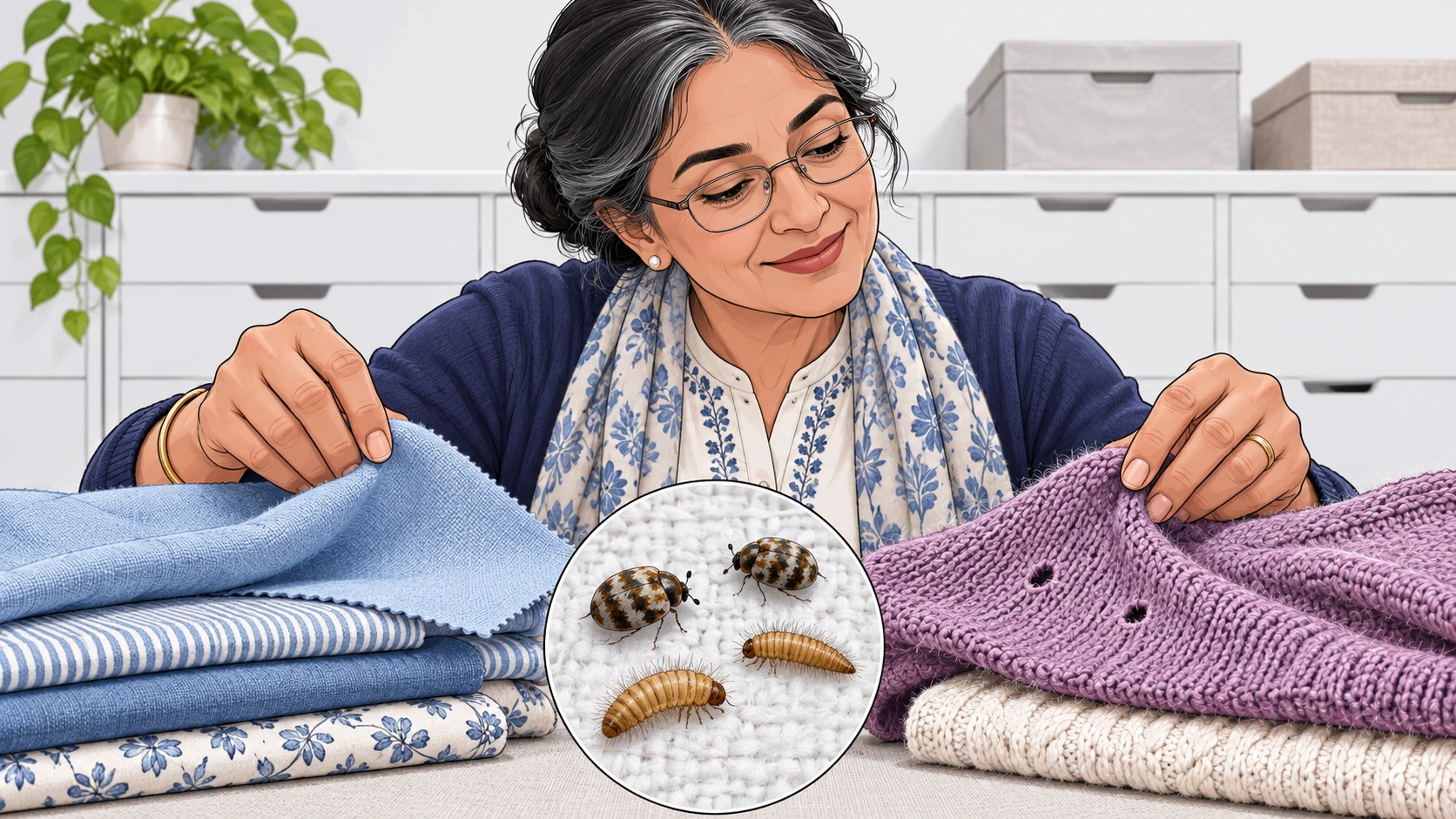
Carpet beetles can eat cotton, but clean cotton is much less susceptible than wool, fur, silk, and other animal-derived materials. Carpet beetle larvae are especially adapted to feeding on animal proteins. Cotton, linen, rayon, and some synthetic fabrics may also be attacked when they contain food stains, perspiration, animal-derived residues, or susceptible fibers blended into the fabric.
This is why the label 100% cotton does not mean a garment is equally attractive to carpet beetles as a wool sweater. Cotton is a plant-based cellulose fiber, while wool is an animal-derived protein fiber. They may both be described as natural fabrics, but their composition makes them very different food resources for the insects.
The distinction becomes more complicated with blended fabrics. A sweater made from 40% wool and 60% polyester may still be vulnerable because the wool provides usable food. Similarly, a cotton garment contaminated with certain organic residues may be attacked even though its underlying fibers are not the larvae’s preferred food.
The stage responsible for feeding is also important. Carpet beetle larvae damage fabrics, not adult carpet beetles. An adult resting on a cotton shirt is not evidence that it has been eating the material.
Why Carpet Beetles Prefer Some Natural Fabrics Over Others
The term natural fabric describes where a fiber comes from, not whether carpet beetles can digest it.
Wool comes from sheep, silk is produced by silkworms, and cotton comes from the seed fibers of cotton plants. Although all three are natural materials, their chemical composition differs substantially.
Wool contains keratin, a tough structural protein found in animal hair. Carpet beetle larvae are among the relatively few household pests capable of digesting this type of material. Silk is also an animal-derived protein fiber, although its principal structural protein is fibroin rather than keratin.
Cotton and linen consist primarily of cellulose, a plant structural carbohydrate. These fibers generally do not provide the same nutritional resources as animal-derived proteins.
The distinction is well established in carpet beetle feeding guidance for household fabrics. Wool, fur, silk, and related animal materials are susceptible, while cotton and synthetic fabrics are much less commonly attacked unless they contain susceptible blends or substantial organic soiling.
This means that fabric susceptibility is not determined by whether an item is expensive, organic, soft, or naturally manufactured. Its actual fiber composition and condition are more useful.
Which Fabrics Can Carpet Beetle Larvae Eat?
The following comparison separates materials that provide recognized larval food from those generally resistant to feeding in a clean, uncontaminated state.
| Fabric or fiber | Typical susceptibility | Main reason |
|---|---|---|
| Wool | High | Contains animal-derived keratin |
| Cashmere | High | Animal hair fiber containing keratin |
| Mohair and alpaca | High | Animal-derived protein fibers |
| Silk | Susceptible | Contains animal-derived proteins |
| Cotton | Usually low when clean | Primarily cellulose; soiling may change susceptibility |
| Linen | Usually low when clean | Plant-based cellulose fiber |
| Rayon and viscose | Usually low when clean | Regenerated cellulose; stains or blends can increase risk |
| Jute and sisal | Variable | Plant fibers; feeding reports depend on material and condition |
| Polyester | Generally resistant when clean | Synthetic polymer is not normal larval food |
| Nylon | Generally resistant when clean | Synthetic polymer is not normal larval food |
| Acrylic | Generally resistant when clean | Synthetic fiber generally lacks suitable nutrients |
| Wool-polyester blend | Susceptible | Wool component can support feeding |
| Cotton-wool blend | Susceptible | Animal-derived fibers remain available |
These categories describe general feeding susceptibility, not guaranteed outcomes for individual garments. Fiber composition, insect species, contamination, and construction can change what happens.
One particularly important exception involves wool-synthetic blends. The synthetic fraction does not necessarily protect the item, because larvae may chew through or around fibers while obtaining nutrition from the wool.
This distinction is recognized in extension guidance on carpet beetles and blended yarns. A blended textile can sustain significant damage even though the larvae cannot digest every fiber in it.
The practical lesson is that the presence of an indigestible fiber does not automatically make an entire fabric resistant.
Do Carpet Beetles Eat 100% Cotton?
Carpet beetle larvae do not usually prefer clean, 100% cotton because cotton consists primarily of cellulose rather than the animal proteins they are especially adapted to digest.
However, cotton cannot be described as completely immune.
Larvae may attack cotton that has been contaminated by suitable food residues, body oils, urine, animal excreta, or other organic substances. Some species may also consume cotton to a limited extent under certain conditions.
The relationship between contamination and cotton feeding is documented in research-based fabric pest guidance, which identifies soiled cotton, linen, and rayon as materials that carpet beetle larvae may attack.
Consider two identical cotton shirts. One has been washed and stored clean. The other has a dried food spill and has remained in storage for several months. The first offers relatively little suitable food, while the second contains an organic residue that may provide an opportunity for feeding.
This does not mean every food stain attracts carpet beetles equally or that any stained cotton item will become infested. The type and amount of residue, insect species, and surrounding conditions all matter.
It also does not mean the larvae are necessarily digesting the cotton itself. In some situations, the nutritional target may be the contaminating material rather than the cellulose fibers.
Can carpet beetles eat cotton T-shirts?
They can be associated with cotton T-shirts, particularly when the garments are soiled or contain blended animal-derived fibers. But an ordinary clean cotton T-shirt is not as favorable as a wool sweater.
A beetle or larva on a cotton shirt does not automatically establish that the insect has eaten it. Larvae may wander across fabrics without feeding on them, while adults can land on clothing without damaging it.
The difference between an insect occupying a garment and actually feeding on its fibers is essential when evaluating a sighting.
Do Carpet Beetles Eat Linen?
Clean linen is generally less susceptible to carpet beetle feeding than wool because it is made from flax fibers, which consist primarily of cellulose.
However, linen contaminated with suitable organic residues can sometimes be attacked. This is particularly relevant to stored table linens, clothing, or other textiles that contain food spills or animal-derived material.
Furniture carpet beetles, Anthrenus flavipes, have specifically been associated with feeding on cotton, linen, rayon, and jute when these materials are stained with animal body oils or excreta.
This species-specific exception is described in the documented feeding behavior of furniture carpet beetles.
A clean linen shirt and a linen upholstery fabric containing animal hair or old organic residues therefore should not automatically be placed in the same risk category.
Linen’s plant origin generally makes it less favorable than animal-derived fabrics, but the surrounding material and contamination can change its susceptibility.
Do Carpet Beetles Eat Silk?
Yes. Silk is one of the animal-derived fabrics that carpet beetle larvae can damage.
Although silk looks and feels different from wool, it consists largely of proteins produced by silkworms. These animal-derived components make silk susceptible to certain fabric-feeding insects.
Silk blouses, scarves, ties, linings, and decorative fabrics may therefore be vulnerable, especially when they remain stored and undisturbed.
However, silk susceptibility should not be explained by claiming that silk and wool contain identical proteins. Wool is rich in keratin, while silk primarily contains fibroin. Both are animal-derived protein materials, but their molecular composition differs.
A silk-polyester garment also requires closer consideration than the label synthetic blend might suggest. The silk fraction remains a potentially susceptible component even when synthetic fibers are present.
The important point is that silk belongs with susceptible animal-derived textiles rather than with clean cellulose-based fabrics such as cotton and linen.
Wool, Cashmere, Alpaca, and Mohair Are Particularly Susceptible
Wool and related animal-hair fabrics are among the clearest examples of materials carpet beetle larvae can use as food.
Cashmere comes from goats, mohair comes from Angora goats, and alpaca fiber comes from alpacas. Although these materials differ in texture and commercial use, they all originate from animal hair and contain structural proteins that can support certain carpet beetle larvae.
A garment does not become less biologically susceptible simply because the fiber is sold as luxurious or delicate.
A cashmere scarf and an ordinary wool blanket both contain suitable animal-derived material. Their construction, storage conditions, and exposure to insects may differ, but neither gains immunity from its price or softness.
This does not mean every wool or cashmere garment will be attacked. Larvae must encounter the material, and local conditions must permit feeding.
Nevertheless, when assessing fiber-specific susceptibility, these animal-hair textiles belong in a higher-concern category than clean cotton, linen, or polyester.
Do Carpet Beetles Eat Rayon, Viscose, or Bamboo Fabric?
Rayon and viscose are regenerated cellulose fibers, commonly manufactured from wood pulp or other plant-derived cellulose.
Bamboo fabric sold as bamboo viscose or bamboo rayon is typically another regenerated cellulose product rather than a textile made from intact bamboo fibers.
These materials are therefore not equivalent to wool merely because their original raw material comes from plants.
Clean rayon and viscose are generally resistant to carpet beetle larval feeding compared with animal-derived protein fabrics. However, heavy soiling or blending with susceptible fibers may increase vulnerability.
This distinction is particularly relevant to clothing labels that use broad terms such as natural, bamboo, or eco-friendly. Those descriptions do not reliably communicate what the larvae can digest.
A viscose blouse with no animal-fiber content is fundamentally different from a viscose-wool blend. The latter contains a direct source of animal-derived protein.
When uncertain, the fiber-percentage label provides more useful information than general marketing language.
Can Carpet Beetles Eat Jute, Sisal, and Other Plant-Fiber Rugs?
Some plant-based rug materials, including jute and sisal, have been reported as susceptible to carpet beetle attack under particular conditions.
This requires more caution than the relatively straightforward explanation for wool.
Plant fibers are composed mainly of cellulose and associated plant substances, while common fabric-infesting carpet beetle larvae are strongly associated with animal-derived materials. Reports of damage to jute or sisal should therefore not be interpreted as proof that every species readily digests clean plant fibers.
Some guidance identifies plant-fiber carpeting as potentially susceptible, while other references emphasize animal-derived fibers and organic contamination as the principal feeding resources.
For a jute rug, factors such as accumulated animal hair, food residues, backing materials, and mixed-fiber construction can complicate the picture.
An insect discovered underneath a jute rug might be feeding on debris trapped beneath it rather than on the rug fibers themselves.
We would therefore consider jute and sisal potentially vulnerable under certain circumstances, but not automatically equivalent to wool in susceptibility.
Do Carpet Beetles Eat Polyester, Nylon, or Acrylic?
Clean polyester, nylon, and acrylic are generally resistant to carpet beetle feeding because they are synthetic polymers rather than the animal-derived materials that most fabric-infesting larvae prefer.
Carpet beetle larvae are not normally capable of using these polymers as nutritious food.
However, synthetic fabrics can still be associated with carpet beetle activity. Wool blends may contain digestible animal fibers, and some soiled synthetics may carry organic residues that attract feeding.
These exceptions are important because the statement carpet beetles cannot eat polyester can be misleading when applied to an entire garment.
A jacket labeled 80% polyester and 20% wool still contains wool. A fabric containing synthetic fibers may also have animal-derived lining, padding, or trim that is not obvious from the outer surface.
Similarly, a larva crawling across an all-polyester blanket may be moving between locations or using debris caught in the fabric rather than digesting the polyester itself.
The correct distinction is that clean synthetic fibers generally are not larval food, but garments containing synthetic fibers are not necessarily free of susceptible materials or residues.
Why Wool-Polyester and Cotton-Wool Blends Can Still Be Damaged
Blended fabrics are a frequent source of confusion because manufacturers may combine fibers with very different nutritional properties.
Consider a sweater containing 30% wool and 70% acrylic. Acrylic is generally resistant to carpet beetle digestion, but the wool fraction remains a suitable food resource.
Larvae feeding on a blended yarn may damage surrounding indigestible fibers as they remove the nutritious component. Consequently, a garment can suffer substantial physical damage even when most of its fiber content is synthetic.
This is an important difference between the percentage of digestible fiber and the percentage of fabric that can be affected.
The following examples illustrate the principle.
| Fabric label | How to interpret susceptibility |
|---|---|
| 100% cotton | Generally low susceptibility when clean and uncontaminated |
| 95% cotton, 5% wool | Wool remains a potential food component |
| 60% polyester, 40% wool | Vulnerable because a substantial wool fraction is present |
| 80% acrylic, 20% alpaca | Animal-hair component can support feeding |
| 70% viscose, 30% silk | Silk remains a susceptible animal-derived component |
| 100% polyester | Generally resistant when clean, although associated debris may support larvae |
These percentages are illustrative examples of common label formats, not experimental thresholds. There is no verified universal wool-percentage cutoff below which a fabric becomes immune to carpet beetle feeding.
A garment with a relatively small animal-fiber fraction may still be affected if larvae reach that component.
Why Stains, Sweat, and Body Oils Change Fabric Susceptibility
A clean fabric’s fiber composition is only part of the explanation. The substances deposited on it during use can alter whether carpet beetle larvae find usable food.
Food residues, perspiration, body oils, urine, and other animal-derived contaminants may supply nutrients that would otherwise be absent from plant-based or synthetic fibers.
This helps explain why fabric pest guidance often distinguishes clean textiles from heavily soiled ones.
For example, a clean cotton tablecloth offers a different potential food resource from the same tablecloth after dried milk or food residue has remained on it. The underlying cotton is unchanged, but the material present on its surface is not.
Some carpet beetle species can exploit such contamination. It would still be too broad to claim that all stains cause feeding or that every larva readily consumes any soiled fabric.
The relationship between soiled fabrics and carpet beetle feeding includes perspiration, body oils, and food or drink residues as factors that can make otherwise less susceptible materials attractive to larvae.
This distinction also explains why storing a garment without cleaning it can change its vulnerability, even when the fiber label remains the same.
However, washing a wool garment does not turn wool into a resistant material. Removing residues reduces one potential attraction while leaving the underlying animal-derived fibers intact.
Does Natural, Organic, or Expensive Fabric Mean Higher Risk?
No single marketing label reliably predicts carpet beetle susceptibility.
The term natural includes both wool and cotton, even though one is an animal-derived protein fiber and the other is plant-derived cellulose.
The term organic usually relates to agricultural or manufacturing standards, not whether an insect can digest the material. Organic cotton remains cotton, while organic wool remains wool.
Likewise, luxury materials are not necessarily less susceptible. Cashmere, silk, and fine wool may contain suitable nutrients regardless of how carefully the garment was manufactured.
A better hierarchy is to identify whether the fabric contains animal-derived fibers, whether it has a susceptible blend, and whether contamination adds potential food resources.
These factors are more informative than price, color, weave, or a general label describing the material as natural.
Can Carpet Beetles Be Found on Fabrics They Cannot Eat?
Yes. The presence of carpet beetles on a textile does not establish that the material is being consumed.
Adult carpet beetles may land on garments or other household surfaces while moving through a room. They are not the life stage responsible for typical fabric feeding.
Larvae can also wander away from the material in which they developed. A larva found on a clean polyester curtain may have originated in wool, pet hair, dead insects, or another food source nearby.
The distinction matters because people sometimes assume that every fabric touched by a carpet beetle must be vulnerable.
A living larva discovered inside a wool fold presents a stronger possible feeding association than one crawling across an exposed synthetic surface.
The explanation of why carpet beetles appear in closets or on clothes addresses these situations without treating every clothing sighting as evidence of damage.
Fabric composition tells you what a larva might be able to eat. It does not prove that the larva has eaten a particular item.
How to Evaluate a Fabric Label When Carpet Beetles Are Present
A clothing or upholstery label is a useful starting point because it can reveal animal-derived fibers that are not obvious by touch or appearance.
Start with the actual fiber percentages. Identify wool, cashmere, mohair, alpaca, and silk, then consider whether the garment contains susceptible linings, padding, or decorative components.
Next, distinguish clean materials from those containing organic residues. A pure cotton garment with heavy food contamination may deserve a different interpretation from a clean cotton item.
Finally, consider whether the insect itself has been identified. A small larva or a hole in fabric cannot automatically be attributed to carpet beetles.
The following sequence helps separate these questions.
-
Read the fiber label. Determine whether the material contains animal-derived fibers, plant cellulose, synthetic polymers, or a blend.
-
Consider contamination. Identify whether food residues, perspiration, or other organic materials may be present.
-
Identify the insect. Adult beetles, carpet beetle larvae, and unrelated fabric pests do not have identical feeding behavior.
-
Avoid assuming contact equals feeding. The insect may be moving across the fabric rather than using it for food.
This is a practical material-assessment framework based on documented feeding differences, not a laboratory test or a guarantee that a specific fabric will remain undamaged.
For a full explanation of the broader diet of carpet beetle larvae, the relevant food categories extend beyond textiles to animal remains, dead insects, and certain stored products.
What If Your Cotton Clothes Have Holes?
Holes in cotton clothing do not automatically mean carpet beetles have been feeding on it.
Ordinary wear, snagging, abrasion, manufacturing weaknesses, and other insects can also damage fabrics. Even when carpet beetles are present in the home, there may be a different explanation for a particular garment.
A clean, all-cotton item with unexplained holes is not strong evidence of carpet beetle feeding by itself.
If carpet beetle larvae are found associated with soiled cotton or an animal-fiber blend, that provides a more plausible explanation, but the material and insects still need to be assessed together.
The appearance and distribution of damage are separate identification questions. Our guide to what carpet beetle damage to clothing looks like addresses the evidence needed to distinguish insect damage from other causes.
The material assessment should come first: confirm what the fabric contains, rather than assuming every hole in a natural textile has the same origin.
Frequently Asked Questions
Do carpet beetles eat 100% cotton?
They may attack cotton under certain conditions, particularly when it contains suitable organic residues. Clean, uncontaminated cotton is generally less susceptible than wool and other animal-derived fibers.
Do carpet beetles eat organic cotton?
Organic cotton is still a plant-derived cellulose fiber. Its organic certification does not make it equivalent to wool or inherently attractive to carpet beetle larvae. Contamination and blended animal fibers remain relevant.
Do carpet beetles eat linen sheets?
Clean linen is generally less vulnerable than animal-derived textiles. However, suitable residues may increase its susceptibility, and finding a beetle on linen does not establish that feeding occurred.
Do carpet beetles eat bamboo clothing?
Bamboo viscose or rayon is generally a regenerated cellulose fabric. Clean material is usually resistant compared with wool, although susceptible blends or organic contamination can affect the risk.
Do carpet beetles eat silk pillowcases?
Silk is an animal-derived protein fiber and can be susceptible to carpet beetle larval feeding. A silk pillowcase should not be treated as equivalent to a clean polyester pillowcase merely because both feel smooth.
Do carpet beetles eat polyester blankets?
Clean polyester fibers are not normal food for carpet beetle larvae. However, a blanket containing wool or another animal-derived component, or one carrying suitable organic debris, may still be associated with larval activity.
Can carpet beetles eat a cotton-polyester blend?
A clean cotton-polyester blend is generally less favorable than wool-containing material. Substantial organic residues may increase susceptibility, but the presence of a larva alone does not prove the blend has been eaten.
Do carpet beetles eat cashmere?
Yes. Cashmere is an animal-hair fiber containing keratin, making it susceptible to carpet beetle larvae in the same general way as wool.
Are wool blends safe if they contain mostly polyester?
Not necessarily. Polyester is generally indigestible to carpet beetle larvae, but the wool component may still provide food. There is no universal percentage of polyester that guarantees protection.
Do carpet beetles eat fabric dye?
Ordinary fabric dye is not the recognized nutritional resource that explains carpet beetle feeding. Fiber composition, suitable organic residues, and insect species are more important factors. A particular color should not be treated as inherently protective.
The Bottom Line
Carpet beetles do not treat all natural fabrics alike. Wool, cashmere, mohair, alpaca, and silk contain animal-derived proteins that make them susceptible to larval feeding. Clean cotton, linen, rayon, and ordinary synthetic fabrics are generally less favorable.
The main exceptions involve contamination and blending. Food stains, perspiration, body oils, and animal-derived residues can make otherwise resistant fabrics vulnerable, while even a partial wool or silk component may provide enough suitable material for larvae to feed.
The most reliable way to judge fabric susceptibility is to look at its fiber composition, organic residues, and the actual insect involved. A natural label alone cannot tell you whether carpet beetles will eat it, and finding a beetle on a garment is not proof that feeding has occurred.