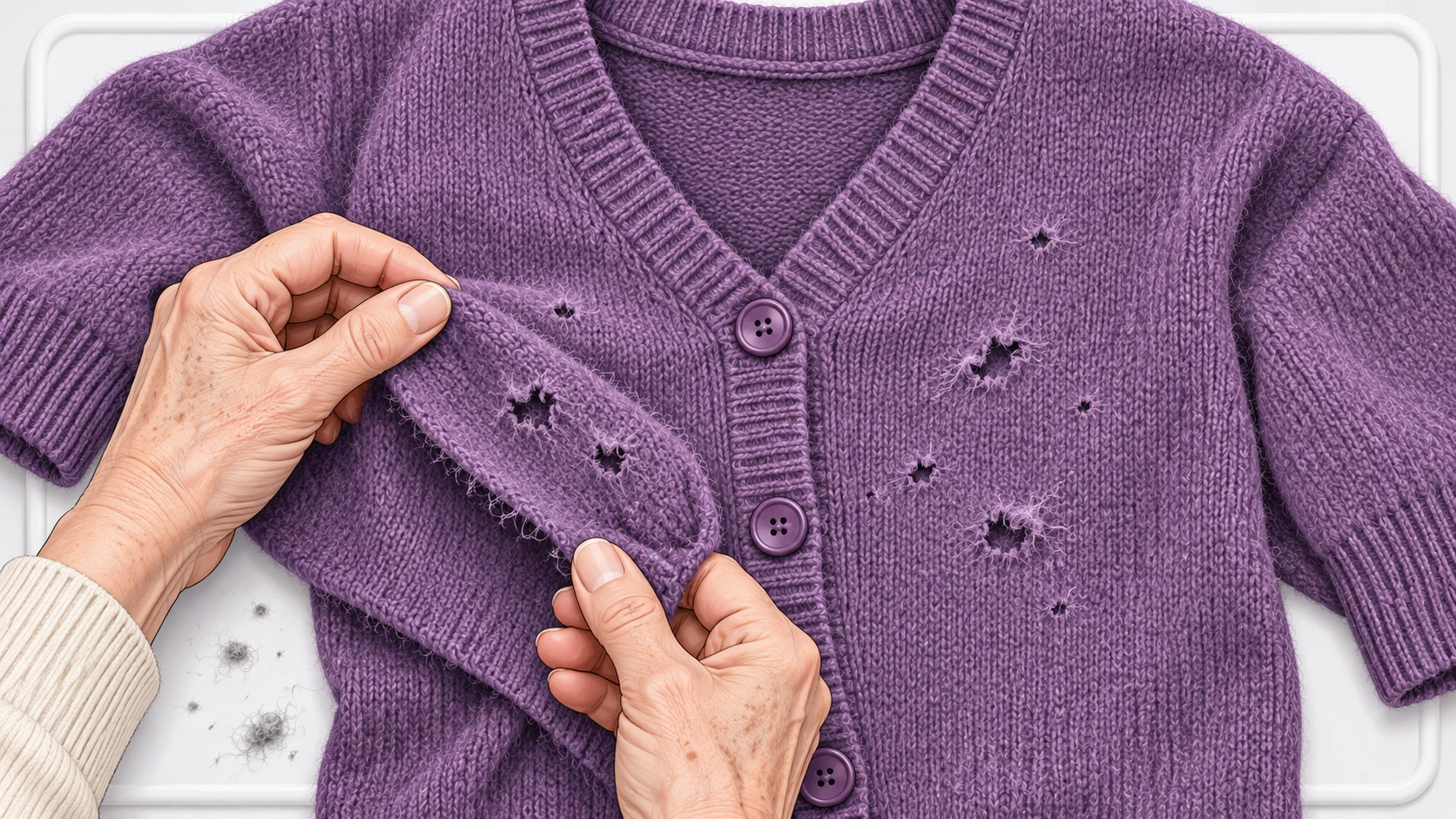
Carpet beetle damage to clothing usually appears as irregular holes, thin or threadbare patches, and areas where fibers have been eaten away. The damage may be concentrated in one section of a garment rather than scattered evenly across it. A wool sweater, for example, might have a rough, thinned patch near a fold, with several small holes where feeding has gone through the fabric.
The damage is caused by carpet beetle larvae, not adult beetles. Larvae feed on susceptible materials and may remain concealed while doing so. Their feeding can remove surface fibers without immediately creating a hole, which means an affected garment may look worn or fuzzy before the damage becomes obvious.
Holes alone cannot confirm carpet beetles. Clothes moth larvae, friction, snags, washing damage, and normal fabric deterioration can produce similar marks. The strongest evidence is a combination of characteristic fabric damage and correctly identified carpet beetle larvae or their shed skins associated with the garment.
Understanding what each type of damage looks like can help you decide whether you are dealing with insects or an unrelated clothing problem.
The Main Signs of Carpet Beetle Damage on Clothes
Carpet beetle larvae feed by chewing susceptible material. The appearance of the resulting damage depends on the garment’s construction, fiber type, and how extensively the larvae have fed.
The most recognizable patterns are surface grazing, uneven thinning, and irregular holes.
Irregular holes in the fabric
Carpet beetle larvae can leave holes with uneven edges after feeding through the thickness of a garment. These openings may be small or become larger when nearby damaged fibers separate.
Unlike a clean cut made by scissors, insect feeding generally removes fibers irregularly. The edges may look ragged, with surrounding threads weakened or missing.
A single hole is not diagnostic. A snagged thread can produce an irregular opening, and clothes moth larvae can create similar damage.
The feeding injury caused by carpet beetle larvae includes irregular holes in textiles. This supports the appearance as a possible clue, but not as proof that a particular hole was made by carpet beetles.
The context matters most when several damaged areas are associated with larvae or their cast skins.
Thin, threadbare patches
Not every carpet beetle feeding injury creates a complete hole.
Larvae may graze over the fabric surface, removing enough fibers to leave a noticeably thinner area. On a wool sweater, this can resemble a worn patch where the fabric has lost its fullness.
The remaining textile may look uneven, fuzzy, or partially transparent when held toward a light. Fine knitted items may show weakened yarns before any complete opening develops.
Carpet beetle larvae can leave threadbare areas and irregular holes as they graze susceptible fabric. These shallow injuries are important because they can be overlooked until the garment is stretched, worn, or handled.
A thin patch becomes more suspicious when it occurs in a protected part of a stored garment that would not normally experience much friction.
Larger areas of concentrated damage
Carpet beetle feeding sometimes affects a relatively broad area of one part of a garment rather than producing many small holes spread throughout it.
Imagine a folded wool cardigan with a damaged patch along one interior panel. The patch may contain weakened fibers, several adjoining openings, and a rough edge where sections of the knit have deteriorated.
This pattern can occur because larvae remain near suitable material while feeding. However, damage distribution varies, and carpet beetles do not always produce one large patch.
The general distinction between carpet beetle and clothes moth damage is that carpet beetles are more often associated with a larger damaged area, while moth feeding may appear as scattered holes. The patterns overlap too much for either arrangement to serve as a reliable identification test.
Carpet Beetle Clothing Damage: A Visual Comparison
Different injuries can look similar during a quick inspection. The following comparison focuses on what you can actually observe and how much diagnostic weight each feature deserves.
| What the clothing looks like | Possible interpretation | How strong is the evidence? |
|---|---|---|
| Uneven holes with missing fibers | Possible carpet beetle or clothes moth feeding | Weak without insects or other evidence |
| A broad, threadbare area on stored wool | Possible repeated larval grazing | Suggestive, but friction can produce similar thinning |
| Several adjoining holes within one damaged patch | Possible localized insect feeding | More useful when larvae or cast skins are present |
| One clean-edged tear following a seam | Mechanical strain or stitching failure may be more likely | Not characteristic evidence of carpet beetles |
| Repeated thinning where a bag strap rubs | Friction or abrasion | Position favors wear rather than insect feeding |
| Holes accompanied by silk threads or fabric-made cases | Possible clothes moth activity | Evidence points away from carpet beetles if the silk is insect-produced |
| Damage with hairy larvae and bristly cast skins | Stronger evidence of carpet beetle activity | Requires correct insect identification and association with the fabric |
No single fabric pattern is exclusive to carpet beetles. The most reliable assessment combines the condition of the garment with evidence of the insect responsible.
Where Does Carpet Beetle Damage Usually Appear on Clothing?
Carpet beetle feeding may be discovered in protected portions of garments, especially where the fabric has remained folded, compressed, or undisturbed.
A sweater may have damage along an interior fold or behind a collar. A coat may show injury in a concealed section near a lining or cuff. Damage on a stored scarf may be concentrated where layers remained in contact.
These areas can be overlooked because the outside of the garment may appear normal while it hangs in a closet.
Fabric pests commonly feed in folds, pleats, and other hard-to-see areas of clothing. This makes the protected portions of a garment worth examining when a hole has been discovered.
Location still cannot establish the cause by itself. Collars and cuffs also experience ordinary wear, while seams can fail under tension.
A hole at a cuff that has been rubbed against a desk for months may be easier to explain through abrasion than insect feeding. The same kind of opening on an otherwise unworn stored garment deserves a different interpretation.
The relevant question is whether the damaged location fits the garment’s normal use or whether it coincides with evidence of larvae.
What Do Carpet Beetle Larvae Leave Behind on Damaged Clothes?
Fabric injury is only part of the evidence. Carpet beetle larvae may also leave shed skins in or near the materials where they have developed.
These cast skins are generally brownish and bristly, resembling an empty version of the larva. They can become lodged within garment folds or collect among nearby debris.
Finding a recognizable cast skin alongside unexplained damage strengthens the possibility of carpet beetle activity. But an old skin alone does not prove that the garment is currently being eaten.
One larva molts multiple times as it grows, so several skins do not necessarily represent the same number of living insects.
Living larvae provide stronger evidence of current presence. Their elongated, hairy bodies distinguish them from the small, oval adult beetles that are often noticed on windowsills.
The appearance of carpet beetle larvae matters because misidentifying an unrelated insect can lead to an incorrect explanation for the fabric damage.
Likewise, distinguishing empty carpet beetle shed skins from living larvae helps avoid interpreting old material as proof of an active infestation.
Does carpet beetle damage leave webbing?
Carpet beetle larvae do not spin the characteristic silk webbing or fabric cases associated with certain clothes moth larvae.
That absence can be a useful clue when other evidence is present. A garment with irregular holes, bristly cast skins, and no associated silk is more consistent with carpet beetles than with a webbing clothes moth infestation.
However, the absence of webbing is not conclusive. Silk can be overlooked, removed during handling, or absent from the exposed portion of an affected garment.
The distinction between carpet beetles and clothes moths is best made by identifying the actual insect rather than relying on damage patterns alone.
Carpet Beetle Holes Versus Clothes Moth Holes
Carpet beetles and clothes moths are easily confused because their larvae can damage similar clothing materials.
Both may cause holes or weakened patches in wool garments. Both can feed while concealed, leaving damage that is discovered only after clothing has been stored.
The main visible difference is often the material left by the insects rather than the exact shape of the holes.
Carpet beetle larvae are typically hairy or bristly, and their discarded skins may remain nearby. Clothes moth larvae are caterpillars, generally pale-bodied, and some produce silk webbing or portable cases.
The damage patterns also offer limited clues. Carpet beetles are sometimes associated with larger concentrated areas, whereas clothes moths may leave scattered holes. But there is enough overlap that neither pattern identifies the pest reliably.
A useful diagnostic comparison is:
-
A wool sweater with a broad damaged patch and a correctly identified hairy carpet beetle larva provides persuasive evidence of carpet beetle feeding.
-
A wool sweater with small holes and a pale caterpillar in a silken case provides stronger evidence of clothes moth activity.
-
A wool sweater with several holes but no insect evidence remains an uncertain case.
The last situation is common. A hole may have appeared long before it was discovered, and the insect responsible may no longer be present.
Could It Be Ordinary Clothing Wear Instead?
Yes. Everyday wear can cause holes, thinning, and broken fibers that resemble insect feeding.
Friction is one of the most important alternatives. Repeated rubbing can wear away fabric around elbows, cuffs, waistbands, underarms, and areas where bags or belts contact clothing.
Knitted garments may also develop holes after a single yarn breaks. A snag can pull threads out of place, making the opening larger when the garment is stretched or washed.
Washing and drying can expose existing weak points or worsen fabric that has already deteriorated. Damage appearing after laundering does not necessarily mean an insect was inside the machine.
The position and shape of the injury can help you evaluate these explanations.
Friction and abrasion
Abrasion often produces gradual thinning in locations exposed to repeated movement or rubbing.
An elbow patch worn thin on a frequently used sweater may be consistent with normal use. Repeated thinning along the waist of shirts can occur where clothing rubs against a belt, waistband, or other surface.
Carpet beetle feeding can also produce thin areas, so the distinction is not based on texture alone.
The location becomes more persuasive when a clear mechanical source is present and no insects or cast skins are associated with the affected garment.
Snags and broken yarns
A knitted garment can develop a visible hole when one yarn is caught and pulled. The opening may have irregular edges because the surrounding loops shift or unravel.
This can resemble insect injury, particularly after the original snag has disappeared.
Examine whether threads are pulled, stretched, or displaced around the hole. Those features may support a mechanical explanation.
An insect-related hole more often involves fibers that have actually been removed, but aged damage can be difficult to interpret with certainty.
Seam failures and fabric deterioration
A split directly along a seam may result from failed stitching or fabric strain. Its position can make it less suggestive of random insect feeding.
Older textiles may also weaken through repeated use, light exposure, storage conditions, or deterioration of the fibers themselves.
A fragile garment may tear during ordinary handling, creating holes that were not caused by insects.
We would not diagnose carpet beetle damage from a photograph of torn fabric alone when these explanations remain plausible.
Can You Identify Carpet Beetle Damage From a Photograph?
A photograph can show the extent and location of damage, but it usually cannot identify carpet beetles with certainty.
A close image of a wool sweater might reveal uneven holes, frayed edges, and a broad area of thinning. Those details may be consistent with insect feeding, yet they do not distinguish every possible pest or mechanical cause.
Photographs become more useful when they include the insects themselves or recognizable associated evidence.
For example, a clear image of a hairy larva beside the damaged fabric provides substantially more information than a close-up of the hole alone. A photograph of an empty cast skin may also help, although the skin’s age and relationship to the garment remain uncertain.
A useful set of photographs would show the entire garment, the location of the damaged section, a close view of the affected fibers, and any insects found directly in the material.
Avoid enlarging an image so aggressively that ordinary fibers or dust particles begin to resemble anatomical features. Blurry photographs can encourage false identification rather than resolve uncertainty.
How Much Clothing Damage Can One Larva Cause?
There is no dependable universal number of holes or amount of fabric loss attributable to one carpet beetle larva.
The extent of damage depends on the species, the material, how long feeding continues, and the conditions surrounding the larva’s development.
One larva may graze an area of fabric without producing a complete hole. More extensive damage may develop when feeding continues or several larvae use the same garment.
A garment containing multiple holes does not prove that multiple larvae were present. Conversely, several larvae may occupy susceptible material before substantial visible damage appears.
The size of the damaged area cannot reliably tell you the age of the infestation, either. A small hole may result from prolonged but limited feeding, while a larger opening may partly reflect later tearing of weakened fabric.
It is more useful to document the visible injury and look for associated insect evidence than to estimate larval numbers or development time from the hole size.
Does Finding Damage Mean the Infestation Is Still Active?
Not necessarily. A garment can retain insect damage long after the feeding larvae have disappeared.
Holes do not heal, and threadbare patches remain visible until the textile is repaired or discarded. Cast skins can also persist after larvae have moved away or completed development.
That means an old damaged sweater is evidence of fabric deterioration, but not automatically evidence of an active carpet beetle infestation.
Living larvae found within the affected material provide stronger evidence of current presence. Repeated discoveries of larvae associated with the same garment or nearby textiles also deserve attention.
The distinction between current activity and old damage matters because unnecessary treatment may follow when every historical hole is interpreted as a new infestation.
The broader signs of a carpet beetle infestation provide context for how damage fits alongside living insects and other observations.
What Should You Do When You Discover Suspicious Holes?
Begin by keeping the damaged garment separate from other belongings until you can identify the problem. This makes it easier to preserve any insect evidence and prevents a potentially affected item from being mixed back into storage.
Examine the damaged area, including nearby folds and seams. Look for recognizable larvae, shed skins, or silk associated with clothes moths. Photograph what you find before brushing away the evidence.
If you find no insects, do not assume the garment is currently infested. Consider its normal wear pattern and whether the damaged section was exposed to friction, snagging, or strain.
When living carpet beetle larvae are confirmed, the affected item needs appropriate handling. Treatment choices depend on the material and its care requirements, so a delicate wool coat should not automatically be treated like a washable cotton shirt.
The temperature and exposure requirements for washing, drying, or freezing carpet beetle-infested clothing are separate from identifying the original damage.
Do not spray insecticide directly onto clothing unless the product label expressly permits that specific use. A garment with unexplained holes is not a sufficient reason to apply pesticides.
Frequently Asked Questions
What shape are carpet beetle holes in clothing?
Carpet beetle feeding can produce irregular holes with uneven edges. The holes do not have one diagnostic shape, and similar openings can result from clothes moths, snags, or ordinary wear.
Do carpet beetles make small holes or big holes?
Both are possible. Feeding may begin as shallow thinning or small openings, while larger damaged areas can develop through continued feeding or later breakage of weakened fibers. Hole size alone cannot identify the pest.
Can carpet beetles make clothing look threadbare without holes?
Yes. Larvae may graze fibers from the surface, leaving a thin or worn-looking patch before a complete hole appears. The appearance can resemble abrasion, so supporting evidence remains important.
Do carpet beetles leave perfectly round holes?
A round-looking opening is not exclusive to carpet beetles. Their feeding usually produces irregular injury, but fabric structure and stretching can affect the final shape. Perfectly round holes should not be used as a diagnostic rule for any one pest.
Can carpet beetles damage clothes without leaving larvae behind?
Yes. Larvae may move away, complete development, or die before the damage is discovered. Old feeding injury can remain even when no insects are visible.
How can I tell whether moths or carpet beetles ruined my sweater?
Look for correctly identified insects and their associated material. Hairy larvae and bristly cast skins support carpet beetle activity. Pale moth caterpillars, silken webbing, or portable cases support clothes moth activity. Holes alone frequently cannot separate the two.
Does one hole in a sweater mean I have carpet beetles?
No. A single hole may result from wear, snagging, fabric deterioration, or an insect. Without additional evidence, it should remain an unexplained hole rather than a confirmed carpet beetle injury.
What the Damage Really Tells You
Carpet beetle feeding on clothing can leave irregular holes, broad areas of thinning, and threadbare patches where fibers have been removed. The injury may be concentrated in protected portions of a stored garment, but its appearance overlaps with clothes moth damage and ordinary wear.
The strongest identification comes from matching the fabric injury with the insect responsible. A correctly identified larva or its cast skin associated with the damaged material is far more informative than the shape of a hole alone.
When the evidence is limited to damaged clothing, the cause should remain uncertain until there is a sound reason to attribute it to carpet beetles.