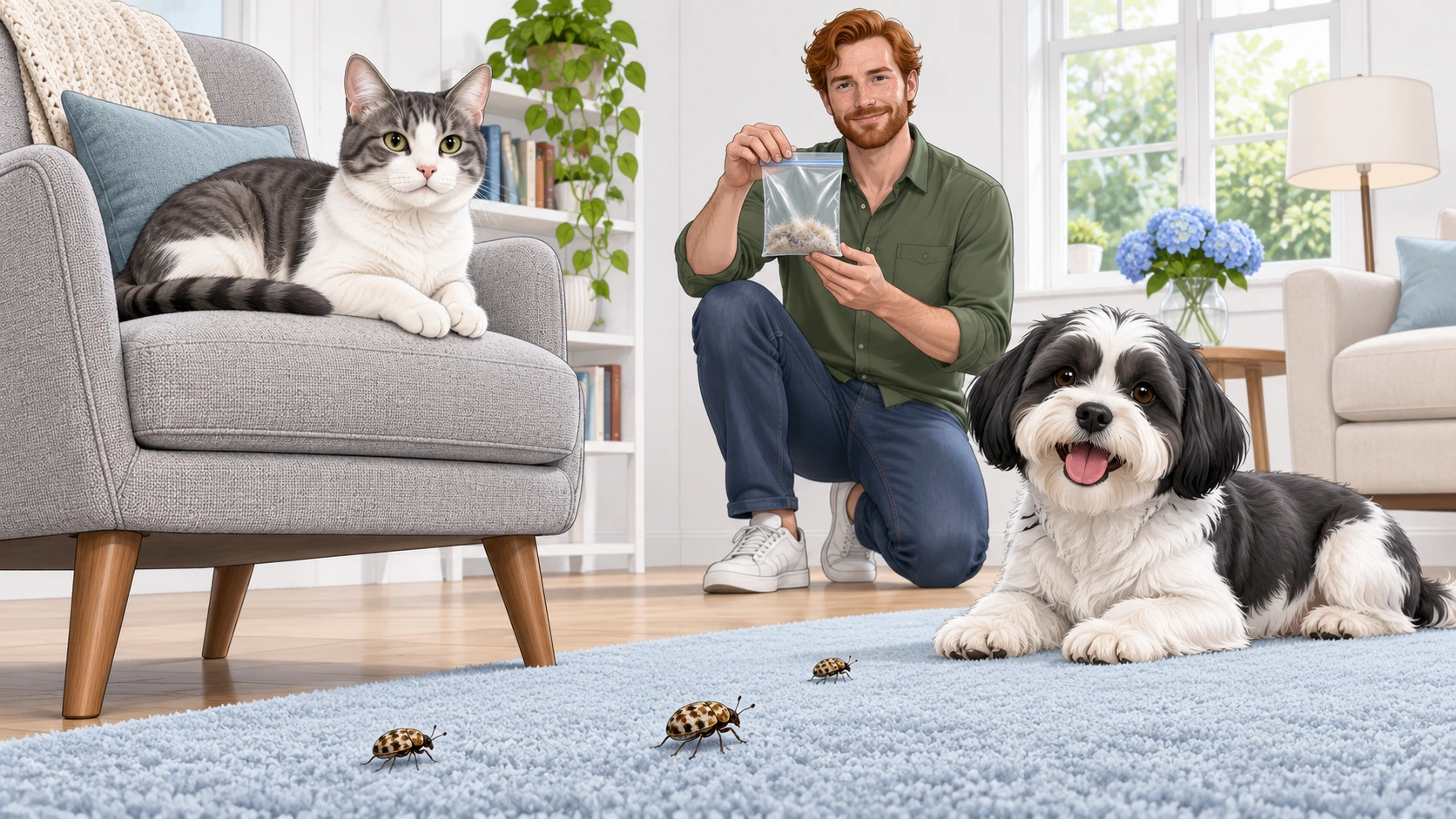
Carpet beetles are not generally dangerous to dogs or cats. They do not feed on living pets, are not known to bite them for blood, and are not recognized as a common cause of poisoning. However, their larvae have hairs that may cause irritation under certain circumstances, and a dog or cat that eats an insect could potentially experience an adverse reaction. Direct veterinary evidence about these specific exposures is limited.
For pet owners, the bigger concern is often what happens around the insects. Carpet beetle larvae can develop in accumulated pet hair, natural-fiber bedding, and sometimes dry pet food. A cat repeatedly grooming an irritated area or a dog scratching after lying on an infested rug deserves attention, but finding carpet beetles nearby does not establish why the animal is uncomfortable.
The safest response is to identify the insects, remove accessible sources of infestation, and assess the pet’s actual symptoms. A healthy animal that encounters one carpet beetle usually does not need emergency treatment. Persistent itching, repeated vomiting, facial swelling, breathing difficulties, or other significant changes require a different response.
Do Carpet Beetles Bite Dogs or Cats?
Carpet beetles do not normally bite dogs or cats. Their larvae feed on dead organic materials, while adults of common household species typically feed on pollen or nectar. Neither stage relies on blood meals, and carpet beetles do not need a living animal to complete their life cycle.
This matters when a pet starts scratching after carpet beetles are discovered. A dog may have fleas, mites, an environmental allergy, or a bacterial skin infection even when a carpet beetle larva is found nearby. The visible insect may be unrelated to the symptoms.
Carpet beetles belong to the family Dermestidae. Common household species include the varied carpet beetle (Anthrenus verbasci), furniture carpet beetles, and black carpet beetles (Attagenus unicolor). Their larvae are commonly bristly or hairy, but the appearance and arrangement of those hairs differ among species.
Unlike fleas, carpet beetles do not jump onto an animal to obtain food. They may occasionally crawl across a pet or become trapped in its coat through accidental contact. That does not mean they have established an infestation on the animal.
A pet repeatedly scratching one area should therefore be examined for more likely causes before attributing the problem to an insect that does not normally bite. The biological difference between larvae and adults is also relevant to whether carpet beetle larvae can bite.
Can Carpet Beetle Larvae Irritate a Dog’s or Cat’s Skin?
Carpet beetle larval hairs provide a plausible route for skin irritation, particularly if a pet lies on material containing larvae or shed skins. However, the evidence is much stronger for carpet beetle dermatitis in humans than for a comparable, clearly established condition in dogs or cats.
Certain larvae possess fine, specialized hairs capable of causing contact reactions in susceptible people. This makes it reasonable to consider accidental hair contact as a possible irritant for pets, but it would be inaccurate to assume that the same reaction occurs with the same frequency or severity in dogs and cats.
A dog’s coat or a cat’s fur may provide some separation between environmental debris and the skin, although areas with thinner hair or exposed skin may still contact contaminated surfaces. The amount of exposure, individual sensitivity, and the condition of the pet’s skin could all affect whether irritation develops. There are not enough reliable veterinary data to assign a particular risk percentage.
An animal with irritated skin might lick its paws, rub its face against furniture, scratch its ears, or groom a particular patch repeatedly. None of these behaviors is specific to carpet beetles. They occur with numerous conditions, including flea allergy dermatitis, mites, environmental allergies, and infection.
Repeated grooming can also create a secondary problem. Broken or inflamed skin may become infected, regardless of what initiated the irritation.
A pet with hair loss, sores, persistent redness, or repeated scratching should be evaluated by a veterinarian. Treating carpet beetles in the home may be appropriate when larvae are confirmed, but it cannot replace a proper examination of the animal.
Can Carpet Beetles Live in Dog or Cat Fur?
Carpet beetles do not normally live or reproduce in the fur of healthy dogs and cats. Their larvae are scavengers that develop among suitable nonliving materials, including shed animal hair, feathers, wool, dead insects, and certain stored products.
This explains why they are associated with pets despite not being pet parasites.
A dog that sheds heavily may leave substantial hair beneath a sofa or along baseboards. A cat’s favorite sleeping area may accumulate loose fur, lint, and other organic debris. When these materials remain undisturbed, they can provide food for carpet beetle larvae.
The larvae may therefore be found close to where an animal sleeps without feeding on the animal itself.
There is an important difference between a larva caught in a dog’s coat and an insect adapted to living on the dog. Fleas and some other parasites use living animals as hosts. Carpet beetle larvae generally remain in the surrounding environment because that is where their food is available.
Their feeding habits and use of dead animal-derived materials explain why piles of shed fur can support an infestation.
If you find a suspected larva on your pet, remove it carefully and preserve it for identification if necessary. Check the animal’s bedding and the surrounding floor for other larvae or shed skins. A single insect on the coat does not establish the cause of itching, and a recurring skin complaint deserves veterinary attention even if insects are found.
What Happens if a Dog or Cat Eats a Carpet Beetle?
Accidentally swallowing a single carpet beetle is not generally recognized as a common poisoning emergency for dogs or cats. Carpet beetles are not known for delivering venom or producing a well-established toxin that routinely poisons household pets.
However, there is limited veterinary research specifically documenting the effects of dogs or cats eating particular carpet beetle species. That evidence gap means it would be inappropriate to guarantee that ingestion is always harmless.
A pet might swallow an adult beetle while playing, eat a larva from the floor, or encounter insects in an infested food container. These situations are not identical.
An otherwise healthy animal that swallows one confirmed carpet beetle and continues behaving normally may need only observation. The risk assessment changes if the animal has swallowed numerous insects, eaten contaminated material, or developed symptoms.
Drooling, pawing at the mouth, repeated swallowing, vomiting, diarrhea, or a refusal to eat warrant closer attention. These signs have many possible causes and do not prove that carpet beetle hairs have injured the animal.
There is also a scientifically relevant distinction within the dermestid family. Certain warehouse beetles, particularly Trogoderma variable, have been associated with concern about irritating hairs in the digestive tract. That finding should not automatically be transferred to common household carpet beetles. The insects are related, but they are not interchangeable species.
The practical response is to identify what the pet actually swallowed rather than assuming that every small, hairy beetle larva presents the same hazard.
If your dog or cat has eaten an unknown insect and becomes ill, contact a veterinarian. Do not induce vomiting or give medications unless a veterinary professional specifically directs you to do so.
What if Carpet Beetles Are Found in Dog or Cat Food?
Carpet beetle larvae can feed on some dry stored products, including certain pet foods. Their presence in a bag or container of kibble is primarily a food-quality and pest-contamination problem.
A pet food container may attract insects when it contains suitable ingredients and is accessible for an extended period. An opened bag stored in a warm utility room, for example, offers a different opportunity for insect entry than a securely closed container kept clean and dry.
Visible insects, shed skins, or insect debris are reasons to stop using the affected food. Discard the contaminated portion or package rather than attempting to remove the visible insects and continue feeding the rest.
The reason for discarding it is straightforward: once insects are developing in the food, it may be difficult to determine the extent of contamination. Removing a few larvae does not establish that the remainder is free of eggs, cast skins, or other debris.
Clean the storage container before refilling it, and inspect nearby dry products for signs of insect activity. Store replacement food in packaging or a container that can be securely closed.
Finding insects in kibble also requires accurate identification. Other stored-product beetles can resemble carpet beetles, and different species may be associated with different food materials. Comparing carpet beetles with other stored-food beetles can help prevent a mistaken identification.
If the pet already ate affected food but remains normal, contact your veterinarian for case-specific advice if the amount or contamination is uncertain. Repeated vomiting, diarrhea, weakness, or refusal to eat calls for prompt veterinary assessment.
Why Carpet Beetles Sometimes Appear Around Pet Beds
Dog beds and cat sleeping areas can provide both food and shelter for carpet beetle larvae, depending on their materials and condition.
The insects may feed on accumulated shed fur, lint, feathers, or wool-containing fabric. A synthetic pet bed is not automatically immune to infestation because animal hair and other organic debris can collect in its seams or beneath it.
A common overlooked location is the narrow space between a pet bed and the wall. Loose fur can accumulate there for months, especially behind furniture or in corners that are not reached during routine cleaning.
That material may support larvae even when the visible sleeping surface looks clean.
When inspecting a pet’s resting area, examine the underside of the bed, removable covers, seams, nearby baseboards, and the floor beneath adjacent furniture. Look for actual larvae and their distinctive shed skins rather than assuming that every piece of lint is insect evidence.
The recognizable appearance of carpet beetle larvae can help distinguish them from ordinary debris and unrelated household insects.
If larvae are confirmed, washable covers can be laundered according to their care instructions. Vacuum the underlying floor and surrounding edges, then remove the vacuumed debris from the living space.
A badly infested bed with inaccessible filling may be more practical to replace, particularly if cleaning cannot reach the material supporting larval development. Replacement alone will not solve the problem if the breeding source remains elsewhere in the room.
How to Tell Whether Carpet Beetles Are Actually Affecting Your Pet
Finding insects and seeing symptoms at the same time is not enough to establish a cause-and-effect relationship.
Consider a cat that has started overgrooming its abdomen. During cleaning, its owner discovers two carpet beetle larvae beneath a nearby rug. The larvae establish that carpet beetles are present, but they do not establish why the cat is overgrooming. The behavior could have an unrelated dermatological, parasitic, or other medical cause.
Now consider a dog with no skin symptoms whose bedding contains several larvae and shed skins. In this situation, the insect problem is confirmed, but there is no demonstrated illness in the animal. Cleaning the bedding and locating the source is appropriate without claiming that the dog has a skin disease.
A third situation involves a pet that suddenly develops vomiting or drooling after chewing an unidentified object near an area that has recently been treated for pests. The possibility of exposure to a chemical product requires prompt attention even if carpet beetles are also present.
These situations illustrate three different questions: Is there an infestation? Is the pet experiencing a medical problem? Is there evidence connecting the two?
Each requires its own assessment.
For the insect problem, physical evidence includes larvae, cast skins, and damaged susceptible materials. A systematic inspection for carpet beetles in the home helps locate where they are developing.
For the animal, the relevant evidence comes from the history of symptoms, physical examination, and any veterinary testing indicated by the findings.
When both are investigated separately, there is less risk of overlooking a treatable condition while concentrating exclusively on household pest control.
Can Carpet Beetle Treatments Be More Dangerous to Pets Than the Beetles?
Improper use of insecticides can create a more immediate danger to a dog or cat than ordinary contact with carpet beetles.
Insecticides are not all equally hazardous, and their safety depends on the specific product, concentration, application site, exposure route, and animal involved. Cats and dogs may also respond differently to particular substances.
Pets can contact residues through their paws, grooming, licking treated surfaces, or accessing improperly stored products. Therefore, a pesticide application should never be assumed safe merely because the label describes it as suitable for household use.
Do not apply a carpet beetle insecticide directly to a dog or cat. Do not spray pet bedding, food bowls, toys, or other animal-contact surfaces unless the specific product label explicitly permits that use and its directions can be followed.
Avoid treating the entire room simply because one adult beetle was discovered. Cleaning, source removal, and careful identification often make pesticide use unnecessary.
The hazards are not limited to sprays. Mothballs and other stored-fabric pesticides can be dangerous if pets reach them. Keep such products inaccessible and use them only in ways specifically authorized by their labels.
If an animal has been exposed to a pest-control chemical and develops drooling, tremors, vomiting, weakness, or abnormal behavior, contact a veterinarian or animal poison service immediately. Keep the product container or label available so the active ingredients can be identified.
The aim is to remove the carpet beetle source without creating a new exposure hazard for the animal.
When Should You Take Your Dog or Cat to the Veterinarian?
A healthy pet that briefly encounters a confirmed carpet beetle does not generally require an emergency veterinary visit. Symptoms, suspected ingestion, and possible chemical exposure determine the urgency.
Arrange a veterinary examination if your dog or cat develops persistent scratching, excessive licking, bald patches, sores, recurring redness, or signs of an ear or skin infection. The veterinarian can evaluate common causes such as fleas, mites, allergies, and infections rather than assigning the problem to carpet beetles based on proximity.
Seek prompt veterinary advice if the animal has eaten a large or uncertain quantity of insects, swallowed contaminated material, or develops repeated vomiting, diarrhea, marked drooling, or difficulty eating.
Facial swelling, widespread hives, or a sudden significant reaction also warrant urgent assessment. Breathing difficulties, collapse, seizures, or severe weakness are emergencies requiring immediate veterinary care.
If there may have been contact with an insecticide or other toxic household product, do not wait for symptoms before seeking professional advice.
You can help the veterinarian by providing a clear timeline of the symptoms, photographs of the suspected insects, a securely contained specimen when appropriate, and the names of any cleaning or pest-control products recently used.
Avoid administering human antihistamines, skin creams, essential oils, or over-the-counter insect treatments without veterinary direction. Some products that appear harmless to people can cause adverse effects in animals, and unsuitable treatment may obscure the original problem.
How to Protect Dogs and Cats From Carpet Beetle Exposure
The most useful prevention measures focus on the areas where carpet beetle larvae actually develop.
Vacuum beneath pet beds, along baseboards, under upholstered furniture, and around other places where loose fur collects. Pay attention to spaces that remain undisturbed for long periods, because larvae often occupy hidden areas rather than the middle of an open floor.
Wash pet bedding and removable covers according to the manufacturer’s care instructions. Where the material permits, laundering followed by an appropriate heated drying cycle can help remove or kill insects and clear accumulated debris. Delicate or nonwashable materials require a different method.
Inspect natural-fiber rugs, wool blankets, feather-filled articles, and upholstered furniture near the animal’s resting area. Remove accessible larvae and debris, and clean or isolate affected items as appropriate.
Store dry pet food securely, dispose of visibly infested food, and clean storage areas before introducing fresh supplies. Also check for other insect food sources, including dead insects, discarded feathers, and accumulated hair in neglected corners.
These measures target the conditions supporting the insects. They also reduce the chance that a pet will encounter larvae or shed skins in its sleeping area.
Regularly vacuuming suspected breeding locations is particularly useful because it physically removes some larvae and debris. However, a single cleaning session may not reach insects inside furniture filling, deep cracks, or inaccessible voids. The limits and usefulness of vacuuming for carpet beetles matter when deciding whether an infestation has actually been reduced.
If repeated inspections continue to reveal larvae, look beyond the pet bed. Stored textiles, inaccessible furniture cavities, and accumulations of animal-derived material elsewhere in the building may be maintaining the population.
Frequently Asked Questions
Are carpet beetles poisonous to cats?
Common household carpet beetles are not recognized as a routine source of poisoning in cats. However, evidence specifically examining ingestion by cats is limited. If a cat eats an unidentified insect and develops drooling, vomiting, abnormal behavior, or difficulty breathing, seek veterinary advice.
Can carpet beetles make dogs itch?
Contact with certain larval hairs is a possible source of irritation, but direct evidence establishing carpet beetles as a frequent cause of canine itching is limited. Fleas, mites, infections, and allergies are common alternative explanations. Repeated scratching should be assessed by a veterinarian.
Can carpet beetles lay eggs in dog or cat fur?
Carpet beetles normally lay eggs near materials that can feed their larvae, such as stored animal-derived fibers and organic debris. Living dogs and cats are not normal egg-laying or breeding habitats. Shed fur accumulating beneath furniture is a more plausible source of larval food.
Will a dog get sick from eating one carpet beetle?
A single confirmed carpet beetle is not known to be a common cause of serious poisoning in dogs, but a completely risk-free outcome cannot be guaranteed. Monitor the animal and contact a veterinarian if symptoms develop or the insect’s identity is uncertain.
Can carpet beetles infest cat litter?
Carpet beetles are not normally considered parasites of cats or characteristic inhabitants of litter. However, organic debris or stored products around a litter area may attract other insects, and a suspected larva should be identified before its presence is attributed to carpet beetles.
Should I throw away my pet’s bed if I find carpet beetles?
Not automatically. A removable, washable cover and accessible filling may be cleaned successfully when the material permits. Replacement becomes more reasonable if numerous larvae are established in inaccessible stuffing or cleaning cannot reach the source. Inspect the surrounding floor and furniture as well.
Can carpet beetles spread diseases to pets?
Common household carpet beetles are not established as important disease vectors for dogs or cats. That does not prove that every contaminated material is safe to eat. Pet food containing larvae or insect debris should be discarded, and illness after suspected ingestion should be assessed by a veterinarian.
The Bottom Line
Carpet beetles are generally a low direct-health-risk pest for dogs and cats. They do not normally bite pets, drink their blood, or live and reproduce in their fur. A healthy pet that encounters an occasional beetle will usually have no obvious problem.
The realistic concerns are accidental contact with larval hairs, uncertain effects following ingestion, contamination of dry pet food, and unnecessary exposure to pest-control chemicals. Some of these risks are plausible rather than well established in veterinary research, so they should not be presented as confirmed causes of common pet illnesses.
Remove carpet beetle larvae and the materials supporting them, keep pet bedding and food-storage areas clean, and have persistent or serious symptoms evaluated by a veterinarian. A confirmed household infestation is a reason to investigate the environment, not a diagnosis of your pet’s condition.