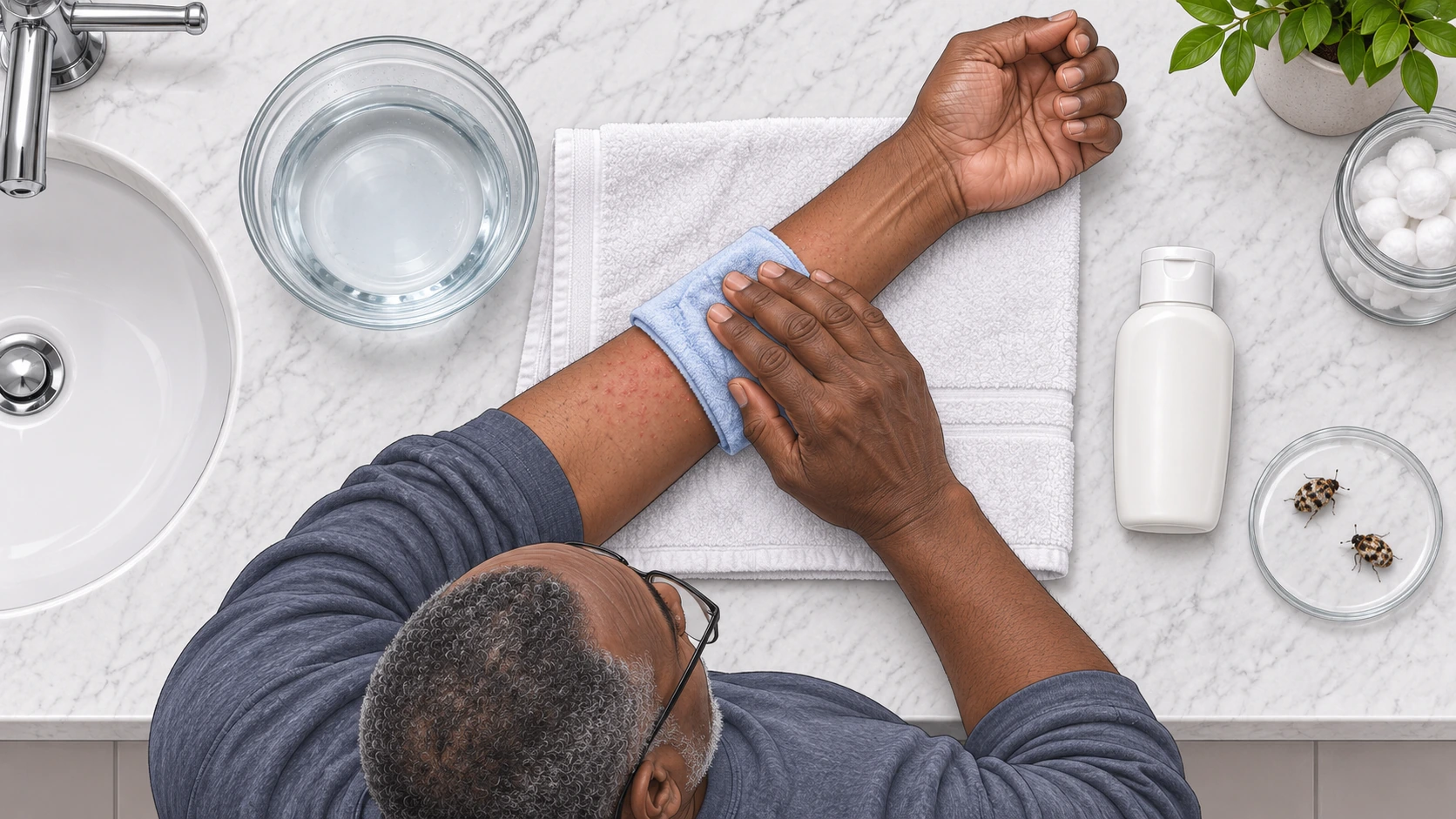
An itchy rash after finding carpet beetles in your home can be uncomfortable, especially when new bumps seem to appear after sleeping or handling stored clothing. Fortunately, mild skin reactions associated with carpet beetles can often be managed at home with gentle skin care, itch relief, and steps to prevent further exposure.
To treat a suspected carpet beetle rash, gently wash the affected skin, apply a cool compress, use a fragrance-free moisturizer, and consider an over-the-counter 1% hydrocortisone cream for itching and inflammation. Just as important, change and wash any clothing or bedding that may contain irritating larval hairs. Seek medical care if symptoms are severe, spreading, becoming infected, or failing to improve.
Carpet beetles do not need to bite you to cause a skin reaction. Contact with the tiny hairs shed by certain carpet beetle larvae can produce dermatitis in susceptible people. However, an itchy rash is not proof that carpet beetles caused it. Eczema, contact allergies, medication reactions, and other conditions can produce similar symptoms.
The safest approach is to relieve the irritation while keeping an open mind about its cause.
What Should You Do First if You Suspect a Carpet Beetle Rash?
If you have recently handled an infested blanket, cleaned a closet, or slept against fabric containing carpet beetle larvae, start by separating yourself from the suspected material. Avoid rubbing your skin against it again until it has been cleaned.
Wash the affected area gently with lukewarm water and a mild, fragrance-free cleanser. This helps remove material resting on the skin without adding unnecessary irritation. Pat the area dry with a clean towel rather than rubbing it. Avoid vigorous scrubbing, which can aggravate an already inflamed skin barrier.
Next, change into clean clothing and place the potentially exposed garments aside for laundering. If your symptoms appeared after sleeping, switch to clean bedding as well. A shower may be useful when exposure involved a large area of the body, but prolonged hot showers can make itching and dryness worse.
These first actions address two separate concerns. Washing and changing clothes may reduce further contact with irritating material, while gentle skin care helps protect skin that is already inflamed. Neither action establishes that carpet beetles caused the rash.
The relationship between carpet beetles and dermatitis has been documented in clinical reports involving contact with larval hairs. These reactions are discussed in the medical literature on carpet beetle dermatitis, although individual symptoms still require appropriate assessment. extension.psu.edu
How to Relieve Carpet Beetle Rash Itching at Home
For mild symptoms, treatment focuses on reducing itching, calming inflammation, and preventing additional skin damage. Several familiar over-the-counter treatments used for contact dermatitis may help, even when the exact trigger has not yet been identified.
Apply a Cool Compress to Calm Itching
A cool, damp compress is one of the simplest ways to relieve itchy or irritated skin. Wet a clean washcloth with cool water, wring out the excess, and hold it against the affected area for 10 to 15 minutes. Repeat several times during the day if needed.
The compress should feel comfortably cool rather than painfully cold. Avoid applying ice directly to the skin, particularly when the area is inflamed, scratched, or unusually sensitive.
Cooling provides temporary symptom relief without introducing another active ingredient. It can be particularly useful when you are uncertain whether your skin will tolerate a medicated cream.
Consider 1% Hydrocortisone Cream for Mild Inflammation
Over-the-counter 1% hydrocortisone cream may help reduce itching, redness, and inflammation associated with a mild dermatitis reaction. Apply a thin layer according to the product label, and use it only for the recommended duration.
Hydrocortisone is not an insecticide and does not remove carpet beetle hairs from clothing or furniture. Its purpose is to reduce the skin’s inflammatory response.
Do not apply it to infected skin, open wounds, or sensitive areas such as the eyelids, face, or genitals without professional guidance. Ask a pharmacist or clinician before using it on young children, during pregnancy, or when treating a large area. Stronger steroid preparations should not be used simply because a suspected carpet beetle rash is particularly itchy.
The same precautions apply if you have another skin condition or are already using prescription topical medication. Combining treatments without guidance can worsen irritation or obscure an underlying problem.
Use Calamine Lotion or a Colloidal Oatmeal Bath
Calamine lotion may provide temporary relief when the skin feels itchy or mildly irritated. Apply it according to the label and discontinue use if it causes burning, excessive dryness, or worsening discomfort.
A cool or lukewarm bath containing colloidal oatmeal is another option, particularly when several areas of skin are affected. Choose a product formulated for bathing rather than adding strongly scented soaps or homemade mixtures. Pat the skin dry afterward and apply a gentle moisturizer.
These measures are commonly used for contact dermatitis symptoms. Practical dermatitis self-care guidance includes cool compresses, calamine, colloidal oatmeal, and appropriate use of 1% hydrocortisone. aad.org
Moisturize the Skin Without Adding Fragrance
Inflamed skin can become dry and more sensitive to ordinary products. A plain, fragrance-free moisturizer can help maintain the skin barrier while the irritation settles.
Apply it after gently washing, ideally while the skin is still slightly damp. Creams and ointments without perfume or unnecessary botanical ingredients are often better tolerated than heavily scented lotions.
If a moisturizer stings, produces new bumps, or makes the itching worse, stop using it. A product marketed as natural or soothing can still contain ingredients that irritate sensitive skin.
Ask About an Oral Antihistamine if Itching Is Disrupting Sleep
An oral antihistamine may help some people with itching, particularly when hives or another histamine-related reaction is involved. However, antihistamines do not reliably control every form of dermatitis, and they do not eliminate the underlying exposure.
A pharmacist can help determine whether an antihistamine is appropriate for your symptoms, age, other medications, and medical conditions. Some products cause drowsiness and may impair driving or interact with alcohol and sedating medicines. Do not assume that taking a larger dose will produce better relief.
If itching remains severe despite ordinary self-care, a clinician can determine whether prescription treatment or a different diagnosis should be considered.
Why Avoiding Scratching Matters
Scratching may temporarily relieve an itch, but it can also damage the skin surface and prolong discomfort. Repeated scratching can create small breaks that allow bacteria to enter, increasing the risk of a secondary skin infection.
Keep your fingernails short and consider covering the affected area with loose, clean clothing if you tend to scratch without noticing. A cool compress can help interrupt the urge to scratch, especially before bedtime.
If the skin has already been scratched open, gently clean the area and protect it from further friction. Avoid putting hydrocortisone directly into an open wound. Watch for increasing tenderness, warmth, swelling, pus, or spreading redness, which may indicate infection rather than uncomplicated irritation.
How to Reduce Further Exposure to Carpet Beetle Hairs
Skin treatment may provide temporary relief, but continued contact with the suspected material can make it difficult to determine whether the reaction is settling. Carpet beetle larvae and their shed skins can occur in wool clothing, blankets, upholstered furniture, stored fabrics, and other undisturbed areas.
You do not need to begin an extensive extermination project to take reasonable exposure precautions. Concentrate first on the objects that have been in direct contact with your skin.
Wash Clothing and Bedding That May Be Contaminated
If the rash appeared after wearing a particular sweater or sleeping against a stored blanket, remove that item from use until it has been cleaned. Follow its fabric-care label and use an appropriate laundering or professional dry-cleaning method.
Washing can help remove loose hairs, shed skins, dust, and other residues. Where the material permits, a suitable hot wash or professional cleaning may also help address insects present in the fabric. Delicate wool, silk, and other sensitive textiles may require special handling.
Use a fragrance-free detergent if your skin is already irritated. Avoid adding strongly scented laundry boosters or fabric softeners in an attempt to neutralize the reaction. Fragrance residues can introduce another potential cause of dermatitis.
For detailed handling of infested garments, see our guide to washing clothes affected by carpet beetles.
Remove Accessible Larval Hairs and Shed Skins
Vacuuming accessible surfaces can help remove loose insect material, especially from upholstery, carpet edges, and areas where clothing or bedding has been stored. Use an appropriate vacuum attachment and avoid brushing dusty material into the air.
Empty the vacuum carefully according to its design, preferably without exposing yourself to collected debris. If cleaning appears to provoke itching or respiratory symptoms, stop and avoid handling the material directly.
The aim here is to reduce immediate exposure, not to carry out a full property treatment. Detailed inspection and removal belong in our carpet beetle control guide.
Avoid Spraying Insecticides on Your Skin or Bedding
Never apply household carpet beetle insecticides to your body to treat a rash. These products are not skin medications and may cause additional irritation or harmful exposure.
Likewise, do not spray mattresses, sheets, pillows, or clothing with a general household insecticide unless the specific product label explicitly permits that use. Insecticides are not a substitute for removing contaminated material from surfaces that touch your skin.
Carpet beetle management guidance emphasizes cleaning and removing infested materials, and specifically warns against spraying clothing or bedding with insecticides. See the carpet beetle management precautions for the broader pest-control context. ipm.ucanr.edu
What Should You Avoid Putting on a Carpet Beetle Rash?
Some home remedies can make irritated skin worse, particularly when the skin barrier has already been damaged by scratching. A suspected carpet beetle reaction should be treated as a skin problem, not as an insect infestation occurring on your body.
Rubbing alcohol, bleach, concentrated vinegar, and household disinfectants should not be applied to a rash. These substances can irritate or damage skin and do not provide an appropriate treatment for dermatitis. Household insecticides, carpet powders, and insect-repellent sprays are equally unsuitable as rash treatments.
Be cautious with undiluted essential oils, including tea tree, peppermint, eucalyptus, and clove oil. Although these ingredients are frequently promoted as natural remedies, they can cause contact irritation or allergic reactions. Applying them to already inflamed skin may create a second problem.
Avoid hot baths, aggressive exfoliation, and repeated washing with harsh soaps. These practices may temporarily make the skin feel cleaner, but they can strip away protective oils and increase dryness or itching.
If you have already applied a product that caused immediate burning or worsening irritation, stop using it and rinse the affected skin with water. Seek medical advice if the reaction is significant or does not settle.
When Should You See a Doctor for a Suspected Carpet Beetle Rash?
Most mild skin reactions do not require emergency treatment, but some symptoms need medical evaluation. The severity and progression of your symptoms matter more than whether you have found carpet beetles nearby.
Seek emergency medical help immediately if you develop difficulty breathing, throat or tongue swelling, faintness, or rapidly developing symptoms affecting several parts of your body. These can be signs of a serious allergic reaction, regardless of the suspected trigger.
Seek prompt medical evaluation if the rash becomes increasingly painful, hot, swollen, or begins producing pus. Spreading redness, fever, or red streaking from an affected area also warrants prompt assessment.
A clinician should also evaluate a rash that covers a large area, involves the eyes or other sensitive regions, produces extensive blistering, or significantly disrupts sleep and daily activities. Persistent or recurring symptoms deserve assessment even when they are not severe.
Children, people with weakened immune systems, and anyone with a history of serious allergic reactions may need individualized advice. Do not assume that an adult’s over-the-counter treatment is appropriate for an infant or young child.
Skin symptoms can have many causes. A clinician may examine the affected area, review recent exposures and medications, and consider whether another condition better explains the findings. For some recurring cases, referral to a dermatologist or further allergy assessment may be appropriate.
How Can You Tell Whether the Treatment Is Helping?
A useful sign of improvement is a reduction in itching and inflammation without the development of new areas of irritation. Skin that previously felt intensely itchy may become more comfortable, and existing bumps may gradually become less noticeable.
It is helpful to monitor three things together: the condition of your skin, whether new symptoms are appearing, and whether you are still coming into contact with potentially contaminated fabrics.
For example, suppose you develop itching after wearing a wool sweater that has been stored for several months. You stop wearing it, gently wash your skin, and use a cool compress. If the irritation becomes less troublesome afterward, that supports continuing gentle skin care and avoiding the suspected material.
However, improvement after changing clothes does not prove that carpet beetle hairs were responsible. Detergent residue, fabric treatments, ordinary friction, and other allergens may also be involved.
If new bumps continue to appear despite avoiding the suspected material, reassess the explanation rather than repeatedly applying stronger treatments. A persistent eruption may need medical evaluation and a closer look at other exposures.
For a separate discussion of the expected course of these reactions, see how long a carpet beetle rash lasts.
What if You Keep Getting a Rash but Cannot Find Carpet Beetles?
Recurring itching without visible insects can be frustrating. Carpet beetle larvae often remain hidden, and shed hairs may be present even when no live larvae are immediately visible. Nevertheless, the absence of identifiable insects means the suspected cause remains uncertain.
A rash cannot reliably identify a particular household pest. Other possibilities include contact dermatitis from laundry products, eczema, hives, fungal infections, and reactions associated with biting insects. The appropriate treatment can differ considerably depending on the actual condition.
Finding an adult carpet beetle on a windowsill is also insufficient evidence that it caused a skin reaction. Adult beetles are commonly encountered indoors, while the larval stage is the main concern in documented carpet beetle dermatitis cases.
For more information about the evidence needed to identify this type of reaction, read what carpet beetle dermatitis looks like. If you are also finding suspicious marks after sleeping, our carpet beetles versus bed bugs comparison explains why physical insect evidence matters.
If the rash persists, photographs taken over time and notes about recent exposures can be useful during a medical appointment. Record changes in clothing, detergent, bedding, medication, and skin-care products, rather than focusing exclusively on insects.
Can a Doctor Prescribe Something Stronger for a Carpet Beetle Skin Reaction?
When ordinary home care does not provide adequate relief, a healthcare professional may recommend a prescription-strength topical corticosteroid or another treatment based on the examination and suspected diagnosis.
Prescription corticosteroids vary in strength, and the appropriate product depends on the affected body area, the patient’s age, the severity of inflammation, and other medical considerations. Stronger preparations are not automatically better, especially on thin or sensitive skin.
If the clinician suspects an infection, fungal condition, or another disease rather than uncomplicated dermatitis, treatment may be entirely different. Using a stronger steroid without an appropriate diagnosis can delay correct care and sometimes worsen certain skin conditions.
For recurring contact dermatitis, identifying and avoiding the responsible exposure is often as important as medication. The medical approach to contact dermatitis may include prescription treatment and, when appropriate, testing to investigate potential allergens. aad.org
Frequently Asked Questions
Can you put hydrocortisone cream on a carpet beetle rash?
Over-the-counter 1% hydrocortisone may help relieve mild itching and inflammation associated with suspected carpet beetle dermatitis. Follow the product label and avoid applying it to infected or broken skin. Seek medical advice if symptoms are severe, involve sensitive areas, or fail to improve.
Does Benadryl help a carpet beetle rash?
Diphenhydramine, sold under the Benadryl name in some formulations, may relieve certain allergy-related itching symptoms, but it is not reliably effective for every type of dermatitis. Oral diphenhydramine can cause significant drowsiness and interact with other medications. Ask a pharmacist whether an antihistamine is suitable before taking it. Avoid topical diphenhydramine unless a clinician recommends it, since it can itself cause contact sensitization.
Can you use aloe vera on a carpet beetle rash?
A plain, fragrance-free aloe vera product may feel soothing to some people, but aloe is not an established treatment specifically for carpet beetle dermatitis. Commercial aloe products can contain alcohol, fragrance, and other ingredients that irritate sensitive skin. Stop using any product that causes stinging or worsening symptoms.
Should you cover a carpet beetle rash with a bandage?
A mild rash usually does not need a bandage. Loose, clean clothing may be sufficient to protect the area from friction. If scratching has broken the skin, an appropriate nonstick dressing may help protect the wound. Avoid adhesive dressings that aggravate the surrounding skin.
Can a carpet beetle rash become infected?
Scratching can damage the skin and create an opportunity for a secondary bacterial infection. Increasing pain, warmth, swelling, pus, spreading redness, or fever should prompt medical assessment. An infected rash requires different care from uncomplicated irritation.
Will carpet beetle rash treatment work if the beetles are still in the house?
Skin treatments may reduce itching and inflammation even while carpet beetles remain present. However, repeated exposure to irritating larval hairs could contribute to recurring symptoms in a susceptible person. Reducing contact with suspected materials is therefore a sensible part of managing the reaction.
Do carpet beetles cause allergic reactions in everyone?
Not everyone exposed to carpet beetle larvae develops dermatitis. Susceptibility varies, and the presence of carpet beetles alone does not establish an allergy. The range of possible responses is covered separately in can carpet beetles cause an allergic reaction?.
The Bottom Line
A suspected carpet beetle rash is best managed by treating the skin gently and reducing contact with potentially irritating material. Cool compresses, fragrance-free moisturizers, and carefully used over-the-counter treatments such as 1% hydrocortisone can help with mild symptoms. Clean clothing and bedding, avoid harsh home remedies, and resist scratching.
Seek medical attention when symptoms are severe, persistent, worsening, or suggest infection. Breathing difficulties or swelling involving the throat require emergency care.
Most importantly, do not let the discovery of carpet beetles prevent you from considering other explanations for a rash. The right treatment depends on the actual skin condition, not simply on which insect happens to be present in your home.