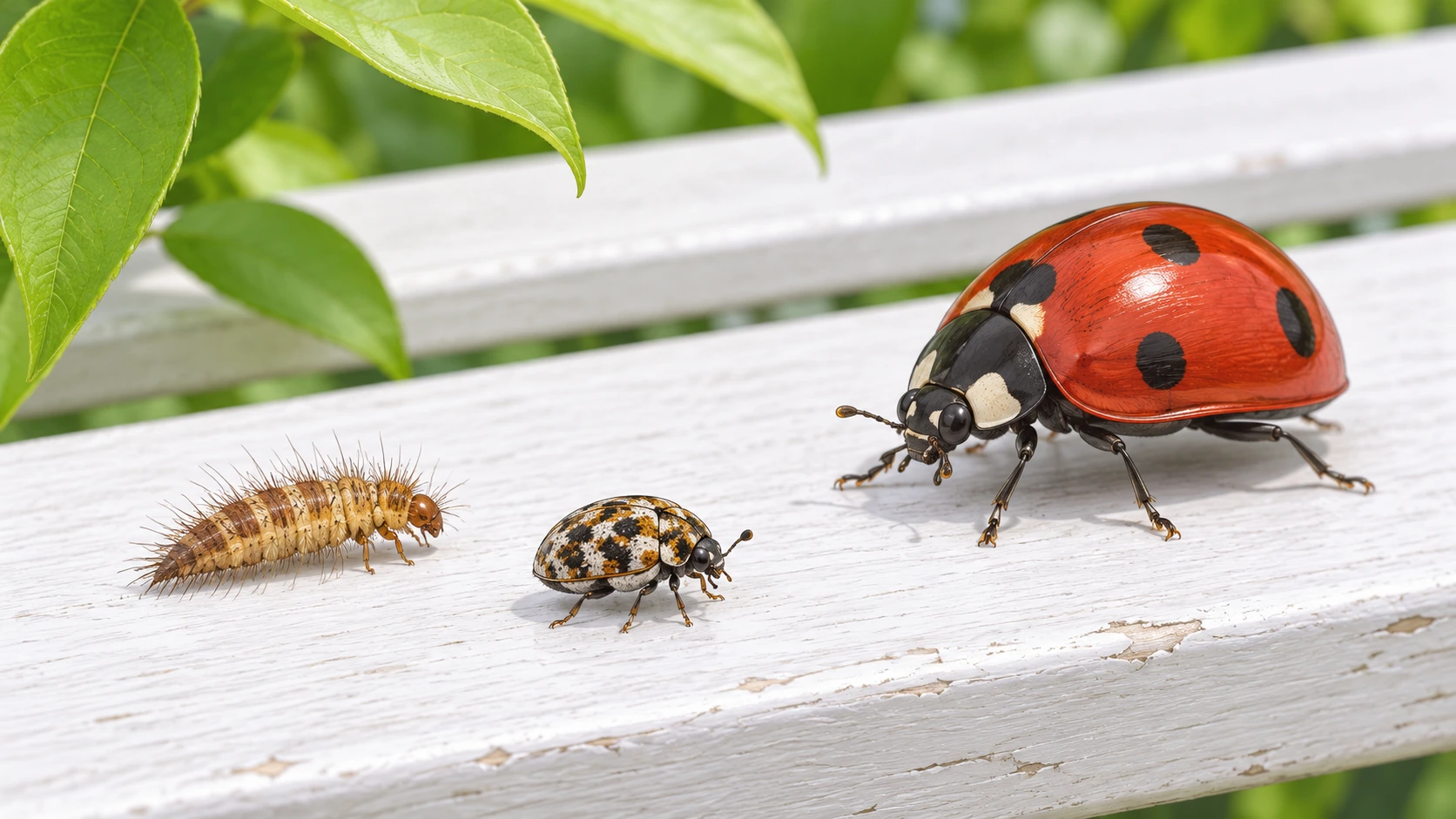
Carpet beetles are usually much smaller than ladybugs, even though both can have rounded bodies and patterned wing covers. A typical varied carpet beetle measures only 2 to 3 millimeters long and has irregular patches of white, brown, yellowish, and black scales. Many familiar ladybugs are larger, with smoother-looking wing covers and more distinct spots or color patterns.
The difference becomes less obvious when the beetles are uniformly dark or have unusual markings. Black carpet beetles lack the mottled appearance of varied carpet beetles, while ladybugs occur in numerous colors, including black, orange, yellow, and red. Some lady beetles have no visible spots at all.
The season also offers a clue. Carpet beetle adults commonly appear near windows during spring and early summer. Certain ladybugs, particularly multicolored Asian lady beetles, often gather around buildings in fall while searching for sheltered places to spend winter. They may reappear indoors during warm winter days or in spring.
For homeowners, the identification affects what should happen next. A ladybug that wandered indoors generally presents a nuisance rather than a fabric-damage concern. Carpet beetle larvae can feed on wool, feathers, fur, and other susceptible materials, although finding one adult does not establish an indoor infestation.
Carpet Beetle vs. Ladybug at a Glance
A side-by-side comparison helps narrow the possibilities before examining the specimen more closely.
| Feature | Carpet beetle | Ladybug or lady beetle |
|---|---|---|
| Family | Dermestidae | Coccinellidae |
| Typical adult size | Common household species approximately 2–5 mm | Many familiar species approximately 4–10 mm |
| Body shape | Compact, rounded to elongated oval | Usually rounded or oval, often strongly domed |
| Adult markings | Irregular mottled scales or uniformly dark | Distinct spots, bands, patches, or no spots, depending on species |
| Surface appearance | Often finely textured or scaly | Usually smoother-looking and often glossy |
| Antennae | Short, generally clubbed | Short, often clubbed |
| Adult food | Many common species use pollen or nectar | Many species feed on aphids or other small insects |
| Larval appearance | Brownish, segmented, hairy or bristly | Often elongated, dark, and spiny or alligator-like |
| Common indoor sightings | Windowsills, curtains, storage areas | Windows, walls, attics, and exterior building surfaces |
| Seasonal clue | Adults often noticed in spring or early summer | Overwintering species often gather around buildings in fall |
| Fabric damage | Larvae can damage susceptible textiles | Not typical fabric pests |
The ranges overlap, and ladybugs are a diverse group. Size, markings, and season should be considered together instead of relying on one feature.
One particularly useful clue is the nature of the markings. A varied carpet beetle often resembles a tiny piece of mottled fabric, while many familiar ladybugs have clearer, more separate markings on a smoother-looking shell.
Why Carpet Beetles Can Look Like Tiny Ladybugs
The resemblance comes from their shared beetle anatomy.
Both insects belong to the order Coleoptera, and both have hardened front wings called elytra. These wing covers protect the folded flight wings beneath them.
Many adult carpet beetles and ladybugs also have convex bodies. Viewed from above, their rounded outlines can look similar, especially when the insects are only a few millimeters long.
The varied carpet beetle, Anthrenus verbasci, is a good example. Its small, rounded body has dark wing covers decorated with irregular patches of pale and yellowish scales. Without magnification, these patches may resemble spots.
However, the rounded appearance of adult carpet beetles is generally associated with a considerably smaller body than that of many familiar ladybugs.
A 2.5-millimeter beetle resting on a white windowsill may look surprisingly ladybug-like in a close-up photograph. Without a ruler or another scale reference, the image can make the insect appear much larger than it is.
This is a common source of misidentification. A magnified carpet beetle photograph is often compared with an ordinary ladybug photograph, even though the real insects differ substantially in size.
The Size Difference Is Often the Fastest Clue
Most adult varied carpet beetles measure approximately 2 to 3 millimeters long, or around one-tenth of an inch. They are small enough to resemble a moving speck when seen from across a room.
Black carpet beetles, Attagenus unicolor, are generally larger, approximately 3 to 5 millimeters long. Their elongated oval bodies are less similar to the classic rounded ladybug shape.
Ladybugs vary widely in size. However, many species homeowners recognize are around 4 to 10 millimeters long.
The multicolored Asian lady beetle, Harmonia axyridis, commonly reaches approximately 7 to 8 millimeters in length. That makes it roughly three times as long as a typical 2.5-millimeter varied carpet beetle.
Length alone understates how different the insects can look because a longer beetle also occupies more surface area. A 7.5-millimeter lady beetle may look much bulkier than a 2.5-millimeter carpet beetle.
Still, size is not an absolute test. Small ladybug species exist, and the largest common carpet beetles overlap with some smaller lady beetles.
When a specimen appears close to the boundary, use a millimeter ruler and examine the body covering rather than assigning the insect based on size alone.
The different sizes of varied and black carpet beetles help explain why the comparison is easiest with a typical mottled adult and less straightforward with a dark, elongated specimen.
Carpet Beetle Markings Are Usually Finer and More Irregular
A varied carpet beetle’s distinctive pattern comes from tiny colored scales covering its body.
These scales create irregular patches of cream, white, yellowish-brown, orange-brown, and black. The boundaries are often uneven, giving the insect a speckled or mosaic-like appearance.
Many familiar ladybugs have larger, more clearly separated markings. A red ladybug with distinct black spots is therefore relatively easy to distinguish from a mottled varied carpet beetle.
However, ladybug coloration is far more variable than the familiar red-and-black pattern suggests.
Some lady beetles are orange or yellow. Others are nearly black, and certain species have pale spots or unusual patterns. Even within a single species, the number and appearance of spots may vary considerably.
The multicolored Asian lady beetle is particularly variable. Its wing covers may be yellow, orange, reddish, or occasionally very dark, with many spots, a few spots, or none.
This variation in Asian lady beetle markings makes color an unreliable identification shortcut.
A black beetle is not automatically a carpet beetle. A spotted beetle is not automatically a ladybug, either.
The most useful approach is to examine how the markings are formed and distributed. Fine, irregular scales on a tiny rounded body favor an Anthrenus carpet beetle. Larger, clearly defined wing-cover markings on a more substantial, domed beetle favor a lady beetle, although exceptions occur.
Can a Black Carpet Beetle Be Mistaken for a Black Ladybug?
Black carpet beetles can resemble certain dark lady beetles, particularly in photographs that conceal their size and body proportions.
An adult black carpet beetle is usually elongated oval rather than almost circular. Its body is dark brown to black, with comparatively inconspicuous markings.
Some black ladybugs, by contrast, have rounded or strongly convex bodies and may carry red, orange, or pale spots. Others are nearly uniform in color.
The overall shape becomes useful when the body surface provides few clues.
A black carpet beetle often looks like a narrow, dark oval. A typical ladybug has a broader, more domed outline, although shape varies among the numerous lady beetle species.
Their antennae are less useful for quick household identification because both groups have relatively short antennae with enlarged tips. Fine differences in antennal structure may require magnification.
The variation among household carpet beetle species is a reason to avoid treating the mottled varied carpet beetle as the appearance of every carpet beetle.
If you find a small, uniformly dark beetle, take a photograph from above and another from the side. Include a measurement and try to preserve the specimen’s antennae.
A photograph showing only a shiny black back may not contain enough information for a confident identification.
What About the M-Shaped Mark Behind an Asian Lady Beetle’s Head?
The multicolored Asian lady beetle often has a black marking shaped like an M or W on the pale pronotum, the plate immediately behind its head.
The marking’s apparent orientation changes depending on which direction the insect faces. On some individuals, it is distinct. On others, it is incomplete or difficult to recognize.
This character can help identify Harmonia axyridis, particularly when combined with the insect’s larger size, rounded body, and variable wing-cover markings.
The M-shaped pronotal marking and fall gathering behavior of Asian lady beetles are useful because the species is among the lady beetles most frequently noticed entering North American homes.
However, the M marking is not a universal feature of all ladybugs. Other lady beetle species have different pronotal patterns.
Likewise, the absence of a clearly visible M does not automatically establish that an insect is a carpet beetle.
The marking is best treated as a species-specific clue. A relatively large orange beetle with a pale pronotum and a dark M-shaped pattern strongly supports an Asian lady beetle identification.
A tiny mottled beetle with fine scales and no corresponding body pattern is more consistent with a carpet beetle.
Their Seasonal Indoor Appearances Are Different
The time of year can help narrow the identification, especially when several beetles appear at once.
Carpet Beetles Are Often Noticed in Spring and Early Summer
Adult varied carpet beetles frequently become noticeable in spring or early summer. They may fly indoors from outdoor flowers or emerge from materials that supported their larval development.
Adults are attracted to light and may collect on sunny windowsills, window frames, and curtains.
That pattern explains why the first carpet beetle someone notices is often an adult near a window rather than a larva feeding in a closet.
The larvae, however, may be present at other times of year. Heated homes can support their development when suitable food is available, so the absence of adult beetles during winter does not prove that no larvae remain.
The seasonal appearance of carpet beetles varies with species, climate, and indoor conditions. A spring window sighting provides context, but it does not identify the insect without its physical features.
Some Ladybugs Gather Around Buildings in Fall
The multicolored Asian lady beetle has a particularly recognizable seasonal pattern.
During fall, adults may gather on sunny exterior walls as temperatures begin to decline. They seek sheltered spaces for overwintering and can enter buildings through small openings around windows, doors, siding, and rooflines.
In colder regions, many of these encounters occur in September and October, although local weather influences the timing.
Some beetles remain hidden through winter. When sunlight warms their shelter, they may become active and crawl toward windows or other bright areas.
The fall entry and winter reappearance of multicolored Asian lady beetles explain why a homeowner may see several orange or spotted beetles in an upstairs room during a sunny winter afternoon.
This overwintering behavior differs from the hidden larval development associated with carpet beetles.
However, not every ladybug species enters buildings in large numbers, and indoor sightings can occur outside the usual fall period. Seasonal timing is useful supporting evidence, not a stand-alone identification method.
Why Both Beetles May Be Found on Windowsills
A windowsill is a poor place to identify a beetle by location alone because adults of both groups can move toward light.
Carpet beetle adults commonly appear there after flying in from flowers or emerging from an indoor source. Some are attracted to the sunny window even when their larvae developed in a different room.
Overwintering lady beetles may also move toward sunlight after emerging from sheltered wall voids, attics, or window-frame gaps.
The difference becomes clearer when you consider the pattern of sightings.
Several tiny, mottled beetles appearing near a window during spring could be carpet beetles. Larger orange or spotted beetles collecting on warm exterior walls during fall, followed by occasional winter appearances, fit the behavior of overwintering lady beetles.
Neither observation is conclusive without examining the beetles.
A homeowner should also avoid assuming that insects found at a window are breeding in the window frame. The window may simply be where mobile adults collect.
The reasons carpet beetles appear near windows include adult light responses and movement away from their larval food sources.
When identification remains uncertain, the most useful next step is to examine an intact specimen, not automatically treat the surrounding window.
The Larvae Look Much Less Alike Than the Adults
Adult carpet beetles and ladybugs may both have rounded bodies, but their larvae usually look very different.
Carpet beetle larvae are commonly brownish, segmented, and covered with conspicuous hairs or bristles. Their shapes vary by species. Some have bands and tufts of long hairs, while black carpet beetle larvae tend to be more elongated and carrot-shaped.
Ladybug larvae generally have elongated bodies with prominent legs and dark, spiny or tuberculate surfaces. Many resemble tiny alligators rather than fuzzy caterpillars.
The larva of a multicolored Asian lady beetle is typically dark with orange markings and spiny projections. It is an active predator that hunts small insects such as aphids.
Carpet beetle larvae behave differently because they develop among food materials such as wool, fur, feathers, dead insects, and accumulated hair.
A brown, hairy larva discovered in the fold of a stored wool blanket is consistent with carpet beetles. A dark, orange-marked, spiny larva moving across a plant covered with aphids is more consistent with a lady beetle.
These examples provide useful context, but other insect larvae can resemble both groups.
The body shapes and hair arrangements of carpet beetle larvae are particularly helpful when a homeowner has found an immature insect rather than an adult beetle.
Do Ladybugs Damage Carpets or Clothing?
Ladybugs are not typical household fabric pests. Many species feed on aphids, scale insects, or other small invertebrates, and some have different diets.
Common household carpet beetles present a different concern. Their larvae can feed on materials containing animal proteins, including wool, fur, feathers, and animal hair.
Adult carpet beetles generally do not chew clothing or carpets. The larval stage is responsible for the characteristic feeding damage.
Therefore, finding a ladybug crawling across a wool rug does not establish that it damaged the rug.
Likewise, discovering a single carpet beetle adult on a sweater does not prove that larvae are feeding inside the garment.
When fabric damage exists, look for physical evidence in the material itself. Carpet beetle larvae may leave shed skins, feeding debris, and irregular thinning or holes in susceptible fibers.
The signs of a carpet beetle infestation are much more informative when several kinds of evidence occur together.
Lady beetles can cause different indoor nuisance problems, particularly when large numbers aggregate. Some species, including multicolored Asian lady beetles, may release defensive fluid that can stain surfaces. They do not normally establish fabric-feeding colonies in clothing or carpeting.
A Simple Identification Check for a Beetle Found Indoors
When you have an unknown rounded beetle, examine it in a consistent order.
First, measure its length. A specimen around 2 to 3 millimeters long is within the normal range for a varied carpet beetle. A beetle closer to 7 or 8 millimeters long is much more consistent with a familiar larger lady beetle.
Next, look at the wing-cover markings. Fine, irregular patches of pale and dark scales suggest a mottled carpet beetle. Clearly separated spots on a smoother, strongly domed body may favor a lady beetle.
Then examine the body shape. Varied carpet beetles are small and broadly oval. Black carpet beetles are more elongated. Many familiar ladybugs have a larger, dome-shaped body.
Finally, consider the season and surrounding evidence. An autumn cluster around siding is more suggestive of overwintering lady beetles. Repeated tiny spring window sightings combined with bristly larvae near wool or feathers support carpet beetles.
The following decision guide combines the clues without treating any single feature as definitive.
| What you found | More likely identification | What could change the answer |
|---|---|---|
| Tiny 2–3 mm beetle with irregular white and brown scaling | Varied carpet beetle | A different small patterned beetle |
| Larger 7–8 mm rounded beetle with distinct spots | Lady beetle | An unusual species or inaccurate measurement |
| Orange beetle with a dark M-shaped mark behind its head | Multicolored Asian lady beetle | An obscured or misread pronotal marking |
| Small, elongated, uniformly black beetle | Black carpet beetle possible | Other dark beetle families |
| Large numbers gathering on a sunny wall in fall | Overwintering lady beetles possible | Physical identification still needed |
| Brown, hairy larvae and shed skins in stored wool | Carpet beetles possible | Other fabric-associated larvae |
| Dark, spiny larva hunting aphids on a plant | Lady beetle larva possible | Other predatory insect larvae |
A clear photograph with a millimeter ruler usually offers more identification value than a description such as “tiny brown ladybug.”
When the insect is too small to examine, preserve it in a secure container. An extension diagnostic service or qualified pest professional may be able to identify the specimen.
Does Finding One Mean You Have an Infestation?
An occasional adult of either group does not automatically indicate an indoor breeding population.
Carpet beetles can fly indoors from outdoor flowers. A single varied carpet beetle on a windowsill may be an accidental visitor rather than evidence of an established fabric infestation.
Finding several larvae, recognizable shed skins, and feeding damage among susceptible materials provides a stronger reason to investigate carpet beetle development.
The meaning of finding one carpet beetle depends heavily on whether the insect is an adult or a larva and whether additional evidence is present.
Multicolored Asian lady beetles create a different situation. Large numbers may enter a building in fall to spend winter in sheltered spaces, yet they generally do not reproduce inside homes.
An indoor cluster can therefore be an overwintering nuisance rather than a continuously breeding household population.
Their numbers can still be inconvenient, especially when they appear repeatedly around windows or leave stains. But the response should focus on accurate identification and preventing entry, rather than assuming they are damaging clothing or food.
For occasional indoor lady beetles, gentle collection and release outdoors when conditions are suitable, or other simple nonchemical removal, is usually sufficient. Avoid crushing them against walls or fabrics because defensive fluids may stain.
Carpet beetles require a different response if larvae are confirmed. Inspecting and removing the materials supporting larval development is more useful than repeatedly collecting adults from windows.
There is no reason to spray an entire room simply because one rounded beetle has appeared.
Frequently Asked Questions
Can a carpet beetle look exactly like a ladybug?
An adult carpet beetle can resemble a very small ladybug, especially in magnified photographs. However, carpet beetles are generally smaller, and mottled species have finely scaled patterns rather than the larger markings seen on many familiar lady beetles. Close examination usually reveals useful differences.
Are tiny black ladybugs actually carpet beetles?
Some may be black carpet beetles, but small black ladybugs and numerous other dark beetles also exist. Color alone cannot establish the identity. Body shape, antennae, surface texture, and size provide stronger evidence.
Are ladybugs and Asian lady beetles the same thing?
Multicolored Asian lady beetles are members of the lady beetle family, Coccinellidae. They can accurately be called ladybugs. The name “ladybug” covers many different species, so not every ladybug is an Asian lady beetle.
Why do ladybugs appear in my house during winter?
Some lady beetles enter sheltered spaces in fall to overwinter. Warm sunlight may reactivate them during winter, causing adults to move toward windows or occupied rooms. This pattern is particularly common with multicolored Asian lady beetles.
Why do carpet beetles appear near windows in spring?
Adult carpet beetles can fly and are attracted to light. They may gather around sunny windows after emerging from indoor feeding sites or entering from outdoor flowers. A window sighting alone does not prove that the insects are breeding inside.
Do carpet beetle larvae look like ladybug larvae?
They are generally distinguishable. Carpet beetle larvae are often brown and densely hairy, while many ladybug larvae have elongated, spiny bodies with prominent legs. The appearance varies by species, so a close photograph or specimen may still be necessary.
Can ladybugs lay eggs and infest my carpet?
Ladybugs do not normally use wool carpets as larval food or establish fabric-damaging infestations. Many species lay eggs near prey such as aphids, often on plants. Finding lady beetles indoors does not mean they are breeding in carpeting.
The Bottom Line
Carpet beetles and ladybugs are related only in the broad sense that both are beetles. They belong to different families, and their typical sizes, markings, larval appearances, and household habits provide several ways to tell them apart.
The familiar varied carpet beetle is tiny, generally 2 to 3 millimeters long, with irregular mottled scales. Many ladybugs are larger, more strongly domed, and have smoother-looking wing covers with more distinct markings. Black carpet beetles and unusually colored ladybugs require closer examination.
Seasonal sightings add useful context. Carpet beetle adults often appear near windows in spring and early summer, while multicolored Asian lady beetles commonly gather around buildings in fall and may emerge indoors during winter.
If you find an isolated adult, identification and observation are usually enough to decide what comes next. Bristly larvae, shed skins, and damaged animal-fiber materials point toward a possible carpet beetle infestation. Larger lady beetles gathering at windows during the colder months generally indicate a different, overwintering nuisance.
Measure the insect, examine its markings and body structure, and use the season as supporting evidence. That approach is more reliable than deciding what you found from its color or the fact that it looks like a tiny ladybug.
One thought on “Carpet Beetle vs. Ladybug: How to Tell Them Apart”