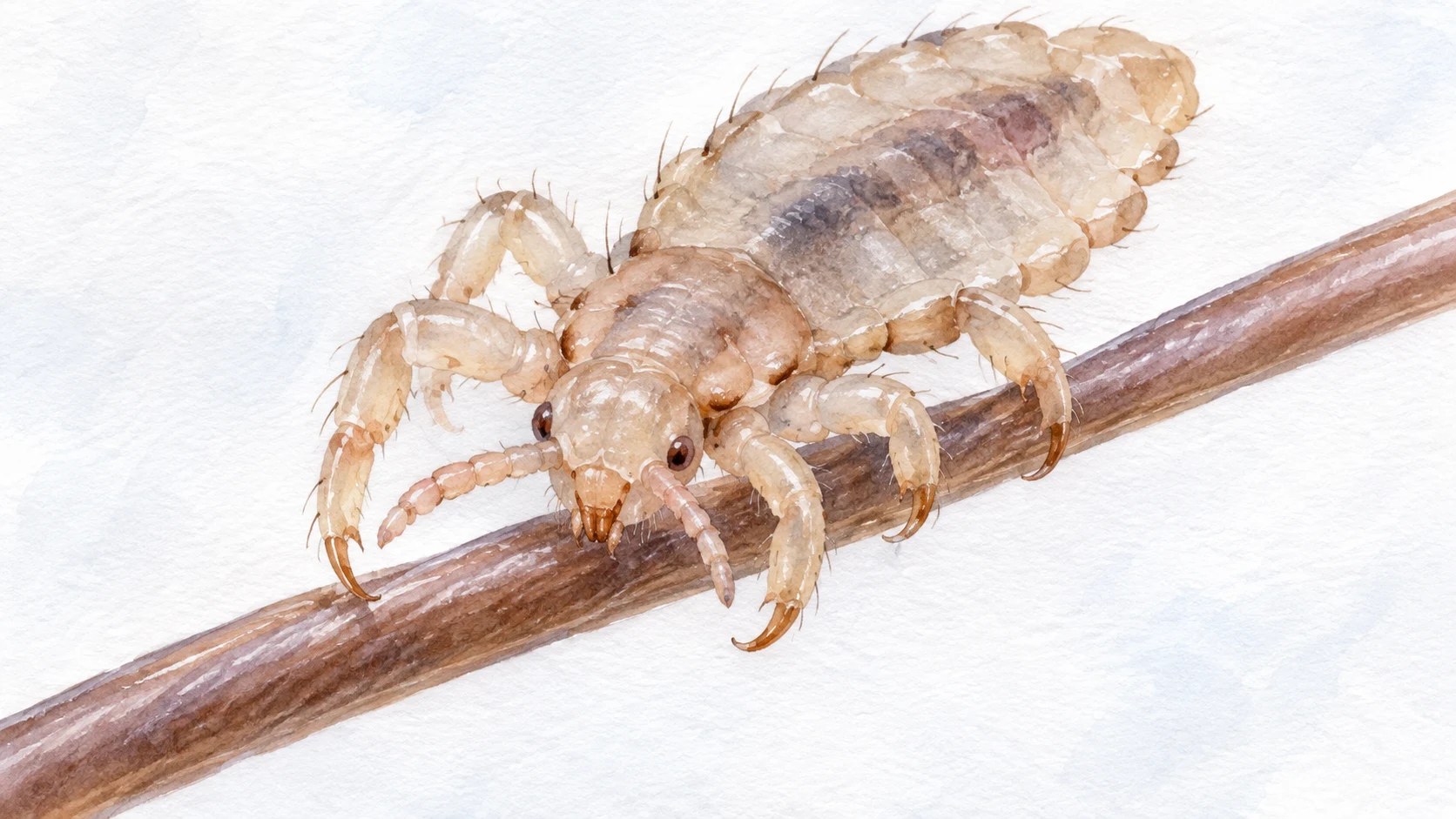
A single fertilized female head louse can potentially start a reproducing infestation. Two or more lice are not necessarily required because a female may have mated before moving onto another person’s head. However, finding one louse does not guarantee that a growing infestation will develop. Its sex, reproductive status, survival, and ability to remain on the scalp all affect what happens next.
There is an important difference between having one living head louse on your head and having a population that continues reproducing. The first represents the presence of a parasite. The second requires successful reproduction and survival of its offspring. You do not need to find several lice before taking a sighting seriously. A single confirmed living louse warrants attention, even though it cannot tell you how many others may be present or whether reproduction has already begun.
Can One Head Louse Really Start an Infestation?
One head louse can establish a reproducing population under the right circumstances, but not every individual louse has that ability.
A female that has already mated may be capable of producing viable offspring after transferring to a new host. She does not necessarily need a male to arrive with her. This makes a single fertilized female a plausible starting point for an infestation.
The reproductive potential of solitary females has been demonstrated in research on the survival and reproduction of head lice. The researchers found that females could retain the capacity to establish an infestation after periods without a blood meal or recent mating.
That finding describes a biological possibility, not a guarantee that every female louse transferred between people will establish a population. Laboratory conditions, the individual insect’s condition, and what happens after transfer can influence the outcome.
A lone male cannot produce offspring without a female. An immature louse cannot reproduce immediately, and an adult female that has never mated cannot produce a reproducing population on her own unless a suitable mate is subsequently present.
Therefore, one louse may be enough, but the statement needs an important qualification: it must have the reproductive capacity necessary to establish a new generation.
The differences between male and female head lice are relevant to understanding this possibility. They do not mean that an ordinary household inspection can reliably determine whether a particular female has already mated.
Why a Fertilized Female Is Different From a Single Male
Head lice reproduce sexually. A female must mate to produce fertilized eggs capable of developing into offspring. Once mating has occurred, a female may retain reproductive potential after becoming separated from the male.
Consider two hypothetical situations. In the first, a single adult male crawls onto a person’s head and no other lice are present. That male cannot establish a reproducing population by himself.
In the second, a previously mated female reaches the scalp and survives. She may begin or continue reproduction without another adult arriving alongside her. If her offspring survive and eventually reproduce, a population can become established.
These situations illustrate why counting the number of insects transferred is not enough to predict the outcome.
The reproductive biology of head lice determines which individuals can produce offspring. A count of one tells you nothing about mating history, and a count of two does not guarantee that the insects are a compatible, reproductively successful pair.
It is also possible for a female to reach a new head and fail to establish an infestation. She may be removed, die, or fail to produce surviving offspring.
For that reason, the biological minimum and the likelihood of a lasting infestation are different questions.
Does Finding One Louse Mean There Are More?
Finding one living head louse does not prove that other lice are present, but it also does not establish that the insect was alone.
Head lice are small, move quickly, and tend to avoid light. Hair can conceal them, especially when someone looks only briefly at the scalp. An inspection that reveals one insect may simply have missed others.
The difficulty of detecting live head lice is well recognized. A fine-toothed louse comb can improve detection compared with looking through the hair alone.
There are at least three possible explanations for a single sighting. The louse may have transferred recently and genuinely be alone. Other lice may already be present but remain undetected. Alternatively, the insect may be part of an infestation that has not yet produced noticeable symptoms.
The sighting itself cannot distinguish these possibilities.
Finding a single louse also does not reveal when it arrived. Someone may have acquired it during recent close contact, or it may have remained unnoticed for some time.
A more detailed check for head lice is therefore more informative than assuming that the number seen during a casual inspection represents the total number present.
How Can an Infestation Begin With So Few Lice?
A reproducing infestation can begin with a very small number of insects because head lice live directly on the human host, where they feed and reproduce.
They do not need to establish a nest in bedding or move into a separate household habitat. Once a reproductively capable female remains on a suitable scalp, the conditions needed for reproduction may already be available.
Head lice attach their eggs to hair near the scalp. If offspring develop successfully, the next generation can eventually reproduce as well. The process can continue while the insects remain on the host.
The basic biology of head lice explains why a population does not need to begin with a large group. Head lice depend on human blood meals and remain closely associated with scalp hair throughout their development.
However, reproduction is not instantaneous. An immature louse must develop before it can reproduce, and the offspring of an adult female also need time to mature.
A newly introduced louse therefore does not produce a large infestation overnight. Population growth depends on successive survival and reproductive events.
The stages involved are covered in the head lice life cycle. For the question of how an infestation starts, the relevant point is simply that successful reproduction can turn a small introduction into a continuing population.
Why One Transferred Louse Does Not Always Establish an Infestation
Even when a living head louse transfers successfully, several outcomes are possible.
The insect might be removed during grooming or inspection. It might die before reproducing. It could be a male without a female present, or an immature individual that does not survive to reproductive maturity.
A previously mated female has greater potential to establish a reproducing population, but her arrival still does not guarantee success. Producing offspring is only part of the process. Those offspring must also survive for the population to continue.
This uncertainty is why there is no reliable percentage that can be assigned to the chance of infestation after a single louse transfers during ordinary household contact.
The risk also depends on whether transfer actually occurred. Head lice spread mainly through direct hair-to-hair contact, but exposure to an infested person does not mean a louse necessarily crossed between heads.
The usual transmission routes for head lice emphasize direct contact rather than insects jumping or flying between people.
A person who briefly stood near someone with lice has not necessarily received a louse. Someone who finds a confirmed living louse on their own head, however, has evidence that at least one insect reached them.
These are different situations and should not be assigned the same level of concern.
Can Head Lice Start Reproducing Before You Notice Symptoms?
Yes. Head lice may be present and reproducing before the affected person experiences itching or other noticeable symptoms.
Itching is largely associated with an immune response to louse saliva. During a first infestation, that response may take several weeks to become noticeable. Some people experience very little itching even after they have lice.
The delayed symptoms associated with head lice mean that the absence of discomfort cannot establish whether reproduction has begun.
A person might therefore acquire a fertilized female, remain unaware of her presence, and notice symptoms only after other lice have developed. Another person may detect a single louse early, before any noticeable increase in numbers.
Neither scenario can be confirmed from itching alone.
This also explains why head lice can be present without itching. A scalp that feels normal does not mean the insects are unable to feed or reproduce.
The first noticeable symptom is not a dependable starting date for an infestation. Likewise, the first louse discovered is not necessarily the first one that arrived.
Does It Take Several Lice to Spread an Infestation to Another Person?
No fixed number of lice must be present on one person’s head before transmission becomes possible. A single living louse can potentially crawl onto another person’s hair during close contact.
Whether that transferred insect can establish a reproducing infestation is a separate question. Its sex, mating history, and survival remain important.
Head lice do not jump or fly. They move by crawling, and direct head-to-head contact is the principal route by which they spread between people.
The mechanism of head lice transmission helps explain why close hair contact matters more than simply being in the same room.
Having more lice on the source person’s head may create more opportunities for transfer, but there is no dependable household rule stating that a particular number must be present before transmission can happen.
A single confirmed louse on another person’s head should therefore not be dismissed merely because only one insect was seen.
At the same time, a person who has been near someone with head lice should not assume that an infestation has begun. Contact creates an opportunity for transfer, not certainty that it occurred.
Why a Single Head Louse Sighting Deserves Attention
A confirmed living head louse is meaningful evidence even when no additional insects are immediately visible.
It establishes that a live parasite was present on the head. What remains uncertain is whether it arrived alone, whether others are hidden, and whether the conditions for ongoing reproduction are already in place.
That uncertainty supports checking rather than guessing. A careful examination can reveal whether additional living lice are present, while a brief glance may miss small, fast-moving insects.
For a child, an adult should check the scalp and hair carefully, particularly around the back of the head and behind the ears. The recommended approach to checking a child for head lice covers the inspection process in greater detail.
The first steps after finding a live head louse also depend on confirming what was found and following appropriate guidance rather than waiting for multiple insects to appear.
Finding one louse is not a reason to assume that everyone in the household is infested. Household members and close contacts may need checking, but treatment decisions should be based on evidence and applicable medical guidance.
The recommended response to a confirmed head lice finding includes examining household members and treating those with evidence meeting the guidance’s criteria.
There is no benefit in waiting for the number of lice to increase before acknowledging a confirmed finding.
Can One Head Louse Disappear Without Starting a Larger Infestation?
Yes. A lone head louse may die or be removed without leaving a reproducing population.
This is particularly straightforward when the insect is a male and no female is present. It can survive temporarily on the scalp, but it cannot reproduce alone.
A single immature louse may also fail to reach adulthood. A fertilized female may be removed before she successfully produces surviving offspring.
However, it is usually impossible to reconstruct these events from a single observation. If someone finds one louse and never sees another, that does not prove the insect was incapable of reproduction. It may simply mean the introduction did not develop into a detectable, continuing population.
The reverse is also possible. A person may believe the original insect disappeared, only to discover other living lice later.
For this reason, the evidence used to determine whether head lice are gone is more useful than relying on the disappearance of one visible insect.
The possibility of natural failure should not be interpreted as a recommendation to ignore confirmed living lice. It simply explains why a single introduction does not always lead to an established, reproducing infestation.
Common Questions About How Head Lice Infestations Begin
Can a single female head louse reproduce without a male on the same head?
A female that has already mated may be able to produce viable offspring without a male remaining on the new host. A female that has never mated cannot establish a reproducing population alone under ordinary sexual reproduction.
Can one baby head louse start an infestation?
An immature louse cannot reproduce immediately. If it survives to adulthood, its ability to contribute to a reproducing population depends on its sex and whether mating occurs.
If you find one louse, should you assume there are ten more?
No. Finding one louse does not establish a particular number of additional insects. There may be others hidden in the hair, but the number cannot be inferred from a single sighting.
Can someone get head lice after one brief head-to-head contact?
Yes, transfer is possible during a single contact if a living louse crawls between heads. However, not every contact results in transfer, and not every transferred louse establishes a continuing infestation.
The Minimum Number Is Not the Same as a Guaranteed Infestation
A single previously mated female head louse can potentially establish a reproducing infestation. That is the biological minimum under suitable circumstances, but it is not a prediction that every lone louse will produce a growing population.
A male alone cannot reproduce, an immature louse needs time to develop, and even a fertilized female may fail to establish surviving offspring. There is no fixed number of transferred lice that guarantees an infestation will continue.
One confirmed living head louse is enough to warrant checking, but one sighting cannot reveal the size or future of the infestation. The sensible response is to take the finding seriously without assuming that a large population is already present.