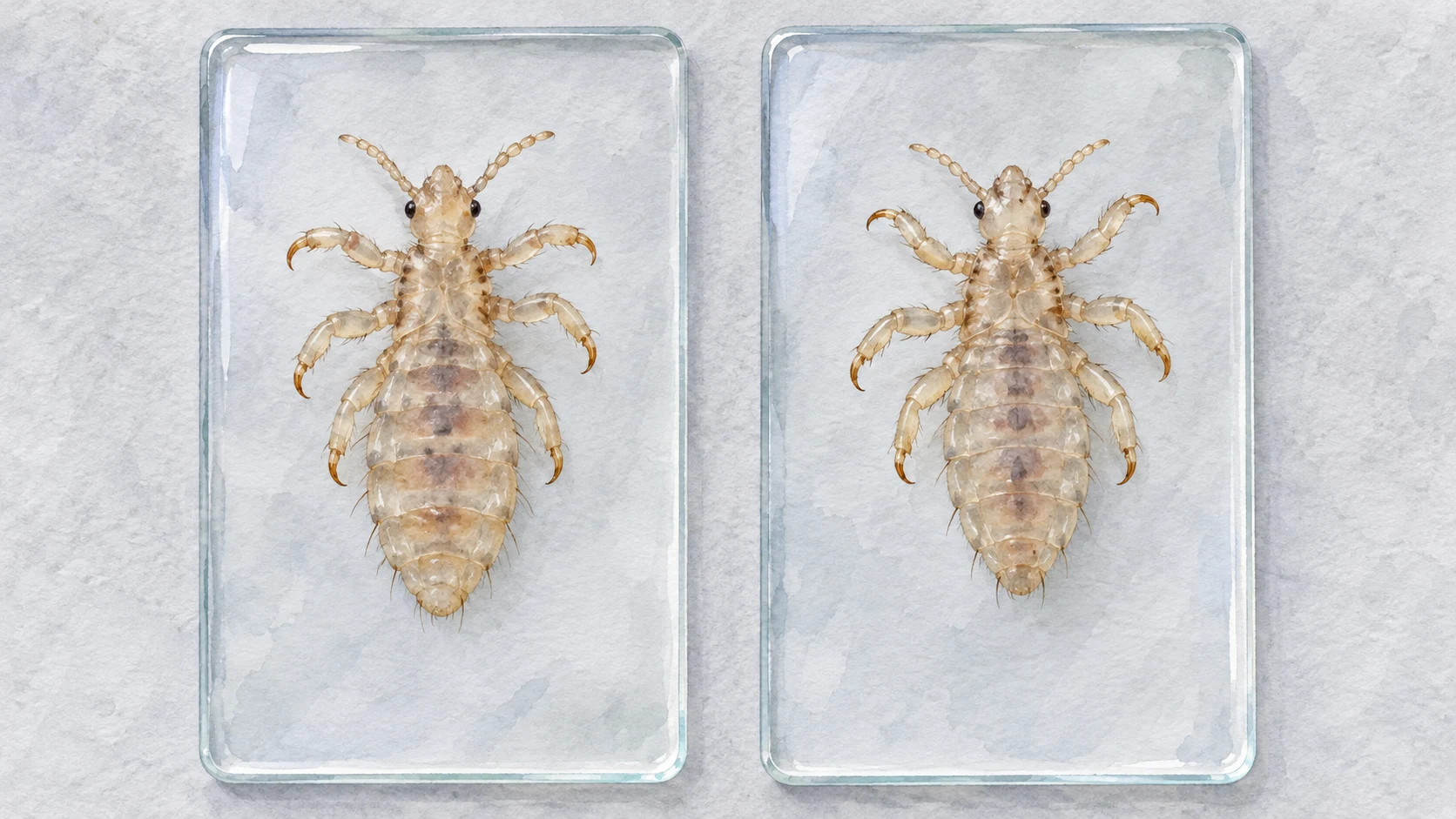
Male and female head lice can be told apart, but their differences are usually too small to recognize with the naked eye. Female head lice are generally larger, with broader abdomens and a distinctive indentation at the rear of the body. Males tend to be smaller, with more rounded abdominal tips and darker transverse markings that may be visible under magnification.
Both sexes are tiny insects, and their differences are subtle enough that a magnifying glass or microscope is often necessary for reliable identification. The sex-related differences in head lice anatomy are well documented, but seeing an individual louse crawling through someone’s hair rarely provides enough detail to determine whether it is male or female.
Are Female Head Lice Bigger Than Males?
Female head lice are usually slightly larger than males. Adult head lice commonly measure approximately 2 to 3 millimeters long, although some references describe larger specimens. Females tend to occupy the upper part of the adult size range, while males are generally somewhat shorter.
The difference is noticeable when specimens of both sexes are placed side by side under the same magnification. A female may have a longer, broader abdomen, giving her a fuller appearance. A male often looks more compact, particularly toward the rear of the body.
However, the difference is not large enough to provide a dependable identification rule. A small female may be similar in length to a large male, and individual variation can make the two difficult to distinguish by measurement alone.
The usual size difference between female and male lice is therefore a general anatomical tendency rather than an absolute boundary. Finding a louse that measures 2.5 millimeters does not establish its sex.
Size estimates are also easily distorted by photographs. Two specimens displayed at different magnifications may appear dramatically different even when their actual measurements are similar.
The actual measurements of head lice provide useful context for understanding just how small these differences are. A variation of a fraction of a millimeter can be meaningful under a microscope but practically invisible during an ordinary scalp examination.
How Is the Female Head Louse’s Abdomen Different?
One of the most distinctive differences between the sexes occurs at the posterior end of the abdomen. In female head lice, the rear margin has paired projections that produce a notched or two-lobed appearance when viewed from an appropriate angle.
These structures are associated with the female reproductive anatomy. The paired appendages, called gonopods, help position and manipulate eggs during deposition. Their arrangement gives the female’s abdominal tip a shape that differs from the more rounded termination typically seen in males.
The indentation is sometimes described as V-shaped. However, its appearance depends on the viewing angle, the position of the appendages, and the quality of the specimen or photograph.
In a clear dorsal view, the paired posterior structures may make the end of the abdomen look divided into two small lobes. In a side view, one lobe may conceal the other, making the characteristic shape less obvious.
The female abdominal projections used in sex identification are among the more useful anatomical features for distinguishing the sexes. They are considerably more specific than overall body length.
The projections should not be confused with legs or external structures extending from the middle of the body. They are located at the posterior end of the abdomen, where the reproductive structures occur.
What Does the Male Head Louse’s Abdomen Look Like?
Male head lice generally have a more rounded abdominal tip. Unlike the female’s paired posterior projections, the male’s rear abdominal margin does not usually show the same conspicuous V-shaped indentation.
The male abdomen may also appear narrower or less expanded than that of a female. This contributes to the relatively compact outline often seen in side-by-side specimen photographs.
Another reported characteristic is the presence of dark transverse bands across the dorsal surface of the male abdomen. These markings can be visible in well-lit, magnified specimens, although their appearance varies with pigmentation, feeding condition, and image quality.
The male’s rounded abdominal tip and dorsal markings provide useful additional clues when the specimen is viewed from above.
However, dark bands alone should not be treated as definitive proof of sex. The abdomen can change in apparent darkness when blood is visible inside the body, and lighting may emphasize or obscure individual markings.
The most informative examination considers the shape of the abdominal tip together with other anatomical characteristics. A specimen that merely looks darker than another cannot automatically be classified as male.
What Are the Differences in Male and Female Reproductive Anatomy?
Male and female head lice have different reproductive structures, concentrated near the posterior end of the abdomen. These structures provide more reliable sex-related characteristics than general body color or the length of the legs.
In females, paired gonopods are associated with the external genital region. They help control the positioning of eggs against individual hair shafts. Their visible arrangement contributes to the characteristic notched appearance of the female’s abdominal tip.
Males possess a different genital apparatus, including structures used to transfer sperm. Some components are internal or retractable, so they are not necessarily visible in an ordinary photograph of a living louse.
The reproductive structures of sucking lice are specialized anatomical features that require sufficient magnification and a suitable viewing angle to examine accurately.
This explains why an entomologist can distinguish specimens using features that are practically unavailable to someone looking through hair. The relevant structures may be present but too small, concealed, or poorly oriented to observe.
The presence of sex-specific genital anatomy also distinguishes mature males and females from immature nymphs, which have not developed the same adult reproductive structures. The appearance of baby head lice is a separate subject because immature specimens cannot be sexed using the full set of adult anatomical characteristics.
Can You Tell Male and Female Head Lice Apart by Color?
Color is not a reliable way to distinguish male and female head lice. Both sexes can appear pale gray, tan, brown, or darker depending on their pigmentation, feeding condition, and the lighting.
Male head lice may show darker transverse abdominal bands, but that does not mean all males are dark or all females are pale. A female that has recently fed may appear considerably darker than a male viewed under the same conditions.
Similarly, a male with relatively pale pigmentation may not display obvious dark markings in an ordinary photograph. The apparent color can also be influenced by the hair or background beneath the insect.
The normal range of head lice colors overlaps between males and females. Neither a reddish appearance nor a dark brown abdomen provides a dependable sex identification.
Anatomical structures are much more useful than overall color. A clear view of the abdominal tip can provide information that a simple observation of light or dark pigmentation cannot.
Can You Identify a Male or Female Head Louse With the Naked Eye?
Usually not with confidence. Adult head lice are visible without a microscope, but the differences between males and females involve features that occupy only a small fraction of the insect’s already tiny body.
A person may notice that one louse appears larger than another, but that observation does not establish their sexes. Differences in body position, feeding condition, and individual size can all affect the comparison.
The abdominal tip is particularly difficult to examine on a moving insect. Hair strands may obscure the posterior end, and the louse may change direction before the observer can see its outline clearly.
Even when the insect is stationary, its position can prevent a useful view. A specimen seen from the side may not reveal the female’s paired posterior projections or the male’s rounded abdominal margin.
The limits of recognizing head lice without magnification become more restrictive when the question is not merely whether a louse is present but which sex it belongs to.
A magnifying glass may improve visibility, but a microscope or high-quality macro image is more suitable for examining fine sex-related structures. An enlarged image is useful only when it preserves enough detail to show the relevant anatomy.
What Should You Look for in Magnified Male and Female Head Lice Photographs?
Side-by-side photographs can make the differences easier to understand, provided both specimens are shown at comparable magnification and from similar angles.
A female may appear larger, with a fuller abdomen and paired projections at its posterior end. A male may look smaller and more compact, with a rounded abdominal tip and visible darker transverse bands.
The most useful photographs show the insects from above. This dorsal perspective allows the observer to compare the overall abdominal outline and the shape of the posterior margin.
Images taken from below can reveal additional reproductive structures, but those details may be difficult for a non-specialist to interpret. Side views can be helpful for understanding body proportions, although they may conceal the most distinctive posterior features.
Photographs also need appropriate lighting. A strongly backlit specimen may show its outline clearly while concealing darker abdominal markings. An overexposed image may make both sexes appear nearly identical in color.
A labeled comparison with a scale bar is preferable to two unrelated photographs. Without a consistent scale, the apparent size difference may be caused by image enlargement rather than a genuine anatomical difference.
Male vs. Female Head Lice: The Main Differences
The following comparison summarizes the characteristics most relevant to distinguishing adult male and female head lice.
| Characteristic | Male head louse | Female head louse |
|---|---|---|
| Overall size | Generally smaller | Generally larger |
| Abdomen | Often relatively compact | Usually broader and fuller |
| Posterior abdominal tip | More rounded | Often notched or two-lobed |
| Posterior projections | Lacks the female’s characteristic paired gonopods | Paired gonopods associated with the genital region |
| Dorsal markings | Dark transverse bands may be visible | Markings can differ and are not a dependable standalone test |
| Naked-eye identification | Usually unreliable | Usually unreliable |
| Best distinguishing features | Abdominal tip and male genital structures | Abdominal tip and paired female projections |
The differences are clearest when several anatomical characteristics can be examined together. Size alone is insufficient, while color and apparent abdominal fullness can change with viewing conditions.
A specimen with a clearly rounded abdominal tip may be consistent with a male, while one showing paired posterior lobes may be consistent with a female. If those structures are obscured, assigning a sex based on general appearance is uncertain.
Does Knowing Whether a Head Louse Is Male or Female Matter?
For ordinary recognition of head lice, determining the sex of an individual insect is generally unnecessary. The main reason to distinguish males and females is to understand their anatomy or examine specimens in an entomological context.
The distinction can be valuable when studying preserved specimens, preparing identification illustrations, or interpreting magnified photographs. It allows anatomical observations to be described more precisely.
However, a person’s response to finding head lice should not depend on guessing whether an individual insect is male or female. The evidence of a head lice infestation concerns the presence of living lice, not whether a particular specimen has a rounded or notched abdominal tip.
The sex of a single observed louse also cannot establish how many other lice are present. Finding one female does not reveal the number of males, and finding one male does not establish the composition of the remaining population.
For most readers, recognizing that male and female lice have genuine anatomical differences is sufficient. Precise sex identification is a specialized task that requires a clear view of structures rarely visible during an ordinary hair examination.
Common Questions About Male and Female Head Lice
Are female head lice always bigger than males?
Females are generally larger, but the size ranges overlap. A small female may be similar in length to a large male, so body size alone cannot reliably establish sex.
Do male and female head lice have different body shapes?
Yes. Females typically have a fuller abdomen with paired projections at the rear, while males generally have a more rounded abdominal tip. These differences are most apparent under magnification.
Do male head lice have dark stripes?
Males may have dark transverse bands across the upper surface of the abdomen. However, markings vary in visibility and should not be used alone to determine sex.
Can you identify a female head louse without a microscope?
It may be possible to suspect that a relatively large specimen is female, but confirming its sex by sight is difficult. The distinctive posterior structures are generally too small to examine reliably without magnification.
Do male and female head lice have the same number of legs?
Yes. Both have six legs. Their leg count is not a sex-related difference, and the claws used to grip hair are present in both sexes.
Is a reddish-brown head louse more likely to be female?
No. Both male and female lice can appear reddish-brown after feeding. Blood visible inside the body affects coloration, so this shade does not reliably indicate sex.
One thought on “Male vs. Female Head Lice: Can You Tell Them Apart?”