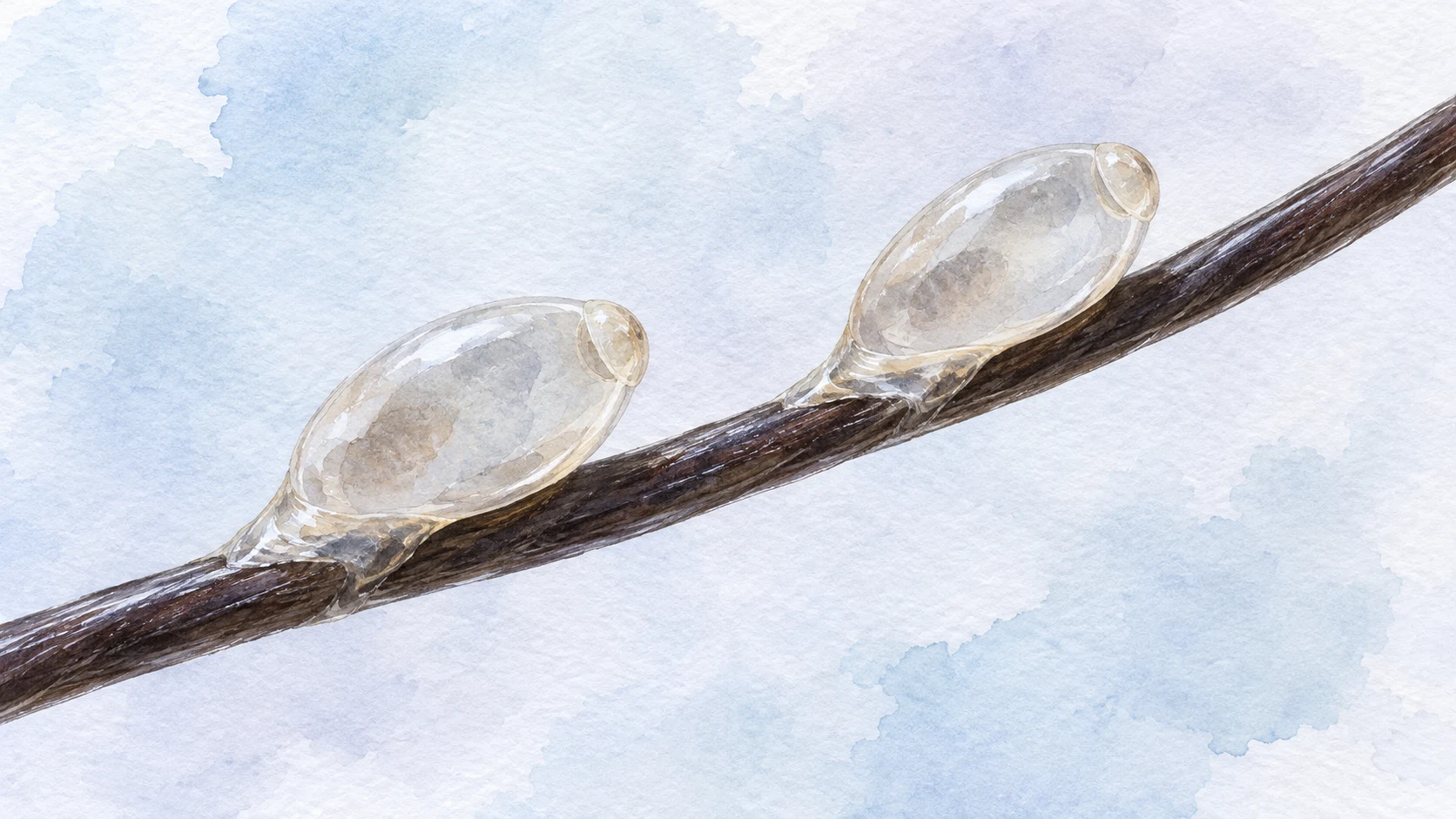
You can have nits in your hair without having any live head lice. Some nits may be empty egg cases left behind after lice have hatched, while others may be old eggs that are no longer capable of developing. These remnants can stay attached to hair even when no living lice remain.
Finding nits without seeing a crawling louse does not automatically mean you have an active infestation. However, it does not completely rule one out either. Head lice are small, move quickly, and can be difficult to find among the hair. The important question is whether the nits represent an old infestation or evidence of possible current activity. Their location on the hair, the circumstances in which they were discovered, and whether living lice can be confirmed all influence that judgment.
Why Nits Can Remain When There Are No Living Lice
Female head lice attach their eggs firmly to individual hair shafts using a specialized adhesive. Once an egg has hatched, the empty case can remain attached instead of falling away immediately.
Hair continues growing while these cases remain in place. Over time, an old egg case can move farther from the scalp as the hair shaft grows. It may remain visible long after the louse that emerged from it has disappeared.
Unhatched eggs can also become nonviable. In that situation, the egg remains attached but can no longer produce a living louse. Neither an empty case nor a nonviable egg is capable of starting an infestation.
The distinction between attached eggs and active insects is important because nits can remain after an infestation is no longer active. Their continued presence is not, by itself, proof that living lice are feeding or reproducing.
This explains why someone may discover several attached nits during a hair examination without finding a single moving insect. The findings may represent an earlier infestation rather than a current one.
It is also possible for an active infestation to be present without living lice being discovered during a brief examination. The absence of a sighting becomes more informative when the examination is careful and the remaining evidence is considered together.
What Does the Distance From the Scalp Tell You?
The position of a nit along the hair shaft provides useful information about whether it is likely to be associated with recent lice activity.
Head lice generally attach eggs close to the scalp, where warmth and other conditions support development. As hair grows, previously attached eggs and empty cases move farther away from the skin.
Nits found more than approximately one-quarter inch, or 6 millimeters, from the scalp are usually old, empty, or nonviable. When no crawling lice are found and the only nits are beyond this distance, the infestation is probably old and does not usually require treatment.
This is a useful guideline rather than an infallible biological boundary. Hair growth rates vary, and environmental conditions can influence egg development. Distance should be interpreted alongside other evidence instead of being treated as an absolute test.
Nits located very close to the scalp deserve more attention because recently deposited eggs are generally found there. Their position raises the possibility of an active infestation, but it does not prove that the eggs are viable or that living lice are currently present.
For someone trying to understand why attached nits remain, the time head lice eggs take to hatch provides additional context. An egg case can remain attached long after the developmental period has passed.
The distance from the scalp is therefore most useful for assessing whether the finding is likely to be old, not for making a definitive judgment about every individual nit.
Does Finding Only Nits Mean You Had Head Lice Before?
If the attached objects are genuinely head lice eggs or egg cases, they indicate that a female louse deposited eggs on the hair at some point. They do not establish whether the infestation is still active.
An old infestation may have ended without every attached egg case being removed. The remaining material can be discovered later, especially when someone examines the hair more closely than usual.
However, not every object mistaken for a nit is actually a louse egg. Hair debris and other material can be confused with nits, so an uncertain identification should not be treated as proof of a previous infestation.
The difficulty of distinguishing genuine nits from other hair material is well recognized in clinical guidance. Incorrect identification can lead to unnecessary treatment and mistaken assumptions about when someone acquired lice.
Even when genuine nits are present, they cannot establish a precise infestation date. Someone may discover an old egg case weeks after it was deposited, and the location of the case does not reveal exactly when the original louse arrived.
The evidence supports a narrower conclusion: genuine nits indicate past egg-laying activity, but they do not independently establish that a living infestation continues.
Can You Have Viable Nits Without Finding Live Lice?
Yes. It is possible to have eggs capable of hatching even when no crawling lice are found during an examination.
Adult and immature head lice can be difficult to locate because they move quickly and tend to avoid light. A person may find attached eggs more readily than the insects themselves.
A female could have deposited eggs before dying or being removed. Some of those eggs might remain capable of developing even if no adult lice are currently present.
This possibility is why a finding of nits close to the scalp cannot always be dismissed. However, it is equally important not to assume that every close-to-scalp nit is viable.
Clinical guidance places considerable weight on finding living lice when establishing an active infestation. Detection of live head lice is the most reliable evidence of current infestation, while nits alone are less conclusive.
The distinction also explains why one living head louse can be a meaningful finding, even when no other insects are immediately visible. A confirmed living insect provides direct evidence that a parasite is present, whereas an attached egg may represent activity that has already ended.
A person with close-to-scalp nits but no confirmed living lice has an uncertain finding, not necessarily a confirmed ongoing infestation.
Should You Treat Head Lice If You Find Only Nits?
Finding only nits does not always justify using a head lice treatment product. Whether treatment is appropriate depends on the evidence, particularly the location of the nits and whether an active infestation can be established.
If the only findings are old nits located well away from the scalp and no living lice are detected, treatment is generally unnecessary. Applying lice medication in that situation may expose the scalp to irritation without addressing a living infestation.
Nits close to the scalp require more careful interpretation. U.S. public-health guidance recommends treating people with living lice or nits within one-quarter inch of the scalp, while other clinical guidance emphasizes confirming living lice before using medication. These recommendations reflect different approaches to managing uncertainty rather than a claim that every nearby nit is definitely viable.
The guidance for deciding who should receive head lice treatment includes the scalp-distance criterion, while pediatric clinical recommendations recognize the limitations of nit-only findings.
If no living lice have been confirmed and the finding is uncertain, a healthcare professional or pharmacist can help determine whether treatment is warranted. This is especially appropriate for young children or when there is uncertainty about whether the attached material is genuinely from head lice.
Avoid treating repeatedly merely because attached nits remain visible. The decision to use medication should be based on evidence and applicable guidance, not on a desire to eliminate every visible speck from the hair.
Why Nit-Only Findings Are Sometimes Misleading
A nit-only finding can be misleading in two different ways. Someone may mistake unrelated hair material for nits, or they may correctly identify old egg cases but incorrectly assume that living lice must still be present.
The second situation is particularly common when a person has heard that finding even one nit automatically means an infestation. That assumption overlooks the fact that egg cases can remain attached after hatching.
It also overlooks the difference between a living parasite and a historical trace of its activity. An empty egg case cannot crawl, feed, reproduce, or transfer to another person’s head as a living louse would.
The signs of an active head lice infestation therefore need to be interpreted according to the strength of the evidence. A confirmed crawling louse carries more weight than an isolated attached object.
A person who notices several nits during a routine hair examination should not assume that the infestation is severe. The number of attached egg cases is not a reliable measure of the number of living lice.
Similarly, finding no crawling insects during one quick look does not guarantee that every louse is absent. The observation is useful, but its limitations should be acknowledged.
Does Having Nits Mean You Can Spread Head Lice?
The presence of nits alone does not establish that someone is currently capable of transmitting living head lice.
Head lice spread primarily when living insects crawl between people’s hair during close head-to-head contact. Nits are attached to hair shafts and do not move independently from one person to another.
An empty egg case cannot transmit an infestation. A viable egg attached to hair is also not the usual mechanism of person-to-person spread.
The reasons head lice spread mainly through direct hair contact help distinguish the presence of attached eggs from the movement of living insects.
There is still some uncertainty when nits are found close to the scalp and no thorough assessment has established whether living lice are present. A person may have undetected insects despite finding only eggs during an initial look.
For that reason, it is more accurate to say that nits alone do not prove current contagiousness than to claim that anyone with nits is definitely free of living lice.
Can a Child Attend School With Nits but No Live Lice?
Yes. Children with nits but no confirmed living lice generally should not be excluded from school solely because attached egg cases remain in their hair.
Traditional no-nit policies required children to have every nit removed before returning to class. Such policies can cause unnecessary absences because many attached nits are old or empty, and the presence of nits does not reliably predict an active infestation.
The recommendations against no-nit school exclusion policies reflect the limited value of using attached eggs as the sole basis for excluding children.
Schools may have their own procedures, but a school rule should not be confused with medical evidence that a child currently has living lice.
A child with old egg cases far from the scalp and no living lice should not be assumed to pose the same transmission concern as someone with confirmed crawling insects.
The broader question of whether a child with head lice can attend school involves school procedures and public-health recommendations. For a nit-only finding, the important point is that attached egg cases alone are not a sound medical reason for unnecessary exclusion.
What If You Keep Finding Nits but Never See a Louse?
Repeatedly finding attached nits without ever observing a living louse can be consistent with old egg cases remaining in the hair. It can also reflect uncertainty about the identification or an examination that has missed living insects.
The location of the nits provides useful context. If the findings are consistently well away from the scalp, they are more likely to represent old material. If newly noticed nits are close to the scalp, the possibility of recent egg-laying activity deserves more attention.
Neither observation should be treated as an absolute conclusion. Hair growth, the timing of egg deposition, and the difficulty of finding mobile lice all limit what can be inferred.
When uncertainty persists, confirmation by a qualified healthcare professional is preferable to repeated precautionary medication.
The appropriate response after finding a suspected head louse differs from the response to finding only attached nits because the quality of the evidence is different.
Someone who has never seen a living louse should not assume that every attached object requires treatment. At the same time, genuine close-to-scalp nits should not be dismissed without considering whether current activity is possible.
Questions About Nits Without Living Head Lice
Can empty nits stay in your hair for weeks?
Yes. Empty egg cases can remain firmly attached to hair as it grows. Their presence weeks later does not establish that living lice remain on the scalp.
Can nits hatch if there are no adult lice?
A viable egg may still hatch even when no adult louse is currently present. Whether an individual egg can develop depends on its viability and environmental conditions, not simply on whether an adult is visible.
Does finding one nit mean you need lice treatment?
Not necessarily. A single attached object may be old, nonviable, or incorrectly identified. Its location and the presence or absence of living lice are important considerations before treatment.
Can you have old nits without knowing you previously had lice?
Yes. Head lice can go unnoticed, particularly when itching is absent or delayed. A person may discover genuine old egg cases without remembering symptoms of an earlier infestation.
What Nits Without Live Lice Actually Mean
Finding nits without living head lice is possible and does not automatically establish an active infestation. Empty egg cases and nonviable eggs can remain attached to hair long after they cease to have any reproductive potential.
Nits far from the scalp are generally more consistent with old activity, while those close to the scalp deserve greater attention. Neither location alone can establish the presence or absence of living insects with complete certainty.
The strongest evidence of an active head lice infestation is a confirmed living louse. When only nits are found, their position, the reliability of their identification, and applicable clinical guidance should inform the decision about treatment. Uncertain findings are a reason to seek clarification, not to assume that medication is automatically necessary.
2 thoughts on “Can You Have Nits but No Live Head Lice?”