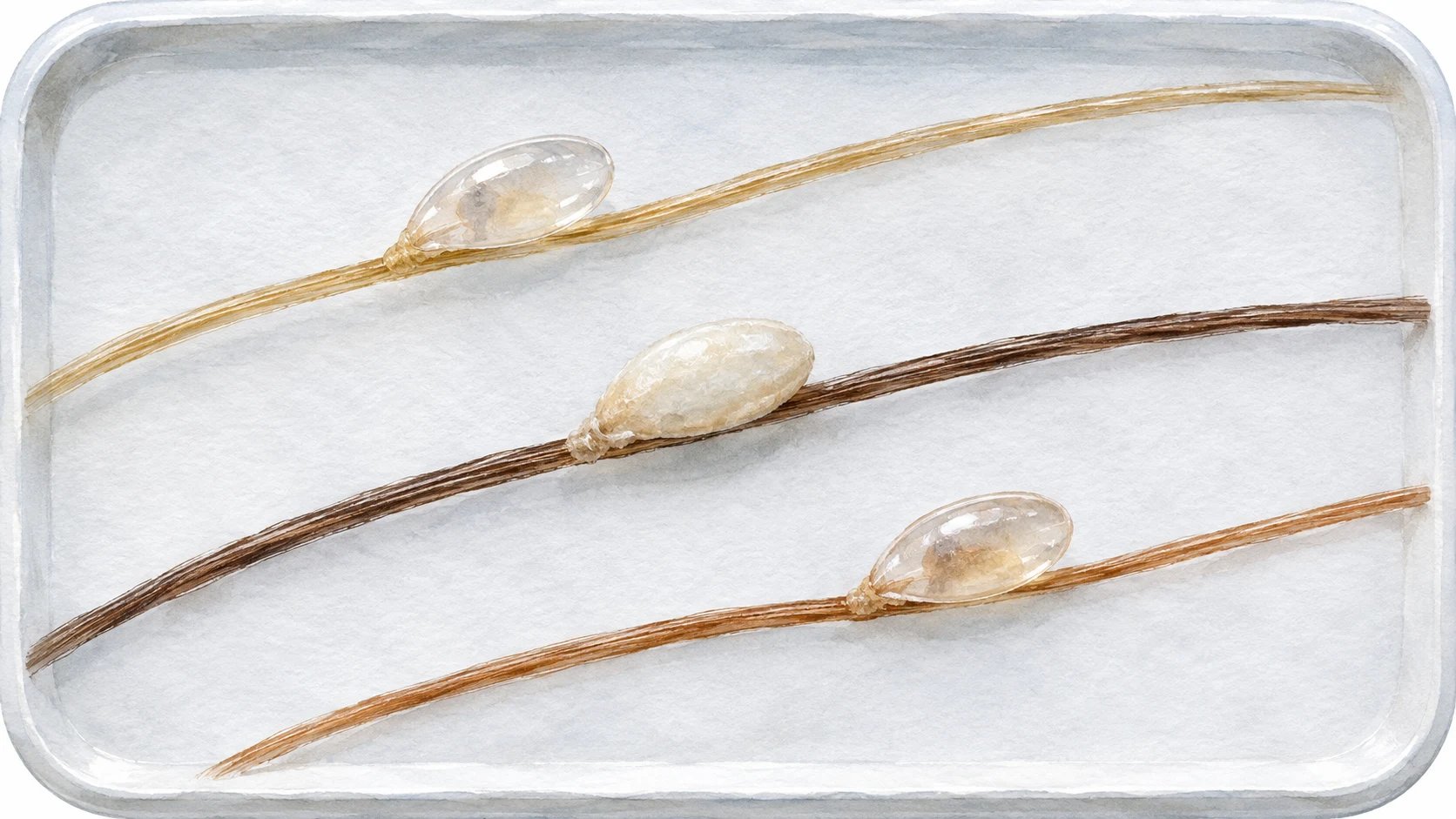
You cannot reliably tell whether a head lice egg is alive, dead, or empty just by looking at its color. An egg that still contains a developing louse may appear tan, yellowish, or brown, while an empty shell is often pale or translucent. However, dead eggs can resemble viable ones, and lighting can make an empty shell appear darker than it really is.
The egg’s position on the hair provides a more useful clue. Eggs attached close to the scalp are more likely to be viable because developing head lice require the warmth and humidity found near the skin. Eggs farther along the hair shaft are usually already hatched or dead, although distance cannot establish the condition of every individual egg.
Finding a living nymph or adult louse is more dependable evidence of an active infestation than trying to judge whether an attached egg is alive. The difference between living lice and remaining egg cases is particularly important because empty shells can remain attached to hair long after the insects have emerged.
What Is the Difference Between a Live Egg, a Dead Egg, and an Empty Nit?
A live head lice egg contains a developing embryo that may eventually hatch into a nymph. It remains attached to a hair shaft while development takes place, provided the conditions are suitable.
A dead egg still contains material from an embryo that has stopped developing or an egg that was never capable of hatching. Its outer shell may remain intact, so it can resemble a viable egg even though no living nymph will emerge.
An empty nit is the shell left behind after a nymph has successfully hatched. The developing insect is no longer inside, but the shell can remain firmly attached to the hair.
The word nit sometimes causes confusion because it is used in two ways. Some medical and scientific descriptions reserve it for empty egg cases, while others use it for both unhatched eggs and their remaining shells. The terminology used for head lice eggs and nits acknowledges this variation.
These three conditions have different meanings. A viable egg could produce another louse, a dead egg cannot hatch, and an empty shell indicates that a nymph has already emerged. Unfortunately, all three may remain attached to hair and can look similar during ordinary observation.
The general appearance of head lice eggs and nits helps establish whether a structure resembles a louse egg. Determining whether it still contains a living embryo is a separate and considerably more difficult question.
Can Egg Color Tell You Whether It Is Alive?
Color can provide clues, particularly when comparing an apparently intact egg with an empty shell, but it cannot reliably establish viability.
Developing head lice eggs often have some pigmentation. They may appear yellowish, tan, brown, or darker depending on their contents, the surrounding hair, and the conditions under which they are viewed.
After a nymph hatches, the remaining shell is often lighter. Empty cases may look whitish, clear, or translucent, making them more noticeable against dark hair.
The appearance of unhatched eggs compared with empty shells illustrates this difference. However, it does not mean that every colored egg is alive or every pale structure is empty.
A dead egg may retain pigmentation. Its contents do not necessarily become transparent when development stops. An apparently brown egg could therefore contain a living embryo, a dead embryo, or material whose condition cannot be established visually.
Similarly, a pale egg-like structure may be an empty shell, but its color alone is insufficient to prove that it has hatched.
The normal color variations of head lice also demonstrate why color should be interpreted cautiously. The appearance of both insects and their eggs can change with lighting, background, and viewing conditions.
Does a White Nit Mean the Louse Has Hatched?
A whitish or translucent nit is often an empty egg case, especially when it is located well away from the scalp. Empty shells tend to become more conspicuous as they remain attached to growing hair.
However, white does not guarantee that an egg has hatched. Reflections, pale hair, and the condition of the egg can affect its appearance.
A genuinely empty shell no longer contains a developing nymph and cannot hatch again. The challenge is establishing that the shell is empty rather than assuming so because it looks pale.
When an egg-like structure is difficult to see clearly, its location and the presence or absence of living lice provide more useful context than color alone.
How Close to the Scalp Are Live Lice Eggs Usually Found?
Viable head lice eggs are generally found close to the scalp, where the warmth and humidity support embryonic development.
Female head lice attach eggs near the base of hair shafts. As hair grows, the attached egg or shell gradually moves farther from the scalp.
The relationship between egg viability and distance from the scalp is useful because viable eggs are usually located within approximately 6 millimeters of the skin.
A commonly used public-health guideline is that nits attached more than one-quarter inch, approximately 6 millimeters, from the scalp are almost always hatched or dead.
That distance is a practical guideline, not an absolute biological boundary. Some eggs farther from the scalp may remain viable under unusual conditions, while an egg very close to the scalp may already be dead or empty.
The distance also depends on where the hair emerges from the skin. An egg attached close to the root on one strand may be more difficult to judge than an egg on a straight, easily separated strand.
Does an Egg Close to the Scalp Have to Be Alive?
No. Proximity to the scalp increases the possibility that an egg is viable, but it does not prove that the embryo is living.
An egg close to the scalp may have failed to develop, died before hatching, or already released a nymph. Its location alone cannot distinguish those outcomes.
An empty shell can also remain near the scalp for some time after hatching. Hair growth gradually carries it farther away, but that movement is not immediate.
The usual locations where head lice remain on the scalp help explain where recently laid eggs are likely to occur. The areas behind the ears and around the nape of the neck are commonly examined because lice and attached eggs may be found there.
Finding an egg in one of those areas does not establish its viability. Location helps estimate likelihood, while the egg’s actual developmental condition remains uncertain.
Are Nits Farther Down the Hair Shaft Usually Dead or Empty?
Yes. Eggs located well away from the scalp are much more likely to be dead or already hatched than eggs near the roots.
Hair continues to grow after an egg has been attached. The egg remains fixed to its original point on the strand, so its distance from the scalp gradually increases.
Head lice eggs normally hatch within approximately 7 to 12 days, depending on conditions. Once a nymph emerges, the shell can remain attached while the hair continues growing.
An egg case found several centimeters from the scalp may therefore represent an earlier infestation rather than current reproductive activity.
The persistence of empty egg cases after hatching is one reason that visible nits can remain in hair long after living lice are gone.
There are limits to using distance as a clock. Hair growth varies between individuals, eggs may be laid at slightly different positions, and environmental conditions influence development. Distance cannot reliably establish the exact day an egg was deposited or hatched.
A nit far from the scalp is strong evidence against viability, but it should not be used to calculate an exact infestation date.
What Does an Empty Head Lice Egg Look Like After Hatching?
An empty egg case usually appears lighter and more translucent than an intact, pigmented egg. Under sufficient magnification, the opening through which the nymph emerged may sometimes be visible.
When a head louse hatches, the nymph exits the egg, leaving the shell attached to the hair shaft. The remaining structure does not contain a living insect.
The empty case may continue to look like a small oval object fixed to the hair. It does not necessarily fall away after hatching.
The head lice life cycle and remaining egg shells provide context for why these structures can persist after the insect has moved on to its next developmental stage.
An intact-looking shell is not necessarily unhatched. The opening may be too small or positioned at an angle that makes it difficult to see without magnification.
Conversely, an egg that appears damaged or partly open is not automatically a normally hatched shell. Damage and hatching are different events, and an incomplete view may not reveal which occurred.
For ordinary household observation, the distinction between an empty case and an intact egg is sometimes possible, but distinguishing a living embryo from a dead one is much less dependable.
Can You Tell Whether an Egg Is Dead by Looking Inside It?
Not reliably with the naked eye. The contents of a head lice egg are too small and difficult to interpret for a dependable household viability judgment.
Magnification may reveal pigmentation, internal structures, or an opening in the shell. These details can help an experienced examiner recognize an empty case or assess the developmental stage of an egg.
They do not necessarily establish whether an embryo is alive at the moment of observation.
A developing egg may show features that indicate embryonic development, but a dead embryo can retain recognizable structures. An apparently intact shell may contain a nonviable egg.
The distinction between a visible developmental structure and proof of life is important. Seeing material inside an egg does not demonstrate that development is continuing.
Some scientific examinations use specialized microscopy or observation of hatching to assess eggs. These methods are not equivalent to examining a nit with an ordinary household magnifying glass.
A person should therefore avoid labeling an egg as definitely alive or definitely dead solely because its contents appear dark, solid, or translucent.
Does an Egg That Makes a Popping Sound Have to Be Alive?
No. A popping or cracking sound when an egg-like object is crushed does not reliably establish whether it contains a living embryo.
The sound may reflect the mechanical breaking of a shell or its contents. It is not a validated household test for egg viability.
A dead but intact egg could still break under pressure. Likewise, the absence of a noticeable sound does not prove that an egg is empty or dead.
There is no dependable scientific basis for assigning a specific sound to living head lice eggs and a different sound to nonviable ones during ordinary handling.
The same caution applies to claims that a live egg must feel firm or that a dead egg must crumble. Shell condition can vary for reasons unrelated to whether an embryo remains alive.
These informal tests create false certainty and are less useful than examining the location of the egg and looking for living lice.
Why Finding Live Lice Is More Reliable Than Judging Eggs
A living nymph or adult louse provides much stronger evidence of an active infestation than an egg whose viability is uncertain.
The reason is straightforward: a moving, correctly identified head louse is visibly alive. An attached egg may be viable, dead, or already empty, and those conditions can overlap in appearance.
The recommended evidence for confirming active head lice places particular importance on finding living nymphs or adults. A fine-toothed lice comb can help reveal insects that are difficult to see during a casual examination.
This does not mean attached eggs are irrelevant. Eggs very close to the scalp deserve attention because some may be capable of hatching. Their presence may justify closer assessment, especially when no living insects are immediately visible.
However, a collection of old, distant egg cases should not be treated as equivalent to finding crawling lice.
The visibility of living head lice explains why adults and nymphs can be difficult to locate despite being large enough to see without a microscope.
When the only evidence consists of attached structures of uncertain viability, a careful search for living lice provides more meaningful information than attempting to classify every egg by color.
How to Interpret Different Egg Findings
The following comparison separates observations that increase the likelihood of viability from those that provide stronger evidence of an old or inactive infestation.
| Observation | Most reasonable interpretation | What remains uncertain |
|---|---|---|
| Pigmented egg very close to the scalp | Could be viable | Color and position do not prove life |
| Pale or translucent egg near the scalp | May be empty | A pale appearance alone does not confirm hatching |
| Egg more than ¼ inch from the scalp | Almost always dead or hatched | Rare exceptions are possible |
| Egg several centimeters from the scalp | Very unlikely to be viable | Exact age and hatching history cannot be determined |
| Shell with a recognizable hatching opening | Supports identification as an empty case | The opening must be correctly recognized |
| Dark egg with no visible opening | May be intact | The embryo may be living or dead |
| Living nymph or adult found in the hair | Strong evidence of active infestation | Does not establish the condition of every attached egg |
The table is a guide to interpreting evidence, not a method for assigning certainty to individual eggs. No single color, distance, or appearance rule can classify every nit correctly.
The broader signs of a head lice infestation should be interpreted with this limitation in mind. Attached eggs may indicate past or possible current activity, while living lice provide more direct evidence.
Why Old Nits Can Remain After Living Lice Are Gone
Empty egg cases remain attached because the adhesive deposited by the female louse forms a strong bond with the hair shaft.
The shell does not need to contain a living embryo to remain in place. It may persist as the hair grows, sometimes for months.
This explains why someone can continue to notice nits long after an infestation has ended. Their presence does not necessarily mean that eggs are still developing.
Dead eggs can also remain attached. An egg that never hatched may retain its shell and some internal material, making it difficult to distinguish from a viable egg without further examination.
The difference between attached nits and ordinary scalp flakes is relevant because the persistence of an attached structure can establish that it resembles a nit, but not whether the contents are alive.
Repeatedly finding the same distant egg cases is therefore different from finding newly deposited eggs close to the scalp or discovering living lice.
The age and condition of an individual nit cannot always be established, but its position and the presence of living insects help prevent old evidence from being mistaken for ongoing activity.
When Egg Appearance Is Too Uncertain to Interpret
There are situations in which even careful observation cannot establish whether a suspected egg is viable.
A dark structure close to the scalp may be a developing egg, a dead egg, or something that is not a louse egg at all. A pale structure farther along the hair may be an empty case, but its exact history may remain unknown.
If no living lice are found and the only visible structures are distant nits, an active infestation becomes less likely. If egg-like structures are close to the scalp, the possibility of viable eggs deserves more attention, but it still does not justify certainty about their condition.
A healthcare professional can help when the identity of the structures or the presence of an active infestation remains unclear.
The practical goal is not to label every attached egg with absolute confidence. It is to avoid mistaking old shells for living insects and to recognize when stronger evidence is needed.
Common Questions About Live, Dead, and Empty Lice Eggs
Are brown lice eggs always alive?
No. Brown or tan coloration may indicate that an egg contains material, but it does not prove that the embryo is alive. A dead egg can retain pigmentation and resemble a viable one.
Are white nits always empty?
Not always. Empty egg cases are often pale or translucent, but color alone cannot establish that hatching has occurred. Lighting and the condition of the shell can affect its appearance.
Can a dead lice egg remain attached to hair?
Yes. Dead eggs can remain cemented to hair shafts, just as empty shells can. Their attachment does not demonstrate that they are capable of hatching.
Can lice eggs hatch when they are far from the scalp?
Eggs found more than approximately one-quarter inch from the scalp are almost always dead or already hatched. Rare exceptions may occur, but the farther an egg is from the scalp, the less likely it is to remain viable.
Does finding only empty nits mean the infestation is over?
Empty shells alone do not demonstrate that living lice remain, but they also cannot prove that every living louse is gone. Looking for living nymphs or adults provides stronger evidence of whether an infestation is active.
4 thoughts on “How to Tell Whether Lice Eggs Are Alive, Dead, or Empty”