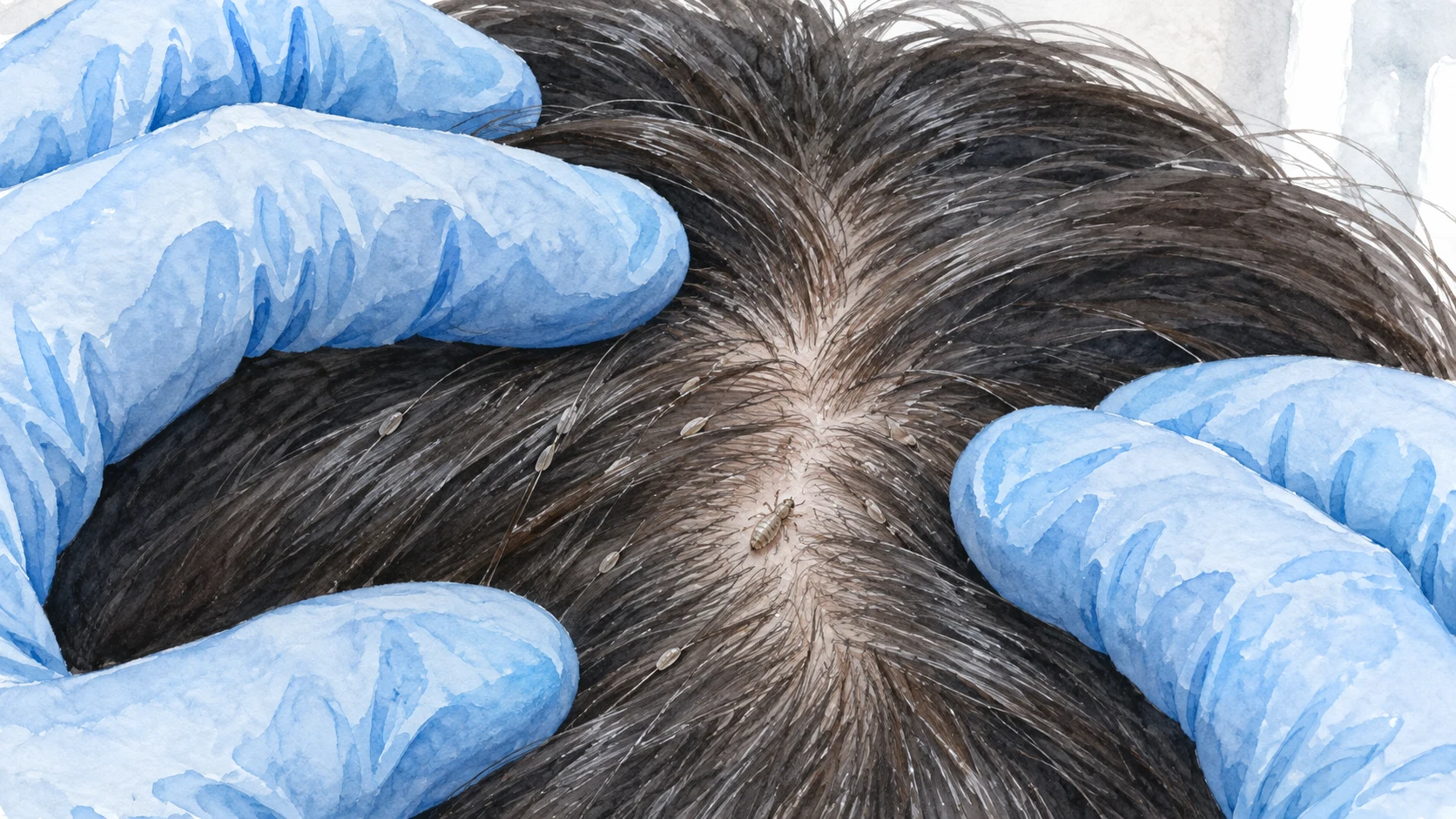
Head lice stay close to the scalp because it provides the blood, warmth, moisture, and shelter they need to survive. Their food comes from living skin rather than hair, and the temperature near the scalp helps their eggs develop. Although head lice can crawl along hair strands, spending extended periods far from the scalp offers little benefit.
Adult lice and their immature offspring depend on repeated blood meals. Female lice also attach their eggs near the hair roots, where body heat creates favorable conditions for incubation. These two requirements explain much of the insect’s close association with the scalp.
The arrangement is highly specialized. Human hair gives lice something to grip, while the skin beneath it provides nourishment and a relatively stable environment. Neither the hair nor the scalp alone supplies everything the insects need.
The Scalp Provides Everything Head Lice Need
The human scalp offers several advantages within a very small area. It supplies blood for feeding, warmth from the body, moisture in the surrounding environment, and hair that provides both shelter and a surface for gripping.
Head lice are adapted to living in this combination of conditions. Their legs have claws that grasp individual hairs, allowing them to remain attached while moving between strands and reaching the skin.
The feeding and environmental requirements of head lice explain why these insects normally remain near the scalp rather than wandering along the full length of the hair.
A strand of hair does not provide food. It is primarily a physical structure that helps the insect remain on its host. The scalp supplies the blood meals needed for survival, while its warmth supports normal activity and egg development.
The environment is also more consistent than the exposed ends of long hair. Hair tips may be subjected to greater changes in surrounding temperature, airflow, and physical movement. Near the scalp, lice remain in closer contact with the conditions to which they are adapted.
These advantages work together. A warm environment without access to blood would not sustain a feeding louse, while a suitable food source would be less useful if the insect could not maintain its grip and remain near it.
Head Lice Must Stay Near Their Blood Supply
Head lice are blood-feeding parasites. They do not eat hair, dandruff, skin oils, or other material found among hair strands.
To obtain nourishment, a louse must reach the skin and use its specialized mouthparts to draw blood. Remaining close to the scalp makes repeated feeding possible without requiring long journeys along the hair.
Head lice generally feed every three to six hours, although this is an approximate interval rather than an exact schedule followed by every insect.
Their need for frequent meals is one reason they are so closely associated with the human head. An insect that spends prolonged periods away from the skin would be separated from the food source on which it depends.
The blood-feeding biology of head lice explains how they obtain nourishment and why both immature and adult lice depend on a human host.
A louse can move away from the scalp temporarily while crawling through hair. However, its ability to feed remains tied to reaching living skin. It cannot obtain a blood meal from the exposed length of a hair shaft.
The scalp therefore functions as a feeding environment rather than merely a place where lice happen to live.
Why Warmth Near the Scalp Is Important
Human body heat helps maintain conditions suitable for head lice. The skin of the scalp is generally warmer and less exposed to rapid environmental changes than the distant ends of hair.
Temperature influences the insects’ biological functions, particularly the development of their eggs. Head lice are adapted to conditions associated with a living human host rather than an arbitrary warm surface.
The temperature dependence of head lice and their eggs is especially important because eggs normally require warmth comparable to that found near the scalp to hatch successfully.
A person’s hair may extend many centimeters beyond the skin, but the environment at its ends is not identical to the environment at its roots.
Air temperature, wind, and other surroundings can influence exposed hair more directly. Near the scalp, body heat provides a relatively stable source of warmth.
This does not mean that the temperature is perfectly constant or that every point on the scalp has exactly the same conditions. Hair density, ambient temperature, and individual circumstances can influence the immediate environment.
Nevertheless, the warmth near the skin is a central reason head lice remain associated with the scalp.
Moisture and Shelter Also Help Head Lice Remain Near the Skin
The scalp provides more than food and heat. Hair and the surrounding skin create a relatively sheltered microenvironment that can help reduce exposure to airflow and changing humidity.
Moisture is relevant because insects must maintain suitable internal water balance to function normally. Head lice are adapted to the conditions found close to a human host rather than to unrestricted exposure to dry air.
The scalp environment supporting head lice is described in clinical literature as providing food, warmth, shelter, and moisture.
These factors are closely connected. Hair can limit direct exposure to moving air, while the skin beneath it supplies warmth and contributes to the local humidity.
However, this does not establish that lice deliberately seek the wettest possible location or that high humidity alone can support them. Moisture cannot replace blood meals, and excessively wet conditions are not necessarily favorable for normal movement.
Shelter also should not be confused with a permanent hiding place. Head lice remain mobile insects capable of crawling between hairs, feeding, and changing position.
Their close association with the scalp reflects the combined advantages of the environment, not dependence on one particular physical feature.
How Their Claws Help Them Remain Near the Scalp
Head lice have six legs equipped with claws adapted for grasping human hair. These structures allow them to maintain contact with their host while moving through a network of narrow, flexible strands.
A louse can grip a hair, reposition itself, and move to another strand when the hairs are sufficiently close together. This helps it navigate without needing wings or specialized jumping legs.
The gripping and crawling abilities of head lice explain how their anatomy supports life among hair strands.
Hair movement creates challenges for a small insect. Individual strands shift when a person walks, turns their head, or handles their hair. A secure grip helps the louse remain attached despite these movements.
The claws do not provide nourishment themselves. Their function is mechanical, allowing the insect to remain within reach of the scalp.
A head louse can crawl farther along a hair, but its gripping anatomy is most useful when it allows continued access to the host environment.
This is why the combination of hair and skin is so important. Hair supplies the structure for movement and attachment, while the scalp provides the resources needed for survival.
Why Female Head Lice Attach Eggs Near Hair Roots
Female head lice normally deposit their eggs close to the base of individual hair shafts. This position places the developing eggs near the warmth supplied by the scalp.
The female attaches each egg using a specialized adhesive secretion that hardens around the hair. The attachment is strong enough that the egg generally remains fixed rather than falling away during ordinary hair movement.
The attachment of head lice eggs to hair shafts is part of their reproductive adaptation to living on a human host.
The egg does not need to move around the hair to find food. Instead, it remains attached while development takes place inside. Its immediate environmental requirements are therefore different from those of a crawling, blood-feeding louse.
The female’s placement of the egg is particularly important because the developing insect cannot relocate itself to a warmer position.
A newly deposited egg attached far from the scalp would not necessarily experience the same temperature conditions as one placed near the roots.
The mating and egg-deposition behavior of head lice explains the reproductive process, while the location of egg attachment reflects the need for suitable incubation conditions.
How Close to the Scalp Are Head Lice Eggs Usually Attached?
Head lice eggs are commonly attached within approximately 6 millimeters, or one-quarter inch, of the scalp. Some pediatric descriptions give a typical distance of around 4 to 6 millimeters.
These figures describe the usual placement of recently deposited eggs, not an exact distance that every female measures before laying an egg.
The typical location of head lice eggs reflects the importance of maintaining a favorable incubation environment.
An egg attached only a few millimeters from the scalp remains close to body heat. An egg attached much farther along the hair may be exposed to different thermal conditions.
The distance also changes naturally as the person’s hair grows. The egg remains attached to the same portion of the hair shaft while new hair emerges from the scalp.
Consequently, an attachment point that was originally close to the skin can gradually move farther away without the egg itself moving.
The approximate distance is useful for understanding the female’s egg-placement behavior. It should not be treated as a precise biological boundary that applies identically to every person, climate, or egg.
Why Head Lice Eggs Need the Warmth of the Scalp
Developing head lice eggs depend on suitable temperatures during incubation. The warmth supplied by the human scalp helps maintain the conditions necessary for normal embryonic development.
An egg cannot regulate its surroundings by crawling to another location. Once attached, it remains in place while development proceeds.
The temperature requirements for head lice egg development explain why females deposit eggs close to the scalp and why incubation conditions can influence developmental timing.
Temperature is not simply a matter of making development faster. Conditions outside the suitable range can interfere with development or prevent successful hatching.
An egg exposed to an environment that is too cool may fail to complete development rather than remaining capable of hatching indefinitely.
This dependence on scalp warmth distinguishes the egg’s needs from the feeding requirements of mobile lice. Crawling lice need regular access to blood, while attached eggs rely on favorable environmental conditions during development.
The hatching window and temperature dependence of head lice eggs provide a more detailed account of how incubation conditions influence the timing of emergence.
For understanding why eggs are placed near the roots, the central explanation is that body heat supports development where the egg remains attached.
Why Head Lice Do Not Normally Live at the Ends of Long Hair
Long hair provides additional surface area, but it does not create an additional food source. A louse positioned at the distant end of a long strand is farther from the skin where it must feed.
The exposed ends of hair may also experience greater environmental variation than the region near the scalp.
A head louse can crawl along a strand, but the ability to reach a location does not mean that location is equally suitable for prolonged residence.
The relationship between hair length, texture, and head lice should be distinguished from the insect’s need to remain close to its feeding environment.
Long hair does not cause lice to develop a different diet, and short hair does not eliminate the need for blood meals.
Similarly, the presence of additional hair length does not mean females will normally place their eggs near the tips. The biological requirements of incubation remain associated with the scalp.
The insect’s preference for staying close to the skin is therefore not simply a consequence of how much hair is available. It reflects where suitable conditions are concentrated.
Does Hair Cleanliness Change Where Head Lice Live?
Cleanliness does not change the basic reasons head lice remain near the scalp. They require blood, warmth, and suitable environmental conditions whether a person’s hair has been washed recently or not.
Hair oils and dirt are not their food. A clean scalp still contains the blood supply needed for feeding, and ordinary washing does not remove the body’s warmth.
The relationship between head lice and hair cleanliness is often misunderstood because people sometimes assume lice are attracted to dirty hair.
The insects’ association with the scalp is primarily biological rather than a response to poor hygiene.
A female louse can attach eggs near the roots of clean hair, just as she can on hair that has not been washed recently. The attachment process does not depend on dirt holding the eggs in place.
The adhesive produced during egg deposition provides that attachment.
Hair cleanliness therefore does not explain why head lice remain close to the scalp. Their feeding and incubation requirements provide a much more direct explanation.
Does Scalp Proximity Mean Head Lice Never Move Farther Along Hair?
No. Head lice are mobile insects, and they can crawl along hair strands away from the skin.
Their normal dependence on the scalp does not mean they remain fixed at one precise distance from it.
An insect may change position while moving between hairs or responding to disturbances. It may temporarily travel along a strand without establishing that location as its normal feeding environment.
The important distinction is between where a louse can move and where it can obtain the resources necessary for continued survival.
A head louse cannot feed from the hair shaft itself. Wherever it travels, access to living skin remains necessary for nourishment.
Likewise, the fact that an insect can move along hair does not mean its eggs can be deposited equally successfully at every distance from the scalp.
The biological requirements of crawling lice and attached eggs both favor close association with the skin, even though their immediate needs differ.
Questions About Why Head Lice Stay Near the Scalp
Do head lice live on hair or on the scalp?
Head lice live among the hair and feed from the scalp. Their claws grip hair strands, while the skin provides the blood meals they need. Both surfaces contribute to their normal habitat.
Why don’t head lice eat hair instead of blood?
Head lice have specialized piercing and sucking mouthparts adapted for blood feeding. They are not equipped to use hair shafts as their normal food source.
Why are head lice eggs glued to hair rather than placed directly on the skin?
The hair shaft provides a secure attachment surface, allowing the egg to remain fixed close to the warmth of the scalp during development.
Does the scalp’s warmth attract head lice?
Warmth is an important feature of the environment in which head lice survive and reproduce. However, that does not establish that temperature alone determines every movement or host-selection decision.
Why Head Lice Remain Near the Scalp
Head lice remain close to the scalp because it combines several resources that are essential to their survival. Living skin provides repeated blood meals, body heat supports a favorable environment, and hair offers shelter and a secure surface for gripping.
Female lice also place their eggs near the hair roots because the warmth of the scalp helps support incubation. The eggs remain firmly attached while development occurs, making their original placement especially important.
The scalp is both a feeding environment for mobile head lice and a source of warmth for their developing eggs. Those two biological needs explain why head lice are closely associated with hair roots rather than spending most of their lives at the exposed ends of hair.
One thought on “Why Do Head Lice Stay Close to the Scalp?”