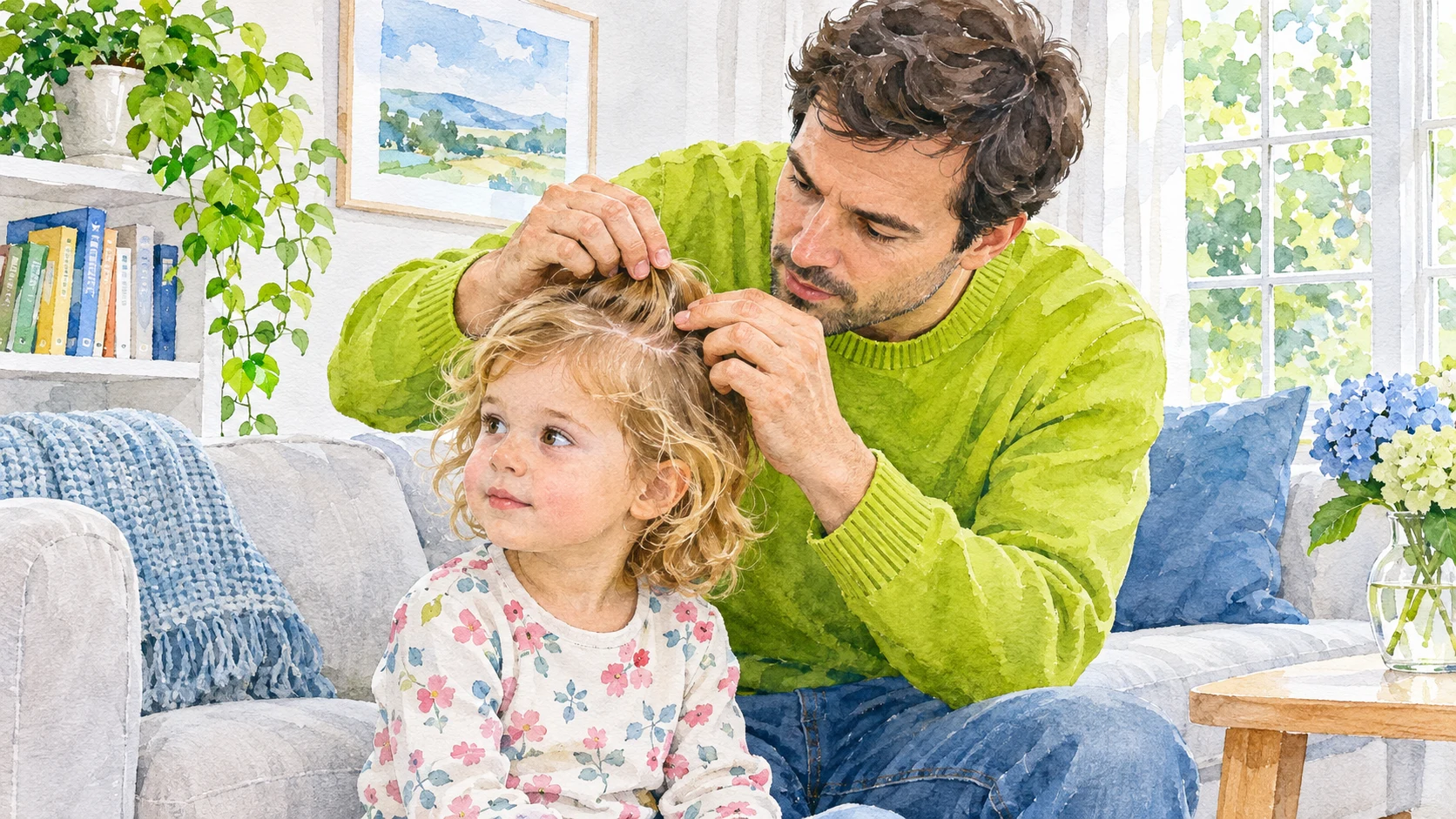
Babies and toddlers can get head lice, although infestations are more commonly reported in preschool and elementary school children. Head lice do not require a person to be a certain age before they can survive on their scalp. Even an infant can become infested if a living louse transfers from another person’s hair.
For very young children, exposure often involves parents, siblings, or caregivers. A baby may spend considerable time with their head resting against an adult’s hair, while a toddler may cuddle an older sibling or play closely with other children.
The biggest difference between head lice in babies and older children is not the insect itself, but how an infestation should be managed. Many lice-treatment products have minimum age restrictions, and a baby’s scalp is particularly sensitive. Parents should consult a healthcare professional before using lice medication on an infant or young toddler.
Finding a suspected louse also does not mean immediate chemical treatment is necessary. Confirming that living head lice are present is the first priority.
Can Newborn Babies Get Head Lice?
Yes. A newborn can theoretically acquire head lice through close contact with someone who has an active infestation. Head lice are human parasites, and their ability to feed does not depend on whether their host is a newborn, toddler, child, or adult.
However, head lice are not typically associated with newborns. Most recognized infestations occur in older children, whose activities provide more frequent opportunities for contact with other children’s hair.
A newborn’s exposure circumstances are different. Babies spend much of their time being held, fed, carried, and comforted by a relatively small group of adults and family members.
If a parent or caregiver has head lice, the baby’s hair may occasionally touch the infested person’s hair during close contact. That creates a possible opportunity for transfer.
An infant does not need to attend daycare or have contact with school-aged children directly. An older sibling could acquire lice elsewhere, and close family contact could eventually provide an opportunity for the insects to reach the baby.
The biology of head lice and their dependence on human hosts explains why age alone does not prevent an infestation.
Nevertheless, finding an insect on a newborn’s scalp should not automatically lead to the conclusion that it is a head louse. Correct identification is particularly important before considering any treatment.
For babies younger than two months, suspected head lice should prompt timely contact with a healthcare professional. Pediatric guidance recommends contacting a doctor within 24 hours for a child in this age group.
Are Toddlers More Likely to Get Head Lice Than Babies?
Toddlers generally have more opportunities for head-lice exposure than newborns because their social interactions become more varied.
A baby may spend most of the day with a parent or caregiver. A toddler may regularly play with siblings, attend daycare, visit relatives, or interact with other young children.
These activities create more opportunities for close contact between people’s hair.
Toddlers also tend to move unpredictably. They may lean their heads against other children, cuddle during play, or press close together while looking at a toy or picture book.
A child who spends much of the day in a group setting may encounter more people than an infant who remains primarily at home. However, daycare attendance does not automatically mean a toddler will acquire lice.
Head lice are most commonly reported among children aged approximately three to eleven and their close contacts. The public-health description of groups commonly affected by head lice identifies preschool and elementary school children as particularly susceptible to exposure.
That pattern does not establish a precise risk for every toddler. A two-year-old who frequently plays closely with other children may have different opportunities for exposure from a child of the same age who spends most of their time with one caregiver.
The practical difference is the child’s contact pattern rather than their birthday alone.
How Babies Can Be Exposed During Everyday Care
Close physical contact is an essential part of caring for babies. Feeding, holding, comforting, and helping an infant sleep often bring the baby’s head near an adult’s face or hair.
These interactions are normal and should not be avoided simply because head lice exist.
An exposure becomes possible when the baby’s hair touches the hair of someone carrying living lice. The insect must actually transfer between the two people; being held by an infested adult does not guarantee that this will happen.
A parent with long hair may notice that loose strands regularly fall across the baby’s head during feeding or cuddling. Another caregiver may rest their cheek and hair against the baby’s head while soothing them.
Such contact provides a more plausible route than lice traveling independently through the nursery.
The same principle applies when an older sibling cuddles a baby. A sibling with an unrecognized infestation may have close hair contact with the infant during ordinary family interactions.
The broader explanation of how head lice transfer between people helps distinguish genuine contact opportunities from unrelated household activities.
Parents should not interpret these examples as a reason to reduce affection or normal caregiving. If head lice are confirmed in the household, checking close contacts and obtaining appropriate advice is more useful than trying to prevent every moment of physical closeness.
Why Older Siblings May Be an Important Exposure Source
A baby or toddler with head lice may have acquired them through contact with an older sibling, particularly when that sibling attends school or regularly plays with other children.
Older children are more frequently affected by head lice and may bring an infestation into the household without immediately realizing it.
A sibling may lie beside a toddler while watching television, share a storybook, or cuddle a baby during supervised family time. These interactions can bring their hair into contact.
The child carrying lice may not be scratching. Itching can take time to develop, especially during a first infestation.
This creates a situation in which an older sibling has an unnoticed infestation while other family members continue their usual routines.
The contact patterns associated with head lice spreading at school or daycare may explain how an older child encounters lice, but they do not establish that school was the original source.
A baby who is found to have head lice does not prove that an older sibling introduced them. A parent, another caregiver, or a different close contact could also have been involved.
Tracing the exact first exposure is often impossible. Once living lice are confirmed, identifying which household members are affected becomes more important than deciding who brought them home.
Can Babies With Very Little Hair Get Head Lice?
Having very little hair does not automatically make a baby immune to head lice.
The insects attach to hair shafts using specialized claws. If suitable hair is present and a living louse reaches it, an infestation may be possible.
However, the amount and distribution of hair can affect how much opportunity an insect has to grip and remain attached. A baby with sparse hair does not have the same hair coverage as a child with a full head of longer hair.
There is insufficient evidence to assign a reliable head-lice risk percentage based on how much hair an infant has.
It would therefore be misleading to claim that babies with fine or sparse hair cannot get lice, or that a baby with thick hair is certain to become infested after exposure.
Head lice also do not live directly on bare skin without relying on hair for attachment. Their normal habitat is the hair-bearing scalp.
The relationship between head lice and different hair types is a separate issue from whether a baby has enough hair to support an insect.
For parents, the important point is that sparse hair may make an infestation seem unlikely, but it does not eliminate the possibility when suitable hair is present.
Can a Baby Have Head Lice Without Scratching?
Yes. Babies and toddlers can have head lice without showing obvious signs of itching.
Itching is caused by a person’s reaction to louse saliva. During an initial infestation, that reaction may take several weeks to become noticeable. Some people experience little itching even when living lice are present.
Babies also cannot describe a crawling sensation or explain that their scalp feels irritated.
A parent might notice that an infant seems uncomfortable or rubs their head against bedding, but these behaviors have many possible causes. They are not reliable evidence of head lice.
Toddlers may scratch their heads for reasons unrelated to insects, including dry skin, sweat, irritation from hair products, or common childhood skin conditions.
The limitations of itching as a sign of head lice are especially relevant when a young child has been exposed to someone with a confirmed infestation.
A child who appears comfortable may still have lice, while a child who scratches frequently may have an entirely different scalp problem.
Symptoms should therefore prompt appropriate attention without being treated as a diagnosis.
What Might Head Lice Look Like on a Baby’s Scalp?
Head lice on a baby are the same species that infest older children and adults. The insects do not have a separate infant form.
Adult head lice are small, wingless insects approximately 2–3 millimeters long. Younger lice, called nymphs, are smaller and can be harder to notice.
Living lice may move among the hair close to the scalp. Their appearance can vary from pale grayish to tan or darker shades, depending on the insect and its recent feeding.
Louse eggs, commonly called nits, are attached firmly to individual hair shafts. However, not every small white or yellowish particle near a baby’s scalp is a nit.
Cradle cap, loose skin flakes, dried skin products, and other debris may be mistaken for lice or eggs.
The distinction is particularly important because scalp scaling is common in infancy. A baby with cradle cap may have visible flakes without carrying any insects.
The clinical signs used to identify an active head-lice infestation emphasize finding living lice rather than diagnosing an infestation from nits or symptoms alone.
If a parent cannot confidently identify what is present, a pediatrician or another qualified healthcare professional can help determine whether the child actually has head lice.
Why Suspected Head Lice in Infants Need Medical Guidance
A suspected infestation in a baby deserves more caution than the same finding in an older child.
Head-lice treatments are not interchangeable. Different products have different minimum ages, instructions, and safety considerations.
A treatment that is appropriate for a school-aged child may not be approved for a newborn or young infant.
The child’s age, skin condition, medical history, and the certainty of the diagnosis all influence the decision.
For this reason, medical guidance on treating head lice in young children specifically advises caregivers to consult a healthcare provider before treating young children.
Parents should not assume that a product is safe for an infant simply because it is available without a prescription or has been used successfully by another family member.
A pharmacist may help explain a product’s labeling, but a pediatrician or other qualified clinician should guide treatment decisions for babies and very young toddlers, particularly when the child is below the product’s approved age.
The need for professional advice does not mean that head lice usually cause serious illness. The concern is choosing an appropriate response for a child whose age may limit the available options.
Why the Child’s Exact Age Matters
The term baby covers a wide range of developmental stages, from a newborn only days old to an infant approaching their first birthday. The term toddler is similarly broad.
Those differences matter because head-lice medications may have specific minimum approved ages.
Some products are approved for children only after a particular age, while others are intended for older children and adults. Approval also varies by country and by the exact formulation.
A parent should therefore never assume that a product described as suitable for children is automatically suitable for every baby or toddler.
The pediatric clinical guidance on head-lice treatment recognizes that treatment choices depend on age, product approval, and the child’s individual circumstances.
For infants younger than two months, medical guidance is particularly important. Parents should contact a healthcare professional promptly rather than attempting an over-the-counter treatment independently.
For older babies and toddlers, age-appropriate options may exist, but the diagnosis should still be confirmed and the treatment selected carefully.
This article does not recommend a particular medication for a particular age group. That decision requires attention to the child’s circumstances and the current product labeling.
What If Your Baby Is Too Young for Lice Medication?
A baby who is too young for a particular lice medication should not receive that product simply because an older sibling used it successfully.
The absence of an age-appropriate over-the-counter option does not mean parents should improvise with stronger products, household chemicals, or unverified home remedies.
A clinician may recommend a nonmedicated approach, such as careful manual removal, when a child is too young for available medications. This requires patience and appropriate follow-up because removing visible insects once does not necessarily address every stage of the infestation.
The clinical approach when a child is too young for commercially available lice treatment recognizes manual removal as an option.
However, the choice should be made with professional guidance, particularly for a newborn or an infant with sensitive or irritated skin.
Parents should also avoid using essential oils, kerosene, insecticides intended for household pests, veterinary products, or other improvised substances on a baby’s scalp.
A product described as natural is not automatically safe for an infant. Some concentrated oils and other substances can irritate skin or cause more serious harm.
The appropriate response is to obtain advice suited to the child’s age rather than attempting to compensate for age restrictions with an unapproved treatment.
What Should Parents Do When a Baby or Toddler Has Confirmed Lice?
When living head lice are confirmed in a baby or toddler, parents should contact a healthcare professional for age-appropriate advice.
It is also important to consider whether other household members have lice. A young child may have acquired the infestation from someone who provides daily care, shares sleeping space, or has frequent close contact with them.
Checking household members helps identify other confirmed infestations without assuming everyone needs medication.
The recommendations for household contacts when head lice are found emphasize examining close contacts and addressing confirmed infestations appropriately.
Parents should avoid treating unaffected family members automatically, although bed-sharing and other particularly close exposures may require individualized advice.
Normal caregiving should continue. A baby still needs to be held, fed, comforted, and supervised. The goal is to manage confirmed lice safely, not to isolate the child or interfere with essential care.
It is also unnecessary to assume that every toy, piece of furniture, or room in the house contains lice. Head lice depend on human hosts and cannot establish independent household populations.
The broader head-lice treatment and household management process is separate from the age-specific question of what is appropriate for an infant.
For babies and young toddlers, the first decision should be guided by the child’s clinician rather than by a treatment routine intended for older children.
Can Head Lice Harm a Baby’s Health?
Head lice are unpleasant parasites, but they are not known to transmit disease.
The main concerns are irritation, itching, disturbed comfort, and skin damage caused by scratching. A baby may be unable to communicate these symptoms clearly.
Repeated scratching can sometimes break the skin, creating an opportunity for a secondary bacterial infection.
Parents should seek medical attention if a child’s scalp develops spreading redness, swelling, pus, painful sores, or other signs of infection.
These symptoms should not automatically be attributed to lice. Babies can develop several scalp conditions that require different care.
The medical distinction between head lice and other childhood scalp problems is important because unnecessary lice treatment can irritate skin without resolving the actual condition.
For a newborn or very young infant, uncertainty about the diagnosis is itself a good reason to seek professional assessment.
A confirmed infestation is manageable, but the child’s age makes careful decision-making especially important.
Questions About Head Lice in Babies and Toddlers
Can a one-month-old baby get head lice?
Yes, a one-month-old can theoretically acquire head lice through contact with infested hair. However, infestations in newborns are not typical. If head lice are suspected in a baby younger than two months, contact a healthcare professional promptly and do not apply lice medication without medical guidance.
Can a toddler get head lice at daycare?
Yes. Toddlers may have close hair contact with other children during play, cuddling, and group activities. Daycare attendance does not guarantee exposure, but frequent close contact can create opportunities for transmission.
Can a baby have lice without itching or crying?
Yes. Head lice may be present before itching develops, and some children experience little noticeable irritation. Crying, head rubbing, or fussiness are not reliable ways to confirm an infestation.
Is it safe to use regular head-lice shampoo on a baby?
Not necessarily. Head-lice products have different age restrictions and safety instructions. A product appropriate for an older child may be unsuitable for an infant. Consult a healthcare professional before using any lice-treatment medication on a baby or young toddler.
The Bottom Line
Babies and toddlers can get head lice, even though infestations are more frequently reported among older children. Exposure usually involves close contact with parents, siblings, caregivers, or other children rather than anything unusual about the baby’s environment.
Young children may have lice without obvious itching, and ordinary scalp conditions can be mistaken for an infestation. Confirming that living lice are present is therefore essential.
The most important precaution is to seek age-appropriate medical advice before treating a baby or young toddler. A clinician can help confirm the infestation and determine which options are appropriate for the child’s exact age and circumstances.