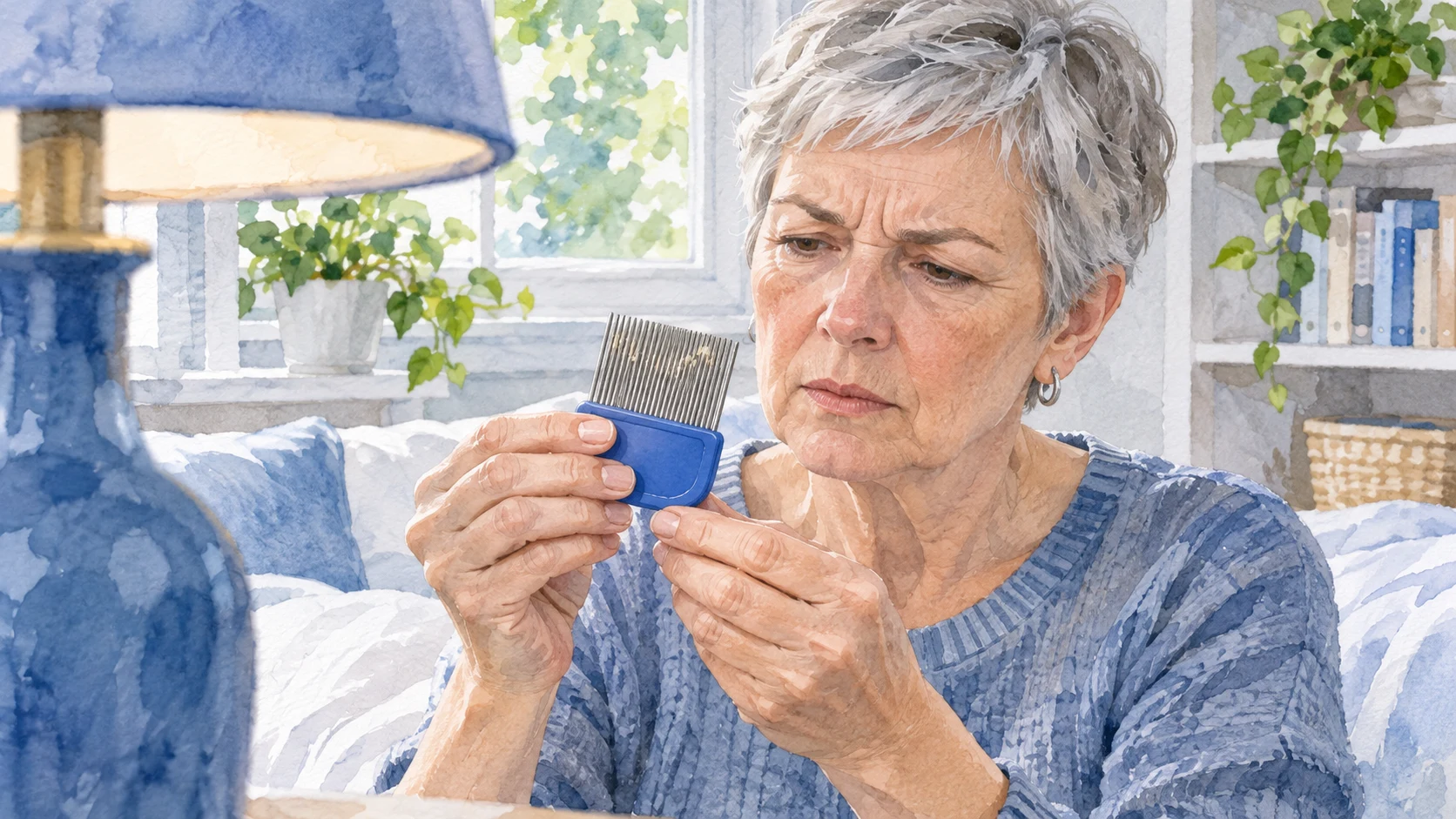
Head lice are often described as being more active at night, but the evidence does not establish that they become active only after dark. They are living, blood-feeding insects throughout the day and night, and they can crawl, feed, and respond to disturbances during daylight hours.
Some public-health and medical references describe head lice as nocturnal. However, these descriptions rarely provide measurements comparing their movement or feeding activity hour by hour. It is therefore difficult to say precisely how much more active they are at night or whether every head louse follows the same daily pattern.
Head lice may show greater activity during darkness, but they do not spend the entire day inactive. Their need for frequent blood meals continues regardless of whether their human host is awake or asleep.
Are Head Lice Nocturnal?
Head lice are sometimes classified as nocturnal insects, meaning they are considered more active during nighttime hours.
The description of head lice as nocturnal parasites appears in medical patient-education material. California public-health guidance also identifies nighttime as a period of increased activity.
These descriptions support the idea that head lice may be more active at night. However, they do not establish that the insects follow an exclusively nocturnal schedule.
A strictly nocturnal insect would concentrate most of its activity during darkness. Head lice, by contrast, must obtain blood meals repeatedly and can move through hair whenever conditions permit.
The distinction is between being more active at night and being active only at night.
A louse observed crawling during the afternoon is behaving normally. Its daytime movement does not contradict the possibility that head lice may have a nighttime activity preference.
The available evidence also does not establish a precise percentage of total daily activity that occurs after sunset. Claims that head lice perform most of their crawling or feeding during a particular set of nighttime hours would require more specific measurements than the commonly cited guidance provides.
Do Head Lice Feed More Often at Night?
Head lice feed repeatedly throughout a 24-hour period. Their feeding needs do not disappear during daylight.
Clinical guidance describes head lice taking blood meals approximately every 3 to 6 hours. That interval indicates that feeding occurs several times daily rather than being restricted to one nighttime feeding period.
The documented feeding frequency of head lice establishes the need for regular nourishment, but it does not provide a complete comparison of feeding rates during daylight and darkness.
For example, a louse that feeds at several-hour intervals could obtain meals during both the afternoon and the night. That does not mean every insect feeds at perfectly regular times.
The blood-feeding behavior of head lice involves repeated access to human blood. It is a continuous biological requirement rather than an activity that begins only when the lights go out.
Some insects have feeding rhythms strongly associated with particular hours. For head lice, the commonly available clinical descriptions do not provide enough quantitative evidence to establish a consistent nighttime peak in feeding.
It is reasonable to say that head lice can feed at night. It is less defensible to claim that they feed exclusively at night or that a particular nighttime hour is their preferred feeding time.
Do Head Lice Crawl Around More After Dark?
Head lice can crawl during both daylight and darkness. Whether their average crawling activity increases after dark is less firmly established.
They move using six legs equipped with claws that grip hair. Their movement does not depend on wings, jumping, or an external light source.
The crawling abilities of head lice allow them to move between nearby hair strands whenever they are active.
Some medical descriptions associate greater head lice activity with nighttime, but those statements generally do not separate crawling from feeding or other forms of movement.
An insect can remain attached to a hair without moving much, feed while relatively stationary, or crawl to another position. These behaviors are not interchangeable measures of activity.
A study of head lice movement and dispersal behavior examined how lice move across hair and respond to different conditions. It provides evidence about locomotion, but it does not establish a complete day-versus-night activity schedule.
Consequently, there is no well-supported universal crawling speed or movement distance that should be assigned specifically to nighttime hours.
A head louse may move rapidly in daylight when disturbed. It may also remain relatively still during part of the night. Neither observation establishes the insect’s overall daily rhythm.
Does Light Affect Head Lice Activity?
Head lice can respond to light, and public-health guidance notes that they tend to avoid it.
This behavior can make living lice difficult to observe during an examination. An insect exposed by separating the hair may quickly crawl away from the illuminated area.
The light-avoidance behavior described in head lice guidance is consistent with their ability to move rapidly when exposed.
However, avoiding light is not the same as having a proven nocturnal biological rhythm.
A louse may move away from a bright light at noon or midnight. That response concerns the immediate stimulus rather than the time shown on a clock.
Similarly, a louse moving after the lights are switched off does not necessarily demonstrate that darkness has triggered a special nighttime feeding period.
Light exposure, physical disturbance, and ordinary crawling behavior can overlap, making it difficult to infer a daily activity pattern from casual observation.
The evidence supports describing head lice as light-avoiding insects. It does not justify assigning a specific increase in activity to every reduction in light intensity.
Are Head Lice Active While a Person Is Sleeping?
Yes. Head lice can remain active while their host sleeps.
Their feeding requirements continue throughout the night, and the insects are capable of moving through hair without any deliberate action by the person carrying them.
They do not need their host to be awake to obtain blood meals. Nor do they need a person to be moving around before they can crawl.
However, there is no established rule that sleep itself causes head lice to become more active.
A sleeping person may remain relatively still for long periods, but that does not prove the insects increase their feeding or crawling in response. The effect of host movement on an individual louse’s behavior is a separate question from whether lice possess a daily activity rhythm.
Head lice can continue their normal activities during sleep without being exclusively nighttime parasites.
The general behavior of head lice on a human host reflects their dependence on living humans rather than a requirement for a particular sleeping schedule.
It would therefore be inaccurate to claim that head lice wait for someone to fall asleep before beginning to feed.
Does Being Nocturnal Mean Head Lice Are Inactive During the Day?
No. Even when an insect is described as nocturnal, that classification does not necessarily mean it is completely inactive during daylight.
For head lice, daytime activity is well established. They can crawl, feed, and react to disturbances while the sun is up.
Their ability to move during the day is also reflected in routine head lice examinations, during which living insects may be observed moving through hair.
The diagnostic guidance for finding living head lice does not require waiting until nighttime to observe crawling insects.
An individual louse may remain still during part of an examination, but inactivity at one moment cannot establish that the insect is resting according to a daily schedule.
Likewise, seeing several lice moving during the afternoon does not prove that head lice have no nighttime activity preference.
The available evidence supports a more limited conclusion: head lice can be active at any hour, while some medical references describe greater nighttime activity.
What Is Actually Known About Head Lice Activity Patterns?
There are several well-supported observations about head lice behavior, but they do not all provide the same level of evidence about daily timing.
| Behavior | What the evidence supports |
|---|---|
| Blood feeding | Occurs repeatedly, approximately every 3–6 hours |
| Daytime movement | Head lice can crawl and respond to disturbances during daylight |
| Nighttime movement | Head lice can remain active after dark |
| Response to light | Head lice tend to avoid bright exposure |
| Greater nighttime activity | Described in some medical guidance, but without a consistently quantified day/night comparison |
| Exact peak activity hour | Not reliably established by the reviewed clinical guidance |
The most important limitation is that a statement about nighttime activity does not necessarily specify what researchers measured.
A source may use the word active without distinguishing crawling, feeding, grooming, or responses to disturbance.
A reliable comparison would need to define the behavior being measured and observe it across both daytime and nighttime periods under comparable conditions.
It would also need to account for differences in temperature, lighting, feeding opportunities, and experimental disturbance.
Without those details, a general statement that head lice are nocturnal should not be expanded into precise claims about when they feed most, move fastest, or become easiest to find.
Can You Tell When Head Lice Are Most Active by Watching Them?
Watching a louse at one particular time can reveal what that insect is doing, but it cannot establish the activity pattern of head lice as a species.
For example, seeing a louse crawl quickly at 10 p.m. shows that it was active at that moment. It does not prove that the same insect would have moved more slowly at 10 a.m.
Similarly, finding a motionless louse during the afternoon does not establish that it was resting because of daylight. The insect may have been gripping a hair, feeding, or temporarily inactive for another reason.
A meaningful day/night comparison would require repeated observations under controlled or carefully documented conditions.
The difficulty is that head lice are small, move through overlapping hairs, and may change their behavior when the hair is disturbed or illuminated.
The practical process of checking your own head for lice is designed to find evidence of living insects, not to measure their daily activity rhythms.
Ordinary household observations can establish that lice are present and moving. They cannot reliably establish a population-wide nocturnal schedule.
Is Nighttime the Best Time to Look for Head Lice?
There is no strong evidence that an examination performed at night is consistently more accurate than one performed during the day.
Although some sources describe head lice as more active after dark, increased movement would not necessarily make them easier to detect. Moving insects may be harder to follow than insects held in place by careful examination.
Good visibility and systematic inspection are more useful than choosing a particular hour based on an assumed activity peak.
A fine-toothed lice comb can help locate living insects. Adequate lighting also makes it easier to examine the hair and recognize what has been collected.
The recommended approach to checking a child for head lice does not depend on performing the examination after sunset.
Waiting until nighttime may also be inconvenient, particularly when examining a tired child.
If a person is available for examination during the afternoon, there is no evidence-based reason to postpone the check solely because lice are sometimes described as nocturnal.
Does Head Lice Treatment Work Better at Night?
Head lice treatment does not generally need to be timed to an assumed nighttime activity peak.
Approved medications have specific instructions governing application, exposure time, rinsing, and any necessary follow-up. Those directions are more important than whether the insects are thought to be especially active at a particular hour.
The treatment instructions for head lice medications emphasize correct use of the selected product rather than applying it during a preferred period of insect activity.
A treatment may act through direct contact with lice or through another product-specific mechanism. Its effectiveness cannot be inferred simply from whether the insects are crawling more frequently at night.
Some products also have restrictions on how long they should remain in the hair. Leaving a medication on overnight when its instructions specify a shorter exposure period can be unsafe or inappropriate.
The reasons head lice treatment may fail involve factors such as incorrect application, resistance, or reinfestation, not a generally established requirement to treat after dark.
Treatment should be scheduled when the instructions can be followed properly, with any age restrictions and safety precautions observed.
Questions About Head Lice Activity at Night
Do head lice sleep during the day?
There is no well-established evidence that head lice follow a human-like sleep schedule. They may remain still for periods, but temporary inactivity does not demonstrate sleep or a consistent daytime resting phase.
Are head lice awake all night?
Head lice can be active throughout the night, but that does not mean every insect moves or feeds continuously. Their activity may include periods of movement and relative stillness.
Do head lice feed only when it is dark?
No. Head lice require repeated blood meals and can feed during both daytime and nighttime hours.
Does turning on a light stop head lice from moving?
No. Head lice may avoid light, but illumination does not reliably immobilize them. They can continue crawling and may move away from an exposed area.
Are Head Lice More Active at Night? The Bottom Line
Head lice are described as nocturnal in some medical and public-health references, suggesting that they may be more active at night. However, the available clinical guidance does not establish a precise nighttime activity peak or demonstrate that feeding and crawling are confined to darkness.
Head lice feed repeatedly throughout the day and night, can crawl during daylight, and may respond to bright light by moving away.
Nighttime activity is a reasonable possibility, but it should not be treated as an exclusive or precisely measured schedule. Head lice can be found and examined during the day, and treatment should follow product instructions rather than an assumed nighttime feeding pattern.