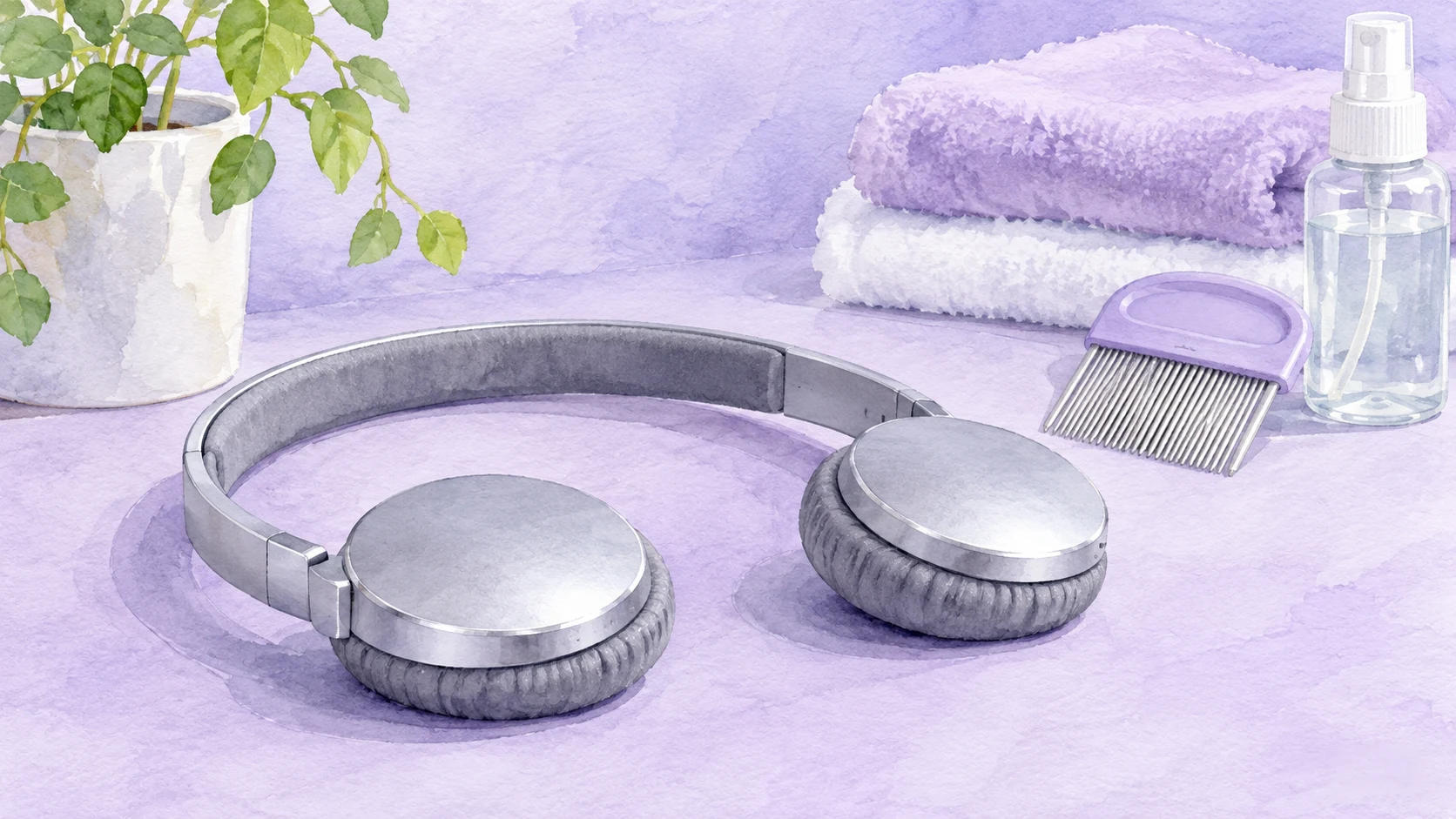
Head lice can potentially spread through shared headphones or headsets, but this is an uncommon route of transmission. The possibility arises when a living louse leaves an infested person’s hair, remains on a part of the headset that touches the head, and reaches another person’s hair when the equipment is reused.
Over-ear headphones, gaming headsets, and classroom listening equipment are worth considering because their headbands and ear cushions can contact hair repeatedly. However, sharing headphones does not automatically expose someone to lice, and there is no reliable evidence showing that headsets are a major source of infestations. Head lice normally remain on the human scalp. They cannot jump or fly, and they are poorly suited to surviving away from a person. The usual route of head-lice transmission is direct contact between people’s hair.
The sensible precaution is to avoid unnecessary sharing of equipment that touches the hair, particularly when someone has confirmed head lice. When sharing is unavoidable, appropriate cleaning and a little attention to how the headset fits can reduce avoidable contact without damaging the electronics.
How Could Head Lice Transfer Through Headphones?
A headset can create an indirect connection between two people’s hair. The first person wears it, a living louse becomes separated from their scalp, and the next person places the same equipment against their head.
For transmission to occur, the insect must remain alive and successfully reach the second person’s hair. Each of those events is necessary, which helps explain why sharing an object is less likely to spread lice than direct hair-to-hair contact.
Consider a pair of over-ear headphones used by several children during a classroom activity. The padded headband rests across the top of each child’s head, while the ear cushions may brush against hair around the ears. If one child has an active infestation, a louse could occasionally become caught on a hair or surface that contacts the equipment.
A later user could potentially encounter that insect. The headset itself does not become infested in the way a person’s scalp can. It provides only a temporary surface where a louse might be present.
Headphones are included among personal belongings that should not be shared when trying to reduce opportunities for head-lice transfer. This is a precaution against an uncommon event, not evidence that every shared headset carries a substantial risk.
The relevant circumstances are how recently the equipment was worn, whether it contacted infested hair, and whether a living louse could reach the next user.
Are Over-Ear Headphones Riskier Than Earbuds?
Different headphone designs contact different parts of the head. That changes the opportunities for an insect to encounter the equipment, although it does not provide a scientifically established ranking of transmission risk.
Over-ear headphones have large ear cushions and often a padded band that crosses the hair. Depending on the fit, the cushions may press against hair around the ears while the band rests directly on the crown. These surfaces create more potential hair contact than a small earbud.
On-ear headphones rest against the outer ears rather than surrounding them. Their cushions can still touch hair, especially when the user’s hair covers part of the ear. The headband may also contact the scalp or hair.
In-ear earbuds usually sit inside or near the opening of the ear canal. They typically have much less contact with scalp hair, making them a less plausible surface for head-lice transfer. That does not mean sharing earbuds is hygienic or advisable for other reasons.
Gaming headsets often have thick cushions, adjustable headbands, and padding that remains pressed against the head for extended periods. Their design creates opportunities for hair contact, but there is no good evidence that gaming headsets transmit lice more frequently than ordinary over-ear headphones.
The contact surface is more informative than the product’s name or price. A headset with a padded band resting against the hair presents a different situation from an earbud that never touches the scalp.
Can Head Lice Hide in Headphone Padding?
A living louse could occasionally become caught in a fabric-covered cushion, a loose hair trapped along a seam, or another area of a headset that recently contacted infested hair.
However, headphones do not provide the conditions needed for head lice to establish a continuing infestation. Lice depend on blood meals from people and normally remain attached to scalp hair.
A headset has no food source for them. They cannot maintain a breeding population inside foam cushions, ear cups, or the spaces around a headband.
Adult head lice generally die within about two days after becoming separated from a human host if they cannot feed. The limited survival of head lice away from the scalp makes a recently worn headset more relevant than one that has been sitting unused for several days.
A louse also needs to move from the equipment onto another person’s hair before it can establish an infestation. Merely being present on the outside of a headset does not guarantee that transfer.
We would not treat a pair of headphones as an ongoing lice reservoir simply because someone with head lice used them. The concern is a possible living insect remaining on a recently used contact surface.
Do Head Lice Lay Eggs Inside Headphones?
Head-lice eggs are normally attached to individual hair shafts close to the scalp. Female lice use a cement-like substance to secure their eggs, and successful development depends on suitable conditions.
A headphone cushion is not a normal egg-laying site. Head lice do not establish nests or breeding colonies inside electronic equipment.
A strand of hair carrying an attached nit could become caught on a headband or ear cushion. However, an egg on a shed hair is not equivalent to a living louse capable of crawling onto another person’s head.
The conditions away from the scalp are generally unfavorable for egg development and hatching. Even if an egg remained attached to a loose hair, successful transmission would require more than the egg simply being present on the headset.
The head-lice life cycle explains why eggs are associated with hair near the scalp rather than household objects.
Parents do not need to search inside headphone foam for hidden egg colonies. Removing loose hair and cleaning the surfaces that contact the head are more relevant precautions.
How Likely Is It to Get Head Lice From Shared Headphones?
The risk is considered low, but there is no reliable transmission percentage specifically for headphones or headsets.
Most head-lice infestations spread through direct hair contact. Indirect transmission through personal belongings is possible, but the available clinical evidence indicates that it occurs much less frequently.
The medical evidence on indirect head-lice transmission places greater importance on contact between people’s heads than on shared objects.
That conclusion does not establish that headphone transmission never happens. It means that a headset should not be treated as an equally likely route.
Several factors can influence the opportunity for transfer. A headset used immediately after an infested person may present a different situation from equipment that has remained unused for several days. A padded band that contacts scalp hair is also different from an earbud that touches little or no hair.
Even in the more plausible circumstances, a living louse must actually be present and reach the next user’s head.
A person who discovers lice after borrowing headphones cannot identify the headset as the source from timing alone. The infestation may have begun earlier through contact with another person.
The distinction between possible exposure and confirmed infestation prevents unnecessary alarm after ordinary use of shared equipment.
Can Head Lice Spread Through Headsets at School?
Schools often use shared headphones for reading programs, language lessons, computer activities, and standardized testing. Several students may use the same pair during a school day, sometimes with little time between users.
The possibility of transfer depends on whether a student has living head lice and whether an insect becomes separated from their hair onto the equipment.
Headsets with adjustable bands and fabric-covered ear cushions may collect loose hair during use. Removing that hair and following a routine cleaning procedure between users are sensible precautions.
Assigning each student a personal headset can reduce sharing, although this may not be practical in every classroom. Another option is to keep a smaller set of equipment assigned to individual students during a particular activity rather than passing the same pair around repeatedly.
Children may also lean their heads together while looking at a shared computer screen. That creates an opportunity for direct hair contact, regardless of whether the students are wearing headphones.
The contact patterns associated with head lice at school and daycare are therefore relevant when assessing a classroom situation.
A child who uses shared headphones is not automatically exposed to lice. Routine cleaning and reasonable sharing practices are sufficient precautions for most classrooms.
What About Gaming Headsets Shared Between Friends?
Gaming headsets may be passed between siblings or friends during visits, gaming sessions, or sleepovers. Some have thick fabric cushions that remain in contact with the user’s hair for hours.
The duration of use does not automatically determine whether a louse transfers. An insect would still need to leave an infested person’s hair and remain on the headset until another person wears it.
A headset used by one person for several hours is not necessarily more hazardous than one worn briefly. There is no established relationship between headset-wearing time and the probability of acquiring lice.
Sharing equipment immediately after someone with confirmed head lice has worn it is a more relevant concern than ordinary use by someone whose infestation status is unknown.
Gaming also introduces other possible contacts. Friends may sit close together while looking at a screen, lean against one another, or share pillows during a sleepover. Those activities can provide opportunities for direct hair contact independently of the headset.
If several people discover lice after a gaming session, the shared headset is only one possible explanation. It would be inappropriate to identify it as the source without evidence.
Keeping personal headsets separate is a reasonable precaution, particularly when a household member has an active infestation.
Can You Get Head Lice From Headphones at a Gym or Public Facility?
Shared headphones may be available at fitness facilities, libraries, museums, workplaces, and other public settings. Their use creates the same basic possibility of indirect transfer as shared classroom equipment.
A louse would need to be present on a part of the headset that contacts hair, remain alive, and reach another person’s head.
The number of people using the equipment does not establish how frequently lice are transferred. A busy facility may have many headset users without any of them having an infestation.
There is also no evidence that public headphones routinely carry head lice.
The rarity of transmission through shared personal belongings is an important consideration when evaluating these situations.
Using personal headphones is a straightforward way to avoid sharing head-contact surfaces. When public equipment is necessary, checking that it is reasonably clean and following the facility’s normal hygiene arrangements are sensible steps.
There is no reason to assume that using a public headset requires immediate lice treatment or a complete inspection of everything you wore that day.
How Should You Clean Headphones After Possible Lice Exposure?
Headphones require a different approach from ordinary hairbrushes because they contain electronic components, adhesives, cushions, and materials that may be damaged by water, heat, or chemicals.
The first step is to stop sharing the headset temporarily if someone with confirmed head lice has recently worn it.
Remove any visible loose hairs from the headband and ear cushions. Clean accessible surfaces according to the manufacturer’s instructions, paying particular attention to areas that normally contact the user’s hair.
Some headphones have removable ear cushions or washable fabric components. Others have permanently attached padding that should only be wiped using approved methods.
Do not immerse an entire headset in hot water, place it in a clothes dryer, or expose it to temperatures that could damage the battery, wiring, or plastic components.
The short survival period of head lice away from a human host provides another option when appropriate cleaning is difficult. Setting a headset aside for more than 48 hours removes the ordinary opportunity for a detached living louse to survive, although longer isolation may be appropriate if recommended for a specific situation.
There is no need to dismantle electronic equipment in search of insects. Cleaning the parts that contact the hair and avoiding immediate reuse are proportionate responses.
Should You Spray Headphones With Lice Killer?
Head-lice medications and household insecticides should not be applied to headphones unless the product is specifically labeled for that use.
Products intended for the human scalp are not general-purpose electronics cleaners. Household insecticides can also introduce unnecessary exposure, leave residues on surfaces that touch the skin, or damage equipment.
A headset may later be worn against the ears and scalp for several hours. Applying an unapproved chemical to its cushions creates a potential exposure that is difficult to justify for an already uncommon transmission route.
Alcohol and other cleaning liquids can damage certain headphone materials, coatings, adhesives, and electronic components. A substance that is suitable for one device may not be suitable for another.
Ordinary cleaning and temporary nonuse are preferable to improvising with insecticides.
The guidance on avoiding unnecessary environmental pesticide treatments for head lice reflects the fact that these insects depend on human hosts rather than establishing persistent infestations in household objects.
A headset should not be sprayed, soaked, heated, or frozen merely because someone with lice has worn it. Follow the device manufacturer’s cleaning instructions and keep the equipment out of circulation when necessary.
Do You Need to Replace Headphone Cushions After Head Lice?
Replacing headphone cushions is generally unnecessary after possible exposure to head lice.
The insects cannot establish a permanent population in the foam, and they cannot survive indefinitely without feeding. A recently detached louse may be present temporarily, but that does not make the cushion permanently contaminated.
If the cushions can be cleaned according to the manufacturer’s instructions, replacement provides little additional benefit specifically for head-lice prevention.
A heavily damaged cushion that traps debris or cannot be cleaned properly may need replacing for ordinary hygiene and maintenance reasons. That decision should not be confused with a requirement to eliminate head lice.
Disposable covers can reduce direct contact between users and shared cushions, but they are not a guaranteed barrier against lice. They also need to be changed appropriately rather than reused between people.
Schools and workplaces should prioritize a consistent routine for managing shared equipment instead of replacing cushions whenever a suspected case is reported.
What Should You Do if Someone With Head Lice Used Your Headphones?
Finding out that someone with head lice recently wore your headphones can be unsettling, especially if you used the same pair shortly afterward.
Start by considering whether the equipment actually contacted the person’s hair. A padded headband that rested against the scalp provides a more plausible opportunity for transfer than an earbud that remained inside the ear.
Even with direct hair contact, exposure does not establish that a louse was present on the equipment.
Stop sharing the headphones until they have been appropriately cleaned or set aside. If you have already worn them, there is no reason to assume you are infested.
A careful check for living lice may be appropriate when there has been a specific, credible exposure. Symptoms alone are unreliable because itching may be delayed or caused by unrelated scalp conditions.
The signs that help distinguish an active head-lice infestation are more useful than assuming every itch after borrowing headphones indicates lice.
Do not apply lice treatment simply because you used the same headset. Treatment should be based on appropriate evidence of infestation and relevant medical guidance.
Can Headphones Cause Repeated Head Lice Infestations?
Headphones are not a plausible long-term reservoir for repeated infestations.
A louse cannot survive indefinitely inside the ear cushions, feed on electronic components, or reproduce in a headset. Repeated infestations require living lice to persist on a human host or be introduced again.
A shared headset could theoretically provide another opportunity for transfer if it were repeatedly used by someone with an active infestation and then immediately worn by others. That would involve new opportunities for contamination, not an established colony living inside the equipment.
When lice continue to appear among household members, the more useful question is whether living infestations have been identified and addressed in the people involved.
Repeatedly cleaning or replacing headphones will not resolve an active infestation on someone’s scalp.
Questions About Head Lice and Headphones
Can you get lice from borrowing someone’s headphones once?
It is possible but unlikely. A living louse would need to become separated from the original user’s hair, remain on the headphones, and transfer to your hair. One-time sharing does not automatically result in an infestation.
Can lice live inside gaming headset ear cushions?
A louse could temporarily become caught on or near a cushion, but it cannot establish a breeding population there. Without access to human blood, head lice generally die within about two days.
Are earbuds safer than over-ear headphones for avoiding lice?
Earbuds generally contact much less scalp hair than over-ear headphones, making them a less plausible route for head-lice transfer. However, there are no reliable studies establishing a specific difference in transmission rates between the two designs.
Do headphones need to be thrown away after someone with lice uses them?
No. Appropriate cleaning and, when necessary, temporarily setting the equipment aside are usually sufficient. Throwing away headphones is not a standard requirement for managing head-lice exposure.
The Bottom Line
Head lice can potentially spread through shared headphones or headsets, but the risk is low compared with direct hair-to-hair contact. A living louse must leave an infested person’s hair, remain on the equipment, and reach another person’s head before an infestation can begin.
Over-ear headphones and padded headsets provide more opportunities for hair contact than earbuds, although their relative transmission risks have not been measured reliably.
Keeping personal headsets separate when practical, removing loose hair, cleaning contact surfaces according to the manufacturer’s instructions, and temporarily setting aside equipment used by someone with confirmed lice are reasonable precautions.
There is no need to discard headphones, spray them with insecticides, or treat someone for lice solely because they borrowed a headset. The presence of living lice on a person’s head is much more important than the possibility that an insect briefly contacted an electronic device.