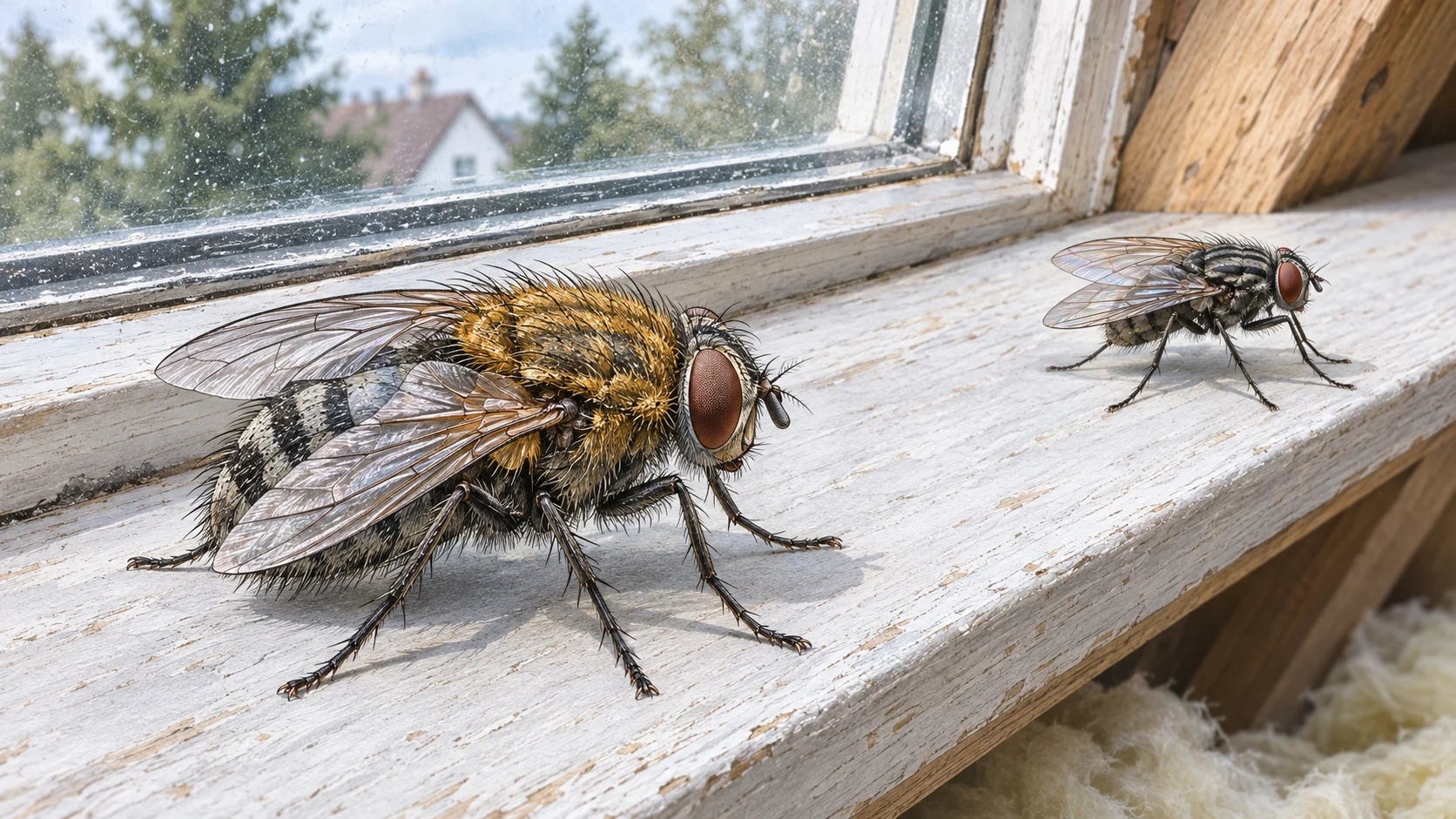
House flies and cluster flies look similar, but cluster flies are generally larger, darker, and slower-moving. A house fly has four distinct dark stripes running along its gray thorax, while a cluster fly typically has short golden-yellow hairs on its thorax and a gray, somewhat checkered abdomen. Their behavior also differs. House flies are familiar visitors around food and garbage, whereas cluster flies are especially noticeable around sunny windows during fall, winter, and early spring.
The season can be a particularly useful clue. A few large, sluggish flies appearing in an upstairs room on a warm February afternoon may have spent months sheltered inside the building. That pattern is more characteristic of cluster flies than of ordinary house fly activity.
House Fly vs. Cluster Fly: Quick Comparison
|
Feature |
House fly |
Cluster fly |
|---|---|---|
|
Scientific identification |
Musca domestica |
Pollenia species |
|
Typical adult length |
Approximately 5–8 mm |
Commonly around 7–10 mm |
|
Body color |
Dull gray |
Dark gray to grayish brown |
|
Thorax markings |
Four dark lengthwise stripes |
Short golden-yellow hairs, sometimes difficult to see |
|
Abdomen |
Grayish or yellowish-gray, sometimes patterned |
Often gray or silver with a checkered appearance |
|
Wings at rest |
Usually held without the distinctive overlapping tips |
Wing tips commonly overlap over the abdomen |
|
Movement |
Generally quick and active |
Often sluggish, particularly indoors during cooler months |
|
Common indoor locations |
Kitchens, garbage areas, doors, and windows |
Upper rooms, attics, wall voids, and sunny windows |
|
Seasonal pattern |
Most active in warm conditions |
Frequently noticed in fall, winter, and early spring |
|
Breeding association |
Manure, garbage, and other moist organic waste |
Larvae develop as parasites of earthworms in soil |
These are typical characteristics rather than absolute rules. Size ranges overlap, golden hairs can wear away, and either fly may be found resting on a window. A reliable identification uses several features together.
Differences in Body Size, Color, and Markings
The common house fly is usually around 5–8 mm long. Its thorax, the section behind the head where the wings and legs attach, is gray with four narrow, dark stripes running lengthwise. These markings are among the most useful features for identifying an adult house fly.
Cluster flies are often slightly larger and more robust. Their bodies are generally darker, with a gray or grayish-brown appearance that can look almost black under poor lighting. The abdomen commonly has a muted checkered pattern rather than the relatively familiar appearance of a house fly.
One of the strongest identifying features is the presence of short, crinkled, golden-yellow hairs on the cluster fly’s thorax. These hairs may create a faint golden sheen, although they are not always obvious to the naked eye. Older specimens can lose some of their hairs through wear, making this characteristic less dependable on its own.
The combination of a dark body, golden thoracic hairs, and checkered abdomen is characteristic of adult cluster fly identification. A clear close-up photograph may reveal these details even when they are difficult to distinguish while the insect is moving.
How Their Wings Look When Resting
Wing position provides another useful comparison. Cluster flies commonly hold their wings flat over their backs, with the tips overlapping across the abdomen. This can resemble two narrow blades crossing one another.
House flies do not typically display the same overlapping wing-tip arrangement. However, wing position can change as an insect moves, so it is best examined while the fly is resting naturally.
The overlapping wings, golden hairs, and darker body are useful physical identification features of cluster flies. When two or three of these features are visible together, identification becomes considerably more dependable than judging size alone.
Why Cluster Flies Gather Around Sunny Windows
Cluster flies often become noticeable when sunlight warms part of a building. Adults that have remained relatively inactive in protected spaces can begin moving again as temperatures rise. They may emerge into occupied rooms and move toward bright windows, where they accumulate while attempting to get outside.
This activity is particularly conspicuous in upper rooms that receive strong afternoon sunlight. Several flies may appear around the same window even when there is no exposed food, garbage, or obvious indoor breeding material nearby.
House flies can also gather at windows. Their attraction to light and attempts to escape enclosed rooms help explain why house flies collect around window glass. A window full of flies is therefore not sufficient evidence of cluster flies.
The surrounding circumstances provide more information. Large, slow-moving flies appearing repeatedly at a sunny upstairs window in late winter are more suggestive of cluster flies. Fast-moving gray flies appearing around kitchen waste during warm weather are more suggestive of house flies.
Cluster flies may also collect around lamps or other bright indoor areas. Their tendency to emerge from sheltered spaces and move toward light is a recognized part of seasonal cluster fly activity inside homes.
Why Cluster Flies Often Appear in Fall and Spring
Cluster flies commonly approach buildings in late summer and fall as they seek protected places to spend the colder months. Warm, sun-exposed exterior walls are attractive gathering surfaces, particularly on south- and west-facing sides of buildings in the Northern Hemisphere.
The flies can enter through small openings around siding, rooflines, windows, and other exterior features. Once inside the building envelope, they may settle in attics, wall cavities, or other sheltered spaces. They do not need to enter a living room immediately to become an indoor nuisance.
During cold weather, these sheltered adults may remain relatively inactive. A warm spell or strong sunlight can stimulate movement, bringing flies into rooms through gaps connecting concealed spaces with the interior. Similar activity may become more frequent as spring approaches.
This explains why cluster flies sometimes seem to appear suddenly in a house that has been closed up for months. The insects may have entered during the previous fall rather than arriving through an open window that day.
House flies follow a different seasonal pattern. They are strongly associated with warm conditions, although their survival depends on the temperatures and resources available in a particular location. The broader question of whether house flies survive winter involves their life stages and the conditions of protected indoor environments.
Season alone cannot confirm the species. Other flies can also shelter in buildings during colder months, and cluster flies may be seen outdoors during warmer seasons.
Do Cluster Flies and House Flies Breed in the Same Places?
House flies and cluster flies have very different breeding associations. House flies commonly lay eggs in moist, decomposing organic material, including manure and suitable garbage. Their larvae feed within these materials before pupating and emerging as adults.
Cluster fly larvae, by contrast, develop as parasites of earthworms in soil. They are not typical garbage-breeding flies, and adults sheltering in an attic or wall cavity are not ordinarily reproducing there. The appearance of many adults inside a house can result from an accumulation of flies that entered to overwinter, rather than successive generations developing indoors.
This difference helps interpret what you find around the property. A concentration of flies associated with damp waste suggests a different investigation from sluggish flies appearing at upper windows after a sunny winter afternoon. Understanding where house flies lay their eggs is useful when the insects appear to be associated with decomposing material.
Cluster fly numbers may be greater around properties with suitable outdoor earthworm habitat, including lawns and fields. However, the presence of earthworms does not prove that every large fly near a house is a cluster fly. The adult’s markings and seasonal behavior still need to agree with the identification.
How to Identify Flies Found on an Upstairs Windowsill
Suppose several large gray flies appear on the windowsill of a second-floor bedroom during a sunny day in March. They move slowly, and a few are already dead. There is no noticeable activity around kitchen garbage or stored food.
Begin by examining one of the insects closely. Look for a dark gray body, a checkered abdomen, overlapping wing tips, and short yellowish hairs around the thorax. If these characteristics are present, the flies are consistent with cluster flies.
Next, consider the timing. A warm day following a period of cold weather supports the possibility that sheltered adults have become active. Repeated appearances near an upper window strengthen that interpretation, although they do not establish exactly where the insects have been hiding.
Dead flies on a windowsill are not automatically cluster flies. House flies and other insects can also become trapped against glass and die indoors. The circumstances behind dead house flies accumulating on windowsills include several possibilities, so dead specimens should be identified rather than assumed to belong to one species.
For a better examination, photograph an intact specimen from above and from the side. A close image of the thorax and resting wings is especially helpful. If the hairs are missing or the specimen is badly damaged, identification may require additional characteristics or expert examination.
Does Finding Cluster Flies Mean Your House Has an Infestation?
Finding numerous cluster flies indoors may indicate that adults have accumulated in concealed spaces, but it does not ordinarily mean they are breeding inside the building.
Their seasonal entry behavior explains how large numbers can be present without an indoor larval food source. Some adults may remain hidden while others emerge on warmer days. The number visible in a room therefore does not necessarily represent the total number sheltered within the structure.
House fly activity can have a different explanation. Repeated appearances during warm weather may involve insects entering from outdoors, an accessible food or waste source, or suitable breeding material nearby.
The distinction affects what deserves attention. With suspected cluster flies, exterior openings and routes between wall cavities, attics, and occupied rooms are especially relevant. With suspected house flies, food and waste associations may be more informative. Neither situation should be diagnosed from the number of visible adults alone.
What Their Seasonal Entry Patterns Tell You
Cluster flies commonly enter buildings through small exterior gaps rather than relying entirely on open doors or damaged window screens. Openings around siding, roof edges, vents, and window assemblies can provide access to sheltered cavities.
An exterior inspection is most informative when it considers the building surfaces where flies were gathering during late summer or fall. A south-facing wall with numerous insects resting in the afternoon may offer a clue about the side of the building they approached.
Maintaining screens and closing appropriate exterior gaps are useful parts of preventing flies from entering a home. However, visible flies emerging from an attic in February may already have been inside the building for several months. Their presence does not establish a new entry problem that began that day.
Seasonal entry and sheltered overwintering are well documented aspects of cluster fly behavior around buildings. Identifying the species first helps avoid mistaking an overwintering nuisance for an indoor waste-related breeding problem.
Questions About House Flies and Cluster Flies
Are cluster flies bigger than house flies?
Cluster flies are generally slightly larger and more robust than common house flies, but their size ranges overlap. A fly measuring around 7–8 mm could belong to either group. Thorax markings, wing position, and behavior provide better supporting evidence.
Why are there slow-moving flies in my house during winter?
Cluster flies are one possible explanation. Adults can shelter in attics and wall cavities during colder months, then become active when sunlight or indoor heating warms their surroundings. Other fly species can also appear indoors during winter, so a close examination is necessary.
Can house flies gather in clusters like cluster flies?
House flies can gather around windows, lights, and attractive food sources, sometimes in substantial numbers. The word cluster does not identify the insect. Cluster flies are distinguished by their physical features and characteristic seasonal sheltering behavior.
Do cluster flies have four black stripes on their backs?
Cluster flies do not typically show the four distinct dark thoracic stripes characteristic of the common house fly. Instead, they generally have a darker thorax bearing short golden-yellow hairs. Those hairs may be worn away in older specimens.
Identifying the Fly Before Drawing Conclusions
A house fly is usually smaller, quicker, and marked by four dark thoracic stripes. A cluster fly is generally larger, darker, and more sluggish, with golden-yellow thoracic hairs and wing tips that overlap at rest.
When flies repeatedly appear at sunny upper windows in fall, winter, or early spring, cluster flies become a strong possibility. When gray flies are active around food and garbage during warm weather, house flies are more plausible.
Neither location nor season provides certainty by itself. Examining an intact adult and considering when and where it appeared offers the most reliable way to distinguish these two flies.