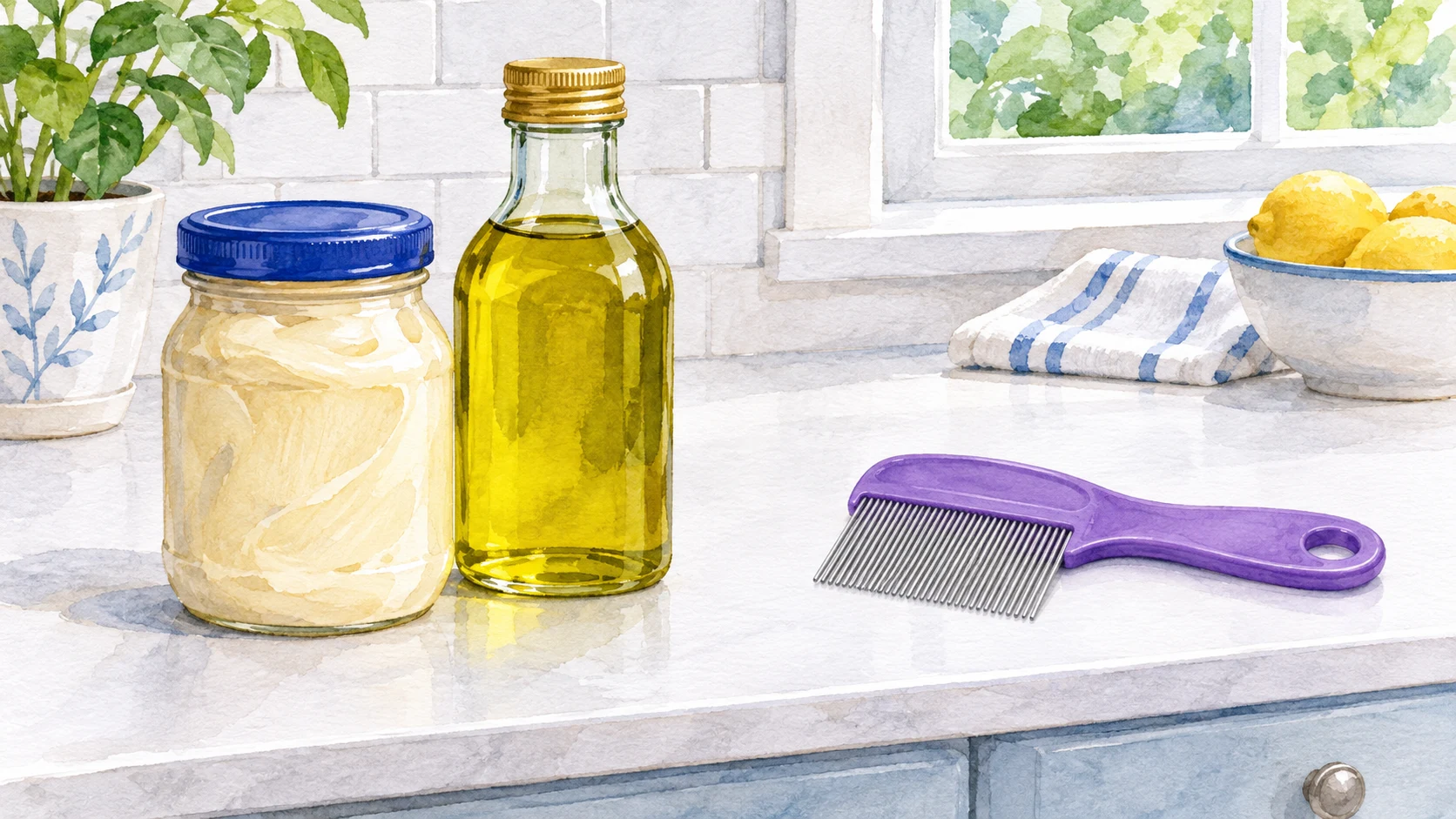
Mayonnaise and olive oil have not been proven to kill head lice reliably. Although both are commonly recommended as home remedies for smothering lice, there is insufficient scientific evidence that coating the hair with either substance eliminates an infestation. Some lice may become temporarily immobilized, but that does not establish that they are dead.
The appeal is understandable. Both ingredients are inexpensive, readily available, and familiar household products. Covering the scalp with something thick or greasy sounds like a reasonable way to suffocate tiny insects. Unfortunately, head lice are more difficult to kill by smothering than this explanation suggests.
The CDC’s head lice treatment guidance identifies insufficient scientific evidence for mayonnaise and olive oil as effective suffocation treatments. For anyone dealing with an active infestation, relying on either ingredient can mean spending time on a method that has not been shown to work.
Why People Believe Mayonnaise and Olive Oil Smother Lice
The smothering theory centers on how head lice breathe. Like other insects, lice exchange gases through small openings called spiracles. Coating their bodies with a thick substance is supposed to obstruct those openings and prevent normal respiration.
Mayonnaise is particularly popular because its thick consistency allows it to cling to hair. Olive oil spreads more easily, leaving a slippery coating over the hair shafts and scalp. Both can make lice appear less active, which may be mistaken for successful treatment.
However, coating a louse does not guarantee that it will die. Head lice can tolerate conditions that temporarily interfere with respiration, and the effects of household substances are not sufficiently predictable to establish a reliable treatment.
The American Academy of Dermatology’s guidance on unsuccessful lice treatments explains that temporary inactivity after exposure to these substances can create the impression that lice have been killed.
A louse that stops moving while covered in mayonnaise may still be alive. Its apparent condition immediately after treatment is therefore a poor measure of success.
There is also the question of eggs. The head lice life cycle includes eggs attached firmly to individual hair shafts. Even if a household substance affects some crawling lice, that result cannot be assumed to extend to the eggs.
Does Mayonnaise Actually Kill Head Lice?
Mayonnaise has no established record as a reliable head lice treatment. Its thick texture is the main reason people believe it can suffocate lice, but thickness alone does not demonstrate insecticidal effectiveness.
A common homemade approach involves coating the scalp and hair with mayonnaise and leaving it in place for several hours or overnight. Some versions recommend covering the hair with a shower cap to keep the mixture from spreading.
There is no scientifically established mayonnaise application time, amount, or treatment schedule that guarantees lice elimination. Leaving it on longer does not solve the lack of evidence.
The American Academy of Pediatrics’ discussion of head lice treatment myths identifies mayonnaise and similar household substances as remedies that have not been proven effective.
Mayonnaise also creates a practical problem. Removing a thick coating from long or dense hair may require repeated washing. The mixture can become unpleasant as it warms against the scalp, and people with sensitivities to its ingredients may experience irritation or allergic reactions.
Food-based ingredients are not automatically suitable for prolonged skin contact. Commercial mayonnaise formulations differ, and some contain ingredients that a person may need to avoid because of allergies.
We would not recommend leaving mayonnaise on a child’s head overnight, particularly beneath a tightly fitted covering. A plastic bag or loose plastic wrap should never be placed over a child’s head because of the suffocation hazard.
Can mayonnaise kill lice eggs?
There is no dependable evidence that mayonnaise kills head lice eggs.
Eggs are attached to hair shafts and protected by an outer shell. A thick coating of mayonnaise does not establish that the developing insect inside has been killed.
This creates a significant limitation for anyone hoping to eliminate an infestation with a single application. The time head lice eggs take to hatch means surviving eggs can produce new crawling lice after the mayonnaise has been washed away.
A treatment that appears successful immediately after rinsing may therefore leave the infestation unresolved.
Does Olive Oil Kill Head Lice?
Olive oil has not been demonstrated to eliminate head lice reliably, despite its popularity as a home remedy.
Unlike mayonnaise, olive oil is a liquid that spreads readily through hair. Supporters of the method believe this allows it to coat lice thoroughly and interfere with their breathing. Some also claim that the oil makes insects easier to remove.
Neither claim establishes olive oil as a proven lice-killing treatment.
The California Department of Public Health’s head lice guidance explains that conclusive scientific evidence does not support claims that olive oil and similar substances suffocate lice and their eggs.
A louse may appear sluggish after exposure to oil, but temporary immobilization is different from death. There is no established household olive oil concentration or exposure period that consistently eliminates an infestation.
Olive oil also has limitations as a scalp treatment. Heavy application leaves the hair greasy and can be difficult to wash away. Repeated shampooing may irritate an already sensitive scalp, especially when scratching has caused soreness.
People sometimes interpret lice removed during washing or combing as proof that the oil killed them. Yet physical removal and chemical or physical killing are separate outcomes.
The method used to remove head lice and nits with a comb can physically extract insects from the hair. Finding lice in the comb afterward does not demonstrate that olive oil was responsible for killing them.
Will olive oil loosen nits?
Olive oil may make hair feel slippery, but there is insufficient evidence that it reliably dissolves or weakens the substance attaching lice eggs to hair.
Female head lice cement their eggs to individual hair shafts. This attachment is considerably more secure than ordinary loose debris caught in the hair.
Oiling the hair does not guarantee that eggs will slide off during rinsing. Some may remain firmly attached even after repeated washing.
The appearance of eggs after treatment also requires care when interpreting results. Determining whether lice eggs are alive, dead, or empty involves limitations that cannot be resolved simply by observing whether an egg remains attached.
Mayonnaise vs. Olive Oil: Is Either One Better?
Neither ingredient has enough reliable evidence to be recommended as an effective head lice treatment.
The differences between them are mainly practical rather than demonstrated differences in lice-killing ability.
|
Consideration |
Mayonnaise |
Olive oil |
|---|---|---|
|
Consistency |
Thick, creamy mixture |
Liquid oil |
|
Ease of spreading |
Can be difficult to distribute evenly |
Spreads readily through hair |
|
Proven ability to kill lice |
Not established |
Not established |
|
Proven ability to kill eggs |
Not established |
Not established |
|
Removal from hair |
May require repeated washing |
Can leave persistent greasy residue |
|
Main practical concerns |
Mess, ingredient allergies, prolonged exposure |
Greasy buildup, difficult washing, possible irritation |
Someone might prefer olive oil because it is easier to spread, while another person might assume mayonnaise stays in place better. Neither preference establishes a meaningful advantage in eliminating lice.
There is also no reliable basis for claiming that combining mayonnaise and olive oil makes the mixture more effective. Adding more grease does not turn an unproven method into a validated treatment.
Why These Home Remedies Sometimes Appear to Work
Reports of successful mayonnaise or olive oil treatments can be difficult to interpret because several things often happen during the same attempt.
A person may apply the substance, leave it on the hair, wash repeatedly, and use a fine-toothed comb afterward. If fewer lice are found, it is tempting to credit the mayonnaise or oil.
However, the washing and combing may have physically removed some lice. The substance itself may not have killed them.
A clinical review of head lice management and alternative therapies describes the limited and conflicting evidence for household smothering remedies. Their effectiveness cannot be established from the available research.
Another complication is that head lice can be difficult to find, especially when only a small number remain. A person may check the hair immediately after treatment, see nothing moving, and conclude that the infestation has ended.
That conclusion is premature without reliable follow-up evidence.
The same uncertainty occurs when an apparent treatment success is based entirely on reduced itching. Scalp irritation can persist after lice are eliminated, while some people with active infestations experience little itching.
The presence or absence of itching cannot establish whether mayonnaise or olive oil worked.
Risks and Drawbacks of Putting Food Products on the Scalp
Mayonnaise and olive oil are ordinary food products, but using them as prolonged scalp treatments introduces problems that are easy to underestimate.
The most immediate drawback is the mess. Both can transfer onto towels, pillows, bedding, clothing, and furniture. Mayonnaise may also develop an unpleasant smell when left in warm hair for an extended period.
Repeated washing to remove greasy residue can dry or irritate the scalp. For someone already scratching because of lice, additional irritation may make the experience considerably more uncomfortable.
Ingredient sensitivity is another consideration. Mayonnaise commonly contains egg and may contain mustard or other ingredients capable of causing reactions in susceptible individuals. Olive oil can also cause contact reactions in some people.
Applying either substance to broken or inflamed skin deserves particular caution. A person with scalp sores, swelling, drainage, or worsening irritation should seek medical advice rather than continue experimenting with household mixtures.
Overnight applications raise additional concerns. Covering a child’s head with plastic to prevent drips is unsafe, and prolonged treatment may create unnecessary discomfort without any demonstrated benefit.
There is also a less visible cost: delaying effective treatment. A household may spend several days repeating greasy applications while surviving lice continue feeding and reproducing.
For that reason, we consider repeated mayonnaise or olive oil applications a poor tradeoff. The effort and inconvenience are substantial compared with the limited evidence supporting their effectiveness.
What to Do If You Already Tried Mayonnaise or Olive Oil
Using mayonnaise or olive oil once does not automatically mean that anything harmful has happened. If the scalp is comfortable and there is no allergic reaction, the immediate concern is usually determining whether live lice remain.
Wash the substance out gently with ordinary shampoo, avoiding excessive scrubbing. Do not apply additional household chemicals to remove the residue.
Once the hair is clean, check for crawling lice rather than relying on the amount of itching or the presence of old nits. Finding live lice indicates that the infestation still needs attention.
If you intend to use a regulated lice treatment afterward, follow its instructions carefully. Some treatments specify that conditioner or other hair products should not be used beforehand because they can interfere with treatment. Avoid applying lice medication directly over a heavy coating of oil or mayonnaise.
The complete head lice treatment guide covers the broader response to a confirmed infestation, including appropriate treatment selection and follow-up.
Parents should consult a healthcare professional before treating very young children, particularly when the child’s age falls below the labeled minimum for a product. Medical advice is also appropriate when the scalp is injured, the diagnosis is uncertain, or correctly used treatment has failed.
Questions About Mayonnaise and Olive Oil for Lice
Can you leave olive oil in your hair overnight to kill lice?
Leaving olive oil on overnight has not been proven to kill head lice reliably. There is no established overnight exposure period that guarantees elimination, and prolonged application can create greasy buildup and discomfort without a demonstrated treatment benefit.
Does full-fat mayonnaise work better than low-fat mayonnaise?
There is no reliable evidence that full-fat mayonnaise kills head lice more effectively than low-fat mayonnaise. A higher fat content may change the mixture’s consistency, but it does not establish that lice or their eggs will be killed.
Can head lice survive after being completely covered in olive oil?
Yes, survival is possible. Coating lice with olive oil does not guarantee death, and an insect that appears motionless immediately afterward may not have been killed. Reliable follow-up is necessary to determine whether an infestation remains active.
Is olive oil safer than mayonnaise for treating a child’s head lice?
Neither should be considered a proven treatment. Olive oil avoids some ingredients commonly found in mayonnaise, but it can still create irritation or cleanup problems. For a child with confirmed lice, treatment decisions should be based on age-appropriate, evidence-supported options rather than assuming a food ingredient is safe and effective.
Should You Use Mayonnaise or Olive Oil for Head Lice?
We would skip both as lice-killing treatments. Mayonnaise and olive oil may coat the hair and temporarily slow lice, but neither has been shown to eliminate an infestation reliably. Claims that a particular quantity or overnight application guarantees success are unsupported.
If you have already used either substance, remove it gently and check for live lice. A confirmed infestation deserves an evidence-supported response rather than repeated applications of a messy home remedy.
The goal is to eliminate living lice and prevent the infestation from continuing, not simply to make the insects appear motionless for a few hours.