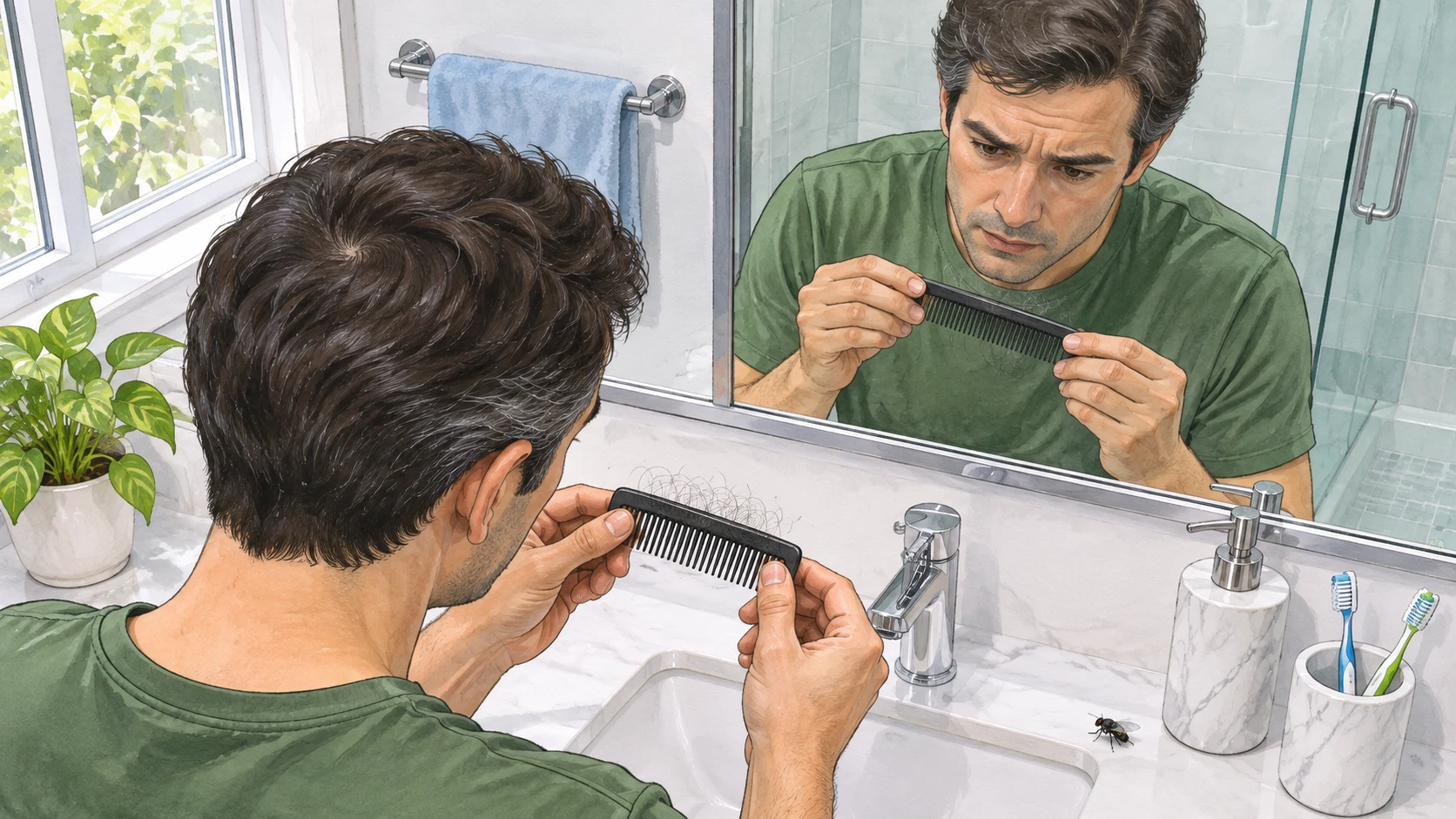
Head lice can be associated with hair loss, but this is uncommon and usually occurs indirectly. Persistent itching can lead to repeated scratching or pulling at the hair, which may cause localized hair breakage or loss. Rare cases of patchy alopecia have also been reported alongside ongoing head lice infestations. Ordinary head lice do not typically cause noticeable hair loss simply by feeding on the scalp.
Finding loose hairs while checking your child’s head can make an already stressful infestation more worrying. It is important to distinguish hair loss associated with scratching from hair loss that happens to occur while someone has lice. The two can coincide without having the same cause.
Do Head Lice Directly Damage Hair Follicles?
Head lice live on the scalp and attach their eggs to individual hair shafts. They feed on human blood rather than consuming hair or burrowing into the follicles.
Their feeding activity can make the scalp uncomfortable, particularly when an infestation produces persistent itching. However, ordinary head lice activity does not usually damage the structures responsible for growing hair.
The clinical description of head lice and their effects on the scalp identifies scratching and hair pulling as possible causes of localized hair loss. This supports an indirect connection between infestation and hair loss rather than suggesting that lice routinely destroy hair follicles.
Hair growth takes place inside follicles beneath the skin. A louse attached to the outside of a hair shaft does not ordinarily interfere with that process. Finding lice or nits attached to the hair therefore does not establish that the follicles are being damaged.
How Scratching and Hair Pulling Can Cause Hair Loss
Persistent itching can make someone repeatedly scratch or pull at their hair without realizing how much pressure they are applying. This is particularly relevant when an infestation has continued for a long time or the person experiences intense itching.
There are two related ways this behavior can affect the appearance of the hair.
Hair breakage: Repeated friction, pulling, and scratching can damage individual hair shafts. Some hairs may break close to the scalp, making the affected area appear thinner.
Localized hair loss: Repeated pulling can remove hairs from affected areas. The result may be small patches where the hair appears less dense.
These changes are not inevitable. Many people experience head lice without losing noticeable amounts of hair. The risk becomes more relevant when scratching and pulling are persistent rather than occasional.
The American Academy of Dermatology’s information about head lice and scalp irritation explains how intense itching can lead to repeated scratching and damage to the scalp. Persistent irritation can make it difficult for someone to leave the affected area alone, particularly during sleep.
Can a Heavy Head Lice Infestation Cause Patchy Hair Loss?
Patchy hair loss has been reported as an unusual manifestation of head lice infestation. However, this is not a typical outcome, and the available evidence does not establish how frequently it occurs.
A published pediatric dermatology case report described a healthy 10-year-old girl who developed distinct patches of hair loss associated with an ongoing head lice infestation. The hair loss had persisted for more than six months, and examination identified lice-related evidence in the affected area.
The published case report of circumscribed alopecia associated with head lice illustrates that a connection is possible. However, a single case report cannot establish that head lice commonly cause patchy alopecia or explain the likelihood of this happening in other children.
A separate clinical review also identifies patchy hair loss as a rare reported manifestation of head lice infestation. The clinical review of pediatric head lice discusses this finding alongside other unusual complications associated with more substantial infestations.
The practical point is that visible bald patches should not automatically be attributed to scratching or lice. A healthcare professional should assess unexplained patchy hair loss rather than assuming it will resolve when the infestation disappears.
Can Hair Loss Have Another Cause While Your Child Has Lice?
Hair loss discovered during a head lice infestation is not necessarily caused by the insects. Children can develop unrelated hair and scalp problems at the same time, and the timing of the discovery alone does not establish a connection.
For example, hair may already have been thinning before anyone noticed the infestation. A parent who parts the hair more carefully during a lice examination may simply notice an existing change for the first time.
Other factors, including illness, nutritional problems, inherited hair-loss tendencies, and repeated tension from certain hairstyles, can affect hair growth. These possibilities require their own assessment. Finding head lice does not rule them out.
We would pay attention to whether the hair loss started with the itching and scratching, whether it is continuing, and whether it remains after the infestation has been addressed. Those observations can help a healthcare professional assess the situation without assuming lice are responsible for every change.
A careful examination of a child’s hair and scalp can establish whether live lice are present. However, confirming an infestation does not establish the cause of separate hair loss.
Does Hair Grow Back After Head Lice?
Hair lost through temporary breakage or pulling can grow back when the damaging behavior stops and the follicles remain capable of producing hair. However, recovery is not guaranteed simply because the lice have been removed.
The outcome depends on what happened to the hair and follicles. Broken hair shafts may grow out naturally, while hair removed through repeated pulling may take time to become noticeable again. Hair loss caused by an unrelated condition may require a different approach.
A person should not assume that every thin area will fill in once the infestation is cleared. Persistent or progressive loss needs assessment, especially when the hair does not appear to be recovering.
Checking whether there are still live lice is also useful. Some people continue scratching after treatment because their scalp remains irritated, even when the infestation has cleared. Post-treatment itching should not automatically be interpreted as evidence that lice are still damaging the hair.
When Should You See a Doctor About Hair Loss During a Lice Infestation?
Noticeable hair loss deserves medical attention when it is unexplained, persistent, or increasing. A pediatrician or dermatologist can examine the scalp and hair, establish whether an active infestation is present, and determine whether another cause needs investigation.
Arrange an assessment when:
You notice distinct bald or thinning patches.
Hair continues to fall out after the lice have been addressed.
The affected area is becoming larger.
Hair loss occurs without substantial scratching or pulling.
The scalp remains uncomfortable and the hair appears to be changing.
You cannot establish whether the problem is breakage or actual hair loss.
A child who has substantial scratching may also develop skin damage. Secondary infection is a separate concern and can accompany prolonged irritation. Scalp sores associated with head lice should receive appropriate attention rather than being treated as an ordinary part of hair shedding.
The overall burden of an infestation also matters. Hair loss is an unusual finding, but heavy head lice infestations can produce more persistent discomfort and complications than uncomplicated cases.
What to Do When You Notice Hair Loss
Do not assume that the lice are responsible or respond by repeatedly applying treatment products. First establish whether live lice remain, then arrange medical assessment if the hair loss is noticeable or persists.
Avoid excessive scratching, forceful pulling, and rough attempts to remove attached nits. Aggressive combing can cause additional mechanical damage, particularly when hair is tangled. Follow an appropriate removal method and seek help when the process is difficult.
A photograph of the affected area can also help you document whether the thinning is changing between appointments. Record when you first noticed it and whether it began before or after the infestation was discovered.
The most useful outcome is identifying the actual reason for the hair loss. Head lice can contribute through scratching and pulling, and rare cases of patchy alopecia have been documented. However, substantial or continuing hair loss deserves its own evaluation instead of being automatically blamed on an otherwise manageable infestation.
Opening paragraph adjustment: Use this revised first paragraph to give the article a more direct search-intent answer:
Head lice can cause hair loss indirectly, although this is uncommon. Persistent itching may lead to repeated scratching or hair pulling, resulting in localized hair breakage or loss. Rare cases of patchy alopecia have also been reported during ongoing infestations. Ordinary head lice feeding does not normally cause hair to fall out.