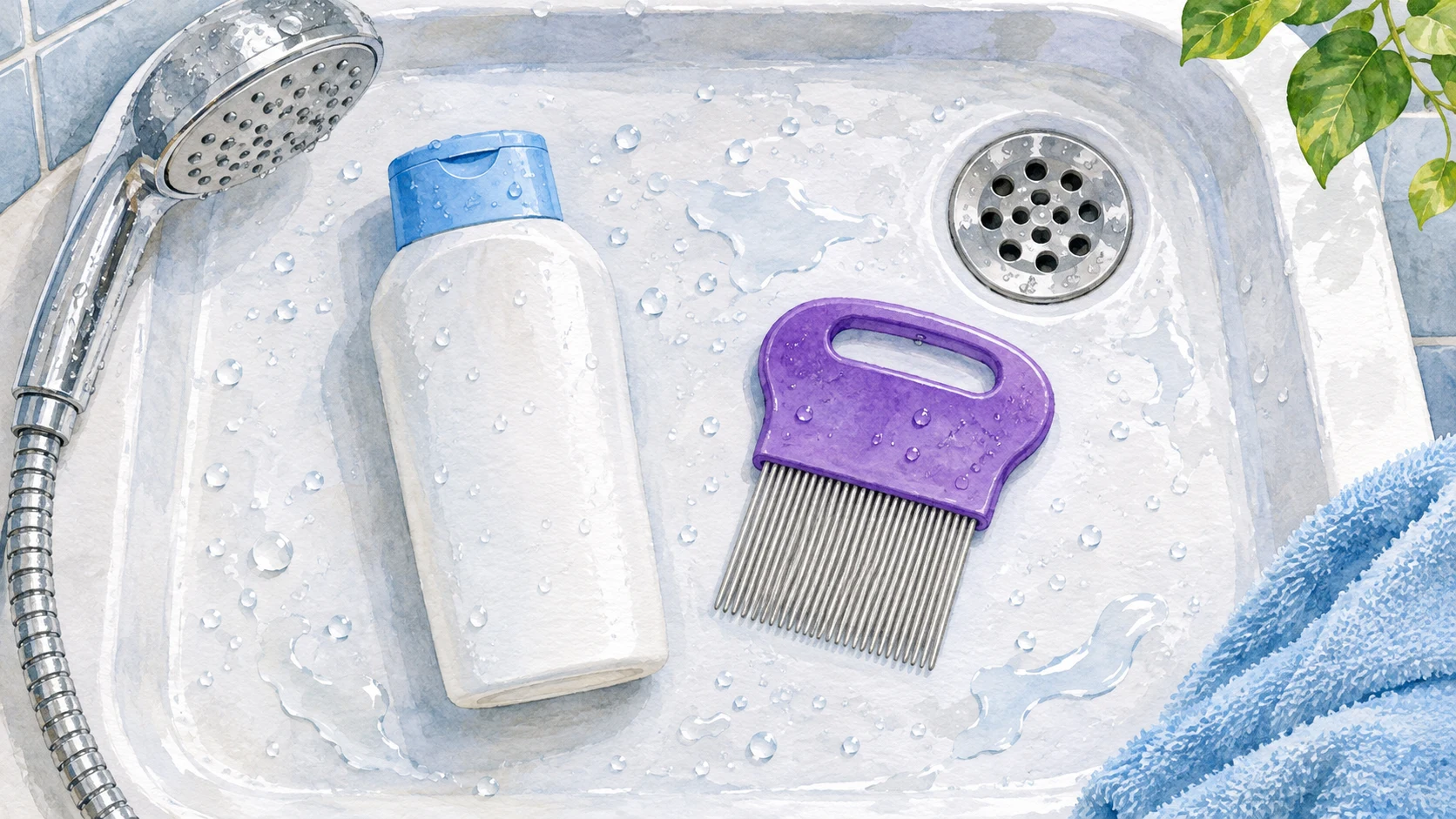
Head lice can survive underwater and usually remain attached to hair when someone washes their head. Their legs have specialized claws that grip individual hair strands, making ordinary rinsing and shampooing unreliable ways to remove them. Washing can slow the insects and prepare the hair for wet combing, but shampooing alone does not reliably eliminate an infestation.
This can be surprising to parents who assume that repeatedly washing a child’s hair should eventually remove every louse. Head lice are adapted to living among human hair, and their ability to hold on makes them difficult to dislodge through ordinary washing.
Can Head Lice Survive Underwater?
Head lice can survive being submerged in water. Water may temporarily immobilize them, but becoming still does not necessarily mean that a louse has drowned.
A submerged louse can hold tightly to a hair strand rather than allowing the water to wash it away. Its ability to cling is particularly important because the insect’s legs are adapted to gripping human hair.
The CDC’s information about head lice and water exposure confirms that head lice can remain alive underwater for several hours. Water exposure therefore cannot be treated as a dependable way to eliminate an active infestation.
Laboratory experiments have also examined how head lice respond to prolonged immersion. The peer-reviewed research on drowning and water immersion in head lice found that some lice survived extended submersion. The researchers also observed differences between immersion in water and exposure to certain other fluids.
The findings help explain why a louse that stops moving underwater may become active again after the exposure ends. Observed immobility should not be mistaken for confirmed death.
Why Don’t Head Lice Wash Out of Hair?
Head lice have specialized claws on their legs that allow them to grip individual hair shafts. These claws help them remain attached while the host moves, brushes the hair, or washes their head.
Their legs are adapted to grasp hair rather than to hold firmly to smooth, flat surfaces. This makes human hair a suitable place for them to remain while the scalp provides access to blood meals.
When water runs through the hair, lice can maintain their grip instead of being carried away with the rinse. The physical adaptations that allow head lice to grip hair explain why ordinary washing has little effect on an established infestation.
Head lice can also move between nearby strands when they need to reposition themselves. Their attachment and movement help them remain close to the scalp, where they normally live and feed.
The usual locations where head lice hide near the scalp are particularly relevant when someone tries to remove them through washing. Many insects remain close to the roots, where rinsing may not reach them with enough force to dislodge their grip.
Can Ordinary Shampoo Kill Head Lice?
Ordinary shampoo is not a reliable head lice treatment. Regular shampoo cleans the hair and scalp, but it is not designed to consistently kill or remove live lice.
Shampooing can make the hair wet and temporarily slow the insects. However, the lice may continue gripping the hair even as the shampoo is rinsed away.
The public-health guidance on ordinary shampoo and head lice specifically notes that washing with plain soap and water does little to disturb them. Repeatedly washing the hair is therefore unlikely to clear an infestation.
There is also a difference between washing away loose material and removing insects attached to hair. Shampoo can remove oil, sweat, styling products, and ordinary dirt without removing every live louse.
A clean-looking scalp is not proof that the infestation has ended. Live lice may remain even after someone has washed their hair thoroughly.
Why Wet Combing Works Differently From Ordinary Shampooing
Wet combing uses washing as preparation for physical removal. The shampoo helps clean and wet the hair, while conditioner makes it easier to move a fine-toothed detection comb through individual sections.
The comb does the actual removal work. Its closely spaced teeth pass through the hair from near the scalp toward the ends, catching lice and attached eggs as it moves.
This is different from simply shampooing and rinsing. Water and shampoo alone do not provide the same mechanical contact as a fine-toothed comb working through the hair.
The NHS wet-combing instructions for head lice use ordinary shampoo followed by conditioner and systematic combing. The repeated combing sessions are important because a single wash or inspection cannot establish that every live louse has been removed.
The method also explains why wet hair can make lice easier to detect. Wetting and conditioning can slow movement and make the hair easier to separate, allowing the comb to pass through sections more consistently.
For a fuller examination, the comb needs to reach close to the scalp rather than passing only through the outer layers of hair. The manual removal process using a fine-toothed lice comb relies on this contact to remove insects that ordinary washing leaves behind.
EXTERMINATOR SECRETS · HL118 · ARTICLE DRAFT
Can Head Lice Live in Water or Survive Shampooing?
Head lice can survive underwater for several hours, and ordinary shampooing does not reliably wash them out of hair. Their claws grip hair shafts, so rinsing may leave live insects attached. Washing can prepare the hair for wet combing, but water and regular shampoo alone are not a dependable way to clear an infestation.
This surprises many parents who assume that repeatedly washing a child’s hair should eventually remove every louse. Head lice are adapted to living among human hair, and their ability to hold on makes them difficult to dislodge through ordinary washing.
Can Head Lice Survive Underwater?
Head lice can survive being submerged in water. Although water may temporarily immobilize them, becoming still does not necessarily mean that a louse has drowned.
A submerged louse can hold tightly to a hair strand rather than allowing the water to wash it away. Its legs are adapted to gripping human hair, which helps it remain attached even when the surrounding hair is completely wet.
The CDC’s information about head lice and underwater exposure confirms that head lice can remain alive underwater for several hours. Water exposure therefore cannot be treated as a dependable way to eliminate an active infestation.
Laboratory experiments have also examined how head lice respond to prolonged immersion. The scientific research on drowning and water immersion in head lice found that some lice survived extended submersion. The researchers also observed differences between immersion in water and exposure to certain other fluids.
The findings help explain why a louse that stops moving underwater may become active again after the exposure ends. Observed immobility should not be mistaken for confirmed death.
Why Don’t Head Lice Wash Out of Hair?
Head lice have specialized claws on their legs that allow them to grip individual hair shafts. These claws help them remain attached while the person moves, brushes their hair, or washes their head.
Their legs are adapted to grasp hair rather than to hold firmly to smooth, flat surfaces. This makes human hair a suitable place for them to remain while the scalp provides access to blood meals. Their basic biology and relationship with the human scalp explain why they are adapted to remain among the hair.
When water runs through the hair, lice can maintain their grip instead of being carried away with the rinse. The public-health explanation of head lice attachment to hair describes why ordinary washing has little effect on an established infestation.
Head lice can also move between nearby strands when they need to reposition themselves. Their attachment and movement help them remain close to the scalp, where they normally live and feed.
The usual locations where head lice hide near the scalp are particularly relevant when someone tries to remove them through washing. Many insects remain close to the roots, where rinsing may not reach them with enough force to dislodge their grip.
Can Ordinary Shampoo Kill Head Lice?
Ordinary shampoo is not a reliable head lice treatment. Regular shampoo cleans the hair and scalp, but it is not designed to consistently kill or remove live lice.
Shampooing can make the hair wet and temporarily slow the insects. However, the lice may continue gripping the hair even as the shampoo is rinsed away.
There is also a difference between washing away loose material and removing insects attached to hair. Shampoo can remove oil, sweat, styling products, and ordinary dirt without removing every live louse.
Attached eggs present another difficulty. Female lice secure their eggs to individual hair shafts using a strong adhesive substance. Ordinary shampoo and rinsing do not reliably detach these eggs. The physical characteristics and attachment of head lice eggs explain why visible nits can remain even after the hair has been washed.
A clean-looking scalp is therefore not proof that an infestation has ended. Live lice may remain even after someone has washed their hair thoroughly.
Why Wet Combing Works Differently From Ordinary Shampooing
Wet combing uses washing as preparation for physical removal. The shampoo cleans the hair, while conditioner makes it easier to move a fine-toothed detection comb through individual sections.
The comb does the actual removal work. Its closely spaced teeth pass through the hair from near the scalp toward the ends, catching lice and attached eggs as it moves.
This is different from simply shampooing and rinsing. Water and shampoo alone do not provide the same mechanical contact as a fine-toothed comb working through the hair.
The NHS wet-combing procedure uses ordinary shampoo followed by conditioner and systematic combing. The repeated combing sessions are important because a single wash or inspection cannot establish that every live louse has been removed.
Wet hair can also make lice easier to detect. Wetting and conditioning can slow their movement and make the hair easier to separate, allowing the comb to pass through sections more consistently. The differences between wet and dry head lice combing help explain why the two examination approaches use different hair conditions.
For a thorough examination, the comb needs to reach close to the scalp rather than passing only through the outer layers of hair. The manual removal process using a fine-toothed lice comb relies on this contact to remove insects that ordinary washing leaves behind.
Does Washing Your Hair Mean the Head Lice Are Gone?
Washing your hair does not establish that an infestation has been eliminated. A person can have clean, freshly shampooed hair and still have live head lice attached to the strands.
The most reliable evidence of an active infestation is finding a live crawling louse. Itching alone is insufficient, and attached nits may remain after eggs have hatched or become nonviable.
A proper examination needs to reach the hair close to the scalp and cover the head rather than relying on a quick visual check. The signs used to identify an active head lice infestation help distinguish confirmed live lice from suspicious particles or residual egg cases.
When an infestation has already been addressed, continued checking is more informative than judging the result by how clean the hair looks. The presence or absence of live lice provides a much better indication of whether the problem has been resolved.