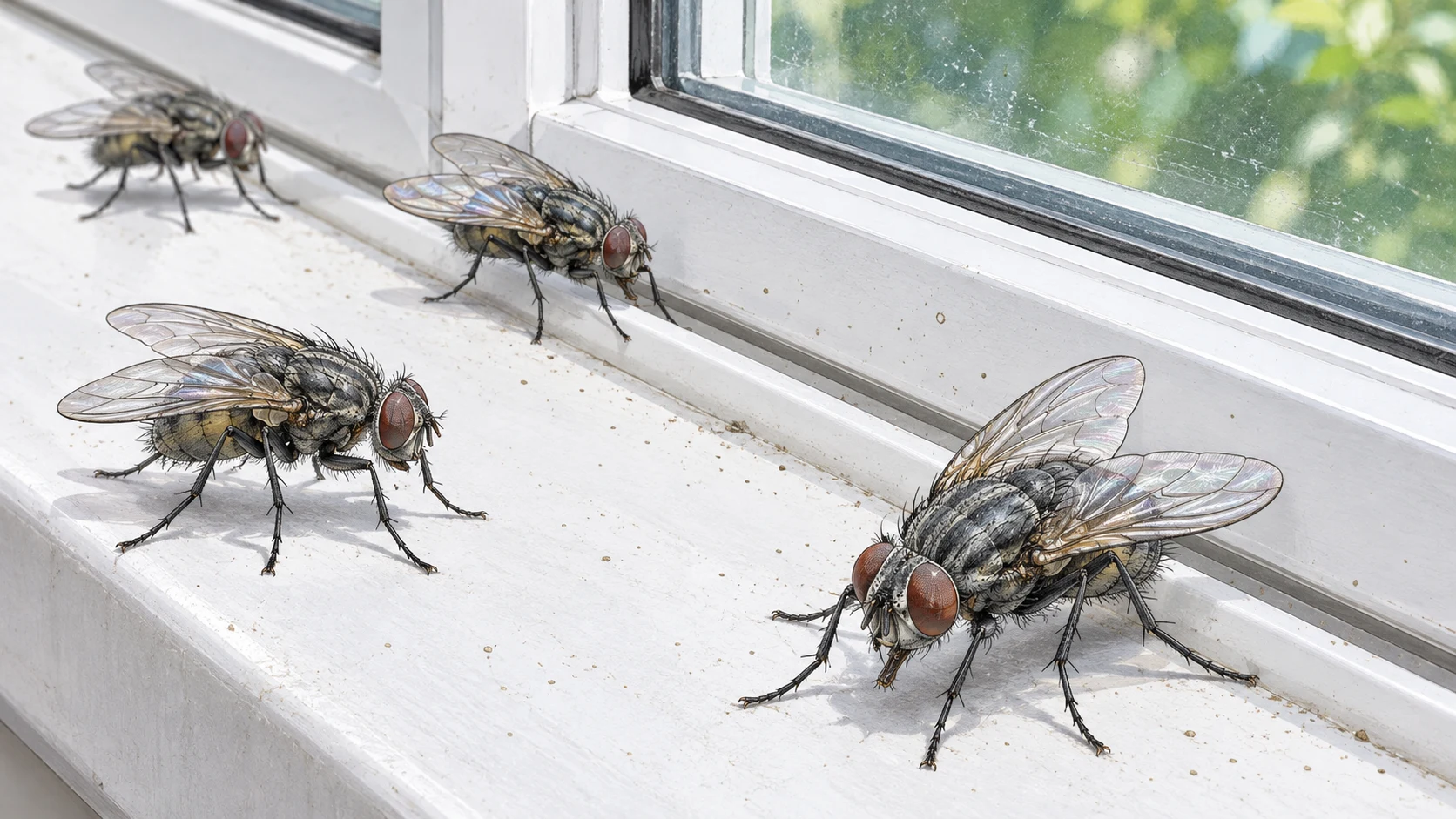
Seeing a house fly indoors does not automatically mean your home is infested. The insect may have entered through an open door, flown in through a window, or arrived from an outdoor breeding site. Even several flies appearing on the same day may be unrelated to reproduction inside the house.
A more concerning situation develops when house flies appear repeatedly, especially when their numbers remain high or there is evidence that immature flies are developing in nearby organic material.
The strongest signs of a house fly infestation are persistent adult activity combined with evidence of breeding, such as maggots, pupae, and suitable decomposing organic matter. Adult sightings alone are less conclusive because house flies commonly develop outdoors and enter buildings after reaching adulthood.
Recognizing the difference between occasional visitors and an established fly problem can help you judge how serious the activity may be without assuming that every insect indoors came from a hidden breeding site.
Repeated House Fly Sightings Are an Early Warning Sign
One or two house flies entering a home during the day is fairly ordinary, particularly when exterior doors are used frequently. A more persistent pattern deserves attention.
You might notice several flies indoors each morning, repeatedly encounter them around food preparation areas, or find new adults after removing those already present. Flies may also accumulate near windows and other bright surfaces.
Repeated sightings suggest that flies are continuing to arrive or that adults already present are becoming noticeable. They do not establish which explanation is correct.
House flies commonly develop outdoors in animal waste, garbage, and decaying organic material. Adults can subsequently enter buildings through accessible openings. A house experiencing steady outdoor fly activity may therefore contain numerous adults without supporting any indoor breeding.
The timing of sightings can provide useful context. Flies that regularly appear after doors have been open may reflect repeated entry. Adults appearing while the house has remained closed raise additional questions, although overlooked openings and insects already inside remain possible explanations.
A consistent pattern is more informative than a single busy afternoon. If fly activity remains noticeable over several days, it deserves more attention than an isolated sighting.
Finding Maggots Is Stronger Evidence of Fly Breeding
Maggots are the larval stage of flies. House fly larvae are pale, legless, soft-bodied insects that feed within suitable organic material.
Unlike adult flies, which can travel considerable distances, larvae depend on the material in which they are developing. Their presence therefore provides more direct evidence of breeding activity at or near that location.
House fly larvae may develop in moist garbage, manure, decomposing food, and other suitable organic waste. The material must provide sufficient food and appropriate conditions for the larvae to survive.
Finding multiple maggots actively feeding in decomposing material is more significant than finding several adult flies resting nearby. It indicates that fly development is occurring within that material.
However, maggots are not automatically house fly larvae. Other fly species also produce pale, legless larvae, sometimes in similar materials. The finding confirms fly breeding activity but does not, by itself, establish the species.
Larvae may be concealed beneath the surface of their food rather than immediately visible. House fly maggots tend to move into the organic material while feeding, and their presence may become more obvious as they grow or begin moving away.
Mature house fly larvae can reach approximately ¼ to ⅜ inch in length. Their bodies taper toward the front and lack the obvious legs found on many other insect larvae.
Finding maggots in an indoor waste container deserves attention because it establishes that the material is supporting insect development. Finding them outdoors establishes breeding activity there, but does not prove that the adults seen inside originated from that particular source.
Brown Pupal Cases Can Indicate a Developing Fly Population
After completing larval development, house flies enter the pupal stage. During this period, the insect undergoes the changes that produce the adult fly.
House fly pupae are enclosed within firm, elongated oval cases, commonly brown to dark brown. These cases are substantially different from the pale, soft-bodied maggots that precede them.
A mature larva may leave its feeding material and move toward a relatively dry, protected location before pupating. Consequently, pupal cases may be found near a breeding material rather than directly inside the wettest portion.
The movement of mature larvae into drier pupation areas explains why pupae may appear around the edges of waste accumulations or in adjacent sheltered spaces.
Several pupal cases associated with decomposing organic material provide stronger evidence of an established developmental site than adult fly activity alone.
An intact case may contain a developing insect, while an empty case can indicate that an adult has already emerged. Empty cases remain useful evidence of previous development, although they do not prove that the breeding activity is still ongoing.
Pupal cases also require cautious interpretation. Other fly species produce similar structures, and an isolated brown object cannot reliably be identified as a house fly pupa from its location alone.
When pupae and maggots are found together in suitable organic material, the evidence for local fly development becomes considerably stronger.
Suitable Breeding Material Is an Important Supporting Sign
House flies cannot establish a breeding population simply because a room contains adult insects. Their eggs and larvae require an appropriate environment.
Female house flies deposit eggs in moist organic material that can support larval feeding. Common examples include manure, decomposing food waste, and accumulations of other suitable decaying matter.
A neglected garbage container containing moist food residue may provide such conditions. So can contaminated animal bedding or a substantial accumulation of decomposing organic waste.
The presence of suitable material is a warning sign, but it is not proof of an infestation. A garbage container may be capable of supporting larvae without actually containing any.
The evidence becomes stronger when suitable material is accompanied by visible maggots, pupae, or repeated adult emergence.
The conditions required for house fly larval development involve warmth, moisture, and sufficient food. A dry floor, clean countertop, or ordinary piece of furniture does not provide the same environment.
Moisture matters because house fly larvae are adapted to developing within organic substrates rather than wandering freely through a dry house.
The condition of the material is therefore more informative than its mere presence. A sealed bag of dry waste and an exposed accumulation of moist, decomposing food do not present equivalent breeding opportunities.
Dark Fly Spots May Show Repeated Adult Activity
Small dark marks can sometimes accumulate where adult flies repeatedly rest or feed.
These marks may include fly fecal deposits or residues associated with feeding. They can appear on walls, windows, ceilings, light fixtures, and other surfaces used by adult flies.
Finding numerous small spots in an area where flies regularly gather may support the conclusion that adult activity has been frequent or prolonged.
However, fly spots have important limitations as infestation evidence.
Similar marks can come from other insects or ordinary household contamination. Even when they are produced by house flies, they do not establish that larvae are developing inside the property.
A fly can enter from outdoors, rest repeatedly on a surface, and leave deposits without reproducing indoors.
Marks left behind may also remain after the insects are gone. Their presence is not a reliable measure of how many flies are currently active.
Fly spots are best interpreted alongside direct sightings and any evidence of immature stages. They may document adult activity, but they are weaker evidence of breeding than larvae or pupae associated with a suitable substrate.
Does Seeing a Large Number of House Flies Mean You Have an Infestation?
There is no universal number of adult house flies that proves a residential infestation.
Five flies inside one house may represent repeated entry through an open doorway. Twenty flies in another property may have emerged from a nearby breeding source. The number alone does not distinguish these situations.
House fly populations can increase rapidly when conditions support reproduction. Females lay eggs in batches, and development from egg to adult can occur in a relatively short period under favorable temperatures.
The house fly life cycle can be completed in approximately eight days under optimal conditions, although development takes longer under less favorable conditions.
This reproductive capacity helps explain why suitable breeding material can produce noticeable numbers of adults.
It does not mean that every sudden increase in indoor fly sightings represents a new generation produced inside the house.
A large outdoor population may contribute to repeated entry. Several adults may also accumulate indoors over time, making their combined number appear more dramatic.
Adult counts become more useful when they are considered over a consistent observation period. A repeated increase, particularly alongside evidence of developing larvae, is more concerning than a one-time count.
Which Signs Provide the Strongest Evidence?
Different observations tell you different things about house fly activity. Some show only that adults are present, while others demonstrate that flies are reproducing in nearby material.
| Observation | What it indicates | Main limitation |
|---|---|---|
| One or two adult flies indoors | Adult flies have entered or are present | Does not establish an infestation |
| Repeated adult sightings | Continued activity or accumulation | Cannot distinguish entry from indoor emergence |
| Numerous flies near windows | Adults are gathering in a particular area | The window may not be the source |
| Small dark fly spots | Possible repeated adult resting or feeding | Marks do not prove breeding |
| Moist, decomposing organic waste | Potential breeding conditions | Suitable material may contain no larvae |
| Maggots feeding in organic waste | Active fly development | Species may be uncertain |
| Brown pupal cases near waste | Fly development has reached the pupal stage | Cases may belong to another fly species |
| Maggots, pupae, and emerging adults associated with the same material | Strong evidence of a local developmental site | House fly identity still requires confirmation |
The strongest conclusion comes from evidence that connects immature development with adult activity. A cluster of adult flies is noticeable, but larvae and pupae provide more direct information about reproduction.
Can a House Fly Infestation Exist Outside Your House?
Yes. A property can have substantial house fly breeding activity outdoors while the interior contains only visiting adults.
House flies commonly reproduce in outdoor garbage, animal manure, and decomposing organic matter. Adults emerging from these materials may enter nearby buildings.
This can produce persistent indoor sightings without any indoor breeding site.
The usual outdoor breeding habits of house flies make it important to distinguish an indoor population from an outdoor population that repeatedly enters the building.
For example, maggots and pupae in an outdoor garbage container demonstrate fly development in that material, assuming the immature stages have been identified appropriately. Adults appearing inside the nearby house may be connected, but the relationship is not established solely by proximity.
An outdoor infestation can still affect household comfort and hygiene. The absence of indoor breeding does not make repeated adult activity irrelevant.
The location of the developmental stages simply changes what the evidence supports.
Are Flies Around Food a Sign of an Infestation?
House flies frequently investigate exposed food and food residues. Their presence around meals or food preparation surfaces is therefore not unusual.
Several flies repeatedly visiting a food area may indicate persistent adult activity, but food-related sightings alone do not establish a breeding population.
A fly can arrive from outside and land on food without laying eggs or completing any part of its development indoors.
There is still a hygiene concern. House flies can mechanically transfer microorganisms after contacting contaminated material. Their feeding habits and movement between waste and food make repeated activity around exposed food undesirable.
The potential for house flies to contaminate food is one reason persistent sightings deserve attention even when no indoor breeding site has been confirmed.
If flies have landed on exposed food, particularly food that will not be cooked, discarding potentially contaminated portions is a prudent precaution. Food-contact surfaces should also be cleaned appropriately.
The health concern and the evidence of infestation should not be confused. A single fly can contaminate a surface, while many flies may be present without reproducing inside the building.
When Should House Fly Activity Be Considered Serious?
Persistent adult sightings deserve closer attention when they occur alongside visible immature stages, suitable breeding material, or repeated emergence over time.
Finding maggots actively feeding in indoor garbage is more concerning than noticing several adults near a window. Discovering pupae in sheltered areas associated with the same waste strengthens the evidence that development is taking place.
A problem also warrants attention when house flies repeatedly contact exposed food or food preparation surfaces. Even without confirmed indoor breeding, frequent adult activity can create sanitation concerns.
The most convincing evidence is not a particular number of flies but the presence of multiple developmental stages associated with suitable organic material.
If the insects continue appearing and the evidence cannot be interpreted confidently, a qualified pest management professional or insect diagnostic service may help establish whether breeding is occurring and whether the immature stages belong to house flies.
An extensive treatment program should not be based solely on adult counts or unexplained marks on a wall.
Questions About House Fly Infestation Signs
Is finding one maggot enough to confirm a house fly infestation?
One maggot indicates that a fly larva is present, but it does not establish the species or prove that an ongoing infestation exists. Multiple larvae actively feeding in suitable organic material provide stronger evidence of local breeding.
Can you have a house fly infestation without seeing maggots?
Yes. House fly larvae develop within organic material and may remain concealed while feeding. Adults can be numerous even when immature stages are not visible. However, the absence of visible maggots means indoor breeding has not been confirmed.
Are empty fly pupal cases evidence of an active infestation?
Empty pupal cases indicate that development may have occurred previously, but they do not establish that larvae are still present. Their significance depends on whether fresh immature stages or continuing adult emergence are also observed.
Do house flies leave droppings on walls and windows?
Yes. Adult flies can leave small deposits on surfaces where they rest or feed. These marks may indicate repeated fly activity, but they cannot independently establish the presence or location of a breeding site.
What Separates an Occasional Fly From an Established Problem?
A house fly passing through an open doorway is not the same as a population developing in organic waste. Both situations can produce adult sightings, and the number of visible flies does not reliably distinguish them.
Repeated activity is a warning sign. Maggots and pupae associated with suitable breeding material provide much stronger evidence that flies are completing their development nearby.
An indoor infestation is most convincingly supported when those immature stages are associated with material inside the building. Outdoor breeding can produce persistent indoor sightings without any reproduction taking place indoors.
The evidence becomes clearer when adult activity, developmental stages, and suitable organic material are considered together rather than treating every fly on a windowsill as proof of an infestation.