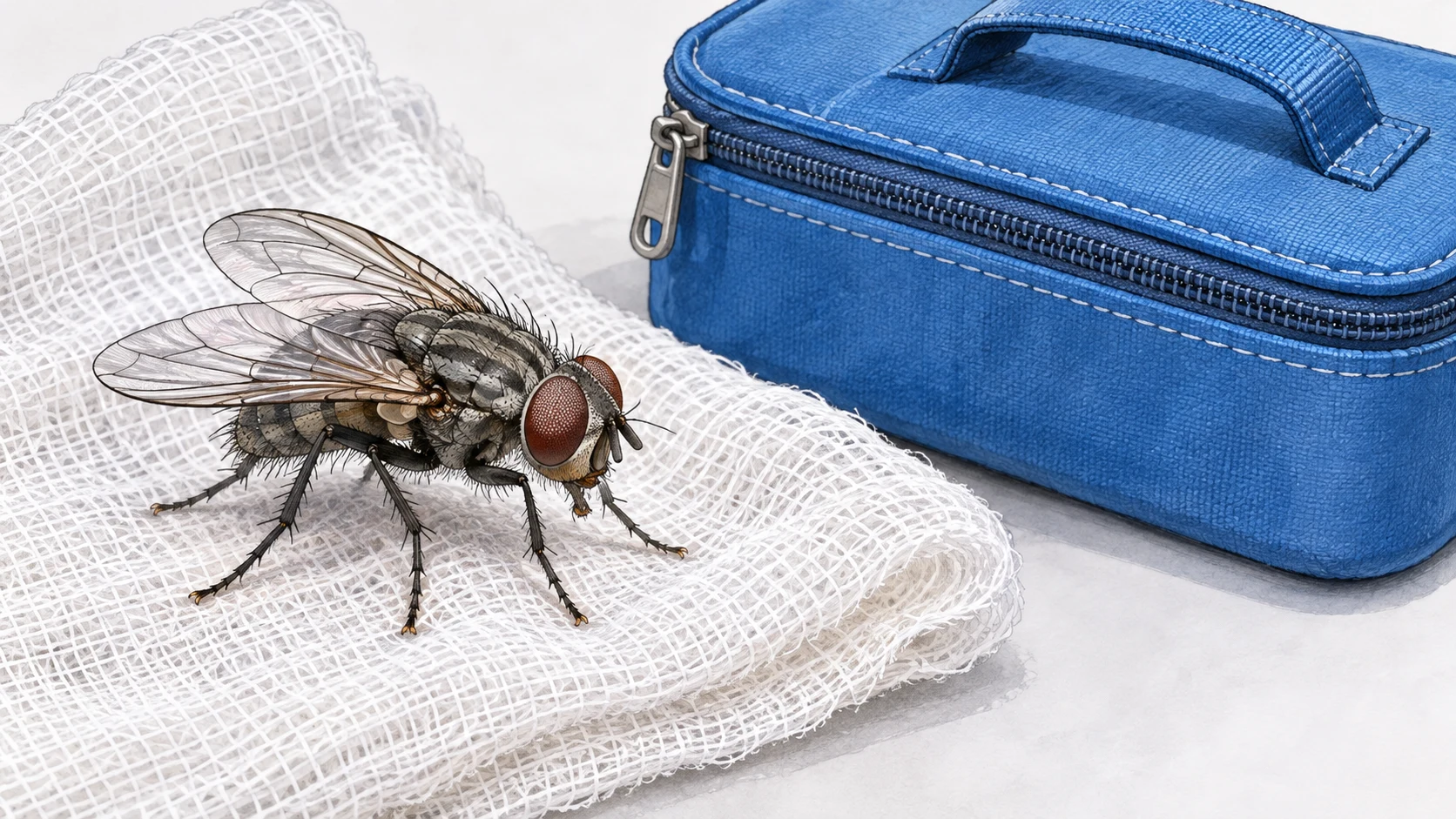
House flies do not normally lay eggs on healthy human skin. The common house fly (Musca domestica) typically deposits its eggs in moist, decomposing organic material rather than using a living person as a breeding site. A house fly landing on your arm, face or leg does not mean it has deposited eggs. There are exceptional circumstances in which house flies have been associated with larvae in human wounds or other body sites. These reports are uncommon and should not be confused with the behavior of specialized parasitic flies that deliberately use living hosts for reproduction.
Do House Flies Lay Eggs on Healthy Human Skin?
Healthy, intact skin is not a normal egg-laying site for the common house fly. Its larvae are adapted primarily to feeding in moist organic material rather than developing on the surface of a living person’s body.
A female house fly must find conditions that support the larvae after they hatch. The skin of a person walking around, bathing and changing clothes does not provide the same environment as the decomposing material in which house fly larvae ordinarily develop.
The documented reproductive habits of house flies identify wet garbage, animal manure and decaying plant material as typical breeding substrates. Intact human skin is not described as a normal egg-laying location.
An adult fly may still land on exposed skin to investigate moisture, salts or other substances. Landing and egg-laying are separate behaviors, and one does not establish that the other has occurred.
The appearance of house fly eggs is also important when evaluating claims about eggs found on the body. Tiny white particles can be mistaken for insect eggs, and their appearance alone cannot establish which species produced them.
There is no good evidence that ordinary house flies routinely deposit eggs on healthy people during everyday encounters.
Could a House Fly Lay Eggs on an Open Wound?
An exposed wound presents different conditions from intact skin, particularly when it contains moist, damaged or decaying tissue.
The common house fly is among the species classified as capable of facultative myiasis, meaning that its larvae normally develop outside a living host but may occasionally become involved with living tissue under unusual conditions.
The classification of facultative myiasis-producing flies includes Musca domestica. It also explains that these flies may be attracted to contaminated wounds, skin lesions or other moist material associated with animals.
This establishes biological plausibility, not a high probability of house fly egg-laying on human wounds.
Published human cases involving house flies are uncommon, and some include more than one fly species. The presence of larvae in a wound does not automatically identify the common house fly as their source.
An uncovered wound should therefore be protected from fly contact, but a fly briefly landing near a wound is not proof that eggs were deposited.
The distinction between exceptional reports and confirmed infestation is examined more fully in whether house flies can cause myiasis.
Can House Fly Eggs Hatch Beneath Your Skin?
House fly eggs are not adapted to being inserted beneath healthy human skin. Female house flies do not possess the specialized reproductive behavior used by certain parasitic flies to establish larvae inside living tissue.
Even if eggs were deposited on the skin’s surface, that would not mean larvae could penetrate intact skin and begin developing underneath it.
A house fly larva normally feeds in accessible organic material. It does not follow the same developmental process as a human bot fly larva, which is adapted to enter and remain within a living host.
There are exceptional reports involving house fly larvae and human tissue, but these do not establish that house fly eggs routinely hatch beneath intact skin.
The appearance and structure of house fly maggots can help explain why larvae from different flies are easily confused. Small, pale maggots may look similar even when their biological relationships with humans are very different.
A bump, itch or sensation beneath the skin cannot be attributed to house fly eggs simply because an adult fly was previously nearby.
Which Flies Actually Lay Eggs on People or Cause Larvae to Enter Skin?
Several fly species have reproductive adaptations that the common house fly lacks. Some deposit eggs near wounds, while others use insects or contaminated clothing to transfer larvae to a host.
The life cycles of medically important myiasis-producing flies illustrate these differences.
| Fly species | How it reaches a human host | Difference from the common house fly |
|---|---|---|
| Common house fly (Musca domestica) | Rare, opportunistic involvement has been reported | Normally breeds outside living hosts |
| Human bot fly (Dermatobia hominis) | Attaches eggs to blood-feeding insects, which transfer larvae to a host | Larvae are adapted to developing beneath skin |
| New World screwworm (Cochliomyia hominivorax) | Deposits eggs on or near wounds and certain body openings | Larvae feed on living tissue |
| Tumbu fly (Cordylobia anthropophaga) | Eggs may be deposited on soil or damp clothing, allowing larvae to contact skin | Larvae can penetrate skin and develop in a host |
| Certain blow flies | May deposit eggs in exposed, damaged or contaminated tissue | Some species are opportunistic wound parasites |
These are not interchangeable forms of fly reproduction. A person who has seen a gray house fly indoors should not assume it possesses the same abilities as a bot fly or screwworm.
Human Bot Flies
The human bot fly uses an indirect method of transferring its larvae. A female can attach eggs to a mosquito or another blood-feeding insect. When that insect contacts a suitable host, the developing larvae can transfer to the skin.
The larvae then enter the tissue and develop beneath the surface.
This behavior is fundamentally different from a house fly briefly landing on someone’s arm. The adult human bot fly does not need to lay its eggs directly on the person’s skin.
New World Screwworm Flies
New World screwworm flies present a different concern because their larvae feed on living tissue.
Females can lay eggs on wounds or near certain body openings, including the nose, mouth and ears. The larvae can then enter the affected tissue and cause serious damage.
The reproductive behavior of New World screwworm flies is specifically associated with wounds and living hosts.
Ordinary house flies do not share this specialized dependence on living tissue. Confusing the two species can make an everyday house fly encounter seem far more dangerous than the evidence supports.
Tumbu Flies
The African tumbu fly provides another example of why the phrase fly eggs on skin can be misleading.
Its eggs may be deposited on soil or damp clothing rather than directly onto a person. Larvae can subsequently contact the skin and penetrate it.
This means a person can acquire a larval infestation without observing an adult fly land on their body.
House flies do not normally use clothing as an indirect means of transferring skin-penetrating larvae.
How Can You Tell Whether the Fly Was Actually a House Fly?
Many insects are casually called house flies even when they belong to other species.
The common house fly is generally gray, with four dark longitudinal stripes on its thorax. Its appearance differs from metallic blow flies and various other flies that may be associated with wounds or decomposing material.
However, species identification from a brief encounter can be difficult. A fly seen for a few seconds on someone’s skin may not have been observed closely enough to identify reliably.
The distinction between ordinary house flies and other flies found indoors is particularly relevant when someone reports an insect depositing eggs.
Identifying the adult is only part of the problem. Eggs and larvae may require specialized examination because several fly species produce superficially similar immature stages.
A claim that a house fly laid eggs on a person is therefore stronger when the adult insect was reliably identified and the egg-laying event was actually observed.
Seeing a fly near an unexplained skin mark does not establish either fact.
What if You Find Small White Eggs on Your Skin?
Small white particles on skin cannot be identified reliably as house fly eggs without additional evidence.
They may be ordinary debris, dried skin products or material from another source. Even if they are insect eggs, their appearance alone may not reveal the species.
If the material is on intact skin, it can generally be washed away with water and mild soap. Avoid harsh chemicals, insecticides or abrasive scrubbing in an attempt to destroy suspected eggs.
The situation is different if material appears inside an open wound or if living larvae are observed. Those findings warrant medical assessment rather than home identification or invasive removal.
The medical guidance for suspected myiasis recommends professional evaluation when an infestation is suspected, particularly when wounds are involved.
An ordinary house fly landing on intact skin, without any visible material or concerning symptoms, is not itself a reason to seek treatment for myiasis.
Does a House Fly Need to Bite You to Deposit Eggs?
House flies do not need to bite in order to lay eggs, and the common house fly cannot pierce human skin with its mouthparts.
Its mouthparts are adapted for sponging liquid food rather than biting through skin. Reproduction involves a separate structure at the rear of the female’s abdomen.
The absence of biting ability does not mean that a fly could never deposit eggs on exposed material. It means the house fly does not create a wound by biting and then use that wound as a normal breeding site.
The explanation of why house flies do not bite humans covers the relevant mouthpart limitation.
Specialized parasitic flies may transfer larvae through wounds or other routes, but those mechanisms should not be attributed to Musca domestica without evidence.
What Can You Do to Reduce Fly Contact With Exposed Skin and Wounds?
For intact skin, ordinary hygiene is generally sufficient after a house fly lands. Washing is reasonable if the insect contacted sweat, an uncovered abrasion or an area that needs cleaning.
Open wounds deserve more attention. Keep dressings clean and follow appropriate wound-care instructions, especially where flies are numerous.
In places where myiasis-producing flies occur, covering wounds and limiting fly exposure are recognized preventive measures. The risk depends on the species present, local conditions and the person’s circumstances.
Household screens and properly closing doors can also reduce contact with adult flies. Preventing house flies from entering the home addresses the entry routes that allow repeated encounters.
Do not apply insect repellents or household pest-control products directly to an open wound unless the product is specifically intended and labeled for that use.
If larvae are found in a wound, prompt medical evaluation is more appropriate than attempting to identify or remove them using household chemicals.
Questions About House Flies Laying Eggs on People
Can a house fly lay eggs on your arm while you sleep?
A house fly is not normally attracted to healthy arm skin as an egg-laying site. Although an insect could land on exposed skin while someone sleeps, that does not establish egg deposition. There is no evidence that ordinary house flies routinely lay eggs on sleeping people.
Can house flies lay eggs in your hair or scalp?
Healthy hair and scalp are not normal breeding sites for house flies. Unusual infestations involving wounds or damaged tissue are a separate concern, and the responsible fly species cannot be established from the presence of larvae alone.
Can house fly eggs burrow into your skin?
House fly eggs do not burrow into skin. The common house fly does not have the specialized reproductive system of flies whose larvae are adapted to enter living tissue. Rare house fly involvement in myiasis should not be mistaken for routine penetration of healthy skin.
Does finding maggots on a person mean a house fly laid the eggs?
No. Many fly species produce maggots, including species more closely associated with human or animal myiasis. Identifying the larvae and determining how they reached the body require evidence beyond their general appearance.
A House Fly Landing on Skin Is Not an Egg-Laying Event
The common house fly does not normally lay eggs on intact human skin, and ordinary contact with an adult fly is not evidence that larvae will develop beneath the surface.
Exceptional cases involving damaged tissue are biologically possible, but the species responsible must be confirmed. Bot flies, screwworm flies and certain other species have reproductive strategies that differ substantially from those of ordinary house flies.
If a fly merely lands on healthy skin, routine hygiene is sufficient. Suspected larvae in a wound require medical evaluation, not assumptions based on which adult fly happened to be nearby.
One thought on “Can House Flies Lay Eggs on Human Skin?”