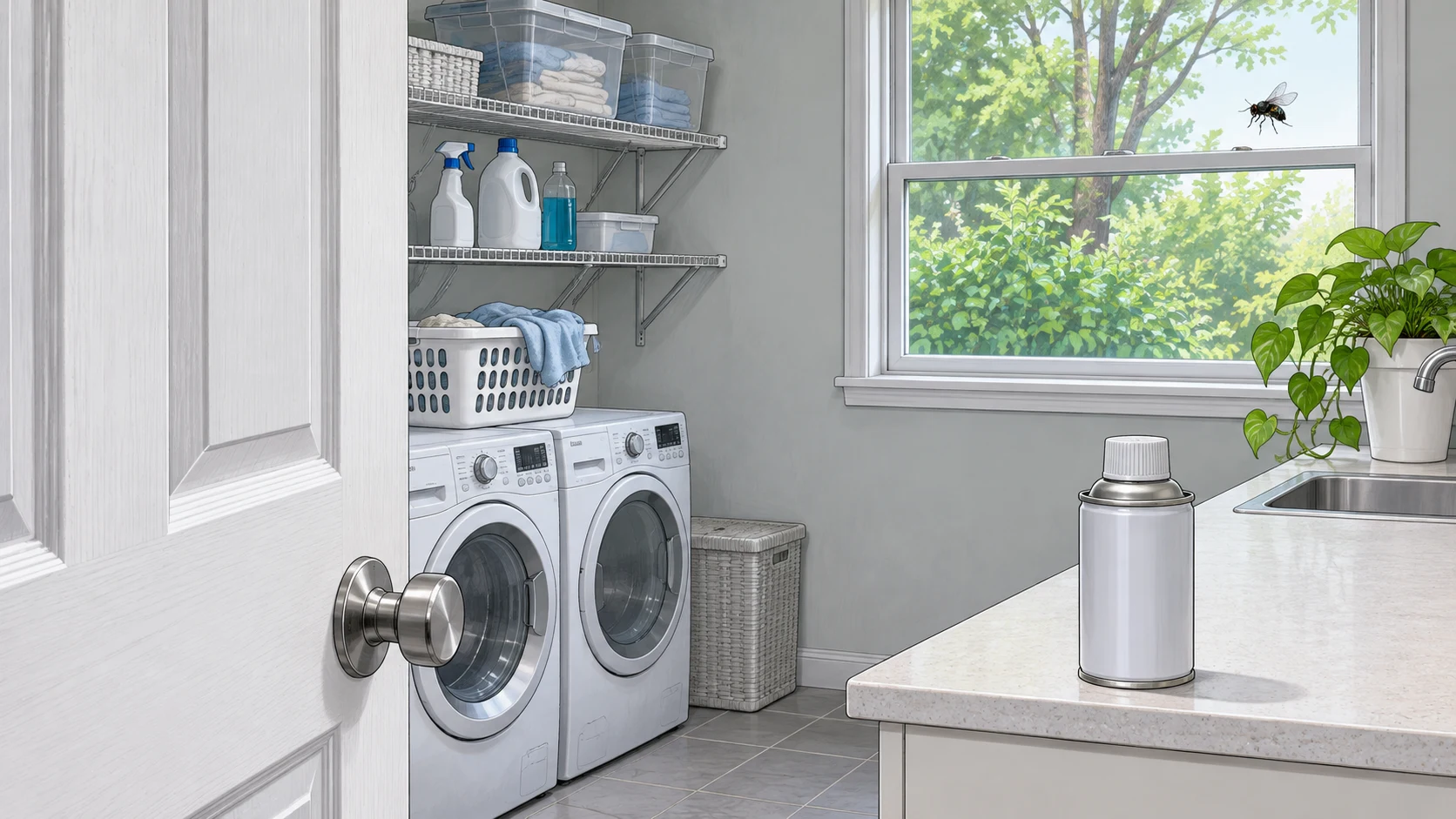
A bug bomb can kill exposed adult house flies, but it is unlikely to eliminate an ongoing house fly problem. Total-release foggers disperse insecticide into an enclosed space, where the droplets can contact insects and settle on exposed surfaces. They cannot reliably reach every fly, and they do not remove the decaying material where new flies may be developing.
For a homeowner, that means a room can appear free of flies immediately after fogging, only for more adults to appear later. The treatment may have killed the insects it reached without addressing the source of the infestation.
There are also substantial safety concerns. Total-release foggers can expose people and pets to pesticides, contaminate household surfaces, and create fire or explosion hazards when used incorrectly. We would not recommend a bug bomb as a routine solution for house flies, particularly when the insects can be removed without treating an entire room.
What Happens When You Set Off a Fly Fogger?
A total-release fogger is a pressurized pesticide container designed to discharge its contents after activation. Unlike equipment operated continuously by an applicator, a consumer bug bomb releases its contents automatically.
The resulting aerosol disperses through the treated space. Insecticide droplets can contact exposed flies and settle onto floors, furniture, and other surfaces.
Despite the name, a bug bomb does not fill every hidden space with a penetrating insecticidal gas. The way total-release foggers distribute pesticide limits their ability to reach insects protected inside cracks, cavities, and other concealed locations.
House flies (Musca domestica) may be exposed while flying or resting in the open. Others may be outside the room, shielded from the aerosol, or present only after the treatment has ended.
A fogger also has no ability to prevent another fly from entering through an open door. Its immediate effect on exposed adults should not be confused with lasting protection.
Why Bug Bombs Rarely Eliminate a House Fly Problem
House flies can develop in garbage, manure, and other moist, decaying organic materials. Their eggs hatch into maggots that feed within suitable breeding material before developing into pupae and eventually adults.
An indoor fogger does not reliably penetrate these materials or eliminate the conditions that support fly development.
Suppose several adult flies are emerging from contaminated waste near a building. Fogging an interior room may kill some adults that have entered, but the developing insects outside remain unaffected. More flies can emerge and enter after the airborne treatment has dispersed.
Even when the breeding source is indoors, insecticide mist may not reach immature flies buried within the material.
The house fly life cycle helps explain why killing visible adults does not necessarily end an infestation. Different life stages occupy different locations, and an adult-focused treatment cannot be assumed to reach all of them.
House flies also frequently enter buildings from outdoor sources rather than breeding inside the living space. Guidance on identifying and controlling indoor flies emphasizes that insecticides alone rarely eliminate recurring fly problems.
A homeowner may therefore mistake the arrival of new flies for a failed application. The original treatment might have killed exposed adults while leaving the source of replacement insects untouched.
Do Foggers Reach Flies Hiding Behind Furniture?
Foggers distribute pesticide most readily through exposed areas. Furniture, storage containers, closed cabinets, and structural features can interrupt that distribution.
A fly resting on an exposed wall may receive insecticide droplets, while another insect protected behind an object may receive substantially less.
The exact exposure depends on the product, room layout, airflow, and where the insects are located. There is no guarantee that activating a fogger will deliver a lethal dose to every adult house fly inside a building.
A review of household bug bomb limitations describes how these products can leave protected insects untreated while depositing pesticide on accessible household surfaces.
This limitation matters even though house flies are often visible and active in open rooms. They can move between spaces, and their presence during the treatment is not guaranteed.
An empty-looking room after fogging provides no evidence that every adult has been killed or that the underlying fly problem has ended.
Can Fly Foggers Leave Pesticide Residues on Household Surfaces?
The aerosol released by a fogger does not remain suspended indefinitely. Droplets can settle on exposed surfaces, including floors, tables, furniture, and household belongings.
That creates exposure concerns beyond the initial period when the fog is airborne.
Food preparation surfaces are particularly sensitive because pesticide deposits may contaminate areas used for cooking or eating. Children’s toys, bedding, and frequently touched objects can also become contaminated when left exposed.
Some labels require food, utensils, and other items to be removed or protected before treatment. They may also specify cleaning procedures before particular surfaces are used again.
Young children deserve additional protection because they spend time close to floors and may place contaminated objects in their mouths. Pets can contact deposits through their paws, fur, or grooming behavior.
The health and household safety concerns associated with foggers extend beyond simply avoiding the visible cloud of pesticide.
Ventilating a room after treatment can help remove remaining airborne material, but it does not automatically remove deposits from surfaces.
Do not assume that a room is suitable for unrestricted use merely because the fog has disappeared or the pesticide odor has faded.
Fire and Explosion Hazards From Bug Bombs
Some total-release foggers contain flammable propellants. If released near an ignition source, the aerosol can ignite and cause a fire or explosion.
Potential ignition sources include pilot lights, open flames, cigarettes, and electrical appliances capable of producing sparks. Equipment that switches on automatically can create hazards even when nobody is operating it.
Using too many foggers in a small space can increase the concentration of flammable material.
The EPA’s total-release fogger safety requirements specifically address ignition sources, excessive product use, evacuation, and ventilation.
A homeowner should never estimate the number of foggers needed by assuming that more pesticide will produce better results. The product label controls the permitted treatment volume, number of containers, and placement restrictions.
If ignition sources cannot be managed exactly as the label requires, the fogger should not be used.
What Does the Label Require Before Using a Bug Bomb?
A fogger must be registered and labeled for the intended pest and application site. A product advertised for household insects is not automatically approved for house flies or every indoor room.
The label may require substantial preparation before activation, followed by a period when nobody can enter the treated space.
| Label requirement | Why it matters |
|---|---|
| Listed target pest | Confirms whether the product is intended for house flies |
| Permitted indoor location | Establishes where the product may legally be applied |
| Room size and container limits | Prevents excessive application in small or confined spaces |
| Ignition-source precautions | Reduces fire and explosion hazards |
| Food and household-item protection | Limits contamination of exposed belongings and surfaces |
| Evacuation and reentry instructions | Reduces exposure while pesticide remains airborne |
| Ventilation and cleanup | Establishes conditions for returning to and using the treated area |
All people and pets must leave the treated space as directed. Depending on the label, evacuation may involve more than the room containing the fogger.
Reentry must wait until the specified period has elapsed, and the required ventilation must be completed. The EPA notes that many labels require occupants to stay out for two to four hours, but the exact product label determines the required interval.
An investigation of illnesses associated with total-release foggers identified failure to leave treated premises and returning too early as common causes of pesticide exposure.
Never shorten the waiting period because the room appears clear. Likewise, do not use additional foggers to compensate for an earlier treatment that failed to eliminate the flies.
Federal pesticide-label requirements apply in the United States, and state or local rules may impose further restrictions. A product’s availability for purchase does not authorize uses outside its labeling.
When Should You Avoid Using a Fly Fogger?
A fogger is a poor choice when only a few house flies are present. Treating an entire room introduces unnecessary pesticide exposure when the insects can be removed individually.
It is also unsuitable when occupants cannot leave for the required period, when ventilation is inadequate, or when food and sensitive household belongings cannot be protected.
Homes containing aquariums, pet birds, or other animals that cannot be safely removed or protected according to the label require particular caution.
Small enclosed spaces, closets, cabinets, and other confined locations may be explicitly prohibited treatment sites. A fogger should never be activated inside such a space unless the exact label permits it.
The presence of repeated fly activity does not make fogging more appropriate. If new adults are arriving from outside or emerging from breeding material, another room treatment may simply repeat the same temporary result.
The causes of house flies returning after treatment need to be understood before considering additional pesticide applications.
What Should You Do If House Flies Return After Fogging?
First, determine whether the insects are entering the building or emerging from a source nearby.
Flies appearing mainly around frequently opened doors may indicate an entry problem. Those gathering around waste areas may be associated with feeding or breeding materials.
The materials where house flies lay their eggs are more relevant to a recurring infestation than the number of adult flies killed during a single treatment.
Do not assume that every fly found indoors belongs to the same species. House flies, blow flies, cluster flies, and other insects can require different explanations for their presence.
For adults already inside, indoor house fly traps may provide a non-fogging method of capture. Physical exclusion, including fly screens and magnetic screen doors, can also reduce repeated entry.
If the suspected source involves inaccessible waste, shared building areas, or a persistent sanitation problem, the responsible property manager or an appropriately licensed pest-control professional may need to investigate.
Repeatedly activating foggers without identifying the source increases pesticide use without establishing that the next treatment will succeed.
Can a Bug Bomb Ever Be Useful Against House Flies?
A fogger specifically labeled for house flies may kill exposed adults under permitted treatment conditions. Its usefulness is therefore limited rather than nonexistent.
For a small, manageable number of flies in a home, we see little justification for treating an entire room with a total-release pesticide. The preparation, evacuation, contamination concerns, and ignition hazards can outweigh the benefit of temporarily reducing adult numbers.
A larger number of flies does not automatically change that assessment. When adults continue entering or emerging, their source remains the controlling factor.
The reasons large numbers of house flies appear indoors should guide the response instead of the assumption that a more extensive pesticide application will provide a permanent solution.
Fly foggers and bug bombs can kill exposed house flies, but they cannot be relied upon to eliminate an infestation. They do not remove breeding material, prevent entry, or guarantee exposure of every insect. Their use also introduces significant safety obligations that must be satisfied before activation.
For most household house fly problems, we would prioritize identifying the source and removing the adults without fogging. A bug bomb should never be treated as a substitute for that investigation.