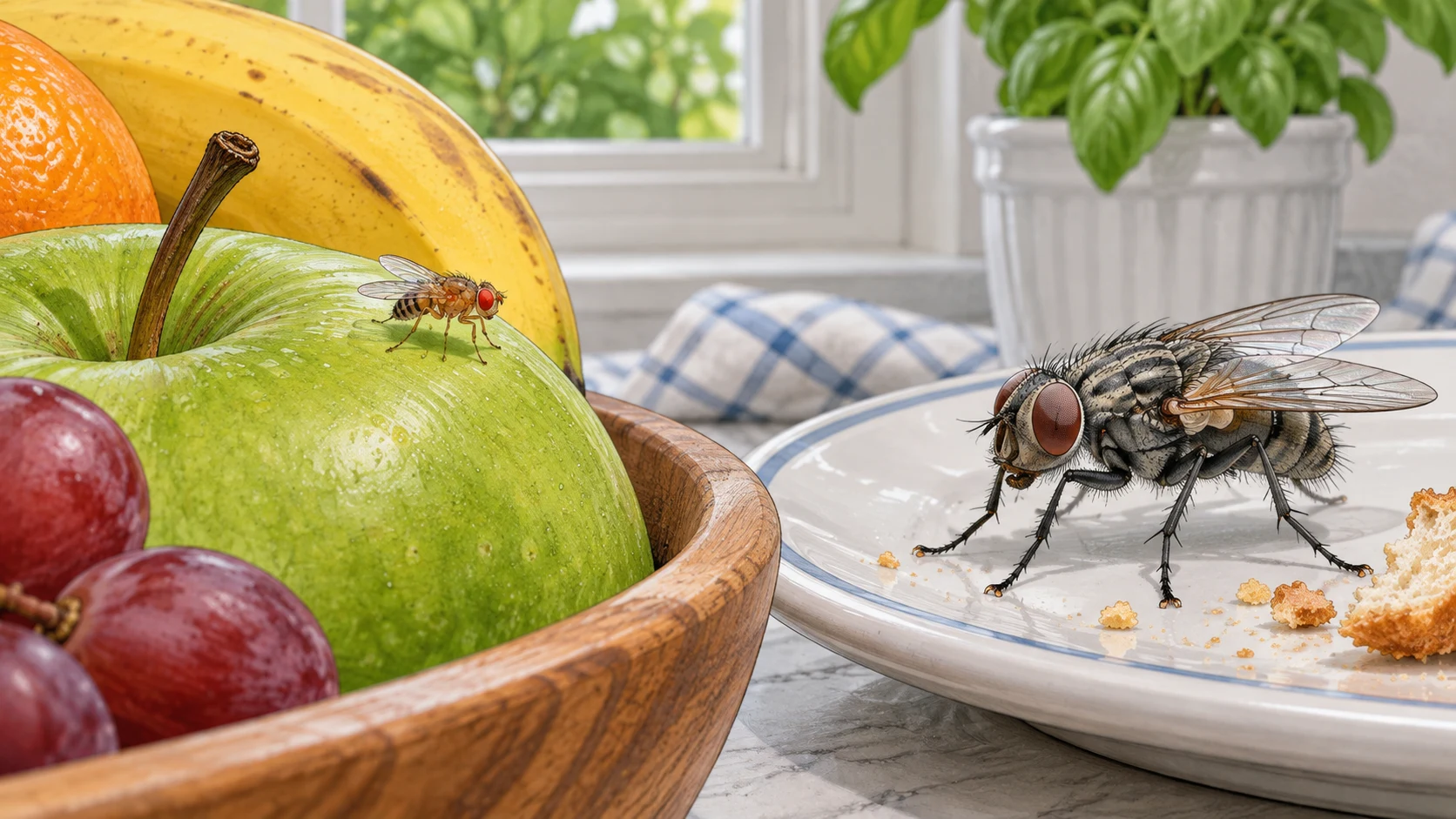
House flies are larger, gray-bodied insects with four dark stripes on their thorax, while common fruit flies are much smaller, usually tan or brown, and often have reddish eyes. Their surroundings provide another useful clue. House flies are commonly associated with garbage, animal waste, and other decaying organic material, whereas fruit flies tend to gather around fermenting fruit, vegetables, and sugary liquids.
Both can appear in a kitchen, and both may land on food. However, finding several tiny flies around an overripe banana suggests a different source from finding larger gray flies moving between a trash container and a window.
House Fly vs. Fruit Fly: Quick Comparison
|
Feature |
House fly |
Fruit fly |
|---|---|---|
|
Scientific identification |
Musca domestica |
Commonly Drosophila species |
|
Typical adult length |
About 5–8 mm |
About 2–4 mm |
|
Body color |
Mostly dull gray |
Often tan, yellowish brown, or darker brown |
|
Body shape |
Larger, relatively elongated fly |
Tiny, compact, somewhat stout fly |
|
Thorax |
Four dark lengthwise stripes |
No corresponding four-stripe house fly pattern |
|
Eyes |
Large compound eyes, often reddish |
Often conspicuously red, but some species have dark eyes |
|
Common adult activity |
Around waste, food, doors, and windows |
Around fermenting produce, spilled drinks, and food residues |
|
Typical breeding material |
Moist garbage, manure, and decaying organic matter |
Fermenting fruit, vegetables, and other moist, yeast-rich residues |
The measurements overlap at the margins because individual flies and species vary. Nevertheless, the usual difference is substantial enough that a house fly looks noticeably larger than a typical kitchen fruit fly.
Size and Body Shape Differences
Size is generally the easiest feature to check without magnification. An adult house fly is commonly around a quarter-inch long, with a substantial thorax and abdomen. A typical fruit fly is closer to one-eighth of an inch or smaller, making it appear almost like a moving speck when seen across a kitchen counter.
A house fly has a dull gray thorax marked with four narrow, dark longitudinal stripes. Its abdomen may appear grayish, yellowish along the sides, or somewhat patterned depending on the individual and viewing angle. These features are useful for recognizing the appearance of a house fly rather than identifying every medium-sized fly by its general silhouette.
Common red-eyed fruit flies have a more compact body, often with a tan or amber thorax and a darker abdomen. Their relatively large eyes can be conspicuous in a close photograph. Some household fruit flies are dark-eyed and darker-bodied, however, so red eyes are not a requirement for identification.
The physical characteristics of common indoor flies illustrate why body markings and proportions are more dependable than color alone. A tiny dark fly is not automatically a fruit fly, just as a gray fly is not automatically a house fly.
Can You Tell Them Apart by Their Eyes?
Fruit flies are often described as having bright red eyes, and this is a helpful feature for identifying many common Drosophila species. Their eyes can stand out strongly against a pale tan body, especially in a close-up photograph.
House flies also have prominent compound eyes that may appear reddish. Therefore, seeing red eyes does not establish that an insect is a fruit fly. Compare the eye color with the insect’s size, thorax markings, and overall body proportions.
The common red-eyed and dark-eyed fruit fly forms also demonstrate why eye color alone can be misleading. Some fruit flies lack the bright red appearance people expect, and lighting can alter how the eyes look.
For a small insect resting on a window or countertop, a close photograph taken from above and slightly to the side is often more useful than trying to identify it while it flies.
Where House Flies and Fruit Flies Are Usually Found
House flies are frequently seen moving between windows, doors, garbage containers, and exposed food. They may enter from outdoors through open doors, damaged screens, or other openings. Their presence inside a room does not necessarily mean they are breeding there.
Fruit flies are more strongly associated with particular indoor food sources. A bowl of overripe fruit, a damaged potato in a cupboard, or residue from a sugary drink can attract adults. Their small size also allows them to occupy places that might not immediately draw attention, including damp food spills beneath kitchen equipment.
An adult fly’s location is a clue, not proof of its breeding site. A house fly resting beside a fruit bowl might simply be feeding, while fruit flies hovering near a trash can could be developing in fermenting produce discarded inside it.
The distinction is especially useful when considering what attracts house flies to food. House flies exploit a wide variety of food and waste materials. Fruit flies are more closely associated with fermentation and the yeasts growing in suitable moist material.
Where Do House Flies Breed Compared With Fruit Flies?
House flies typically lay their eggs in warm, moist organic material capable of supporting their developing larvae. Suitable sites include animal manure, wet garbage, decaying plant matter, and other accumulated organic waste. The resulting maggots feed within that material before developing into adults.
This means a house fly found indoors may have originated from a breeding site outside the building. An uncovered garbage container, accumulated waste, or manure near an animal enclosure may support development even when the flies are most noticeable in the kitchen. The broader range of house fly egg-laying sites helps explain why checking only indoor food sources may miss their origin.
Fruit flies, particularly the familiar vinegar flies in the genus Drosophila, generally breed in fermenting organic material. Overripe bananas, damaged tomatoes, rotting onions, and residues from beer, wine, juice, or syrup can provide suitable conditions. Their larvae feed largely on microorganisms, including yeasts, associated with these materials.
Unlike house flies, which often develop outdoors and then enter buildings, fruit flies can complete their development entirely inside a home when suitable fermenting material remains available. Indoor fruit fly breeding habitats can include surprisingly small accumulations of moist, food-rich residue.
There is some overlap. House flies can breed in decaying fruit or vegetables under suitable conditions, and fruit flies can develop in fermenting material inside garbage containers. The condition of the material, particularly whether it is fermenting and yeast-rich, helps distinguish the likely source.
What If Both Types of Flies Are Around the Same Garbage Can?
A garbage container can attract both house flies and fruit flies, but for different reasons. House flies may be drawn to a mixture of moist food scraps and decomposing waste. Fruit flies may concentrate around discarded fruit, vegetable scraps, or liquids that have begun fermenting.
Look at where the insects gather most densely. Larger gray flies moving between the container, nearby surfaces, and windows are consistent with house fly activity. Numerous tiny flies hovering close to fruit scraps or sticky liquid residue are more consistent with fruit flies.
Neither observation confirms that the insects developed inside the container. Adult flies can travel to a food source from elsewhere. However, examining the material present provides a useful starting point for identifying possible breeding sites.
The condition of outdoor waste can also influence house fly activity around garbage containers. A container holding damp, decomposing material is a more plausible house fly breeding site than a clean, dry bin.
How to Identify a Fly When You Cannot See Its Markings
A small fly moving rapidly around a room can be difficult to examine. Rather than relying on its flight pattern, look for an opportunity to observe it while resting.
Start with its approximate size. A fly around 6 mm long with a gray body is more consistent with a house fly than a typical Drosophila fruit fly. A tiny, compact insect around 2–3 mm long, particularly one gathering around fermenting produce, is more consistent with a fruit fly.
Next, inspect the thorax and eyes. Four dark stripes running lengthwise along the thorax support a house fly identification. A tan body with conspicuous red eyes supports identification as a common red-eyed fruit fly, although other fruit fly species may be darker.
Finally, consider the surrounding conditions. If the insects appear primarily near windows and entry doors, they may be arriving from outdoors. If tiny flies repeatedly appear around the same fermenting food material, that location may be supporting their development.
These observations work best together. The identification characteristics of house flies include their gray bodies and four thoracic stripes, while fruit fly identification depends on a different combination of size, body color, and food associations.
When the insect does not match either description, avoid forcing an identification. Many flies occur around homes, and not every fly found indoors is a house fly.
Can House Flies and Fruit Flies Breed in the Same Place?
Yes. Both may develop in the same general location if it contains suitable material for each species. A garbage container holding moist organic waste alongside fermenting fruit scraps is one possible example.
That does not mean they use every part of the waste equally. House fly larvae can develop in a broad range of moist, decomposing organic materials. Common fruit fly larvae are particularly associated with fermenting material containing yeasts and other microorganisms.
It is also possible to have adults of both species visiting the same food source without either species breeding there. Adult feeding activity and larval development are separate observations.
Common Questions About House Flies and Fruit Flies
Are fruit flies just baby house flies?
No. Fruit flies and house flies are different insects. A young house fly develops through egg, larval, and pupal stages before emerging as an adult. It does not emerge as a miniature winged fly that gradually grows larger. The small fruit flies seen hovering around produce are already adults.
Do house flies have red eyes like fruit flies?
Yes, house flies can have reddish compound eyes. Many common fruit flies also have red eyes, but some have dark eyes. Body size and thorax markings are more useful than eye color alone.
Are all tiny flies around bananas fruit flies?
Not necessarily. Fermenting bananas strongly suggest fruit fly activity, but other small flies can occur in kitchens. A close look at the insect’s body and the material around it is needed for a more reliable identification.
Do fruit flies turn into house flies?
No. Fruit flies develop into adult fruit flies, and house flies develop into adult house flies. They belong to different fly families and have separate life cycles.
The Most Reliable Difference to Look For
For a quick identification, compare the fly’s size and body markings before considering where it was found. A relatively large, dull gray fly with four dark thoracic stripes is consistent with a house fly. A much smaller, compact fly with a tan or brown body, often with red eyes, is more consistent with a common fruit fly.
The likely breeding material provides additional evidence. Moist waste and manure favor house fly development, while fermenting produce and sugary residues favor fruit flies. Using both the insect’s appearance and the condition of nearby organic material produces a more dependable identification than either clue alone.