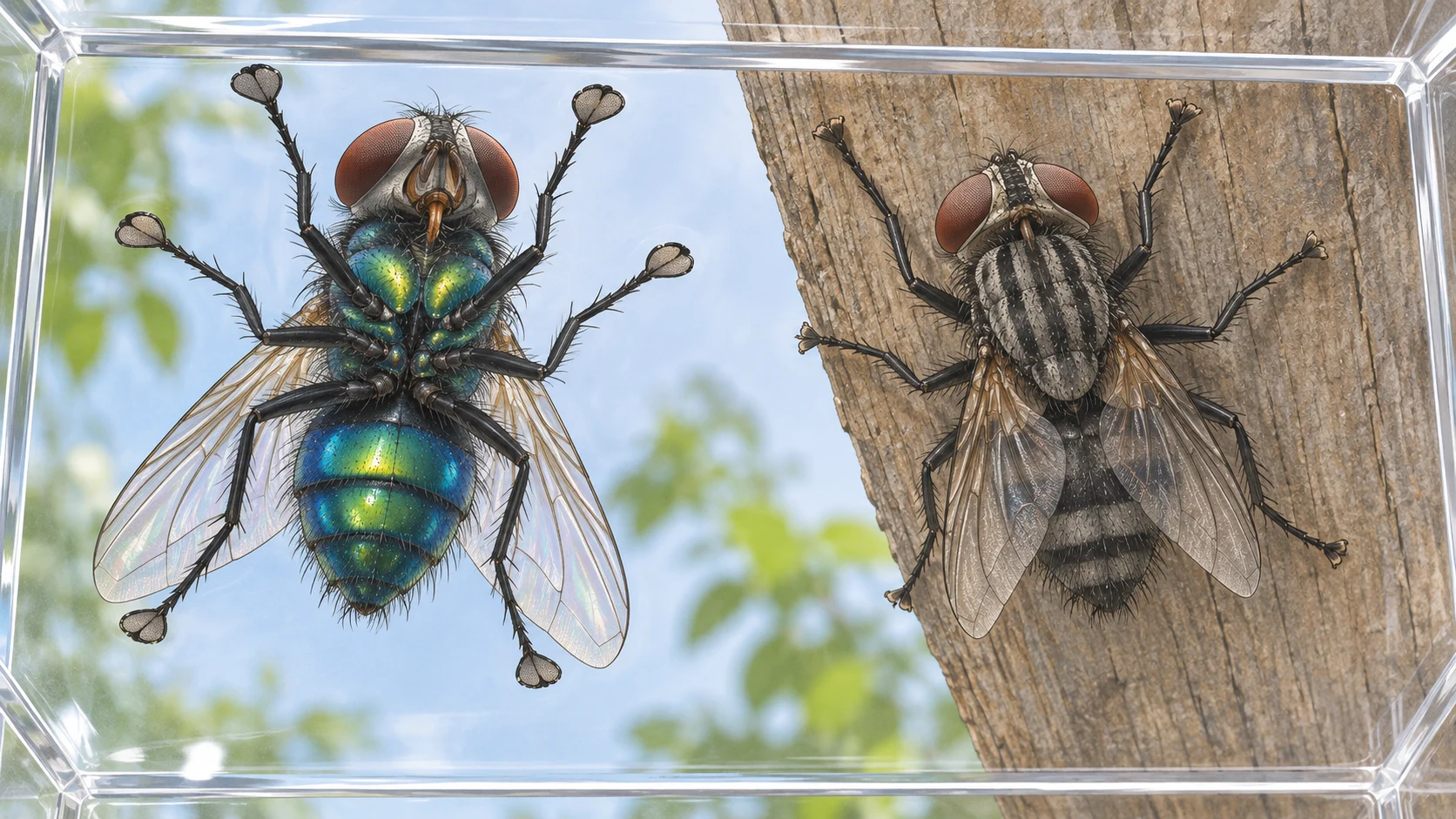
The easiest way to distinguish a house fly from a blow fly is by looking at its body color. House flies are dull gray with four dark stripes running along their thorax, while many blow flies have shiny, metallic blue, green, bronze, or black bodies. Blow flies are also often larger and more robust, although the two groups overlap considerably in size.
Their breeding habits provide another useful clue. House flies commonly develop in manure, moist garbage, and other decomposing organic material. Blow flies are particularly associated with dead animals, discarded meat, and animal-based waste, although some species also develop in garbage and feces.
A large metallic fly inside a house does not automatically mean there is a dead animal nearby. However, finding numerous blow flies indoors, particularly when they appear suddenly, makes an animal-based breeding source worth considering.
House Fly vs. Blow Fly: Quick Comparison
|
Feature |
House fly |
Blow fly (bottle fly) |
|---|---|---|
|
Scientific classification |
Musca domestica |
Family Calliphoridae |
|
Typical adult size |
About 5–8 mm |
Often 6–12 mm, with substantial variation |
|
Body color |
Dull gray |
Frequently metallic blue, green, bronze, or dark |
|
Thorax |
Four dark lengthwise stripes |
Varies by species; often shiny or partly metallic |
|
Body shape |
Medium-sized, relatively compact |
Often broader and more robust |
|
Wings |
One functional pair |
One functional pair |
|
Common breeding materials |
Manure, moist garbage, decaying organic matter |
Carrion, meat waste, garbage, and sometimes feces |
|
Indoor clues |
Flies around food, waste, doors, and windows |
Metallic flies around windows, garbage, or an unidentified nearby source |
The most useful difference is coloration, not size. A small metallic blow fly can be similar in length to a house fly, while some larger blow flies are considerably bigger.
The Metallic Color of Blow Flies Is Their Most Recognizable Feature
House flies have a comparatively plain appearance. Their thorax is gray with four dark longitudinal stripes, and the abdomen may be grayish or yellowish along its sides. Their bodies can reflect some light, but they do not normally have the bright metallic appearance associated with bottle flies.
Blow flies often look as though their bodies have been coated with polished metal. Depending on the species, the abdomen or much of the body may appear brilliant blue, green, coppery, or bronze. Some are considerably darker, with a blackish appearance that makes their metallic sheen less obvious.
This coloration is a useful first step in identification because it can often be recognized without magnification. The distinctive metallic appearance of blow flies separates many common bottle flies from the dull gray house fly.
Not every blow fly is brightly colored, however. Some species have a duller thorax with a metallic abdomen, while others appear almost black. Lighting also affects their appearance. A dark blue fly in a shaded room may look black until sunlight catches its abdomen.
The four dark thoracic stripes remain a useful feature when identifying the common house fly. When the color is ambiguous, a close photograph of the thorax and abdomen can provide more information than the insect’s overall appearance from a distance.
Are Blow Flies Bigger Than House Flies?
Blow flies are often larger than house flies, but size alone cannot reliably separate them.
An adult house fly generally measures about 5–8 mm long, roughly a quarter of an inch. Blow flies vary substantially because the name covers an entire family rather than one species. Many familiar bottle flies measure approximately 6–12 mm, while the broader group includes smaller and larger species.
A robust blow fly may therefore appear nearly twice as large as a typical house fly. Its wider abdomen and heavier-looking body can exaggerate the difference, especially when the insects are seen resting beside one another.
However, a blow fly measuring 6–7 mm may be no longer than an ordinary house fly. The size variation among common household flies makes color and body markings more dependable than measurements alone.
A useful identification approach is to compare the fly’s overall proportions with its surface appearance. A relatively small, gray fly with four thoracic stripes is consistent with a house fly. A broader insect with a metallic blue or green abdomen is more suggestive of a blow fly, even if it is not especially large.
Where House Flies and Blow Flies Breed
The breeding material associated with each fly provides an important distinction, although their habitats are not completely separate.
House flies commonly lay eggs in moist, decomposing organic matter. Animal manure, wet garbage, and suitable decaying plant material can support their larvae. Their eggs hatch into maggots that feed within the material before moving into the pupal stage.
Blow flies are strongly associated with animal-based organic material. Many species lay eggs on dead animals, decaying meat, or garbage containing meat scraps. Their larvae feed in these materials, helping break down animal remains.
The association with carrion is particularly characteristic of many blow flies. Their ability to locate and use dead animals as breeding material explains why metallic flies sometimes appear around a deceased rodent, bird, or other animal.
However, blow flies are not restricted to carcasses. Some species develop in garbage or animal waste, and suitable food waste can be an important breeding source in residential settings. The different breeding materials used by house flies and blow flies overlap enough that the material alone cannot identify an adult fly.
For house flies, the range of places where eggs can be laid includes several kinds of moist organic waste. For blow flies, the presence of animal tissue or meat-rich waste is a particularly useful clue, although not proof of the species.
Why Metallic Flies May Suddenly Appear Inside a House
Finding one metallic fly indoors is usually insufficient to identify its origin. It may have entered through an open door, damaged screen, or another opening while searching for food or a place to rest.
A sudden appearance of numerous blow flies is more significant. When several adults emerge within a relatively short period, it may indicate that larvae developed in a nearby source and completed their transformation into adults.
One possible explanation is a dead animal in a concealed part of the building. A mouse in a wall cavity, a bird in a chimney, or another small animal in an attic can provide suitable material for some blow fly species.
This association is sufficiently common that large numbers of blow flies appearing indoors can warrant checking for a nearby breeding source. Nevertheless, the same pattern may arise from accessible garbage containing meat scraps or other suitable organic material.
The timing and distribution of the insects can help narrow the possibilities. Metallic flies repeatedly appearing around one room or section of a building may suggest a source in that general area. Flies concentrated around a garbage container may instead be associated with discarded food waste.
Neither observation establishes an exact breeding location. Adult blow flies can move away from their developmental site, and mature larvae may leave the original material before pupating.
House flies can also appear suddenly when adults emerge from suitable breeding material. The difference is that their breeding sources more commonly include manure and a broad range of moist, decomposing waste.
Can Both Flies Be Found Around the Same Garbage?
House flies and blow flies can occur around the same garbage container because household waste may contain materials suitable for both groups.
A container holding damp vegetable scraps, food residue, and other decomposing organic matter can attract house flies. If it also contains discarded meat, fish, or animal-based waste, blow flies may be attracted as well.
Adult feeding activity should not be confused with successful breeding. A fly landing on a garbage lid may have arrived from elsewhere. Evidence of larvae developing within the waste provides stronger support that the container is functioning as a breeding site.
The type and condition of the material are more informative than the container itself. Moist, decomposing waste is more favorable for fly development than clean, dry surfaces. The relationship between outdoor garbage and house fly activity is therefore relevant even when metallic blow flies are present nearby.
Both groups may also visit exposed food. Their presence on a countertop or dining table does not mean they developed there. These are adult feeding or resting locations, not necessarily larval habitats.
What If You Find Maggots but Cannot Identify the Adult Flies?
House fly larvae and blow fly larvae are generally pale, legless maggots. Their appearance can be similar enough that a casual visual inspection is unlikely to provide a dependable identification.
The surrounding material offers a useful clue. Maggots developing in manure or mixed moist garbage could be house flies, while larvae in a dead animal or decomposing meat may belong to blow flies.
These associations are not exclusive. Both groups can use some of the same materials, and several fly species may develop within a single source.
Mature larvae may also crawl away from their food before pupating. Finding maggots on a nearby floor does not necessarily mean the floor itself contains the breeding material.
Adult specimens are generally easier for a homeowner to distinguish. If metallic flies are emerging nearby, that supports a blow fly identification. If the adults are dull gray with four thoracic stripes, house flies become more likely.
Do House Flies and Blow Flies Present the Same Contamination Concerns?
Both groups can carry microorganisms from contaminated material to surfaces they visit. Their association with waste, feces, and decomposing organic matter creates opportunities for mechanical transfer.
House flies have sponging mouthparts and can feed on liquid or softened material. Blow flies also commonly feed on liquids and suitable organic substances as adults. Neither group should be treated as harmless merely because it does not ordinarily bite people.
Their potential to transfer microorganisms depends on where they have been feeding or resting, what organisms are present, and what surfaces they subsequently contact. A fly landing on food does not automatically establish that disease-causing organisms were transferred or that illness will follow.
The contamination potential of filth-breeding flies applies to both groups, despite their different appearances and breeding preferences.
For identification purposes, contamination concerns do not distinguish one fly from the other. The adult’s markings and likely developmental material are more useful.
How to Distinguish Them When Both Are Near a Window
Windows are common resting and escape-attempt locations for many flies. House flies and blow flies may both gather against glass after entering a building.
A large fly buzzing repeatedly against a sunny window is not necessarily a blow fly. The same behavior occurs in house flies and several other groups.
Examine the insect while it is resting. A metallic blue, green, or bronze abdomen strongly suggests a blow fly. A dull gray thorax with four dark stripes points toward a house fly.
If the insect is difficult to examine, a clear photograph can help. Photographing it from above may reveal thoracic markings, while a side view can show body proportions and metallic coloration.
Finding dead flies on the windowsill is not diagnostic either. Both groups may become trapped indoors and die near windows. The reasons house flies accumulate at windows also apply more broadly to insects attempting to move toward daylight.
When numerous metallic flies repeatedly appear in the same room, their appearance and emergence pattern together provide a stronger reason to investigate a nearby source than either observation alone.
Questions About House Flies and Blow Flies
Is a bottle fly the same as a blow fly?
The names are commonly used interchangeably for members of the blow fly family, Calliphoridae. Bottle fly is particularly associated with the shiny blue or green appearance of many familiar species. Blow fly is the broader group name.
Are all blow flies blue or green?
No. Although metallic blue and green are common, blow flies can also appear bronze, coppery, blackish, or partly dull-colored. Their coloration varies by species, so a fly does not need to be bright green or blue to belong to this family.
Does finding a blow fly mean there is a dead animal in the house?
Not necessarily. A single adult may have entered from outdoors, and blow flies can develop in garbage and other suitable organic material. Numerous metallic flies emerging indoors may raise suspicion of a nearby carcass, but their presence does not confirm one.
Can house flies and blow flies breed in the same garbage?
They can, provided the garbage contains suitable material for both. House flies commonly develop in moist decomposing waste, while many blow flies favor animal-based material such as meat scraps. Mixed household garbage can contain both.
The Most Reliable Way to Tell Them Apart
The strongest visual distinction is the body surface. House flies are dull gray with four dark stripes on the thorax. Many blow flies have a conspicuous metallic sheen, often blue, green, or bronze, and may be larger and more robust.
Breeding clues provide additional evidence. Moist garbage and manure commonly support house flies, while carrion and meat-rich waste are particularly associated with blow flies. Both can use certain types of garbage, so the source alone is not conclusive.
A single metallic fly indoors may simply be a visitor. Numerous metallic flies appearing suddenly deserve closer attention because they can indicate a nearby source of decomposing animal material or suitable waste. Identifying the adult fly before interpreting the surrounding conditions helps distinguish an ordinary house fly problem from activity involving blow flies.