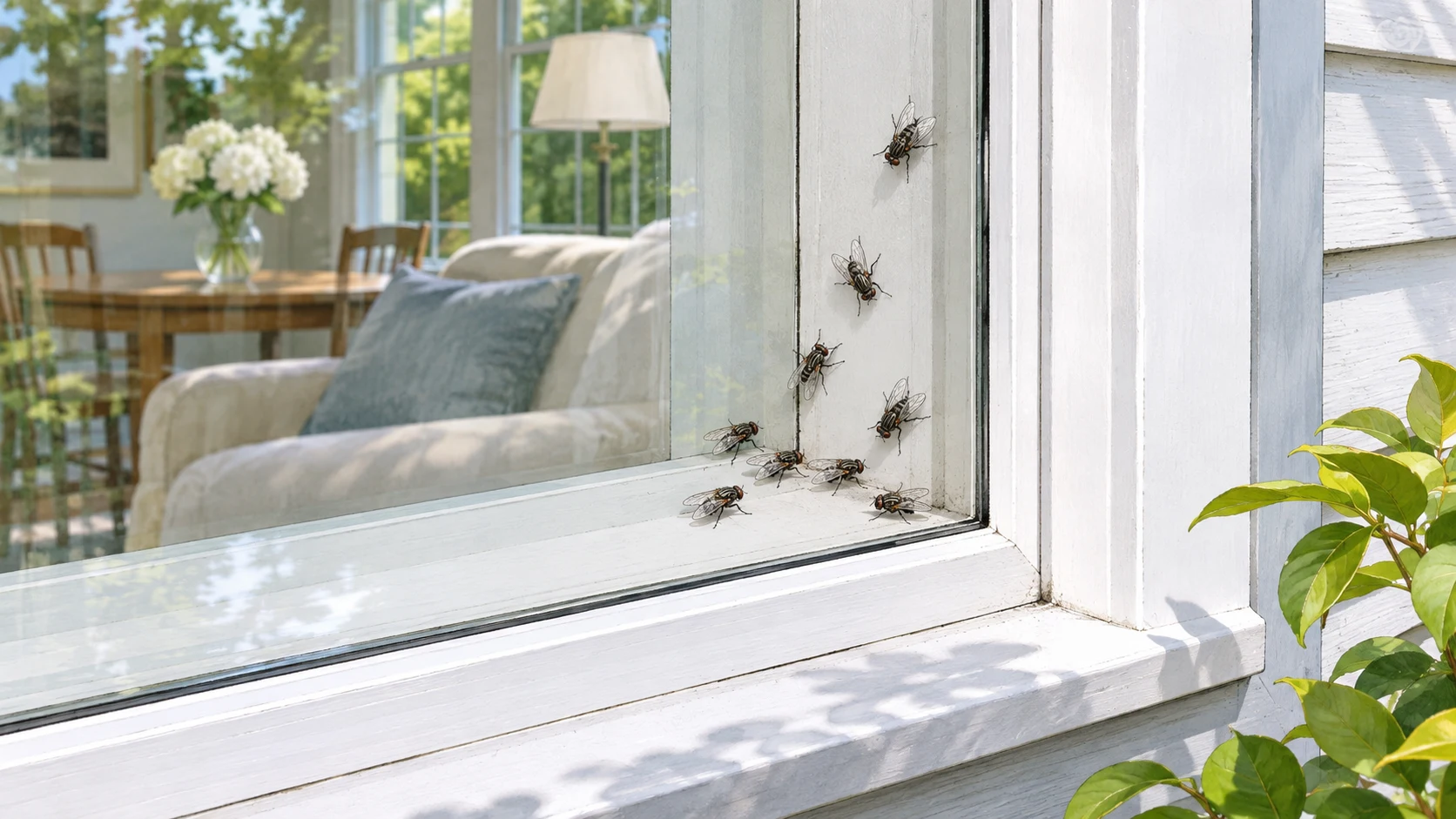
House flies gather around windows because bright areas attract flying insects and provide convenient surfaces for resting. Daylight entering through glass can influence their movement, while window frames and nearby walls offer places to settle. Warmth from sunlight can also make window areas attractive to certain flies. However, large groups of flies collecting around windows are not always ordinary house flies. Several other species, particularly cluster flies and face flies, show much stronger associations with this behavior.
Why Do House Flies Fly Toward Windows?
Windows allow daylight to enter buildings, creating bright areas that can influence the movement of flying insects. A house fly moving through a relatively dim room may approach an illuminated window because of the visual contrast between that area and its surroundings.
House flies use their compound eyes to detect visual information and navigate their environment. Brightness, movement and the visual arrangement of nearby objects can all influence their flight. Their responses are therefore connected to how they perceive the room rather than to an understanding of windows as openings.
Glass creates an obstacle the fly cannot pass through. An insect approaching a bright window may repeatedly change direction or circle near the glass while attempting to move through the illuminated area.
The same behavior can make a window appear to be a collection point for flies. Several insects approaching the same bright surface may remain in that area instead of dispersing throughout the room.
The visual system of house flies helps explain why changes in illumination influence their movement, even when the illuminated surface is physically inaccessible.
Why Do Flies Rest on Window Frames and Nearby Walls?
A window provides more than an illuminated surface. The surrounding frame, sill and nearby walls offer places where flies can land and remain undisturbed.
House flies frequently rest on walls and other stationary surfaces between periods of activity. They also show a preference for light-colored resting surfaces. Consequently, pale window frames, painted walls and bright interior surfaces can become noticeable resting locations.
These resting spots can sometimes be recognized by the small dark marks left behind by house flies. Their droppings and regurgitated material may accumulate on surfaces where the insects repeatedly settle.
Research-based house fly behavior and resting-site information describes their preference for light-colored resting surfaces and explains why fly marks can become particularly noticeable when adult numbers increase.
A window surrounded by pale walls may therefore attract attention for two different reasons. Its illumination can influence flight, while its surfaces provide convenient places for resting.
Does Sunlight and Warmth Make Windows More Attractive to Flies?
Sunlight can warm window glass, window frames and nearby walls, creating warmer surfaces inside a building. This can influence where some insects become active or choose to rest.
The effect is particularly noticeable with certain flies that spend periods sheltering inside buildings. When their surroundings become warmer, they can become active again and move toward illuminated areas.
A Canadian government explanation of clustering flies describes how overwintering flies become more active when temperatures rise and may gather near windows where light attracts them. Warm areas around the building can also contribute to their earlier movement indoors.
This does not mean every house fly gathering around a sunny window is responding to warmth. Light and temperature are separate environmental influences, and their relative importance varies between fly species.
A sunny window can consequently attract attention from several different kinds of flies, particularly when the surrounding room remains relatively cool.
Why Do Large Numbers of Flies Collect Around One Window?
A large gathering around a single window deserves closer attention because ordinary house flies are not the only insects that display window-gathering behavior.
Cluster flies (Pollenia species) are particularly associated with collecting around windows inside buildings. They can enter structural spaces and remain there until conditions encourage them to become active. Once moving around indoors, they frequently congregate near illuminated windows.
Face flies (Musca autumnalis) can show similar behavior. Although they closely resemble house flies, their normal association is with cattle and other grazing animals. Their ability to gather around windows can make identification difficult when several insects appear together.
Extension entomology guidance on flies found around windows describes how cluster flies and face flies can collect in large numbers around indoor windows. These insects can be mistaken for common house flies because their adult appearance is similar.
Another relevant observation involves face flies emerging from indoor resting locations. They can become active around windows when attracted to light, particularly after spending time inside protected areas of a building. The face fly’s indoor behavior and attraction to illuminated windows illustrates why a large gathering should not automatically be attributed to Musca domestica.
The species distinction matters because the presence of numerous flies near a window does not establish that they are breeding inside the home or that they all belong to the same species.
How Can You Tell Whether the Flies Around Your Window Are House Flies?
Appearance and movement provide useful clues when identifying flies gathered around windows.
The common house fly is generally gray, with four dark longitudinal stripes running along the upper surface of its thorax. It usually moves readily when disturbed and may fly between several resting surfaces.
Cluster flies tend to be somewhat larger and more sluggish. They have distinctive golden hairs on the upper thorax, although these can be difficult to see without close inspection.
Face flies resemble house flies closely, making reliable identification more difficult from a casual observation. Their association with livestock and their characteristic feeding behavior around cattle provide additional identification context.
A useful first step is to examine the insect’s overall size, thoracic markings and movement rather than relying on the location where it was found. The typical appearance of common house flies provides a starting point for distinguishing them from other similarly sized household flies.
|
Observation |
What it may suggest |
|---|---|
|
Individual gray flies resting on pale surfaces |
Common house flies are possible |
|
Large numbers of sluggish flies near windows |
Cluster flies or other indoor-resting species are possible |
|
Similar-looking flies in a rural property near livestock |
Face flies may warrant consideration |
|
Tiny flies gathering around window glass |
Another small-fly species may be involved |
These are identification clues rather than definitive diagnoses. A photograph showing the body markings and shape can provide more useful evidence than the location alone.
Why Do House Flies Remain Near Windows Instead of Flying Elsewhere?
A fly that repeatedly returns to a window may be responding to the same visual conditions each time it moves around the room. The bright area remains noticeable, and the nearby frame or wall continues to offer a place to land.
The fly’s normal activity pattern also influences what you observe. House flies are primarily active during daylight, so window gatherings are often more noticeable when natural light fills the room. Their daily activity patterns help explain why these encounters change between daytime and nighttime.
Resting behavior contributes too. A fly may alternate between short periods of movement and stationary periods on nearby walls or frames. Its usual indoor resting locations provide additional context for these periods of inactivity.
Consequently, a fly remaining near a window does not necessarily mean it is trapped there or that the window is its preferred resting place under every condition.
Why a Window Gathering Does Not Always Mean You Have a House Fly Infestation
Several different fly species can enter buildings and collect around illuminated windows. Some arrive from outside, while others use protected areas within buildings temporarily.
The location of the insects alone cannot establish an infestation or identify where they originated. A group gathered around a window may include insects that entered through openings, emerged from sheltered areas or simply moved toward the brighter part of the room.
The difference between an indoor-breeding fly and an outdoor species that temporarily enters a building is particularly important. Different flies found inside homes can have very different habits, even when their adult appearance is similar.
When you see an unusually large gathering, examine the insects themselves before assuming they are ordinary house flies. Their appearance, movement and surrounding circumstances provide a better basis for identification than the window location alone.
4 thoughts on “Why Do House Flies Gather Around Windows?”