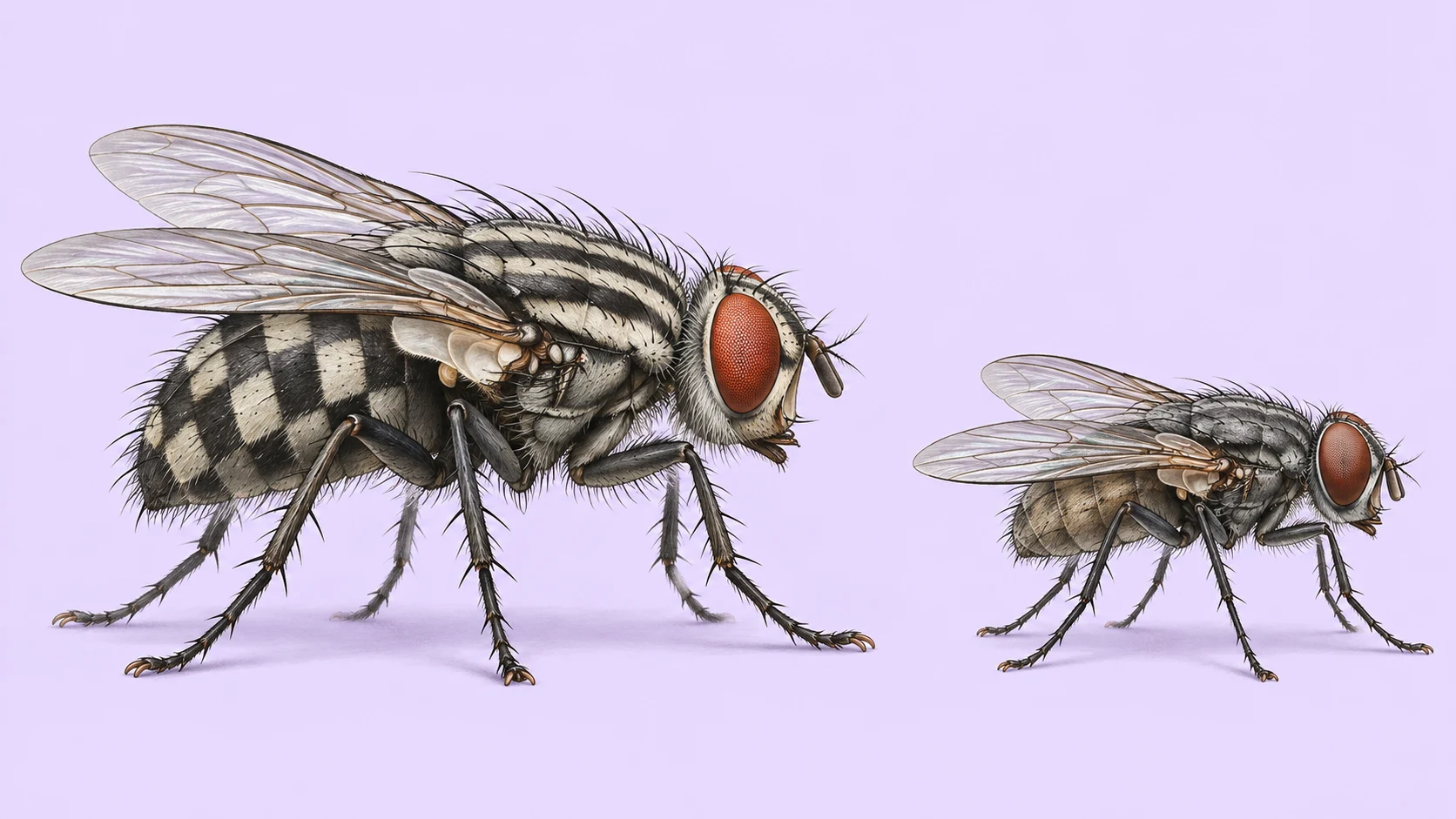
House flies and flesh flies are both gray, nonbiting flies, but their markings make them distinguishable. A house fly has four dark stripes running lengthwise along its thorax, while a typical flesh fly has three broader black stripes and a conspicuous black-and-gray checkerboard pattern across its abdomen. Flesh flies are also generally larger and more heavily built.
Their reproductive habits provide another important difference. House flies lay eggs that hatch into maggots. Many flesh flies retain their eggs until they hatch inside the female, then deposit living larvae directly onto suitable material. This material often includes decomposing animal tissue, carrion, or animal waste. Because both flies can visit garbage and enter houses, finding one near a trash container does not identify it. Body markings, size, and the type of decaying material nearby offer much stronger evidence.
House Fly vs. Flesh Fly: Main Differences
|
Feature |
House fly |
Flesh fly |
|---|---|---|
|
Scientific classification |
Musca domestica, family Muscidae |
Family Sarcophagidae |
|
Typical adult size |
About 5–8 mm |
Many familiar species measure 10–14 mm |
|
Body color |
Dull gray |
Gray to grayish black |
|
Thorax markings |
Four dark lengthwise stripes |
Usually three prominent dark lengthwise stripes |
|
Abdomen |
Grayish or yellowish, sometimes with darker markings |
Often a distinct black-and-gray checkerboard pattern |
|
Abdomen tip |
No characteristic bright red tip |
Reddish or orange coloration in some species |
|
Reproduction |
Female lays eggs |
Many species deposit living larvae |
|
Common larval habitats |
Manure, moist garbage, decaying organic material |
Carrion, animal waste, decaying meat, and other species-dependent habitats |
|
Common indoor clues |
Activity around food, garbage, and entry points |
Large gray flies near decomposing animal material or suddenly appearing indoors |
These characteristics describe the common forms most likely to be confused around homes. Flesh flies are a large family containing many species, and not all have identical appearances or developmental habits.
The Difference Between Three and Four Thorax Stripes
The most useful visual distinction is the number of dark stripes on the thorax, the middle section of the insect’s body where its legs and wings attach.
A house fly has four relatively narrow, dark longitudinal stripes against a gray background. These are characteristic markings of the common house fly, although they can be difficult to count when the insect is moving or viewed from an angle.
A typical flesh fly has three prominent black stripes running in the same direction. They tend to be broader and more conspicuous, creating a bold striped appearance across the thorax.
The difference is easiest to see from directly above. A side view may hide one or more stripes, and reflections can make the lighter spaces between them difficult to distinguish. A clear photograph of a resting fly is usually more helpful than trying to count stripes while it walks.
The three-stripe flesh fly pattern is especially useful when combined with the abdomen’s checkerboard appearance. Counting stripes alone is not sufficient to identify every gray fly, because other fly families can also have longitudinal thoracic markings.
The Checkerboard Pattern on a Flesh Fly’s Abdomen
Many familiar flesh flies have a striking pattern of alternating light gray and dark patches across the upper abdomen. The markings create a checkered or tessellated appearance that can change noticeably with the angle of light.
This pattern is often more obvious than the thorax stripes, particularly on a large specimen resting against a pale wall. It may resemble irregular black squares separated by silver-gray areas.
House flies can also have patterned abdomens, so a checkered appearance is not exclusive to flesh flies. However, a large gray fly displaying both three dark thoracic stripes and a strongly contrasting checkerboard abdomen is much more suggestive of a flesh fly than a house fly.
Some flesh flies also have a reddish or orange tip to the abdomen. This can be helpful when present, but it is not universal and should not be treated as a required characteristic. The combination of thorax stripes, abdominal checkering, and body size provides a more dependable identification.
Flesh Flies Are Usually Larger Than House Flies
A typical house fly measures approximately 5–8 mm long, while many flesh flies commonly encountered around buildings measure around 10–14 mm. The difference can be substantial when the insects are viewed side by side.
Flesh flies often have a robust body with a relatively broad thorax and a substantial abdomen. Their larger size can make them appear heavier than house flies, even when their overall shape is similar.
Size is not conclusive, however. The family Sarcophagidae contains species of different dimensions, and some smaller flesh flies overlap with larger house flies.
A large gray fly should therefore be examined for its stripes and abdominal pattern before being identified. Likewise, a smaller gray fly is not necessarily a house fly.
House Flies Lay Eggs, but Many Flesh Flies Deposit Living Maggots
One of the most interesting differences between these flies is how females deliver their offspring to a breeding site.
Female house flies lay batches of eggs in suitable warm, moist organic material. The eggs hatch into legless larvae, commonly called maggots, which feed within the material before eventually pupating.
The reproductive biology of many flesh flies is different. Their eggs hatch within the female’s reproductive tract, and she deposits living larvae directly onto a suitable developmental substrate. This process is called larviposition, and the reproductive condition is often described as larviparity.
As a result, the larvae can begin feeding soon after they are deposited, without first spending an external egg stage on the material. This is a well-established characteristic of many flesh flies in the family Sarcophagidae.
The distinction is important, but it does not mean every flesh fly species reproduces identically. Reproductive strategies vary within the family, and the precise biology depends on the species.
For homeowners, this difference is rarely visible. Observing a fly on a garbage container will not reveal whether it has deposited eggs or larvae. The egg-laying behavior of house flies is better understood as part of their development rather than as a reliable way to identify a moving adult.
Can You Identify Them by Their Maggots?
Not reliably without a closer examination.
Both house fly and flesh fly larvae are typically pale, soft-bodied, legless maggots. Their general appearance is too similar for a homeowner to identify them confidently from color or shape alone.
The breeding material may offer clues, but the larvae of several different fly groups can occupy similar substrates. Finding maggots in decaying meat does not automatically establish that they are flesh flies, and finding them in manure does not establish that they are house flies.
An identifiable adult specimen provides a more practical starting point. The differences in stripes, body size, and abdominal markings are usually easier to recognize than the diagnostic structures of larvae.
Where Flesh Flies Breed Compared With House Flies
House flies use a wide variety of moist, decomposing organic materials. Animal manure, wet garbage, decaying vegetation, and certain food wastes can support their larvae. The material must provide suitable moisture, nutrients, and conditions for development.
Flesh flies are particularly associated with animal-derived material. Many species develop in dead animals, decomposing meat, or excrement. Others have more specialized relationships with living or dead invertebrates, including insects and other small animals.
These differences reflect the diversity of flesh flies rather than a single universal breeding habit. The range of flesh fly developmental habitats includes carrion, dung, and other decaying material, with important variation between species.
The two groups can occur around the same waste source. A garbage container containing meat scraps, damp vegetable waste, and other decomposing material may attract both house flies and flesh flies. Likewise, animal waste can support or attract more than one fly group.
This overlap explains why location alone is insufficient for identification. A gray fly resting on garbage could be either one. The adult’s markings provide more reliable evidence than the container on which it happens to land.
Why Flesh Flies Sometimes Appear Near Dead Animals
Many flesh flies are attracted to the odors released by decomposing animal tissue. These odors can lead adults to carcasses that provide suitable food for their developing larvae.
A dead mouse, bird, or other animal may attract flesh flies if it is accessible. Depending on the species and circumstances, adults may deposit larvae on the remains, allowing them to begin feeding.
This association can occasionally bring flesh flies into buildings. If an animal dies in an attic, wall cavity, or another concealed location, developing larvae may eventually produce adults that emerge into occupied rooms.
A sudden appearance of several large, checkered gray flies may therefore suggest a nearby animal-based breeding source. However, it does not prove that a carcass is present. Flesh flies can also originate outdoors or from other suitable decomposing material.
The association between flesh flies and dead animals inside buildings is a useful diagnostic clue, especially when adults appear in numbers without an obvious connection to household food waste.
House flies can also develop around decomposing material, but they are more broadly associated with manure, garbage, and moist organic waste. When the adults have four thoracic stripes rather than three, those alternative sources become more relevant.
What Their Presence Around Garbage Can Tell You
Garbage is a shared attraction for house flies and some flesh flies, but the contents of the waste can help explain why each group is present.
A container holding moist vegetable scraps, animal manure, or mixed food waste may provide suitable conditions for house fly development. Discarded meat, fish, or other animal material may be particularly attractive to flesh flies.
The difference is not absolute. Flesh flies can develop in certain types of excrement and other decomposing matter, while house flies are not restricted to plant-based waste.
There is also an important distinction between adult attraction and breeding. A fly may visit garbage to feed without depositing offspring there. Its presence on a container does not establish that larvae are developing inside.
If numerous flies repeatedly appear around the same outdoor waste area, the condition of the material is more informative than the container’s location alone. Moisture, decomposition, and accessibility can all influence fly activity. These conditions also explain why house flies gather around outdoor garbage.
A garbage container containing several kinds of decomposing material may support multiple fly species simultaneously. Finding both three-striped and four-striped adults nearby is therefore entirely plausible.
Identifying a Large Gray Fly Found Indoors
Consider a large gray fly resting on a kitchen window. Its abdomen has an obvious black-and-silver checkerboard pattern, and three broad dark stripes run along the top of its thorax.
Those characteristics strongly suggest a flesh fly, particularly if the insect is noticeably larger than an ordinary house fly.
Now consider a smaller gray fly moving around exposed food. Its thorax has four narrow dark stripes, and its abdomen is comparatively less conspicuously checkered. That combination is more consistent with a house fly.
The location of either insect is supporting evidence rather than a decisive characteristic. Flesh flies can enter kitchens, and house flies can appear near windows. The ways house flies enter homes also demonstrate why an indoor sighting does not necessarily indicate an indoor breeding source.
When identification is uncertain, a photograph taken directly above the resting insect is particularly useful. The thorax stripes and abdominal pattern should both be visible. A second photograph from the side can help document the body proportions and any reddish coloration near the abdomen tip.
A badly damaged or poorly photographed specimen may not be identifiable with confidence. Some flies require microscopic examination to distinguish closely related species, although that level of identification is usually unnecessary for recognizing a typical house fly versus a typical flesh fly.
Can Both Flies Contaminate Food and Household Surfaces?
Both house flies and flesh flies may contact decomposing material, feces, or other potentially contaminated substances before landing on household surfaces.
Their movements create opportunities for microorganisms to be transferred mechanically. However, the presence of either fly does not establish that a particular surface contains harmful organisms or that illness will result.
House flies are particularly familiar around human food and waste. Flesh flies may also enter food preparation areas, especially when attracted by meat or other organic material.
The potential for contamination is related to the fly’s exposure history and subsequent contact with food, rather than whether it has three or four thoracic stripes. The same general concerns surrounding house flies landing on food can therefore be relevant when a flesh fly is involved.
Neither adult house flies nor typical adult flesh flies have the piercing mouthparts used by biting flies. They are not ordinarily blood-feeding insects. Their association with decaying material, rather than biting behavior, is the principal household concern in this comparison.
Questions About House Flies and Flesh Flies
Do flesh flies have four stripes like house flies?
Typical flesh flies have three prominent dark stripes on the thorax, while the common house fly has four. This is one of the most useful differences when the insect can be viewed clearly from above. Other markings should also be checked before making an identification.
Do flesh flies lay eggs or living maggots?
Many flesh flies deposit living larvae because their eggs hatch inside the female before deposition. House flies normally lay eggs externally, which subsequently hatch into maggots. Flesh fly reproductive biology varies by species, so the distinction should not be applied without qualification to every member of the family.
Does a flesh fly indoors mean an animal has died in the wall?
A dead animal is one possible source, particularly when numerous flesh flies appear suddenly in a particular area. However, individual adults may enter from outdoors, and suitable breeding material can include garbage or animal waste. The insect’s presence alone cannot establish the location or existence of a carcass.
Are flesh flies just large house flies?
No. Flesh flies belong to the family Sarcophagidae, while the common house fly, Musca domestica, belongs to Muscidae. They are different groups with distinct markings and reproductive characteristics. A flesh fly is not an older or enlarged version of a house fly.
Which Fly Are You Looking At?
A medium-sized gray fly with four dark thoracic stripes is consistent with a common house fly. A larger gray fly with three bold stripes and a strongly checkered abdomen is more suggestive of a flesh fly.
The surrounding material may reinforce the identification. House flies are associated with a broad range of moist organic waste, while many flesh flies are closely connected with decomposing animal material and excrement.
The reproductive distinction is especially notable: house flies deposit eggs, whereas many flesh flies deposit living maggots. Although this cannot usually be observed during an ordinary household encounter, it helps explain how the two groups use suitable breeding material.
When both flies occur around the same property, examine the adults rather than relying entirely on where they were found. Their thorax stripes, abdominal markings, and relative size offer the clearest practical differences.